Global Planned Financial Tsunami Has Just Begun

By F. William Engdahl

Source: Global Research

Since the creation of the US Federal Reserve over a century ago, every major financial market collapse has been deliberately triggered for political motives by the central bank. The situation is no different today, as clearly the US Fed is acting with its interest rate weapon to crash what is the greatest speculative financial bubble in human history, a bubble it created. Global crash events always begin on the periphery, such as with the 1931 Austrian Creditanstalt or the Lehman Bros. failure in September 2008. The June 15 decision by the Fed to impose the largest single rate hike in almost 30 years as financial markets are already in a meltdown, now guarantees a global depression and worse.

The extent of the “cheap credit” bubble that the Fed, the ECB and Bank of Japan have engineered with buying up of bonds and maintaining unprecedented near-zero or even negative interest rates for now 14 years, is beyond imagination. Financial media cover it over with daily nonsense reporting , while the world economy is being readied, not for so-called “stagflation” or recession. What is coming now in the coming months, barring a dramatic policy reversal, is the worst economic depression in history to date. Thank you, globalization and Davos.

Globalization

The political pressures behind globalization and the creation of the World Trade Organization out of the Bretton Woods GATT trade rules with the 1994 Marrakesh Agreement, ensured that the advanced industrial manufacturing of the West, most especially the USA, could flee offshore, “outsource” to create production in extreme low wage countries. No country offered more benefit in the late 1990s than China. China joined WHO in 2001 and from then on the capital flows into China manufacture from the West have been staggering. So too has been the buildup of China dollar debt. Now that global world financial structure based on record debt is all beginning to come apart.

When Washington deliberately allowed the September 2008 Lehman Bros financial collapse, the Chinese leadership responded with panic and commissioned unprecedented credit to local governments to build infrastructure. Some of it was partly useful, such as a network of high-speed railways. Some of it was plainly wasteful, such as construction of empty “ghost cities.” For the rest of the world, the unprecedented China demand for construction steel, coal, oil, copper and such was welcome, as fears of a global depression receded. But the actions by the US Fed and ECB after 2008, and of their respective governments, did nothing to address the systemic financial abuse of the world’s major private banks on Wall Street and Europe , as well as Hong Kong.

The August 1971 Nixon decision to decouple the US dollar, the world reserve currency, from gold, opened the floodgates to global money flows. Ever more permissive laws favoring uncontrolled financial speculation in the US and abroad were imposed at every turn, from Clinton’s repeal of Glass-Steagall at the behest of Wall Street in November 1999. That allowed creation of mega-banks so large that the government declared them “too big to fail.” That was a hoax, but the population believed it and bailed them out with hundreds of billions in taxpayer money.

Since the crisis of 2008 the Fed and other major global central banks have created unprecedented credit, so-called “helicopter money,” to bailout the major financial institutions. The health of the real economy was not a goal. In the case of the Fed, Bank of Japan, ECB and Bank of England, a combined $25 trillion was injected into the banking system via “quantitative easing” purchase of bonds, as well as dodgy assets like mortgage-backed securities over the past 14 years.

Quantitative madness

Here is where it began to go really bad. The largest Wall Street banks such as JP MorganChase, Wells Fargo, Citigroup or in London HSBC or Barclays, lent billions to their major corporate clients. The borrowers in turn used the liquidity, not to invest in new manufacturing or mining technology, but rather to inflate the value of their company stocks, so-called stock buy-backs, termed “maximizing shareholder value.”

BlackRock, Fidelity, banks and other investors loved the free ride. From the onset of Fed easing in 2008 to July 2020, some $5 trillions had been invested in such stock buybacks, creating the greatest stock market rally in history. Everything became financialized in the process. Corporations paid out $3.8 trillion in dividends in the period from 2010 to 2019. Companies like Tesla which had never earned a profit, became more valuable than Ford and GM combined. Cryptocurrencies such as Bitcoin reached market cap valuation over $1 trillion by late 2021. With Fed money flowing freely, banks and investment funds invested in high-risk, high profit areas like junk bonds or emerging market debt in places like Turkey, Indonesia or, yes, China.

The post-2008 era of Quantitative Easing and zero Fed interest rates led to absurd US Government debt expansion. Since January 2020 the Fed, Bank of England, European Central Bank and Bank of Japan have injected a combined $9 trillion in near zero rate credit into the world banking system. Since a Fed policy change in September 2019, it enabled Washington to increase public debt by a staggering $10 trillion in less than 3 years. Then the Fed again covertly bailed out Wall Street by buying $120 billion per month of US Treasury bonds and Mortgage-Backed Securities creating a huge bond bubble.

A reckless Biden Administration began doling out trillions in so-called stimulus money to combat needless lockdowns of the economy. US Federal debt went from a manageable 35% of GDP in 1980 to more than 129% of GDP today. Only the Fed Quantitative Easing, buying of trillions of US government and mortgage debt and the near zero rates made that possible. Now the Fed has begun to unwind that and withdraw liquidity from the economy with QT or tightening, plus rate hikes. This is deliberate. It is not about a stumbling Fed mis-judging inflation.

Energy drives the collapse

Sadly, the Fed and other central bankers lie. Raising interest rates is not to cure inflation. It is to force a global reset in control over the world’s assets, it’s wealth, whether real estate, farmland, commodity production, industry, even water. The Fed knows very well that Inflation is only beginning to rip across the global economy. What is unique is that now Green Energy mandates across the industrial world are driving this inflation crisis for the first time, something deliberately ignored by Washington or Brussels or Berlin.

The global shortages of fertilizers, soaring prices of natural gas, and grain supply losses from global draught or exploding costs of fertilizers and fuel or the war in Ukraine, guarantee that, at latest this September-October harvest time, we will undergo a global additional food and energy price explosion. Those shortages all are a result of deliberate policies.

Moreover, far worse inflation is certain, due to the pathological insistence of the world’s leading industrial economies led by the Biden Administration’s anti-hydrocarbon agenda. That agenda is typified by the astonishing nonsense of the US Energy Secretary stating, “buy E-autos instead” as the answer to exploding gasoline prices.

Similarly, the European Union has decided to phase out Russian oil and gas with no viable substitute as its leading economy, Germany, moves to shut its last nuclear reactor and close more coal plants. Germany and other EU economies as a result will see power blackouts this winter and natural gas prices will continue to soar. In the second week of June in Germany gas prices rose another 60% alone. Both the Green-controlled German government and the Green Agenda “Fit for 55” by the EU Commission continue to push unreliable and costly wind and solar at the expense of far cheaper and reliable hydrocarbons, insuring an unprecedented energy-led inflation.

Fed has pulled the plug

With the 0.75% Fed rate hike, largest in almost 30 years, and promise of more to come, the US central bank has now guaranteed a collapse of not merely the US debt bubble, but also much of the post-2008 global debt of $303 trillion. Rising interest rates after almost 15 years mean collapsing bond values. Bonds, not stocks, are the heart of the global financial system.

US mortgage rates have now doubled in just 5 months to above 6%and home sales were already plunging before the latest rate hike. US corporations took on record debt owing to the years of ultra-low rates. Some 70% of that debt is rated just above “junk” status. That corporate non-financial debt totaled $9 trillion in 2006. Today it exceeds $18 trillion. Now a large number of those marginal companies will not be able to rollover the old debt with new, and bankruptcies will follow in coming months. The cosmetics giant Revlon just declared bankruptcy.

The highly-speculative, unregulated Crypto market, led by Bitcoin, is collapsing as investors realize there is no bailout there. Last November the Crypto world had a $3 trillion valuation. Today it is less than half, and with more collapse underway. Even before the latest Fed rate hike the stock value of the US megabanks had lost some $300 billion. Now with stock market further panic selling guaranteed as a global economic collapse grows, those banks are pre-programmed for a new severe bank crisis over the coming months.

As US economist Doug Noland recently noted, “Today, there’s a massive “periphery” loaded with “subprime” junk bonds, leveraged loans, buy-now-pay-later, auto, credit card, housing, and solar securitizations, franchise loans, private Credit, crypto Credit, DeFi, and on and on. A massive infrastructure has evolved over this long cycle to spur consumption for tens of millions, while financing thousands of uneconomic enterprises. The “periphery” has become systemic like never before. And things have started to Break.”

The Federal Government will now find its interest cost of carrying a record $30 trillion in Federal debt far more costly. Unlike the 1930s Great Depression when Federal debt was near nothing, today the Government, especially since the Biden budget measures, is at the limits. The US is becoming a Third World economy. If the Fed no longer buys trillions of US debt, who will? China? Japan? Not likely.

Deleveraging the bubble

With the Fed now imposing a Quantitative Tightening, withdrawing tens of billions in bonds and other assets monthly, as well as raising key interest rates, financial markets have begun a deleveraging. It will likely be jerky, as key players like BlackRock and Fidelity seek to control the meltdown for their purposes. But the direction is clear.

By late last year investors had borrowed almost $1 trillion in margin debt to buy stocks. That was in a rising market. Now the opposite holds, and margin borrowers are forced to give more collateral or sell their stocks to avoid default. That feeds the coming meltdown. With collapse of both stocks and bonds in coming months, go the private retirement savings of tens of millions of Americans in programs like 401-k. Credit card auto loans and other consumer debt in the USA has ballooned in the past decade to a record $4.3 trillion at end of 2021. Now interest rates on that debt, especially credit card, will jump from an already high 16%. Defaults on those credit loans will skyrocket.

Outside the US what we will see now, as the Swiss National Bank, Bank of England and even ECB are forced to follow the Fed raising rates, is the global snowballing of defaults, bankruptcies, amid a soaring inflation which the central bank interest rates have no power to control. About 27% of global nonfinancial corporate debt is held by Chinese companies, estimated at $23 trillion. Another $32 trillion corporate debt is held by US and EU companies. Now China is in the midst of its worst economic crisis since 30 years and little sign of recovery. With the USA, China’s largest customer, going into an economic depression, China’s crisis can only worsen. That will not be good for the world economy.

Italy, with a national debt of $3.2 trillion, has a debt-to-GDP of 150%. Only ECB negative interest rates have kept that from exploding in a new banking crisis. Now that explosion is pre-programmed despite soothing words from Lagarde of the ECB. Japan, with a 260% debt level is the worst of all industrial nations, and is in a trap of zero rates with more than $7.5 trillion public debt. The yen is now falling seriously, and destabilizing all of Asia.

The heart of the world financial system, contrary to popular belief, is not stock markets. It is bond markets—government, corporate and agency bonds. This bond market has been losing value as inflation has soared and interest rates have risen since 2021 in the USA and EU. Globally this comprises some $250 trillion in asset value a sum that, with every fed interest rise , loses more value. The last time we had such a major reverse in bond values was forty years ago in the Paul Volcker era with 20% interest rates to “squeeze out inflation.”

As bond prices fall, the value of bank capital falls. The most exposed to such a loss of value are major French banks along with Deutsche Bank in the EU, along with the largest Japanese banks. US banks like JP MorganChase are believed to be only slightly less exposed to a major bond crash. Much of their risk is hidden in off-balance sheet derivatives and such. However, unlike in 2008, today central banks can’t rerun another decade of zero interest rates and QE. This time, as insiders like ex-Bank of England head Mark Carney noted three years ago, the crisis will be used to force the world to accept a new Central Bank Digital Currency, a world where all money will be centrally issued and controlled. This is also what Davos WEF people mean by their Great Reset. It will not be good. A Global Planned Financial Tsunami Has Just Begun.
Is Housing a Bubble That’s About to Crash?

By Charles Hugh Smith

Source: Of Two Minds

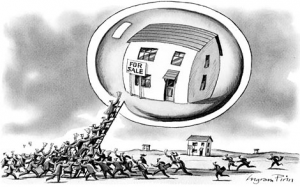
Are we heading into another real estate bubble / crash? Those who say “no” see the housing shortage as real, while those who say “yes” see the demand as a reflection of the Federal Reserve’s artificial goosing of the housing market via its unprecedented purchases of mortgage-backed securities and “easy money” financial conditions.

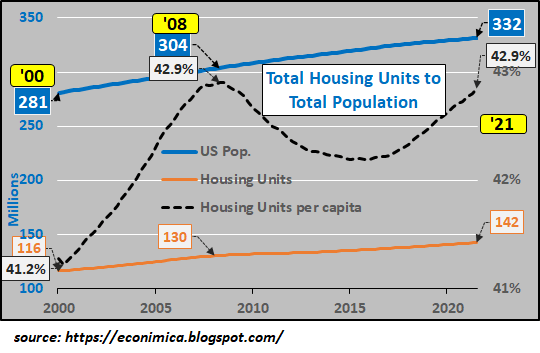
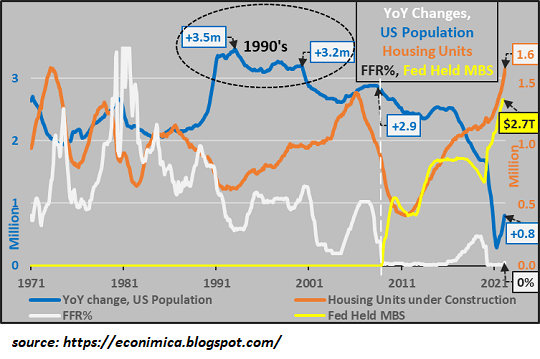
My colleague CH at econimica.blogspot.com recently posted charts calling this assumption into question. The first chart (below) shows the U.S. population growth rate plummeting as housing starts soar, and the second chart shows housing unit per capita, which has just reached the same extreme as the 2008 housing bubble.

Demographics and housing do not reflect a housing shortage nationally, though there could be scarcities locally, of course, and other factors such as thousands of units being held off the market as short-term rentals or investments by overseas buyers who have no interest in renting their investment dwellings.

On a per capita basis, housing has reached previous bubble levels. That suggests housing shortages are artificial or local, not structural.

Next, let’s consider how the current housing bubble differs from previous bubbles in the late 1970s and 2000s. In my view, the previous bubbles were driven by demographics, inflation and monetary policy: in the late 70s, the 65 million-strong Baby Boom generation began buying their first homes, pushing demand higher while inflation soared, making real-world assets such as housing more desirable.

Once the Federal Reserve pushed interest rates to 18%, mortgage rates rose in lockstep and housing crashed as few could afford sky-high housing prices at sky-high mortgage rates.

The housing bubble of 2007-08 was largely driven by declines in mortgage rates (as the Fed pursued an “easy money” policy to escape the negative effects of the Dot-Com stock market bubble crash) and a loosening of credit/mortgage standards. These fueled a bubble that morphed into a speculative free-for-all of no-down payment and no-document loans.

This decline in the cost of borrowing money (mortgage rates) enabled a sharp rise in the price of housing, a speculative boom that was greatly accelerated by “innovations” in the mortgage market such as zero down payments loans, interest-only loans, home equity loans, and no-document “liar loans”–mortgages underwritten without the usual documentation of income and net worth.

These forces generated a speculative frenzy of house-flipping, leveraging the equity in the family home to buy two or three homes under construction and selling them before they were even completed for fat profits, and so on.

Needless to say, the pool of potential buyers expanded tremendously when people earning $25,000 a year could buy $500,000 houses on speculation.

Once the bubble popped, the pool of buyers shrank along with the home equity.

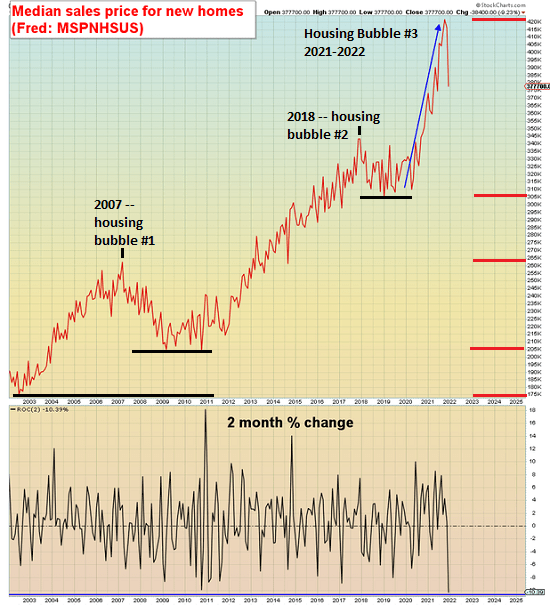
If we study this chart below of new home prices (courtesy of Mac10), we can see that the 21st century’s Bubble #2 rose as the Federal Reserve pushed mortgage rates far below historic norms. Once rates reached a bottom, the 7-year inflation of home prices (from 2011 to 2018) began rolling over.

This deflation of home prices was reversed by the pandemic recession, as the Fed’s vast expansion of credit and mortgage-buying, which pushed mortgage rates to new lows. Trillions of dollars in new credit and cash stimulus ignited a speculative frenzy in stocks, bonds and real estate, a frenzy which drove bubble #3 to extraordinary heights.

All this unprecedented fiscal and monetary stimulus also ignited inflation, and so rates are rising in response. Bubble #3 is already deflating, at least by the measure of new home prices.

But the current bubble has a number of dynamics that weren’t big factors in previous bubbles.

One is the rise of remote work. Many people have been working remotely since the late 1990s enabled Internet-based work, but the pandemic greatly increased the pool of employers willing to accept remote work as a permanent feature of employment.

This trend has been well documented, but the consequences are still unfolding: remote workers are no longer trapped in unaffordable, congested cities and suburbs.

Several other trends have attracted much less attention, but I see them as equally consequential.

1. Housing in many urban zones are out of reach of all but the top 10% without extraordinary sacrifice, and now that employment isn’t necessarily tied to urban zones, the bottom 90% of young people without family wealth or high incomes are coming to realize the benefits of urban living are not worth the extreme sacrifices needed to buy an overvalued house.

A middle-class life–home ownership, financial security, leisure and surplus income to invest in one’s family and well-being–is no longer affordable for the majority of young Americans.

Few are willing to concede this because it reveals the neofeudal nature of American life. Those who bought homes in coastal urban zones 20+ years ago are wealthy due to soaring housing valuations while young people can’t even afford the rent, much less buying a house.

If you’re not making $250,000 or more a year as a couple, the only hope for a middle-class life that includes leisure and some surplus income to invest is top move to some place with much lower housing and other costs. That place is rural America.

2. The benefits of urban living are deteriorating while the sacrifices and downsides are increasing. Urban living is fun if you’re wealthy, not so fun if you don’t have plenty of surplus income to spend.

Urban problems such as homelessness, traffic congestion and crime are endemic and unresolvable, though few are willing to state the obvious. Americans are expected to be optimistic and to count on some new whiz-bang technology to solve all problems.

Unfortunately, problems generated by dysfunctional, overly complex institutions, corruption and unaffordable costs can’t be solved by some new technology, and so the decay of cities will only gather momentum.

The hope that billions of federal stimulus funding would solve these problems is about to encounter reality as the funds dry up and all the problems remain or have actually expanded despite massive “investments” in solutions.

Few analysts have looked at the finances of high-cost cities. The decline in bricks-and-mortar retail, rising crime, soaring junk fees, rents and property taxes have all made urban small business insanely costly and therefore risky.

Small businesses are the core sources of employment and taxes. As high costs, crime, etc. choke small businesses, employment and tax revenues drop and commercial real estate sits empty, generating decay and defaults.

Once office and retail space is no longer affordable or necessary, commercial real estate crashes in value as owners who bought at the top default and go bankrupt.

People need shelter but they don’t need office space or to start a bricks-and-mortar retail business.

As urban finances unravel, cities won’t have the funding to run their bloated, inefficient, overly complex and unaccountable bureaucracies.

3. In geopolitics, we speak of the core and the periphery. Empires have a core (Rome and central Italy in the Roman Empire) and a periphery (Britain, North Africa, Egypt, the Levant).

As finances and trade decay and costs soar, the periphery is surrendered to maintain the core.

In urban zones, the same dynamic will become increasingly visible: the peripheral neighborhoods will be underfunded to continue protecting the wealthy enclaves.

Crime will skyrocket in the periphery even as residents of the wealthy enclaves see little decay in their neighborhoods.

This asymmetry–already extreme–will drive social unrest and disorder. This is a self-reinforcing feedback: as the periphery neighborhoods deteriorate, the remaining businesses flee and the smart money sells and moves away.

Tax revenues plummet and city services decay even further, persuading hangers-on to move before it gets even worse. Cities compensate for the lower revenues by increasing taxes on the remaining residents and cutting services.

Each turn of the screw triggers more closures and selling and fewer tax revenues.

4. Dependency chains will become increasingly consequential: the greater a city’s dependency on essentials trucked/shipped from hundreds or thousands of of kilometers/miles away, the more prone that city will be to disruptions of essentials: food, energy, materials and infrastructure.

Though few are willing to dwell on such vulnerabilities, most cities are totally dependent on diesel fueled fleets of trucks, rail and jet fuel for luxuries flown in from afar for virtually all goods. Cities produce very little in the way of essentials such as food and energy.

The past reliability of long supply chains has instilled a confidence that these supply chains stretching thousands of kilometers and miles are unbreakable and forever. They aren’t, and the initial disruptions will be a great shock to Americans who believe full gas tanks and fully stocked store shelves are their birthright.

5. As I’ve explained in my new book Global Crisis, National Renewalthe era of cheap, reliable abundance has drawn to a close and now we are entering an era of scarcity in essentials.

Another reality few discuss is the relative stability of global weather over the past 40 years. As weather becomes less reliable, so too do crop yields and food supplies.

Globalization has poured capital into expanding acreage under cultivation to the point that the planet’s forests are being decimated to grow more soy to feed animals to be slaughtered for human consumption.

On the margins, land that was once productive has been lost to desertification. Fresh water aquifers have been drained and glaciers feeding rivers are melting away. Soil fertility has declined even as fertilizer use has expanded.

The low-hanging fruit of GMO seeds, fertilizers, insecticides, herbicides and Green Revolution hybrids have all been plucked. The gains have been reaped but now the downsides of these dependencies are becoming increasingly consequential: fertilizer costs are rising fast, insects and diseases are evading chemicals and vaccines, and the vulnerabilities of mono-crop, industrialized agriculture and animal husbandry threaten to cascade into crop failures, soaring prices and shortages.

6. This will have two consequences: rural incomes which have been falling for decades due to globalization (i.e. bringing in cheap food from places with no environmental standards, cheap labor and few taxes / social costs) will start rising sharply, fueling a reversal in the long decline of rural communities based on agricultural income.

The soaring costs of essentials will reduce the disposable income of the bottom 90%, reducing the money they’ll have to spend on eating out, retail shopping, etc.–all the surplus spending that drives cities’ economies and tax revenues.

Few (if any) commentators forecast a cyclical reversal of the demographic trend of people moving from rural locales to cities. I think this trend has already reversed and will gather momentum as cities become increasingly unlivable, disposable incomes decline as scarcities push prices higher and people flee for lower cost, more secure environs.

7. As I often note, following what the super-wealthy are doing is a pretty sound investment strategy because the super-wealthy spend freely to buy the best advice and are highly motivated to protect their wealth.

People who live in well-known, highly desirable rural towns (Telluride, Jackson Hole, Lake Tahoe, etc.) are describing a feeding frenzy of wealthy urbanites buying multi-million dollar homes. Small cities such as Bozeman, MT and Ashville, NC are experiencing a flood of new residents that is straining infrastructure and pushing housing prices out of reach for local residents with average wages.

8. Rural towns in the U.S., Italy, Japan and even Switzerland are trying to attract new residents with offers of free land, subsidized rent, low cost homes, etc. This shows that the trends are global and not limited to any one nation. Would you take free land in rural America?

The decay of urban life isn’t yet consequential enough to push people into making a major move, but once someone has been robbed, repeatedly found human feces on their doorstep or experienced scarcities that trigger the madness of crowds, the decision to leave becomes much, much easier.

Some cities will manage the decline of employment and tax revenues more gracefully than others. Most will suffer from the dynamic I’ve often described on the blog: the Ratchet Effect. Costs move effortlessly higher as tax revenues have increased in one speculative bubble after another, but once revenues drop, cities have no mechanisms or political constituency to manage a sharp, long-term decline in revenues.

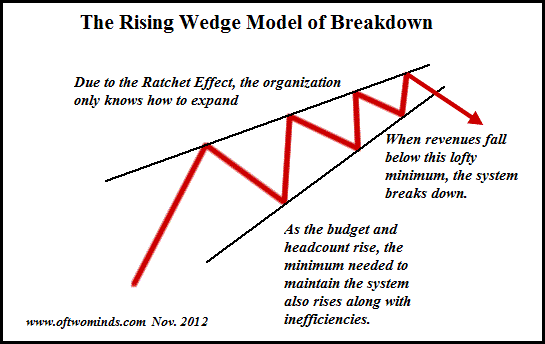
They then become prone to the other dynamic I’ve described, the Rising Wedge Breakdown (see chart below): as agencies and institutions become sclerotic, unaccountable and self-serving, even a relatively modest cut in revenues triggers institutional collapse, as the system requires 100% funding to function. A 10% reduction doesn’t cause a 10% decline in service, it causes an 50% decline in service, on the way to complete dysfunction.

Few believe cities can unravel, but remote work, geographic arbitrage (discussed below), tightening credit, rising crime, the decline of commercial real estate, end of massive stimulus, scarcities, the madness of crowds, the decline of civic services and amenities and an insanely high cost of living all have consequences and second-order effects.

What were beneficial synergies become fatal synergies as dynamics reverse and begin reinforcing each other.

So let’s put all this together.

A. The cycle of declining interest rates and inflation has ended and a cycle of much higher interest and mortgage rates and inflation is beginning. Higher mortgages rates will depress housing prices as only the highest income households will be able to afford today’s prices once mortgage rates rise.

B. The decay of urban finances and quality of life will accelerate as stimulus ends, credit dries up and inflation decimates disposable income.

C. The stress of trying to make enough money to afford the high costs of city/suburban living as the real estate bubble pops and the benefits of city living decline will burn out increasing numbers of people who will have no choice but to find more affordable, more secure and more livable places.

D. While the wealthy have already secured second or third homes in the toniest desirable towns, there are still opportunities for lower cost, more secure residences in rural areas.

E. This migration, even at the margins, will further depress urban housing prices and push prices in desirable rural locales higher.

F. This migration will have regional, ethnic and cultural variations. For example, some African-Americans leaving the upper Midwest are finding favor with communities in the South where family, church and cultural ties beckon.

G. Correspondent John F. used the phrase geographic arbitrage which means earning money remotely in high-wage sectors while living some place that’s low cost and secure.

I wrote about this many years ago in my post about young Japanese maintaining a part-time remote-work gig while pursuing farming in rural communities: Degrowth Solutions: Half-Farmer, Half-X (July 19, 2014).

H. Though monetary / inflationary forces will pop housing prices based solely on low mortgage rates, this doesn’t mean housing everywhere will decline: as burned out urbanites seek lower cost, more secure and livable places in rural locales, homes in desirable towns and small cities could rise sharply because they’re starting from such low levels.

I. If urban areas decay rapidly, housing prices could plummet much faster than most people think possible.

When cities lose employment, tax revenues and desirability, they can go down fast. Property values can fall in half and then by 90%.

How is this possible? Supply and demand: if demand falls off a cliff, there won’t be buyers for thousands of homes that come on the market all at once. This is just like a stock market in which buyers disappear, as no one wants to buy an asset that’s rapidly losing value.

As I’ve noted many times, prices for assets are set on the margins: the last sale of a house resets the price for the entire neighborhood.

The stock market is easily manipulated by the big players, who can stop a slide in prices by buying huge chunks of stocks and call options. There are no equivalent forces which can stop a decline in housing prices.

And since rates will rise regardless of what the Federal Reserve does because global capital is demanding a real return above inflation, then the hope for lower mortgage rates to support bubble-level housing prices will be in vain.

How low could housing go? As explained above, there will likely be very asymmetric declines and increases in housing valuations going forward. But on a technical-analysis level, we can anticipate a general decline to previous lows, first to the 2019 lows and then to the 2011 lows.

Some analysts believe inflation will funnel capital into housing as investors seek assets that will go up with inflation, but this is a murky forecast: the bottom 90% of American households are already priced out of coastal housing, so inflation only robs their wages of purchasing power. They don’t have any hope of buying a house anywhere near current prices.

Corporations are buying thousands of houses for the rental income, but once all the stimulus runs out and the excesses of speculation reverse, they’ll find few renters can afford their sky-high rents. At that point corporate buyers become corporate sellers, but they won’t find buyers willing or able to pay their asking prices, which are based on bubble pricing, not reality.

All these swirling currents will affect housing valuations in different places differently. Some areas could see 50% declines while others see 50% increases, regardless of mortgage rates or Fed policy.

What will become most desirable is a low cost of living, security and livability, which includes community, reduced dependency on long supply chains and local production of essentials.

We are all prone to believing the recent past is a reliable guide to the future. But in times of dynamic reversals, the past is an anchor thwarting our progress, not a forecast.

Another Housing Crisis in America Is Coming

By Tim Kirby

Source: Covert Geopolitics

There is now an unprecedented spike in housing costs while COVID-19 has driven down the wealth of the average American.

Let’s begin our discussion of the next Housing Crisis with a relevant personal anecdote, that is a microcosm of what is happening all over the United States right now.

Some of my relatives made the wise decision to live within their means and build a smaller (by American standards) house in the early 2000s. They live in the Midwest which means there is generally plenty of space for a big house even within city limits. Mortgages and loans were super easy to get for even fantastically large sums of money at that time. So my kin were definitely in the minority in terms of choosing something smaller and affordable rather than a giant debt pit with a huge kitchen. In a region of America known for having a shockingly low average income of $20,000-$30,000 per year in the 2020s, the banks two decades ago were just throwing $300,000 worth of credit for McMansions to all-comers with seemingly little discretion.

When the 2008 Financial Crisis hit it was the McMansions that got seized first and foremost, whereas my relatives got through it relatively unscathed. It looks like across America some 10,000,000 homes were lost (or perhaps it would be better to say “transferred” to the banks) due to this crisis. Again, because of choosing to have low square footage my family members did just fine with their more reasonable payments, however something recently happened that should sound some alarm bells that a second crisis is nigh.

Image: It costs over a quarter of a million dollars to live in a relatively small stick-frame house in the absolutely most dangerous neighborhood in a city with no significant employment opportunities. Something is not right here.

My relatives were given an offer from a neighbor to buy their home at its value (the last time it was appraised before the Covid Pandemic) plus more than $100,000 on top of that. The explanation was that the offering party wanted to have their son or daughter move closer to them and they were willing to pay big bucks for any house on that particular street. My family members thought they had won the lottery. They ecstatically looked for smaller homes to buy, so they could sell theirs, pay off their current mortgage early and keep a hefty percentage of this seemingly massive overpayment living the rest of their lives debt free.

But to their surprise, besides double-wide trailers they couldn’t find anything to buy. Now even the price of a home, smaller than their already modest home, in the impoverished Rust Belt, now sells for the prices that the McMansions demanded before the 2008 Crisis. To be clear, a house at Pre-Covid value + $100,000 in that region, now cannot even buy a sanitary home that is one half its size.

Again, for foreign readers, the house in question is not a piece of real estate in Silicon Valley or Manhattan where insane sounding prices could be justified by elite salaries and the presence of successful entrepreneurs. No, this is in the part of America where making $15 an hour to sling pizzas is considered a “good” job, but this price hike is not isolated to my state of birth, this madness is happening across all of America, just take a look at the graph below.

It does not take an elite degree in economics to see that there is now an unprecedented spike in housing costs while at the same time, paradoxically, COVID-19 has driven down the wealth of the average American. It is true that building materials have become artificially expensive and that would reflect on housing prices, but in a nation that has so many homes, including abandoned ones, it is hard to believe that America is in a desperate shortage of housing, furiously building to catch up like the Soviets after WWII, who had all their villages bombed into the dirt by the Germans.

Panic is driving housing prices up in a few different ways. Americans are flipping out because of the supposed…

  • Lack of building materials, which means there must be a housing “shortage” because construction is mostly off the table, so they must buy now or be left outdoors.
  • Prices, that are just going to keep going up so they must buy now before the affordability train leaves the station forever.
  • “Historically low mortgage rates”, which are probably the most dangerous aspect of this situation that will turn it into the next economic fiasco.

One of the key reasons that the 2008 Financial Crisis happened was because of the low interest rates on mortgages and inflated values of homes in connection with a lack of regulation over the financial world as a whole – and these exact same things are happening again right now in front of our faces. Just look at these interest rates.

It is not hyperbolic to say that they are “historically low”, because they are. The only difference is that in the past people were suckered into a McMansion while making $20,000 a year, now they will be suckered into a tiny house, trailer or grungy hellhole for the same price, that they will probably end up losing anyways when the crisis hits. Ranch-style homes in Texas far from major cities are starting to reach the $600,000-$700,000 mark which is simply unsustainable unless there are vastly more cattle and oil tycoons down there than we are aware of.

It simply does not require a genius financial mind or the word “Harvard” on your resume to see where this is going. We are again heading towards a housing crisis, only this time the bar is lower as the average American is getting less house and is paying more for it. Of course, the banks will “win” because whenever homes are lost they do not vanish out of existence, but get transferred to them the real lords of the realm so this won’t be bad for everyone, just almost everyone. The normies are doomed.

In a political context this repeating madness seems only to underline my belief that the arguments for small government are correct, but the problem is when government is both small and weak. This situation would not happen if those we elect were completely in charge of how America works systemically as a reflection of the will of the masses. The power that banks have may at times be overexaggerated by the conspiratorial types, but as we can see the nation is again being pushed down the wrong path and no one can stop it, meaning the benefactors of the coming crisis, the bankers, must have vastly more influence and power over Washington than anyone else, who would not benefit from this housing catastrophe.