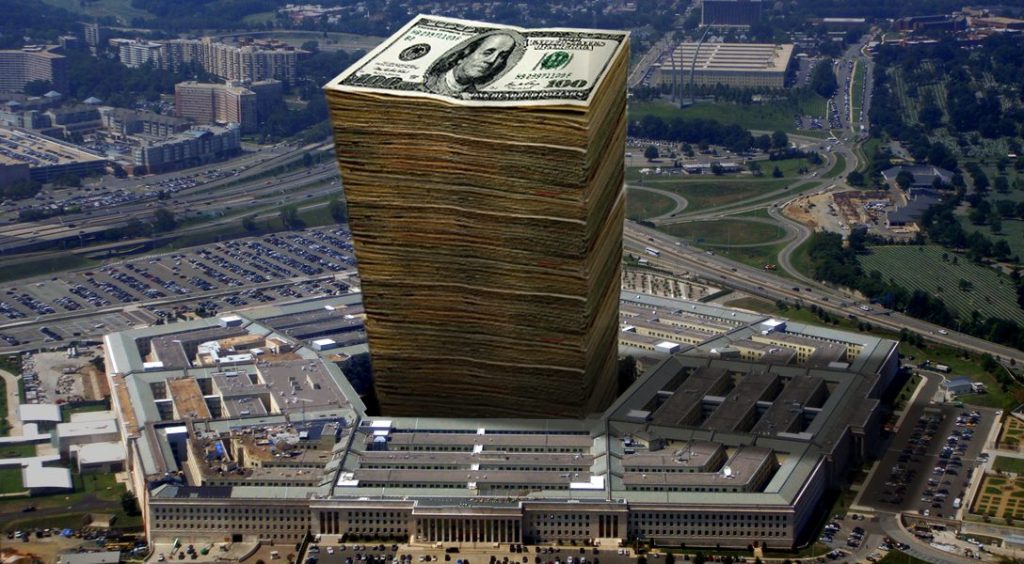
House Passes $886 Billion National Defense Authorization Act

The bill extends Section 702 of FISA, which allows mass warrantless surveillance of Americans

By Dave DeCamp

Source: Antiwar.com

On Thursday, the House passed the $886 billion 2024 National Defense Authorization Act (NDAA), which funds the Pentagon and some military spending for other government agencies. The NDAA has already been passed by the Senate and now heads to President Biden’s desk.

The NDAA includes a provision to extend Section 702 of the Foreign Intelligence, which allows mass warrantless surveillance of Americans. US government agencies portray the law as designed to target foreigners outside of the US, but it allows the collection of any communications they have with Americans, including emails and text messages.

Section 702 was due to expire at the end of this year, but the NDAA extends it to April 19, 2024. According to Rep. Thomas Massie (R-KY), the House only needed 143 votes to strip the extension out of the NDAA, but only 118 House members voted “nay,” including 73 Republicans and 45 Democrats.

“Here are the 118 Representatives who voted to protect your right to privacy. (Nay to FISA warrantless surveillance as part of NDAA),” Massie wrote on X with a picture of the roll call. “We lost but it was close. We needed 143 votes (1/3) to stop FISA since they suspended the rules to bring it to the floor.”

The mammoth $886 billion NDAA is $28 billion more than what was approved last year. President Biden is seeking another $111 billion to fund military aid for Ukraine, Israel, and Taiwan on top of regular military spending, but Republicans are holding out until Democrats agree to a deal on significant changes to border policies.

The new NDAA includes several amendments to fund the US and allied military buildup in the Indo-Pacific that’s aimed at China. One amendment allows the Pentagon to transfer three nuclear-powered Virginia-class submarines to Australia as part of the AUKUS military pact the US, Britain, and Australia signed in 2021 to prepare for a future war with China.

New York Times Is Now Telling Bigger Lies Than Iraq WMDs and More Effectively

By David Swanson

Source: War Is a Crime

The New York Times routinely tells bigger lies than the clumsy nonsense it published about weapons in Iraq. Here’s an example. This package of lies is called “Liberals Have a Blind Spot on Defense” but mentions nothing related to defense. It simply pretends that militarism is defensive by applying that word and by lying that “we face simultaneous and growing military threats from Russia and China.” Seriously? Where?

The U.S. military budget is more than those of most nations of the world combined. Only 29 nations, out of some 200 on Earth, spend even 1 percent what the U.S. does. Of those 29, a full 26 are U.S. weapons customers. Many of those receive free U.S. weapons and/or training and/or have U.S. bases in their countries. Only one non-ally, non-weapons customer (albeit a collaborator in bioweapons research labs) spends over 10% what the U.S. does, namely China, which was at 37% of U.S. spending in 2021 and likely about the same now despite the highly horrifying increases widely reported in the U.S. media and on the floor of Congress. (That’s not considering weapons for Ukraine and various other U.S. expenses.) While the U.S. has planted military bases around Russia and China, neither has a military base anywhere near the United States, and neither has threatened the United States.

Now, if you don’t want to fill the globe with U.S. weaponry and provoke Russia and China on their borders, the New York Times has some additional lies for you: “Defense spending is about as pure an application of a domestic industrial policy — with thousands of good-paying, high-skilled manufacturing jobs — as any other high-tech sector.”

No, it is not.  Just about any other way of spending public dollars, or even not taxing them in the first place, produces more and better jobs.

Here’s a doozie:

“Liberals also used to be hostile to the military on the assumption that it skewed right wing, but that’s a harder argument to make when the right is complaining about a ‘woke military.’”

What in the world would it mean to oppose organized mass murder because it skews right wing? What the hell else could it skew? I oppose militarism because it kills, destroys, damages the Earth, drives homelessness and illness and poverty, prevents global cooperation, tears down the rule of law, prevents self-governance, produces the dumbest pages of the New York Times, fuels bigotry, and militarizes police, and because there are better ways to resolve disputes and to resist the militarism of others. I’m not going to start cheering for mass killings because some general doesn’t hate enough groups.

Then there’s this lie: “The Biden administration touts the size of its $842 billion budget request, and in nominal terms it’s the largest ever. But that fails to account for inflation.”

If you look at U.S. military spending according to SIPRI in constant 2021 dollars from 1949 to now (all the years they provide, with their calculation adjusting for inflation), Obama’s 2011 record will probably fall this year. If you look at actual numbers, not adjusting for inflation, Biden has set a new record each year. If you add in the free weapons for Ukraine, then, even adjusting for inflation, the record fell this past year and will probably be broken again in the coming year.

You’ll hear all sorts of different numbers, depending on what’s included. Most used is probably $886 billion for what Biden has proposed, which includes the military, the nuclear weapons, and some of “Homeland Security.” In the absence of massive public pressure on a topic the public hardly knows exists, we can count on an increase by Congress, plus major new piles of free weapons to Ukraine. For the first time, U.S. military spending (not counting various secret spending, veterans spending, etc.) will likely top $950 billion as predicted here.

War profiteer-funded stink tankers like to view military spending as a philanthropic project to be measured as a percentage of an “economy” or GDP, as if the more money a country has, the more it should spend on organized killing. There are two more sensible ways to look at it. Both can be seen at Mapping Militarism.

One is as simple amounts per nation. In these terms, the U.S. is at a historic high and soaring far, far over the rest of the world.

The other way to look at it is per capita. As with a comparison of absolute spending, one has to travel far down the list to find any of the designated enemies of the U.S. government. But here Russia jumps to the top of that list, spending a full 20% of what the U.S. does per person, while only spending less than 9% in total dollars. In contrast, China slides down the list, spending less than 9% per person what the United States does, while spending 37% in absolute dollars. Iran, meanwhile, spends 5% per capita what the U.S. does, compared to just over 1% in total spending.

Our New York Times friend writes that the U.S. needs to spend more to dominate four oceans, while China need worry only about one.  But here the U.S. desire to treat economic competition as a form of war blinds the commentator to the fact that a lack of war facilitates economic success. As Jimmy Carter told Donald Trump, “Since 1979, do you know how many times China has been at war with anybody? None. And we have stayed at war. . . . China has not wasted a single penny on war, and that’s why they’re ahead of us. In almost every way.”

But you could drop the idiotic economic competition and still understand the benefits of investing in something other than death since tiny fractions of military spending could transform the United States and the rest of the world. Surely there would remain plenty of other things to lie about.

Explain It to Me, Please

If you want a war with Iran, Russia, China and Venezuela tell me why and how it would benefit Americans

By Philip Giraldi

Source: The Unz Review

So Honest Joe Biden is now going to give another $1.2 billion to the Ukrainians on top of the sixty or so billion that is already in the pipeline, but who’s counting, particularly as Congress refused to approve having an inspector general to monitor whose pockets will be lined. The money will be printed up without any collateral or “borrowed” and the American taxpayer will somehow have to bear the burden of this latest folly that is ipso facto driving much of the world into recession. And it will no doubt be blamed on Vladimir Putin, a process that is already well under way from president mumbles. But you have to wonder why no one has told Joe that the whole exercise in pushing much of the world towards a catastrophic war is a fool’s errand. But then again, the clowns that the president has surrounded himself with might not be very big on speaking the truth even if they know what that means.

Having followed the Ukraine problem since the United States and its poodles refused to negotiate seriously with Vladimir Putin in the real world, I have had to wonder what is wrong with Washington. We have had the ignorant and impulsive Donald Trump supported by a cast of characters that included the mentally unstable Mike Pompeo and John Bolton followed by Biden with the usual bunch of Democratic Party rejects. By that I mean deep thinkers about social issues who would not be able to run a hot dog stand if that were what they were forced to do to make a living. But they are real good at shouting “freedom” and “democracy” whenever questioned concerning their motives.

Indeed, opinion polls suggest that there is a great deal of unrest among middle and working class Americans who see a reversion to Jimmy Carter era financial instability, at that time caused by the oil embargo. Well, there is a new energy embargo in place brought about by the Biden Administration’s desire to wage proxy war to “weaken” Russia. Analysts predict that the costs for all forms of energy will double in the next several months and surging energy costs will impact the prices of other essentials, including food. Given all that, the fundamental issue plaguing both Democrats and Republicans is their inability to actually explain to the American people why the country’s foreign and national security policy always seems to be on the boil, searching for enemies and also creating them when they do not exist, even when the results are damaging to the interests of actual Americans.

That a serious discussion of why the United States needs to have a military that costs as much as the next nine nations in that ranking combined is long overdue and rarely addressed outside the alternative media. The 2023 military budget has been increased from this year’s, totaling $858 billion, and, if one includes the constantly growing largesse to Ukraine, approaching a hitherto unimaginable trillion dollars. The military budget has become a major driver of the country’s unsustainable deficits. The deaths of millions of people directly and indirectly in the wars started in 9/11 aside, the wars of choice have cost an estimated $8 trillion.

The Constitution of the United States makes it clear that a national army was only acceptable to the Founders when it was dedicated to defending the country from foreign threats. Do Americans really believe that bearing the burden of having something like 1,000 military bases scattered around the world really makes them safer? The recent rapid collapse of the security situation in Afghanistan suggests that having such bases turns soldiers and bureaucrats into potential hostages and is therefore a liability. One might also suggest that the insecurity currently prevailing in the country can in large part be attributed to the government’s depiction of numerous “threats” in order to justify both the commitment and the expense.

So where does all the money go? And what are the threats? Starting with a war that the United States is de facto though not de jure involved in, Ukraine, what was the Russian threat that demanded Washington’s intervention? Well, if one discards the nonsense of a “rules based international order” or a plucky little democracy Ukraine fighting valiantly against the Russian bear, Moscow did not threaten the United States in any way before the missiles starting flying. Putin sought to negotiate a settlement with Ukraine based on a number of perceived existential Russian national security interests, all of which were negotiable, but the US and its friends were uninterested in compromise while also plying the corrupt Zelensky regime with weapons, money and political support. The final result is a conflict that will likely only end when the last Ukrainian is dead and it includes the possibility that a misstep by the United States and Russia could lead to a nuclear holocaust. To put it succinctly, what is going on does not enhance US national security, nor does it benefit Americans economically.

And then there is China. Biden let the cat out of the bag on his recent trip to the Far East. He stated that the United States would defend Taiwan if China were to attempt to annex it. In saying that, Biden demonstrated that he does not understand the strategic ambiguity that the US and the Chinese have preferred over the past fifty years as an alternative to war. The White House for its part quickly issued a correction to the Biden statement, explaining that it was not true that Washington is obligated to defend Taiwan. Some uber hawkish congressmen have apparently found the Biden gaffe appealing and are promoting a firm US commitment to defend Taiwan, coupled with a $4.5 billion military assistance package, of course.

At the same time, some officials in the Pentagon and the usual gaggle of congressmen also keep warning about the over the horizon threat from China as an excuse to boost defense spending. Most recently, there was alarm over Chinese participation in a meeting in May in Fiji to consider a China-Pacific Islands free trade pact! In reality, the only serious current threat from China is as an economic competitor. A trade war with China would be a disaster for the US economy, which is heavily dependent on Chinese manufactured goods, but Beijing, with its relatively small military budget, does not pose a physical threat to the United States.

And let’s not ignore Iran which has been hammered by economic sanctions and also through the covert killing of its officials and scientists. The US/Israeli war on Iran has also spilled over into neighboring Syria, where Washington actually has troops on the ground occupying the country’s oil producing region and stealing the oil. Iran’s possible expansion of its nuclear program to produce a weapon was effectively impeded through monitoring connected to a multilateral 2015 agreement called the Joint Comprehensive Plan of Action (JCPOA) but Donald Trump, unwisely and acting against actual American interests, withdrew from it. Joe Biden has been warned by Israel not to re-enter the agreement, so he will no doubt comply with Prime Minister Naftali Bennett’s determination to have Washington continue to apply “extreme pressure” on the Islamic Republic. Does either Iran or its ally Syria threaten the United States in any way? No. Their crime is that they are in the same neighborhood as the Jewish state, which finds the US government easy to manipulate into acting against its own interests.

Finally, in America’s own hemisphere there is Venezuela, which has been elevated to the status of Washington’s most hated nation in the region. Venezuelans have been subjected to increasingly punitive US sanctions, including some new ones just last week, which hurt the poorer citizens disproportionately but have not brought about regime change. Why the animosity? Because the country’s leader Nicolas Maduro is still in power in spite of a US assertion that the country’s opposition leader Juan Guaido should rightfully and legitimately be in charge after a possibly fraudulent election in 2018. The latest therapy applied by the United States on Caracas consisted of blocking the country as well as Nicaragua and Cuba from participating in the recent meeting of the Ninth Summit of the Americas which was held in Los Angeles. A State Department spokesman explained that the move was due to the three countries “lacking democratic governances.” Mexican President Lopez Obrador protested against the move and removed himself from his country’s delegation, saying “There can’t be a Summit of the Americas if not all countries of the American continent are taking part.” The despicable US Senator Robert Menendez of the Senate Foreign Relations Committee then felt compelled to add his two cents, criticizing the Mexican president and warning that his “decision to stand with dictators and despots” would hurt US-Mexico relations. So where was the threat from Venezuela (and Cuba and Nicaragua) and why is the US involved at all? Beats me.

What all of this means is that there is absolutely no standard of genuine national security that motivates the US’s completely illegal aggression in many parts of the world. What occurs may be linked to a desire to dominate or a madness sometimes described as “exceptionalism” and/or “leadership of the free world,” neither of which has anything to do with actual security. And the American people are paying the price both in terms of decline in standards of living due to the upheaval created in Ukraine and elsewhere as well as a completely understandable loss of faith in the US system of government. By all means, let us shrink the US military until it is responsive to actual identifiable threats. Let’s elect a president who will follow the sage advice of President John Quincy Adams, who declared that “Americans should not go abroad to slay dragons they do not understand in the name of spreading democracy.” At this point, one can only imagine an America that is at peace with itself and with what it represents while also being considered a friend to the rest of the world.

$21 Trillion of Unauthorized Spending by US Govt Discovered by Economics Professor

Source: Covert Geopolitics

he US government may have misspent $21 trillion, a professor at Michigan State University has found. Papers supporting the study briefly went missing just as an audit was announced.

Two departments of the US federal government may have spent as much as $21 trillion on things they can’t account for between 1998 and 2015. At least that’s what Mark Skidmore, a Professor of Economics at MSU specializing in public finance, and his team have found.

They came up with the figure after digging the websites of departments of Defense (DoD) and Housing and Urban Development (HUD) as well as repots of the Office of the Inspector General (OIG) over summer.

The research was triggered by Skidmore hearing Catherine Austin Fitts, a former Assistant Secretary in the HUD in the first Bush administration, saying the Inspector General found $6.5 trillion worth of military spending that the DoD couldn’t account for. She was referring to a July 2016 report by the OIG, but Skidmore thought she must be mistaking billion for trillion. Based on his previous experience with public finances, he thought the figure was too big even for an organization as large as the US military.

“Sometimes you have an adjustment just because you don’t have adequate transactions… so an auditor would just recede. Usually it’s just a small portion of authorized spending, maybe one percent at most. So for the Army one percent would be $1.2 billion of transactions that you just can’t account for,” he explained in an interview with USAWatchdog.com earlier this month.

After discovering that the figure was accurate, he and Fitts collaborated with a pair of graduate students to comb through thousands of reports of the OIG dating back to 1998, when new rules of public accountability for the federal government were set and all the way to 2015, the time of the latest reports available at the time. The research was only for the DoD and the HUD.

“This is incomplete, but we have found $21 trillion in adjustments over that period. The biggest chunk is for the Army. We were able to find 13 of the 17 years and we found about $11.5 trillion just for the Army,” Skidmore said.

The professor would not suggest whether the missing trillions went to some legitimate undisclosed projects, wasted or misappropriated, but believes his find indicates that there is something profoundly wrong with the budgeting process in the US federal government. Such lack of transparency goes against the due process of authorizing federal spending through the US Congress, he said.

Skidmore also co-authored a column on Forbes, explaining his research.

The same week the interview took place the DoD announced that it will conduct its first-ever audit. “It is important that the Congress and the American people have confidence in DoD’s management of every taxpayer dollar,” Comptroller David Norquist told reporters as he explained that the OIG has hired independent auditors to dig through the military finances.

“While we can’t know for sure what role our efforts to compile original government documents and share them with the public has played, we believe it may have made a difference,” Skidmore commented.

Interestingly, in early December the authors of the research discovered that the links to key document they used, including the 2016 report, had been disabled. Days later the documents were reposted under different addresses, they say.

This is probably where the Deep State government called CIA and State Department took their extra fund to topple uncooperative governments around the world. The bulk, of course, may have gone to the military industrial complex.

The United States has double the military budget of the combined military spending of Russia, China and G7 countries. Said military spending remains unauditable due to “widespread material internal control weaknesses, significant uncertainties, and other limitations” according to a GAO report in 2010.

So, how can a government spread its wings beyond its own borders, and demand democratic ideals elsewhere when it is not practicing the same values at home?

Trump proposes huge hike in military and police spending

discretionary_spending_pie_2015_enacted

By Patrick Martin

Source: WSWS.org

The Trump administration sent instructions to federal agencies Monday proposing a $54 billion increase in spending for the Pentagon, the intelligence agencies and the Department of Homeland Security, to be offset by $54 billion in cuts for other agencies, mainly those involved in domestic social services and regulation of business.

Trump’s budget outline sets the stage for his first address to Congress on Tuesday. It provides further evidence that the Trump administration will be dedicated to radically rolling back social spending to finance a dramatic escalation of military operations, both in the neo-colonial wars in the Middle East and against the United States’ ‘great power’ rivals: China and Russia.

Federal departments are being told to file budget requests for the fiscal year that begins October 1, 2017 based on the numbers they were given by the Office of Management and Budget. Each agency will be responsible for working out the cuts required to meet proposed reductions, while the Pentagon, CIA and DHS will propose expanded operations with the additional funds they are to be awarded.

There were no details made public about the exact budget ceilings given to each federal department, but White House officials made it clear that foreign aid programs in the State Department and anti-pollution regulation through the Environmental Protection Agency (EPA) would suffer some of the largest cuts.

The total budget of the EPA is only $9 billion, so many other domestic programs are certain to be hard-hit, involving such departments as Education, Labor, Transportation, Agriculture (which includes food stamps), Housing and Urban Development and Health and Human Services.

The biggest federal social programs, Social Security, Medicare and Medicaid, are not affected by the budget order, which involves only funding for so-called discretionary programs, those financed through annual congressional appropriations. Entitlement programs, where benefits are paid out automatically to those who establish their eligibility, are covered by a separate budget process.

OMB Director Mick Mulvaney appeared at the White House press briefing Monday afternoon to explain the action taken by the Trump administration. He emphasized that setting what he called the “top-line budget number” for each department was only the start of a protracted process.

The OMB will use the figures from each department and agency to prepare a budget outline to be submitted to Congress on March 16. A full budget will not be ready until sometime in May, Mulvaney said. He also indicated that while spending on Social Security, Medicare and Medicaid were not addressed in the action taken Monday, “entitlement reform”—i.e., cuts in these critical programs—would be a subject of discussion with congressional leaders later in the budget process.

Press reports identified the three White House officials who have played the main roles in the initial budgeting: Mulvaney, who was confirmed on February 16 as budget director; National Economic Council Director Gary Cohn, the former president of Goldman Sachs, the huge investment bank; and Stephen K. Bannon, Trump’s chief strategist, the former chief executive of the fascistic Breitbart News site, who exercises increasingly broad sway over all White House policy decisions.

While no details have yet been released of what the $54 billion increase in military-police spending will pay for, the scale of the increase, in and of itself, shows the real character of the Trump administration. This is to be a government of war abroad and mass repression at home.

Trump himself touched on this theme in typically rambling and unfocused remarks to a meeting of the National Governors Association Monday. “We never win a war,” he said. “We never win. And we don’t fight to win. We don’t fight to win. So we either got to win, or don’t fight at all.”

He continued, telling the governors, “My first budget will be submitted to the Congress next month. This budget will be a public safety and national security budget, very much based on those two with plenty of other things, but very strong. And it will include a historic increase in defense spending to rebuild the depleted military of the United States of America at a time we most need it.”

Additional money for the Pentagon is likely to go to a dramatically increased tempo of operations in Iraq and Syria. Defense Secretary James Mattis delivered proposals to the White House Monday for an offensive against Islamic State in Iraq and Syria (ISIS), as required by an executive order issued by Trump last month. No details are available yet, but any acceleration of the bombing campaign, let alone the deployment of significant numbers of the US ground troops, would increase the cost of that war by many billions.

The $54 billion increase would also presumably include funds for the construction of Trump’s planned wall on the US-Mexico border, as well as a massive increase in spending on detention facilities for the hundreds of thousands of immigrants to be rounded up under the executive orders already issued by the White House.

The federal budget is operating under the constraints imposed by the 2011 Budget Control Act, the bipartisan legislation negotiated by the Obama White House, the Republican-controlled House of Representatives, and a Democratic-controlled Senate. This set up the so-called sequester process, under which all discretionary spending is subject to a budget freeze, for both domestic and military programs.

Each year, increased spending for programs under the sequester has been worked out on the basis of roughly equal increases for domestic and military programs. Last year, for fiscal year 2016, Congress approved $543 billion for domestic discretionary programs and $607 billion for the military. The Trump White House plan would thus represent a cut of about 10 percent for domestic programs, and an increase of nearly that amount for the military.

Any significant change in the sequester process would require support from congressional Democrats, particularly in the Senate, where the Republican party holds only a narrow 52-48 edge, and any major legislation would require a 60-vote majority to pass.

Several congressional Republican leaders criticized the White House plan as insufficiently skewed to the military. House Armed Services Committee Chairman Mac Thornberry of Texas issued a statement criticizing the “low budget number” and adding, “The administration will have to make clear which problems facing our military they are choosing not to fix.”

Senator John McCain of Arizona, chairman of the Senate Armed Services Committee, declared that the Trump plan is “a mere 3 percent above President Obama’s defense budget, which has left our military underfunded, undersized and unready.”

For all the statements by Trump and the Republicans bemoaning the supposedly “depleted” state of the US military, the United States spends more on its armed forces than the next 15 countries in the world combined. The military budget is only inadequate if the mission of the US military is assumed to be the conquest of the entire planet and the subduing of all armed resistance from any quarter—which is actually the perspective of the American ruling elite.

The U.S. Military Suffers from Affluenza

f9052cf3c11a568d844c43318fe9d952

Showering the Pentagon with Money and Praise

By William J. Astore

Source: TomDispatch.com

The word “affluenza” is much in vogue. Lately, it’s been linked to a Texas teenager, Ethan Couch, who in 2013 killed four people in a car accident while driving drunk. During the trial, a defense witness argued that Couch should not be held responsible for his destructive acts. His parents had showered him with so much money and praise that he was completely self-centered; he was, in other words, a victim of affluenza, overwhelmed by a sense of entitlement that rendered him incapable of distinguishing right from wrong. Indeed, the judge at his trial sentenced him only to probation, not jail, despite the deaths of those four innocents.

Experts quickly dismissed “affluenza” as a false diagnosis, a form of quackery, and indeed the condition is not recognized by the American Psychiatric Association. Yet the word caught on big time, perhaps because it speaks to something in the human condition, and it got me to thinking. During Ethan Couch’s destructive lifetime, has there been an American institution similarly showered with money and praise that has been responsible for the deaths of innocents and inadequately called to account? Is there one that suffers from the institutional version of affluenza (however fuzzy or imprecise that word may be) so much that it has had immense difficulty shouldering the blame for its failures and wrongdoing?

The answer is hidden in plain sight: the U.S. military. Unlike Couch, however, that military has never faced trial or probation; it hasn’t felt the need to abscond to Mexico or been forcibly returned to the homeland to face the music.

Spoiling the Pentagon

First, a caveat. When I talk about spoiling the Pentagon, I’m not talking about your brother or daughter or best friend who serves honorably. Anyone who’s braving enemy fire while humping mountains in Afghanistan or choking on sand in Iraq is not spoiled.

I’m talking about the U.S. military as an institution. Think of the Pentagon and the top brass; think of Dwight Eisenhower’s military-industrial complex; think of the national security state with all its tentacles of power. Focus on those and maybe you’ll come to agree with my affluenza diagnosis.

Let’s begin with one aspect of that affliction: unbridled praise. In last month’s State of the Union address, President Obama repeated a phrase that’s become standard in American political discourse, as common as asking God to bless America. The U.S. military, he said, is the “finest fighting force in the history of the world.”

Such hyperbole is nothing new. Five years ago, in response to similar presidential statements, I argued that many war-like peoples, including the imperial Roman legions and Genghis Khan’s Mongol horsemen, held far better claims to the “best ever” Warrior Bowl trophy. Nonetheless, the over-the-top claims never cease. Upon being introduced by President Obama as his next nominee for secretary of defense in December 2014, for instance, Ash Carter promptly praised the military he was going to oversee as “the greatest fighting force the world has ever known.” His words echoed those of the president, who had claimed the previous August that it was “the best-led, best-trained, best-equipped military in human history.” Similar hosannas (“the greatest force for human liberation the world has ever known”) had once been sprinkled liberally through George W. Bush’s speeches and comments, as well as those of other politicians since 9/11.

In fact, from the president to all those citizens who feel obliged in a way Americans never have before to “thank” the troops endlessly for their efforts, no other institution has been so universally applauded since 9/11. No one should be shocked then that, in polls, Americans regularly claim to trust the military leadership above any other crew around, including scientists, doctors, ministers, priests, and — no surprise — Congress.

Imagine parents endlessly praising their son as “the smartest, handsomest, most athletically gifted boy since God created Adam.” We’d conclude that they were thoroughly obnoxious, if not a bit unhinged. Yet the military remains just this sort of favored son, the country’s golden child. And to the golden child go the spoils.

Along with unbridled praise, consider the “allowance” the American people regularly offer the Pentagon. If this were an “affluenza” family unit, while mom and dad might be happily driving late-model his and her Audis, the favored son would be driving a spanking new Ferrari. Add up what the federal government spends on “defense,” “homeland security,” “overseas contingency operations” (wars), nuclear weapons, and intelligence and surveillance operations, and the Ferraris that belong to the Pentagon and its national security state pals are vrooming along at more than $750 billion dollars annually, or two-thirds of the government’s discretionary spending. That’s quite an allowance for “our boy”!

To cite a point of comparison, in 2015, federal funding for the departments of education, interior, and transportation maxed out at $95 billion — combined! Not only is the military our favored son by a country mile: it’s our Prodigal Son, and nothing satisfies “him.” He’s still asking for more (and his Republican uncles are clearly ready to turn over to him whatever’s left of the family savings, lock, stock, and barrel).

On the other hand, like any spoiled kid, the Defense Department sees even the most modest suggested cuts in its allowance as a form of betrayal. Witness the whining of both those Pentagon officials and military officerstestifying before Congressional committees and of empathetic committee members themselves. Minimalist cuts to the soaring Pentagon budget are, it seems, defanging the military and recklessly endangering American security vis-a-vis the exaggerated threats of the day: ISIS, China, and Russia. In fact, the real “threat” is clearly that the Pentagon’s congressional “parents” might someday cut down on its privileges and toys, as well as its free rein to do more or less as it pleases.

With respect to those privileges, enormous budgets drive an unimaginably top-heavy bureaucracy at the Pentagon. Since 9/11, Congressional authorizations of three- and four-star generals and admirals have multipliedtwice as fast as their one- and two-star colleagues. Too many generals are chasing too few combat billets, contributing to backstabbing and butt-kissing. Indeed, despite indifferent records in combat, generals wear uniforms bursting with badges and ribbons, resembling the ostentatious displays of former Soviet premiers — or field marshals in the fictional Ruritarian guards.

Meanwhile, the proliferation of brass in turn drives budgets higher. Even with recent modest declines (due to the official end of major combat operations in Iraq and Afghanistan), the U.S. defense budget exceeds the combined military budgets of at least the next seven highest spenders. (President Obama proudly claims that it’s the next eight.) Four of those countries — France, Germany, Great Britain, and Saudi Arabia — are U.S. allies; China and Russia, the only rivals on the list, spend far less than the United States.

With respect to its toys, the military and its enablers in Congress can never get enough or at a high enough price. The most popular of these, at present, is the under-performing new F-35 jet fighter, projected to cost $1.5 trillion (yes, you read that right) over its lifetime, making it the most expensive weapons system in history. Another trillion dollars is projected over the next 30 years for “modernizing” the U.S. nuclear arsenal (this from a president who, as a candidate, spoke of eliminating nuclear weapons). The projected acquisition cost for a new advanced Air Force bomber is already $100 billion (before the cost overruns even begin).  The list goes on, but you catch the drift.

A Spoiled Pentagon Means Never Having to Say You’re Sorry

To complete our affluenza diagnosis, let’s add one more factor to boundless praise and a bountiful allowance: a total inability to take responsibility for one’s actions. This is, of course, the most repellent part of the Ethan Couch affluenza defense: the idea that he shouldn’t be held responsible precisely because he was so favored.

Think, then, of the Pentagon and the military as Couch writ large. No matter their mistakes, profligate expenditures, even crimes, neither institution is held accountable for anything.

Consider these facts: Iraq, Afghanistan, and Libya are quagmires. The Islamic State is spreading. Foreign armies, trained and equipped at enormous expense by the U.S. military, continue to evaporate. A hospital, clearly identifiable as such, is destroyed “by accident.” Wedding parties are wiped out “by mistake.” Torture (a war crime) is committed in the field. Detainees are abused. And which senior leaders have been held accountable for any of this in any way? With the notable exception of Brigadier General Janis Karpinskiof Abu Ghraib infamy, not a one.

After lengthy investigations, the Pentagon will occasionally hold accountable a few individuals who pulled the triggers or dropped the bombs or abused the prisoners. Meanwhile, the generals and the top civilians in the Pentagon who made it all possible are immunized from either responsibility or penalty of any sort. This is precisely why Lieutenant Colonel Paul Yingling memorably wrote in 2007 that, in the U.S. military, “a private who loses a rifle suffers far greater consequences than a general who loses a war.” In fact, no matter what that military doesn’t accomplish, no matter how lacking its ultimate performance in the field, it keeps getting more money, resources, praise.

When it comes to such subjects, consider the Republican presidential debate in Iowa on January 28th. Jeb Bush led the rhetorical charge by claiming that President Obama was “gutting” the military. Ted Cruz and Marco Rubio eagerly agreed, insisting that a “dramatically degraded” military had to be rebuilt. All the Republican candidates (Rand Paul excepted) piled on, calling for major increases in defense spending as well as looser “rules of engagement” in the field to empower local commanders to take the fight to the enemy. America’s “warfighters,” more than one candidate claimed, are fighting with one arm tied behind their backs, thanks to knots tightened by government lawyers. The final twist that supposedly tied the military up in a giant knot was, so they claim, applied by that lawyer-in-chief, Barack Obama himself.

Interestingly, there has been no talk of our burgeoning national debt, which former chairman of the Joint Chiefs of Staff Admiral Mike Mullen once identified as the biggest threat facing America. When asked during the debate which specific federal programs he would cut to reduce the deficit, Chris Christie came up with only one, Planned Parenthood, which at $500 million a year is the equivalent of two F-35 jet fighters. (The military wants to buy more than 2,000 of them.)

Throwing yet more money at a spoiled military is precisely the worst thing we as “parents” can do. In this, we should resort to the fiscal wisdom of Army Major General Gerald Sajer, the son of a Pennsylvania coal miner killed in the mines, a Korean War veteran and former Adjutant General of Pennsylvania. When his senior commanders pleaded for more money (during the leaner budget years before 9/11) to accomplish the tasks he had assigned them, General Sajer’s retort was simple: “We’re out of money; now we have to think.”

Accountability Is Everything

It’s high time to force the Pentagon to think. Yet when it comes to our relationship with the military, too many of us have acted like Ethan Couch’s mother. Out of a twisted sense of love or loyalty, she sought to shelter her son from his day of reckoning. But we know better. We know her son has to face the music.

Something similar is true of our relationship to the U.S. military. An institutional report card with so many deficits and failures, a record of deportment that has led to death and mayhem, should not be ignored. The military must be called to account.

How? By cutting its allowance. (That should make the brass sit up and take notice, perhaps even think.) By holding senior leaders accountable for mistakes. And by cutting the easy praise. Our military commanders know that they are not leading the finest fighting force since the dawn of history and it’s time our political leaders and the rest of us acknowledged that as well.

William J. Astore, a retired lieutenant colonel (USAF), is a TomDispatchregular. He blogs at Bracing Views.