
Saturday Matinee: Real Genius

By Roger Ebert

Source: RogerEbert.com

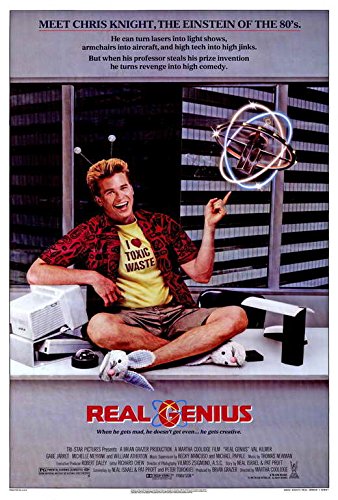
The movie involves the saga of Mitch (Gabe Jarret), a brilliant high school student whose Science Fair project has revised the theory of laser beam technology. He is personally recruited by Professor Hathaway (William Atherton), a famous physics professor who wants the kid to work in his personal laboratory. Once on campus, the kid meets the legendary Chris Knight (Val Kilmer), the most brilliant freshman in history who is now a junior whose mind is beginning to be cluttered by mischief. The two students room together, and there seems to be a third person in the room: a strange, wraith-like bearded figure who disappears into the clothes closet, and doesn’t seem to be there when the door is flung open.

The professor is running a scam. He has a Defense Department contract for a sophisticated laser device so accurate that it could incinerate a single man on Earth from a base in orbit. The professor is using his students as slave labor to do most of the work on the project, while ripping off the government grant to build himself a new house. The students, meanwhile, have no idea they’re working on a weapons system, and are more interested in using laser beams to lead everyone to a “Tanning Invitational” they’ve set up by turning a lecture hall into a swimming pool.

“Real Genius” allows every one of its characters the freedom to be complicated and quirky and individual. That’s especially true of Jordan (Michelle Meyrink), a hyperactive woman student who talks all the time and never sleeps and knits things without even thinking about it, and follows Mitch into the john because she’s so busy explaining something that she doesn’t even notice what he’s doing. I recognize students like this from my own undergraduate days. One of the most familiar types on campus (and one of the rarest in the movies) is the self-styled eccentric, who develops a complex of weird personality traits as a way of clearing space and defining himself.

“Real Genius” was directed by Martha Coolidge, who made “Valley Girl,” one of the best and most perceptive recent teenage movies. What I like best about her is that she gives her characters the freedom to be themselves. They don’t have to be John Belushi clones, or fraternity jocks, or dumb coeds. They can flourish in all of their infinite variety, as young people with a world of possibilities and a lot of strange, beautiful notions. “Real Genius” contains many pleasures, but one of the best is its conviction that the American campus contains life as we know it.

Saturday Matinee: Valley Girl

80S BITS: VALLEY GIRL

By Richard Grey

Source: TheRealBits.com

With the release of a fourth American Pie film this year, one that largely looks back at the highs and lows of the 1999 original, it is tough to imagine a time when teen sex comedies weren’t a dime a dozen. When reflecting on Martha Coolidge’s 1983 hit film Valley Girl, what makes it stand out is just how much hasn’t changed in the last three decades. Some of the fashions might have altered, the music is now retro and valley girls have been parodied in everything from Frank Zappa music to Buffy the Vampire Slayer. Yet there remains a central familiarity that this film set the tone for in many ways.

In fair California, where we lay our scene, Julie Richman (Deborah Foreman) is a rich valley girl who has everything a young lady could dream of: cool parents, money, a gaggle of friends and the hottest boyfriend in town. After hanging out with her valley friends Loryn (Elizabeth Daily), Stacey (Heidi Holicker), and Suzi (Michelle Meyrink), she decides that Tommy (Michael Bowen) doesn’t respect her anymore and unceremoniously dumps him. When she meets Hollywood punk Randy (Nicolas Cage) at a party, the pair share an instant connection, and Randy falls in love hard, showing her a world she never knew existed. Yet Julie’s friends don’t approve, and she must decided whether to go with Randy or cave to peer pressure and reconcile with Tommy.

The disparity between rich and poor, and the class war it created, was a major theme in the films of the 1980s, proving to be the Romeo and Juliet stumbling block that stopped couples from uniting in Pretty in Pink and Some Kind of Wonderful to name but a few. Just as the decade of decadence was getting underway, the familiar trope is pulled out here not so much as a cheap cash grab, but rather as a parody of the popular youth culture of the 1980s. More so than any other film that has lampooned or been set in the 1980s since, Valley Girl captures the era perfectly, from the plastic image-focused girls of the valley, to the New Wave punks of Hollywood, just as caught in the scene as the sex-obsessed girls.

Where most teen comedies are the fantasies of the middle-aged, who vicariously live out deflowering fantasies that they missed out in their own formative years, female filmmaker Martha Coolidge creates a world inhabited with real kids. Much of the film cleverly sits back and observes conversations, adopting an almost documentary approach to exposition. Refreshingly, this means that catching girls out in the nude or obtaining a pair of panties as a trophy are not the ultimate goals in the film, nor is there a contest to be the first past the cherry-popping post. These young characters are sexual active, aware of their own bodies but in contrast conflicted over the dichotomy between their feelings and social status. Through the mere act of listening, we find out their fears and their desires. Who knew that girls talk about sex almost as much, if not more than, boys?

Valley Girl is fuelled by a terrific New Wave soundtrack, making liberal use of  The Plimsouls and Josie Cotton, who both appear in the film. Peppered with minor hits of the 1982-83 charts, “I Melt with You” by Modern English serves as an unofficial theme song for the film. The film originally had a lot more on the soundtrack, with the music rights costing $250,000 on top of the film’s original $350,000 budget. However, while The Clash, Culture Club, Bananarama, and The Jam all originally appeared in the credits to the film, none of their songs can be found in the actual picture thanks to an inability to secure the rights. Frank Zappa, whose satirical 1982 song “Valley Girl” served as the basis for the film, unsuccessfully attempted to sue the film’s makers for capitalising on his song’s name.

Trivia fans will know that this was the first film in which a young Nicolas Coppola first used his more famous stage name of Nicolas Cage, but the legacy of the film goes well beyond beginning the career that launched a thousand hairpieces. Apart from popularising the highly imitable “Valspeak”, Valley Girl opened the door for frank and open explorations of youth anxiety and sex, far more than the Porky’s films ever did. Indeed, a direct line can be traced between Valley Girl‘s star-crossed lovers and the Jane Austen-inspired Clueless. Like, totally for sure.


Watch the full film for free here: https://youtu.be/9VbyTLnRXCs