By James Cogan
Source: WSWS.org
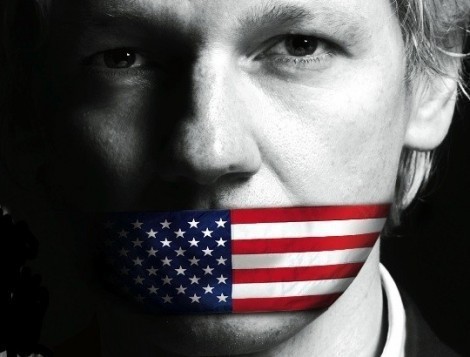
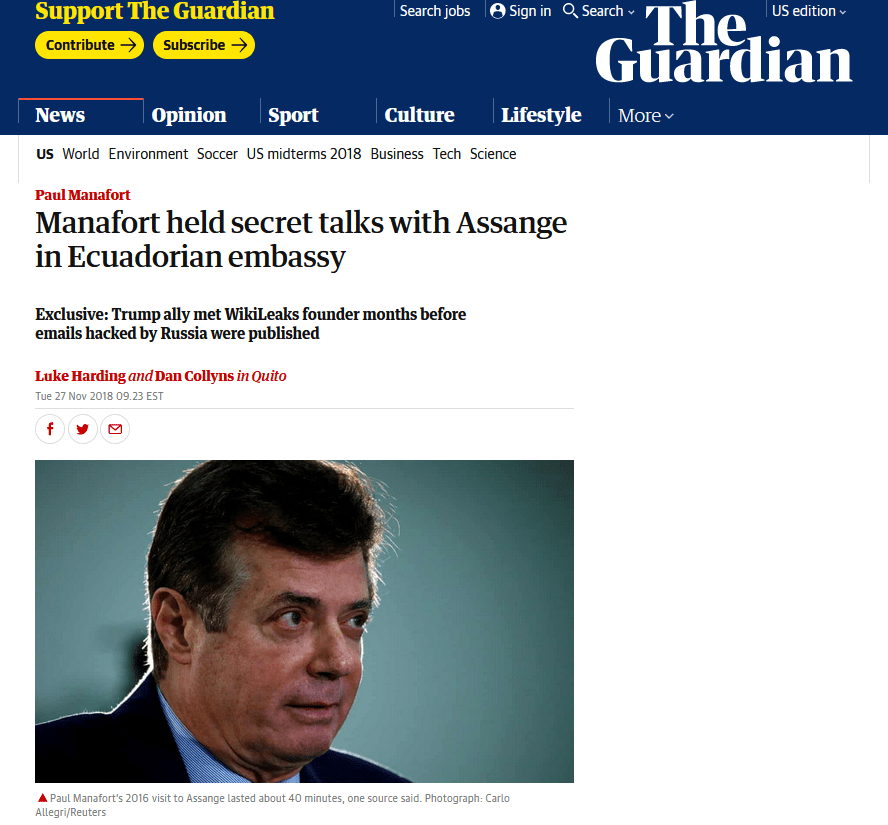
WikiLeaks has announced it will sue the British Guardian over the scurrilous allegations it made on May 15 that Julian Assange “hacked” the communication system of the Ecuadorian embassy in London where he has been confined since he sought political asylum in June 2012.
The only and obvious motive behind the unsubstantiated, “anonymous” allegations is to provide the Ecuadorian government with a pretext to renege on Assange’s asylum and force him out of the embassy. Upon doing so, he would be arrested by waiting British police for breaching bail conditions. Once in British custody, the WikiLeaks editor would face the prospect of extradition to the US to stand trial on charges of espionage, which could lead to his protracted imprisonment or, potentially, even his execution (see: “Conspiracy emerges to push Julian Assange into British and US hands”).
In a tweet issued shortly after the publication of the Guardian articles, WikiLeaks denounced the assertions as an “anonymous libel” made on behalf of the “current UK-US government onslaught against Mr Assange’s asylum—while he can’t respond. You’ve gone too far this time. We’re suing.”
Assange cannot respond because on March 28, more than seven weeks ago, the Ecuadorian government of President Lenín Moreno cut off all his communications with the outside world and has blocked him from even receiving visitors. Ample indications exist that Ecuador did so on the demand of Washington, as part of the price for improved relations with the US.
WikiLeaks ended its tweet with a link to the scathing review that Assange wrote of the Guardian-published 2014 book, The Snowden Files: The Inside Story of the World’s Most Wanted Man. The author of the book was Luke Harding, the same Guardian journalist who co-wrote the May 15 attack on Assange and WikiLeaks.
In the first sentence of his review, Assange described Harding’s work as a “hack job in the purest sense of the word” and more than substantiated that characterisation. He condemned the Guardian for having “caved to government pressure” over the publication of leaked material and for leaving Edward Snowden “in the lurch” when the NSA whistleblower fled to Hong Kong in June 2013. It was a representative of WikiLeaks who organised for Snowden to escape to Russia, where he was eventually granted political asylum.
Harding and the Guardian did not have credibility in 2014 and they do not today.
Beside WikiLeaks and the World Socialist Web Site, only a handful of other websites and individuals have stepped forward to denounce the Guardian for serving as the conduit for the anti-Assange vendetta of the US government and intelligence agencies. In the main, there is a complicit silence on the part of the pro-imperialist establishment media and no less pro-imperialist pseudo-left organisations.
Former British whistleblower Craig Murray, who has vocally defended Assange from the outset, wrote on his blog yesterday that the Guardian articles included “outright lies.” Murray exposed, for example, the false claim by the newspaper that Sweden was “unable to question Assange” over allegations he may have committed sexual offences in 2010. The reprehensible attempt to slander Assange as a “rapist” has been relentlessly used to try and undermine the immense international support for WikiLeaks and its editor.
In fact, Assange was questioned before he left Sweden for Britain and a prosecutor deemed he had no case to answer. A second prosecutor, however, reopened the case and pursued it aggressively, gaining an arrest warrant to force Assange to return to Sweden to answer “questions.” The warrant was issued under conditions in which US and allied governments were baying for Assange’s blood because WikiLeaks had published vast amounts of damning evidence of war crimes and intrigues that had been courageously leaked by then Private Bradley [now Chelsea] Manning.
Assange correctly refused to submit to the politically-motivated warrant and challenged it in the British courts. He sought asylum in June 2012 only when his legal avenues ran out to prevent his extradition to Sweden, and likely rendition on to the US.
When Swedish authorities finally agreed to Assange’s longstanding offer to answer any questions, from Britain, he was interviewed by prosecutors and police for two days in November 2016. In May 2017, Sweden completely dropped the case. After more than six years of persecution, Assange was never charged with any crime.
Craig Murray characterised the May 15 Guardian articles as a “new low… in a collaboration between long term MI6 mouthpiece Luke Harding and the CIA financed neo-con propagandists of Focus Ecuador”—the right-wing Spanish-language site which was also provided the “anonymous” information that Assange “hacked” the embassy.
Murray opined: “I would bet any money that these anonymous ‘sources’ are as always Harding’s mates in the British security services.”
The Intercept website featured today an interview conducted by Glenn Greenwald, its editor and former whistleblower, with previous Ecuadorian President Rafael Correa, whose administration granted Assange asylum in 2012.
Correa denounced his protégé and successor Lenín Moreno for cutting off Assange’s communications and visitors, labelling it as “basically torture and “a clear violation of his rights.” He declared the Ecuadorian government “is attacking Julian’s mental health.” He reviewed the closer relations between Moreno’s administration and Washington that had been developed immediately prior to the attack on Assange
Correa stated that the Guardian allegations that Assange hacked the embassy were “absurd” and that it had “presented no evidence for this, just an anonymous source.”
The ex-president stated that if Moreno allowed the WikiLeaks’ editor to be forced out of the London embassy without an iron-clad guarantee he would not be extradited to the US, it would be a “terrible betrayal, a violation of the rules of asylum and a breach of Ecuador’s responsibility to protect the safety and welfare of Julian Assange.”
The almost universal hostility towards Assange and indifference to his fate on the part of the establishment press and self-styled “left” is in stark contrast to mass popular sentiment. On Facebook, Twitter and other social media, every defence of Assange is being responded to with a stream of supportive comments, retweets and shares, and sharp and informed rebuttals of all those who attempt to attack Assange and WikiLeaks with pro-state propaganda and lies.
The social force that must be politically mobilised in defence of democratic rights is the international working class. It must be alerted and educated as to the tremendous dangers posed by the steadily escalating efforts to censor the Internet, suppress free speech and railroad whistleblowers and principled journalists like Julian Assange into prison or worse.
The author also recommends:
Ecuador hints it may hand over Julian Assange to Britain and the US
[12 May 2018]
Freedom for Julian Assange!
[11 January 2018]

 After the Crash