Saturday Matinee: Beau is Afraid

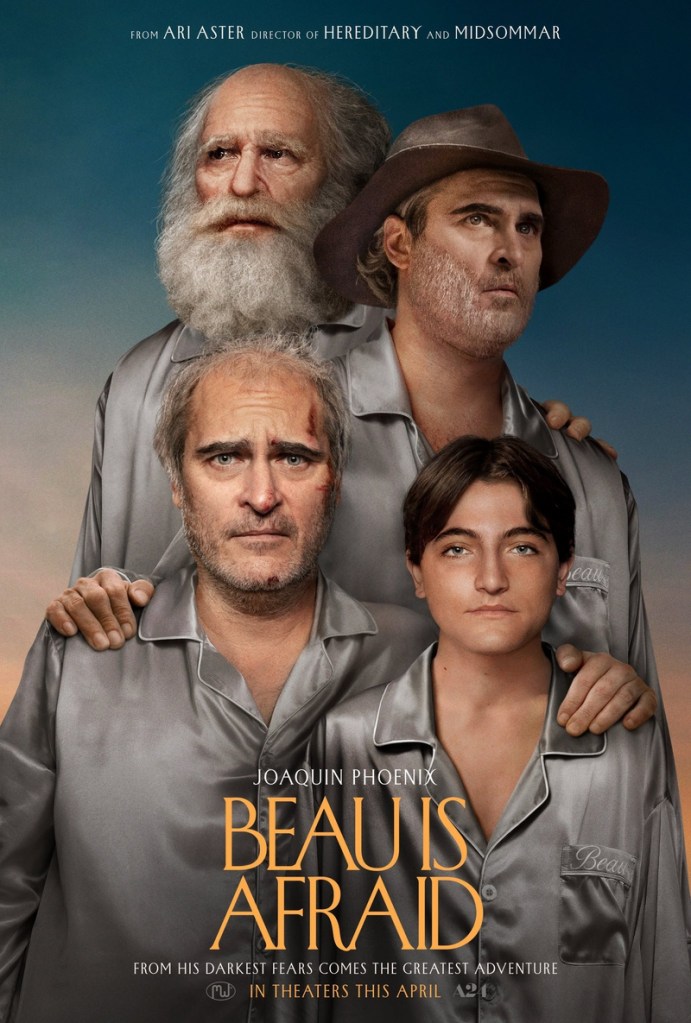
Beau Is Afraid (Film Review): A Baffling Nightmare

By Joseph Tomastik

Source: Loud and Clear

Beau is Afraid. And I’m afraid of what’s in Ari Aster’s head after watching his latest film. The director of Hereditary and Midsommar is back with Beau is Afraid, a baffling three-hour effort to make his other films look easily accessible in comparison. I love Hereditary and consider it one of the best horror films of the 2010s. I like Midsommar purely for the sensory experience of watching it, but its bare-bones, overblown story stops me from calling it good. Beau Is Afraid takes those strengths and weaknesses of Midsommar and cranks them up to eleven. And, fittingly enough, my feelings on that film are repeated twofold with this one.

Beau (Joaquin Phoenix) is an anxious man who lives in a broken-down apartment in a corrupt, violent city. He’s set to go on a trip to visit his overbearing mother (Patti LuPone), but shocking news and unfortunate events derail his trip, forcing him to cross paths with a variety of bizarre characters and surreal events. That’s as much of the plot as I’ll be revealing. Not just to avoid spoiling any surprises, but also because that’s about all I feel I’m even capable of saying. Outside of Beau being tended to along his way by a seemingly caring couple (Amy Ryan and Nathan Lane), the events of Beau is Afraid are increasingly difficult to properly wrap one’s head around.

Beau is Afraid is the kind of film that I’ve become more open to over the years. I once had the impulse to dislike any film that I didn’t instantly understand, but now I can appreciate the experience of such a baffling film if I find myself sucked into the craft, performances, visuals, or overall feel. Beau is Afraid is an unshakable 10/10 in all of those aspects. This is Aster’s most skillfully shot, visually haunting film to date. He has such an insanely perfect grasp on his directorial style that I struggle to comprehend how any human being could bring some of this film’s beauty to reality. That sounds hyperbolic, but I really was that mesmerized by what was accomplished here.

There’s so much detail in almost every single shot that you could blink and potentially miss a jarring detail. This is not only impressive, but it guarantees that no matter where or when you look, some form of misery is happening. This is especially true early on when we see what kind of environment Beau lives in. It looks like your typical city, but it feels downright alien because of how relentlessly cruel everyone is and how well the nightmare of such a place is captured. The entirety of Beau is Afraid feels like a nightmare, in fact. The are sights, sounds, and ideas are like something straight out of a David Lynch movie, and they’re never going to leave my head. And, as is typical of Aster, the whole film is effectively raw and relentlessly unpleasant. Even if you don’t always understand what’s happening or why, you feel it.

The editing emphasizes that nightmarish feel as well, not letting you skip out on a single second of the discomfort that would exist in these scenarios. There are no loud tactics or cheap jump scares here, as every dark reveal is slowly thrust upon you. The editing also gets morbidly funny. Beau is about to take a bath, he gets bad news, and a match cut shows the water spilling out onto to the floor, showing how long he’s been standing there stunned. The blocking of characters from wide shots gives so many of them the physical presence of a creeping demon, even if you don’t always know why you’re afraid of them, and the lighting outlines so many set pieces and characters in a disarming otherworldly void.

The actors are all spectacular. Phoenix is amazing as always, getting across Beau’s frightened vulnerability, uncertainty, and buried anger in a heartbreakingly sympathetic way, especially when it’s met with so much hostility. Everyone else works so well with the material they’re given. Their lines get so excessively cruel and heightened that they could easily come across as inauthentic, but every performance brings enough painfully realistic conviction to sell them.

There’s also a sequence at the center of Beau is Afraid involving a stage play that tells its own little story. This entire stretch is stunning enough to work as its own Oscar-worthy short film. It combines a variety of styles and artistry and works them into the emotion of the story being told. If other filmmakers take away anything from Beau is Afraid, it should be how innovative they can get with their own storytelling. Aster’s recurring cinematographer Pawel Pogorzelski needs to become one of the most sought-after people in his field. I’m really doing very little justice in describing what he does here.

If only that play sequence felt like it mattered in the grand scheme of things. Which leads me to where Beau is Afraid falls short: the story. I don’t know whether to classify this movie as ridiculously simple or excessively convoluted, because its story is a very long, winding road to what feels like a very basic destination. Beau is Afraid is, above all else, meant to be about a man dealing with the damage his overprotective, abuse mother inflicted onto him, and how that’s molded his paranoia and anxiety. But additionally, you’re also supposed to be trying to figure out the nature of Beau’s reality. Yet the more I think about it (without the luxury of a rewatch, I must stress), the more the story and structure begin to fall apart.

A lot of this has to do with character motivations. Beau’s are fine and understandable, but everyone else makes so many nonsensical and sporadic decisions that don’t feel baked into the well-established natures of who they are. They feel like excuses to show upsetting content or move us to the next set piece. The couple that takes care of Beau has a daughter (Kylie Rogers) who believes Beau is replacing her … and I have no idea why that is, let alone why it drives her to the drastic actions she takes. They have a veteran son (Denis Ménochet) with a severe but pointless and almost tastelessly portrayed mental illness. The parents’ outlook on Beau also eventually flips in a way that feels almost pointless in the grand scheme of things.

The play I brought up initially seems like it may connect somehow to Beau’s past, present, and future, but it really doesn’t. A character supposedly from his past soon shows up, and there are no hints as to how he got there, what he’s been doing, or even what he’s even trying to accomplish, especially after another reveal later on. Flashbacks to Beau’s childhood see him interacting with a very deranged girl whose unnatural, almost sociopathic dialogue is seemingly written that way just to be weird and off-putting.

think I know the very, very basic nature of what’s going on … maybe. The ending and the hints of said ending definitely lead me down one road, along with a few other theories that may hold some weight when I factor in my own interpretations of other reveals. But that road still leaves a lot of other threads and sequences failing to click into place, at least in a way that contributes to whatever Aster is going for thematically … I think? I swear, there’s something here that could potentially justify a lot of what I’m unclear on. I can’t say specifically what that is, but I’m hesitant to just dismiss the whole story entirely.

By the time the ending rolls around, you understand the core of what Beau is Afraid is supposed to be about. It just stretches what little meat that core has to such an absurd degree, throwing in all kinds of self-indulgent hurdles that distract from the point of the film more than they add to it. I get that certain films are supposed to not follow conventional, natural logic. But they should still have some method to their madness. Beau is Afraid goes all over the place. It’s a few minutes short of being three hours long, and that length is partially due to the many non sequiturs and needless details that muddy up the ambiguous information that probably is relevant to the bigger picture.

To the film’s credit, I never once felt that length, I was never bored, and I never wanted the glacial pacing to speed up. I also, despite how little I can grasp the film’s intentions, still find myself feeling more positively about Beau is Afraid than negatively. I think I’ll even watch it again just to relive this astonishingly constructed fever dream. I must stress that my enjoyment is almost only due to the visceral experience of the entire nightmare playing out, and not from the meaning behind it. Ari Aster is becoming a frustrating director for me because he clearly has god-tier levels of talent behind the camera. But that talent seems to lose its focus when he’s writing, a problem he’s so far only avoided with Hereditary.

I’ll give full props to A24: they clearly don’t care whether or not all of their films make money. There’s no way in my mind they could have looked at this script with this running time and thought it was going to do well. This is the kind of film that’s destined to get a C or D grade on Cinemascore and leave many audiences at odds with the general critical praise the film is getting. In that regard, if you can see yourself enjoying a film for the same reasons I enjoyed Beau is Afraid, then you should absolutely give it a shot in theaters. The same applies if you just like weird, trippy, dark films regardless of their substance. I’m still going to see Aster’s next film, because everything he’s made has shown him to be on another level of directing. He’s one of the few filmmakers who can win me over solelywith his craft, even when his stories are lacking. I just hope he eventually regains control of that crucial other half.

____________________

Watch Beau is Afraid on Hoopla here: https://www.hoopladigital.com/movie/beau-is-afraid-joaquin-phoenix/16497118

Saturday Matinee: The Sisters Brothers

By Tomris Laffly

Source: RogerEbert.com

Who would have thought that Jacques Audiard, the French director of slow-burn, humanistic character studies would one day take on one of the most characteristically American of genres, the Western, with his English-language debut? While worlds apart from his socially realist “Dheepan” and “Rust and Bone,” Audiard’s “The Sisters Brothers” sports a similarly closely watched, leaned in sensitivity with its brotherly story. Adapted from Patrick deWitt’s 2011 novel (by Audiard and Thomas Bidegain) and infused with sweetness, graphic body horror (that, at times, spins a childlike icky humor) and a high body count, this alcohol-soaked Frontier road trip constantly reinvents itself at every turn in fun, witty and ultimately touching ways. Call it a revisionist or an absurdist Western if you will, but Audiard’s film feels both refreshingly new (without ever going to the extreme lengths the Zellner Brothers did with “Damsel”) and nostalgically familiar.

The backdrop is the Gold Rush, which is said to have made a Sherriff’s job much easier: if there’s trouble, you follow the gold to get to the source of the unrest. But when we meet the central brothers Eli (John C. Reilly, goofy, soulful and great at physical comedy as ever) and Charlie (Joaquin Phoenix, quietly enigmatic) one random dark night at the start of the film, there doesn’t seem to be any wealth to be pursued. With the playful last name “Sisters,” the pair of cold-blooded hit-men, without much thought about the consequences of their actions, murder a household of people in a tightly orchestrated set piece of nocturnal shootouts. The reason remains unknown—with this job and everything else, the ruthless duo answers to a much feared, mostly unseen mysterious crime boss called ‘The Commodore’ and habitually assassinates their way through the 1850s Oregon. Along the way, they bond and trivially bicker about life as casually as they kill.

But just when the soft-edged Eli starts contemplating his future and ongoing profession despite the unaffected heavy drinker Charlie’s shrugs, The Commodore sets them up for a new task. They will tail and kill a criminal called Hermann Kemit Warm (Riz Ahmed, cheekily mysterious) for reasons we would slowly piece together later—for now, he is just a thieving enemy who once betrayed their boss. Enter Morris (Jake Gyllenhaal, reuniting with Ahmed after “Nightcrawler”), a British-accented bounty hunter for hire, tasked with delivering Warm to the brothers. But then the prospect of immediate wealth turns tables for everyone involved—the brainy chemist Warm’s creamy invention that makes gold glaringly appear in water, redefines priorities at once. The two pairs, traced on parallel storylines for a while (that admittedly slows down the film’s previously absorbing rhythm), find themselves entangled in a ploy against each other. Along the way, local madams, kindly prostitutes, further the accidentally amusing events and some dead horses unfortunately enter the story, sharpening the film’s tone as an original yet studied homage to its genre.

A delightful tale of familial ties balanced well with a slick cat-and-mouse yarn, “The Sisters Brothers” owes much of its breezy charm to John C. Reilly, whose comic timing does wonders for the meatiest and most multifaceted character of the ensemble. Phoenix feels right at home in Charlie’s quieter shoes, while Gyllenhaal’s familiarly on-edge persona and a mischievous turn from Ahmed impress. Reilly and Phoenix demonstrate tremendous chemistry throughout—we buy both their longtime amity and occasional callousness, especially when the script drip-feeds the brothers’ back-story into the narrative. In this bittersweet tale with a sentimental heart, and among a dangerous milieu of blood, greed and spiders (one in particular that causes the film’s biggest gross-out moment), Audiard’s characteristically sensitive touch gradually lifts familial emotions, letting them linger in the air long after the credits roll. 

Saturday Matinee: Buffalo Soldiers

buffalo_soldiers_film_poster

“Buffalo Soldiers” (2001) is a dark satire directed by Gregor Jordan based on the 1993 novel by Robert O’Conner. The story centers on U.S. Army soldier Ray Elwood (Joaquin Phoenix), whose drug and black market schemes are disrupted when his company gets assigned a new First Sergeant, Robert E. Lee (Scott Glenn). The battle between Elwood and Lee rapidly escalates leading to a fiery showdown. The film’s original theatrical run was delayed by two years due to fears that its unflattering depiction of the military would offend the sensibilities of the culture which was still caught up in a (partly real, partly media-induced) post-9/11 patriotic fervor.

Watch the full film here.