The Age of Disintegration

images

Neoliberalism, Interventionism, the Resource Curse, and a Fragmenting World

By Patrick Cockburn

Source: TomDispatch.com

We live in an age of disintegration. Nowhere is this more evident than in the Greater Middle East and Africa. Across the vast swath of territory between Pakistan and Nigeria, there are at least seven ongoing wars — in Afghanistan, Iraq, Syria, Yemen, Libya, Somalia, and South Sudan. These conflicts are extraordinarily destructive. They are tearing apart the countries in which they are taking place in ways that make it doubtful they will ever recover. Cities like Aleppo in Syria, Ramadi in Iraq, Taiz in Yemen, and Benghazi in Libya have been partly or entirely reduced to ruins. There are also at least three other serious insurgencies: in southeast Turkey, where Kurdish guerrillas are fighting the Turkish army, in Egypt’s Sinai Peninsula where a little-reported but ferocious guerrilla conflict is underway, and in northeast Nigeria and neighboring countries where Boko Haram continues to launch murderous attacks.

All of these have a number of things in common: they are endless and seem never to produce definitive winners or losers. (Afghanistan has effectively been at war since 1979, Somalia since 1991.) They involve the destruction or dismemberment of unified nations, their de facto partition amid mass population movements and upheavals — well publicized in the case of Syria and Iraq, less so in places like South Sudan where more than 2.4 million people have been displaced in recent years.

Add in one more similarity, no less crucial for being obvious: in most of these countries, where Islam is the dominant religion, extreme Salafi-Jihadi movements, including the Islamic State (IS), al-Qaeda, and the Taliban are essentially the only available vehicles for protest and rebellion. By now, they have completely replaced the socialist and nationalist movements that predominated in the twentieth century; these years have, that is, seen a remarkable reversion to religious, ethnic, and tribal identity, to movements that seek to establish their own exclusive territory by the persecution and expulsion of minorities.

In the process and under the pressure of outside military intervention, a vast region of the planet seems to be cracking open. Yet there is very little understanding of these processes in Washington. This was recently well illustrated by the protest of 51 State Department diplomats against President Obama’s Syrian policy and their suggestion that air strikes be launched targeting Syrian regime forces in the belief that President Bashar al-Assad would then abide by a ceasefire. The diplomats’ approach remains typically simpleminded in this most complex of conflicts, assuming as it does that the Syrian government’s barrel-bombing of civilians and other grim acts are the “root cause of the instability that continues to grip Syria and the broader region.”

It is as if the minds of these diplomats were still in the Cold War era, as if they were still fighting the Soviet Union and its allies. Against all the evidence of the last five years, there is an assumption that a barely extant moderate Syrian opposition would benefit from the fall of Assad, and a lack of understanding that the armed opposition in Syria is entirely dominated by the Islamic State and al-Qaeda clones.

Though the invasion of Iraq in 2003 is now widely admitted to have been a mistake (even by those who supported it at the time), no real lessons have been learned about why direct or indirect military interventions by the U.S. and its allies in the Middle East over the last quarter century have all only exacerbated violence and accelerated state failure.

A Mass Extinction of Independent States

The Islamic State, just celebrating its second anniversary, is the grotesque outcome of this era of chaos and conflict. That such a monstrous cult exists at all is a symptom of the deep dislocation societies throughout that region, ruled by corrupt and discredited elites, have suffered. Its rise — and that of various Taliban and al-Qaeda-style clones — is a measure of the weakness of its opponents.

The Iraqi army and security forces, for example, had 350,000 soldiers and 660,000 police on the books in June 2014 when a few thousand Islamic State fighters captured Mosul, the country’s second largest city, which they still hold. Today the Iraqi army, security services, and about 20,000 Shia paramilitaries backed by the massive firepower of the United States and allied air forces have fought their way into the city of Fallujah, 40 miles west of Baghdad, against the resistance of IS fighters who may have numbered as few as 900. In Afghanistan, the resurgence of the Taliban, supposedly decisively defeated in 2001, came about less because of the popularity of that movement than the contempt with which Afghans came to regard their corrupt government in Kabul.

Everywhere nation states are enfeebled or collapsing, as authoritarian leaders battle for survival in the face of mounting external and internal pressures. This is hardly the way the region was expected to develop. Countries that had escaped from colonial rule in the second half of the twentieth century were supposed to become more, not less, unified as time passed.

Between 1950 and 1975, nationalist leaders came to power in much of the previously colonized world. They promised to achieve national self-determination by creating powerful independent states through the concentration of whatever political, military, and economic resources were at hand. Instead, over the decades, many of these regimes transmuted into police states controlled by small numbers of staggeringly wealthy families and a coterie of businessmen dependent on their connections to such leaders as Hosni Mubarak in Egypt or Bashar al-Assad in Syria.

In recent years, such countries were also opened up to the economic whirlwind of neoliberalism, which destroyed any crude social contract that existed between rulers and ruled. Take Syria. There, rural towns and villages that had once supported the Baathist regime of the al-Assad family because it provided jobs and kept the prices of necessities low were, after 2000, abandoned to market forces skewed in favor of those in power. These places would become the backbone of the post-2011 uprising. At the same time, institutions like the Organization of Petroleum Exporting Countries (OPEC) that had done so much to enhance the wealth and power of regional oil producers in the 1970s have lost their capacity for united action.

The question for our moment: Why is a “mass extinction” of independent states taking place in the Middle East, North Africa, and beyond? Western politicians and media often refer to such countries as “failed states.” The implication embedded in that term is that the process is a self-destructive one. But several of the states now labeled “failed” like Libya only became so after Western-backed opposition movements seized power with the support and military intervention of Washington and NATO, and proved too weak to impose their own central governments and so a monopoly of violence within the national territory.

In many ways, this process began with the intervention of a U.S.-led coalition in Iraq in 2003 leading to the overthrow of Saddam Hussein, the shutting down of his Baathist Party, and the disbanding of his military. Whatever their faults, Saddam and Libya’s autocratic ruler Muammar Gaddafi were clearly demonized and blamed for all ethnic, sectarian, and regional differences in the countries they ruled, forces that were, in fact, set loose in grim ways upon their deaths.

A question remains, however: Why did the opposition to autocracy and to Western intervention take on an Islamic form and why were the Islamic movements that came to dominate the armed resistance in Iraq and Syria in particular so violent, regressive, and sectarian? Put another way, how could such groups find so many people willing to die for their causes, while their opponents found so few? When IS battle groups were sweeping through northern Iraq in the summer of 2014, soldiers who had thrown aside their uniforms and weapons and deserted that country’s northern cities would justify their flight by saying derisively: “Die for [then-Prime Minister Nouri] al-Maliki? Never!”

A common explanation for the rise of Islamic resistance movements is that the socialist, secularist, and nationalist opposition had been crushed by the old regimes’ security forces, while the Islamists were not. In countries like Libya and Syria, however, Islamists were savagely persecuted, too, and they still came to dominate the opposition. And yet, while these religious movements were strong enough to oppose governments, they generally have not proven strong enough to replace them.

Too Weak to Win, But Too Strong to Lose

Though there are clearly many reasons for the present disintegration of states and they differ somewhat from place to place, one thing is beyond question: the phenomenon itself is becoming the norm across vast reaches of the planet.

If you’re looking for the causes of state failure in our time, the place to start is undoubtedly with the end of the Cold War a quarter-century ago. Once it was over, neither the U.S. nor the new Russia that emerged from the Soviet Union’s implosion had a significant interest in continuing to prop up “failed states,” as each had for so long, fearing that the rival superpower and its local proxies would otherwise take over. Previously, national leaders in places like the Greater Middle East had been able to maintain a degree of independence for their countries by balancing between Moscow and Washington. With the break-up of the Soviet Union, this was no longer feasible.

In addition, the triumph of neoliberal free-market economics in the wake of the Soviet Union’s collapse added a critical element to the mix. It would prove far more destabilizing than it looked at the time.

Again, consider Syria. The expansion of the free market in a country where there was neither democratic accountability nor the rule of law meant one thing above all: plutocrats linked to the nation’s ruling family took anything that seemed potentially profitable. In the process, they grew staggeringly wealthy, while the denizens of Syria’s impoverished villages, country towns, and city slums, who had once looked to the state for jobs and cheap food, suffered. It should have surprised no one that those places became the strongholds of the Syrian uprising after 2011. In the capital, Damascus, as the reign of neoliberalism spread, even the lesser members of the mukhabarat, or secret police, found themselves living on only $200 to $300 a month, while the state became a machine for thievery.

This sort of thievery and the auctioning off of the nation’s patrimony spread across the region in these years. The new Egyptian ruler, General Abdel Fattah al-Sisi, merciless toward any sign of domestic dissent, was typical. In a country that once had been a standard bearer for nationalist regimes the world over, he didn’t hesitate this April to try to hand over two islands in the Red Sea to Saudi Arabia on whose funding and aid his regime is dependent. (To the surprise of everyone, an Egyptian court recently overruled Sisi’s decision.)

That gesture, deeply unpopular among increasingly impoverished Egyptians, was symbolic of a larger change in the balance of power in the Middle East: once the most powerful states in the region — Egypt, Syria, and Iraq — had been secular nationalists and a genuine counterbalance to Saudi Arabia and the Persian Gulf monarchies. As those secular autocracies weakened, however, the power and influence of the Sunni fundamentalist monarchies only increased. If 2011 saw rebellion and revolution spread across the Greater Middle East as the Arab Spring briefly blossomed, it also saw counterrevolution spread, funded by those oil-rich absolute Gulf monarchies, which were never going to tolerate democratic secular regime change in Syria or Libya.

Add in one more process at work making such states ever more fragile: the production and sale of natural resources — oil, gas, and minerals — and the kleptomania that goes with it. Such countries often suffer from what has become known as “the resources curse”: states increasingly dependent for revenues on the sale of their natural resources — enough to theoretically provide the whole population with a reasonably decent standard of living — turn instead into grotesquely corrupt dictatorships. In them, the yachts of local billionaires with crucial connections to the regime of the moment bob in harbors surrounded by slums running with raw sewage. In such nations, politics tends to focus on elites battling and maneuvering to steal state revenues and transfer them as rapidly as possible out of the country.

This has been the pattern of economic and political life in much of sub-Saharan Africa from Angola to Nigeria. In the Middle East and North Africa, however, a somewhat different system exists, one usually misunderstood by the outside world. There is similarly great inequality in Iraq or Saudi Arabia with similarly kleptocratic elites. They have, however, ruled over patronage states in which a significant part of the population is offered jobs in the public sector in return for political passivity or support for the kleptocrats.

In Iraq with a population of 33 million people, for instance, no less than seven million of them are on the government payroll, thanks to salaries or pensions that cost the government $4 billion a month. This crude way of distributing oil revenues to the people has often been denounced by Western commentators and economists as corruption. They, in turn, generally recommend cutting the number of these jobs, but this would mean that all, rather than just part, of the state’s resource revenues would be stolen by the elite. This, in fact, is increasingly the case in such lands as oil prices bottom out and even the Saudi royals begin to cut back on state support for the populace.

Neoliberalism was once believed to be the path to secular democracy and free-market economies. In practice, it has been anything but. Instead, in conjunction with the resource curse, as well as repeated military interventions by Washington and its allies, free-market economics has profoundly destabilized the Greater Middle East. Encouraged by Washington and Brussels, twenty-first-century neoliberalism has made unequal societies ever more unequal and helped transform already corrupt regimes into looting machines. This is also, of course, a formula for the success of the Islamic State or any other radical alternative to the status quo. Such movements are bound to find support in impoverished or neglected regions like eastern Syria or eastern Libya.

Note, however, that this process of destabilization is by no means confined to the Greater Middle East and North Africa. We are indeed in the age of destabilization, a phenomenon that is on the rise globally and at present spreading into the Balkans and Eastern Europe (with the European Union ever less able to influence events there). People no longer speak of European integration, but of how to prevent the complete break-up of the European Union in the wake of the British vote to leave.

The reasons why a narrow majority of Britons voted for Brexit have parallels with the Middle East: the free-market economic policies pursued by governments since Margaret Thatcher was prime minister have widened the gap between rich and poor and between wealthy cities and much of the rest of the country. Britain might be doing well, but millions of Britons did not share in the prosperity. The referendum about continued membership in the European Union, the option almost universally advocated by the British establishment, became the catalyst for protest against the status quo. The anger of the “Leave” voters has much in common with that of Donald Trump supporters in the United States.

The U.S. remains a superpower, but is no longer as powerful as it once was. It, too, is feeling the strains of this global moment, in which it and its local allies are powerful enough to imagine they can get rid of regimes they do not like, but either they do not quite succeed, as in Syria, or succeed but cannot replace what they have destroyed, as in Libya. An Iraqi politician once said that the problem in his country was that parties and movements were “too weak to win, but too strong to lose.” This is increasingly the pattern for the whole region and is spreading elsewhere. It carries with it the possibility of an endless cycle of indecisive wars and an era of instability that has already begun.


Patrick Cockburn is a Middle East correspondent for the Independent of London and the author of five books on the Middle East, the latest of which isChaos and Caliphate: Jihadis and the West in the Struggle for the Middle East(OR Books).

Hillary Clinton’s war crimes are unforgivable. No real progressive could ever support her.

clinton-kissinger-2-article-header

By Zach Cartwright

Source: U.S. Uncut

Hillary Clinton made headlines with a speech in San Diego casting Donald Trump as unfit for the presidency due to the damage his incendiary rhetoric could cause. Simultaneously, the former Secretary of State sought to convince the California audience that she was the safer choice in foreign policy matters.

But when taking a closer look at US foreign policy under her leadership as the nation’s top diplomat, it’s obvious that Clinton could potentially be as disastrous as Trump if given the position of Commander-in-Chief.

Here are a few examples of countries where conditions are tremendously worse as a result of Hillary Clinton’s policies.

Hillary Clinton made Libya a failed state

In an April interview with Fox News, President Barack Obama, reflecting on his 7 years as Commander-in-Chief, admitted that ousting Libyan dictator Muammar Gaddafi was the biggest mistake of his presidency. While Obama took responsibility for the failure of Libya in that interview, he relied on the input of Hillary Clinton, his Secretary of State at the time.

In March of 2011, Clinton met with Mahmoud Jibril, who was leading the opposition to Gaddafi. As the New York Times reported, Clinton asked Jibril a series of questions about how his coalition planned to fill the power vacuum that would be created by Gaddafi’s ouster. And in the end, it was Clinton who convinced the White House that deposing Gaddafi was the right thing to do:

Her conviction would be critical in persuading Mr. Obama to join allies in bombing Colonel Qaddafi’s forces. In fact, Mr. Obama’s defense secretary, Robert M. Gates, would later say that in a “51-49” decision, it was Mrs. Clinton’s support that put the ambivalent president over the line.

The 2011 NATO-led invasion of Libya that took place after Clinton’s visit has since allowed extremist groups to seize power in an unprecedented takeover of much of the country over the last five years.

In 2014, the US State Department shut down the US embassy in Libya and issued a travel warning urging all Americans to stay away from the country. Roughly one year ago, Libya’s central bank, the last remaining institution in the failed state, was forced to flee to a city in the Eastern region of the country due to rebel forces encroaching on the bank’s facility in Tripoli, the capital. Libya is now a haven for terrorists, with thousands of ISIS soldiers using the country as a staging ground.

In an interview on CBS, Clinton laughed about Gaddafi’s slaying, proudly exclaiming, “We came, we saw, he died.”

Hillary Clinton deserves credit for poverty and instability in Haiti

In Haiti, the first state ever founded by freed black slaves, citizens are still fighting for political and economic freedom today, largely due to the influence of Bill and Hillary Clinton.

In 2011, Wikileaks published US State Department cables from 2008 and 2009 confirming that State Department officials were meeting behind closed doors with Haitian business leaders, plotting on how to stop the Haitian government from implementing a 37-cent hike in the minimum wage from $0.24 an hour to $0.61 cents an hour.

While Haitian President René Préval was initially neutral on the proposal of raising the minimum wage, he went on the record opposing the wage hike after consistent efforts from within the US Embassy in Haiti and the Haitian business lobby by July of 2009. Politifact rated the claim that Clinton’s State Department tried to suppress the wage hike as half-true, since there’s no link proving that Clinton directly played a role.

However, Clinton’s influence on Haiti didn’t stop there. As US Uncut previously reported, the former Secretary of State took an active role in swinging Haitian’s presidential elections in favor of corporate special interests. In the first round of Haiti’s presidential elections, thousands of citizens took to the streets demanding an annulment of election results, alleging that then-Haitian president Michel Martelly committed election fraud.

Martelly, who succeeded René Préval, is a close confidant of the Clinton family. In 2011, Martelly appointed Bill Clinton to an advisory board whose stated goal was to court foreign investors.

And in one of Hillary Clinton’s State Department emails made public, Clinton’s chief of staff received an email from another staffer openly boasting about using connections within the Haitian business elite to lobby for the withdrawal of Jude Célestin, Martelly’s political rival, from an upcoming runoff election. The aide, Kenneth Merten, predicted the news of the US interfering in election results would create widespread protests, and said he had called Martelly, asking him to plead with Haitians “to not pillage.”

While Martelly is no longer in power, his hand-picked successor, Jovenel Moïse, won the most recent election. However, watchdogs are calling the results fraudulent and demanding a new election. Ricardo Seitenfus, who has served as representative of the Organization of American States (OAS) for the last eight years, admitted that Haiti’s government is essentially a puppet of US interests, saying the Haitian election schedule is “subject to the U.S. schedule.” Hillary Clinton deserves to be closely scrutinized when touting her diplomacy record, as Haiti’s political instability is a result of her policies.

Honduras’ downfall resulted from a coup Clinton supported

In 2009, shortly after Obama took office and appointed Hillary Clinton as his Secretary of State, Honduran president Manuel Zelaya was arrested at gunpoint by the military and forced onto a plane to Costa Rica while a new government took power. While the US State Department didn’t directly oust Zelaya, it refused to call his ouster a coup, despite calls from the U.S. ambassador to Honduras and from Congress to do so. In her interview with the New York Daily News editorial board, Clinton defended her decision to keep sending aid to Honduras despite the violent overthrow of Zelaya:

I think, in retrospect, we managed a very difficult situation, without bloodshed, without a civil war, that led to a new election. And I think that was better for the Honduran people. But we have a lot of work to do to try to help stabilize that and deal with corruption, deal with the violence and the gangs and so much else.

However, the result of the coup was a massive amount of bloodshed, as gangs and drug cartels began to take more power in the absence of a stable government. In the year following the coup, Clinton’s State Department published a list of human rights abuses prevalent in Honduras:

“…unlawful killings by police and government agents, which the government took some steps to prosecute; arbitrary and summary killings committed by vigilantes and former members of the security forces; harsh prison conditions; violence against detainees; corruption and impunity within the security forces; lengthy pretrial detention and failure to provide due process of law; politicization, corruption, and institutional weakness of the judiciary; corruption in the legislative and executive branches; government restrictions on the recognition of some civil society groups; violence and discrimination against women; child prostitution and abuse; trafficking in persons; discrimination against indigenous communities; violence and discrimination against persons based on sexual orientation; ineffective enforcement of labor laws; and child labor.”

The horrific conditions in Honduras triggered a mass exodus of migrants to the US. As Telesur reported, approximately 9,000 child refugees fled Honduras in 2015. Also in 2015, Clinton defended the deportation of children back to the Central American countries they’re fleeing in order “send a message.” However, Clinton has since walked back that statement as her Democratic presidential primary battle with Bernie Sanders became more competitive.

Honduras-Activists-Berta-Cáceres-and-Nelson-Garcia-Assassinated-Called-Out-Hillary-Clinton-for-Backing-Honduran-Coup

This March, the violence in Honduras became a subject of international scrutiny when 44-year-old environmental activist Berta Caceres was assassinated in her home. Caceres had been an outspoken opponent of a proposed hydroelectric plant on indigenous land, and had recently gotten in an altercation with soldiers, police, and employees of a private power company while protesting the project just weeks before she was killed.

Clinton is responsible for the fall of Iraq and Syria (and the rise of ISIS)

In late 2011, after months of sustained anti-government protests inspired by the “Arab Spring” movement, Hillary Clinton called for the resignation of Syrian president Bashar al-Assad. Then, in April 2012, Clinton gave a speech in Turkey more forcefully calling specifically for regime change, saying, “Assad must go.” Those three words created the policies that led to both the rise of ISIS in Syria and the European refugee crisis of 2015.

One of Clinton’s last actions as Secretary of State was to call for the arming of Syrian rebels fighting Assad. As the London Telegraph reported, Clinton’s plan to give weapons to Assad’s enemies was backed by not only former Defense Secretary Leon Panetta, but also by former CIA director David Petraeus and General Martin Dempsey, chairman of the Joint Chiefs of Staff. While Obama initially rejected his Secretary of State’s plan, he eventually agreed to arm Syrian rebels in the goal of ousting Assad.

However, as ISIS began to get a foothold into Syria and Iraq, the “moderates” that received weapons from the US were eventually overtaken by ISIS fighters, who suddenly found themselves in the possession of military-grade weapons paid for with US tax dollars. In a study conducted by Conflict Armament Research, which tracks the movement of arms in war-torn regions, researchers found that ISIS has weapons and ammunition not just from the US, but also from coalition forces that are funded by the US government. The access to advanced weaponry was likely the reason for ISIS’ rapid expansion into Libya, Egypt, and elsewhere.

The consequences of destabilizing Syria and Iraq are apparent. Over one million refugees, largely from countries where the US intervened militarily, fled to Europe between 2015 and 2016, creating the world’s largest refugee crisis since World War II. In this chart compiled by Eurostat, the top three countries people are fleeing are Syria, Afghanistan, and Iraq:

refugeechart

Yemeni blood is on Hillary Clinton’s hands

Saudi Arabia’s invasion of Yemen, which started in 2015 and continues today, was made possible with arms purchased by the US government. Since Obama’s presidency, the US has sold approximately $46 billion in arms to the Saudis, with many of those weapons sales greenlighted by Hillary Clinton’s State Department. As US Uncut reported in April, Clinton was particularly focused on making sure the US came through for Saudi Arabia in a 2011 weapons deal. David Sirota of the International Business Times reported that Clinton argued the arms deal was “in the national interest.”

At press conferences in Washington to announce the department’s approval, an assistant secretary of state, Andrew Shapiro, declared that the deal had been “a top priority” for Clinton personally. Shapiro, a longtime aide to Clinton since her Senate days, added that the “U.S. Air Force and U.S. Army have excellent relationships in Saudi Arabia.”

Saudi Arabia is very likely using the weapons acquired from that 2011 exchange to wage brutal bombing campaigns in Yemen. In March, Foreign Policy magazine accused the US and its allies of complicity in war crimes by funding and arming the Saudi regime:

Hundreds of civilians have been killed in airstrikes while asleep in their homes, when going about their daily activities, or in the very places where they had sought refuge from the conflict. The United States, Britain, and others, meanwhile, have continued to supply a steady stream of weaponry and logistical support to Saudi Arabia and its coalition.

This week, the United Nations added the Saudi-led coalition to a blacklist of states and armed groups that violate children’s human rights during conflicts, with UN Secretary General Ban Ki-moon personally slamming the coalition for killing and maiming Yemeni children.

Hillary Clinton is completely right that Donald Trump is woefully unprepared to take on the responsibilities of Commander-in-Chief. But voters should also be leery of Clinton, who, despite having met with more world leaders than any presidential candidate in US history, is responsible for some of the worst foreign policy blunders of the 21st century.


Zach Cartwright is an activist and author from Richmond, Virginia. He enjoys writing about politics, government, and the media. Send him an email: zachcartwright88@gmail.com. 

US Law Enforcement Knew Florida Shooter BEFORE Shooting

Mateen-NYPD

Did radicalization by NYPD make Omar Mateen a trigger-happy homophobe?

Recent Bloodbath Looks Almost Identical to FBI-Staged Entrapment Cases in 2015.

By Tony Cartalucci

Source: Land Destroyer

A horrific mass shooting unfolded in Florida claiming the lives of at least 52 with scores more injured. The British Independent would report in its article, “Omar Mateen: Orlando gay club gunman identified by police,” that:

Police have identified the gunman in the mass shooting at a gay club in Florida as 29-year-old Omar Mateen, an American citizen whose parents are from Afghanistan. 

Authorities in Orlando said they were investigating the shooting as an act of terrorism, as the death toll rose to 50 with a further 53 wounded.

At face value – it appears to be another senseless tragedy perpetrated by a “terrorist” inspired by militant groups the US claims to have been fighting for now nearly two decades. However the Independent reports another fact further down in the body of its article, claiming that:

ABC News reported he had been on police’s “radar”, though not subject to an investigation.

If this sounds like a familiar narrative, that’s because virtually every high-profile “terrorist attack” carried out in North America and Europe in recent years has been done so by suspects long under investigation by US, Canadian, and European law enforcement and intelligence agencies.

CNN’s article, “50 killed in Florida nightclub, shooter pledged ISIS allegiance,” would further elaborate on Mateen’s background, stating: 

Two officials tell CNN that the FBI had investigated Mateen at some point for possibly having ties to or sympathizing with Islamic extremism. A law enforcement official said there were two cases opened involving Mateen but the probes didn’t result in enough evidence to charge him with anything.

In the past two weeks Mateen legally purchased a Glock pistol, found at the shooting scene, from a St. Lucie County area gun store, a law enforcement official said.

What CNN fails to mention is the long history the FBI has of taking “sympathizers” through a series of steps to acquire “enough evidence,” including posing as terrorists and providing suspects with weapons and plans for attacks precisely like the one that just unfolded in Florida.

To understand the implications of yet another high-profile terror attack involving a suspect already known to law enforcement agencies, one must examine previous examples of admittedly set up attacks “foiled” at the last moment by the FBI, as well as attacks that have been carried out by individuals tracked for years and even arrested multiple times by Western police and intelligence agencies only to be let go time and time again until finally carrying out “the big one.”

ISIS Inspired? Or FBI Inspired? FBI Set Up Multiple Attacks in 2015 Almost Exactly Like the Florida Shooting

A terror suspect armed to the teeth storming a public place and killing scores is actually a very familiar script. The FBI wrote several such scripts in 2015 alone, including entrapping and arresting a mentally-ill suspect after providing him with an arsenal of deadly weapons almost identical to the arsenal recently employed in Flordia.

The Intercept would report in its article, “Another “Terror” Arrest; Another Mentally Ill Man, Armed by the FBI,” that:

U.S. law enforcement officials announced another terror arrest on Monday, after arming a mentally ill man and then charging him with having guns. 

ABC News quoted a “senior federal official briefed on the arrest” as saying: “This is a very bad person arrested before he could do very bad things.” 

But in a sting reminiscent of so many others conducted by the FBI since 9/11, Alexander Ciccolo, 23, “aka Ali Al Amriki,” was apparently a mentally ill man who was doing nothing more than ranting about violent jihad and talking (admittedly in frightening ways) about launching attacks—until he met an FBI informant. At that point, he started making shopping lists for weapons.

The Intercept would also reference the FBI’s affidavit (.pdf), stating (emphasis added):

According to the affidavit, Ciccolo first talked to the FBI informant about attacking two bars and a police station. Later, he spoke of attacking a college campus with a homemade pressure-cooker bomb like the one used in the Boston Marathon terror attack; he also talked about using guns and a lot of ammo. Ciccolo, according to the affidavit, then “ordered the firearms from a confidential human source (“CHS”) working with the FBI.”

The list of weapons provided to the mentally-ill suspect by the FBI informant is shocking. Revealed in the official FBI affidavit (.pdf), the weapons included a 9mm Glock 17, a 10mm Glock 20, a .223 Colt AR-15 rifle, (referred to by the media as an “assault rifle”), and a 556 Sig Arms SG550 rifle (also often referred to as an assault rifle). Also included in the affidavit is the same hysterical rhetoric encouraged by FBI informants now evident in the recent actions of terror suspect Omar Mateen in Florida.

FBI_ShoppingList_for_Terrorists

Image: The FBI literally handed these weapons to a mentally-ill man who was contemplating attacking bars, police stations, and university campuses. Two of the four weapons were Glocks, a weapon used by Mateen in the recent Florida shooting. Both the 2015 patsy and Mateen also appeared to have been in possession of improvised explosive devices.

The FBI literally provided a mentally-ill man they helped plan a terrorist attack together with, an arsenal of deadly weapons – arresting him just before he committed his crime. The only factor that prevented the 2015 entrapment of Ciccolo from becoming a live Florida shooting-style attack was the fact that the FBI arrested Ciccolo before he carried out his planned attack – while those following Mateen did not arrest him.

The role of the FBI in Mateen obtaining his weapons will never be known since Mateen is now – conveniently – dead. Even if he purchased them “legally” at a gun store, it should be noted that in other FBI entrapment cases, suspects were encouraged to purchase weapons themselves, with the FBI arresting them only after they left gun stores with their newly acquired arsenal.

Image: Another patsy set up by the FBI in 2015 was allowed to purchase two semi-automatic rifles at a gun store before being arrested upon leaving with the weapons.

Image: Another patsy set up by the FBI in 2015 was allowed to purchase two semi-automatic rifles at a gun store before being arrested upon leaving with the weapons.

NBC Cincinnati affiliate WLWT5 would report in their 2015 article, “FBI: Cincinnati man bought rifles, planned to attack U.S. Capitol,” that (emphasis added):

Agents said that on Tuesday and Wednesday Cornell met with the informant the final time to plan their trip to D.C. to execute their plan. He purchased two Armalite M-15 5.56 mm semi-automatic rifles Wednesday morning, along with 600 rounds of ammunition, and was arrested. 

Cornell bought the rifles at the Point Blank gun store on Harrison Avenue in Colerain Township. He passed a background check and paid $1,900 in cash, $700 for each rifle and about $400 for the ammunition. 

The gun store owner, John Dean, said FBI agents notified him that Cornell was going to come in to buy the guns about 10 minutes before he entered the store. 

Dean said the agents told him to allow the purchase and agents would stop Cornell after he left the store.

What if agents didn’t stop him after he left the store? He had two semi-automatic rifles and 800 rounds of ammunition – more than enough to carry out a Florida shooting-style attack. Some may be immediately tempted to conclude that the FBI would never allow an attack they played a role in planning to go “live.” However, they would be wrong.

A Notorious FBI-Staged Attack that Went Live

The FBI in fact was presiding over the terrorists who carried out the 1993 World Trade Center bombing. The role of the FBI leading up to the deadly attack would most likely have gone unreported had an FBI informant not taped his conversations with FBI agents after growing suspicious during the uncover operation. The New York Times in their article, “Tapes Depict Proposal to Thwart Bomb Used in Trade Center Blast,” reported:

Law-enforcement officials were told that terrorists were building a bomb that was eventually used to blow up the World Trade Center, and they planned to thwart the plotters by secretly substituting harmless powder for the explosives, an informer said after the blast.

The informer was to have helped the plotters build the bomb and supply the fake powder, but the plan was called off by an F.B.I. supervisor who had other ideas about how the informer, Emad A. Salem, should be used, the informer said.

The account, which is given in the transcript of hundreds of hours of tape recordings Mr. Salem secretly made of his talks with law-enforcement agents, portrays the authorities as in a far better position than previously known to foil the Feb. 26 bombing of New York City’s tallest towers. The explosion left six people dead, more than 1,000 injured and damages in excess of half a billion dollars.

The FBI and other US, Canadian, and European law enforcement and intelligence agencies “accidentally” failing to stop terror suspects they have long-known about and have even arrested multiple times has since become endemic. In recent years, virtually every suspect has either been known by such agencies beforehand, or has been involved in a history of crime and terrorism before carrying out their final acts of grand terrorism.

Such was the case in the various French attacks. Many from the network that carried out the French attacks were then directly involved in the Belgium attacks. To explain away the fact that virtually all the suspects had been within European security agencies’ grasp for years but were still able to carry out their deadly attacks – the Western media has attempted to cite a lack of resources.

In reality, what is playing out is an engineered strategy of tension using both the threat of terrorism and actual terrorism to create hysteria, fear, division, and ultimately obedience and capitulation across Western populations.

It should be remembered that Al Qaeda itself began as a US-Saudi joint venture to fight proxy warfare against the Soviet Union in Afghanistan where conventional Western forces could not go. It should also be pointed out that since then, Al Qaeda and its more recent affiliate, the self-proclaimed “Islamic State,” have enjoyed logistical support from the US and NATO for years in proxy wars ranging from Libya to Syria to Iraq and the frontiers of Iran, southern Russia, and western China.

More recently it has been admitted even within the Western press that the “Islamic State” is being resupplied and reinforced from NATO territory itself, with the UK Telegraph admitting in its article, “US-backed Syrian opposition forces surround Isil in key city and cut off main supply route,” that:

…Syrian opposition forces have completely surrounded the Islamic State-held stronghold of Manbij and cut off the group’s main route to the outside world….. 

The loss of Manbij will be a huge loss to the group. It had been a waypoint on an Isil supply line between the Turkish border and the extremist group’s de facto capital, Raqqa. 

Again, we see that while the US claims to fight the “Islamic State,” its NATO partner Turkey is quite literally the source of the terrorist organization’s fighting capacity, with US forces permanently stationed in Turkey for decades and Turkey having been a NATO member since the 1950s. Despite open acknowledgments that the “Islamic State” is operating out of Turkey, the US has used the presence of the terrorist organization inside Syria as a pretext for intervening in the war directly.

Were the US truly interested in stopping the “Islamic State,” it and its allies in Ankara would be easily able to wield maximum force within Turkey’s territory to cut the group off before it even reached Syrian territory.  That both Washington and Ankara are feigning an inexplicable inability to do this, and insist instead that the war must be fought inside Syria exposes the cynical nature with which the West uses – not fights – terrorism to further its geopolitical and domestic political agendas.

As special interests attempt to leverage this latest terrorist attack – all of these actual facts must be kept in mind to ground us to a reality Western politicians and media outlets will attempt to detach us from in the coming days and weeks.


Related Link: Zero Hedge Orlando Shooting Updates

America created and supports the Islamic State

obama-isis-cia

By Stephen Lendman

Source: Intrepid Report

Obama’s so-called war to degrade and destroy Islamic State is a complete fabrication. Defeating it is simple. Stop recruiting, arming, funding, training and directing its elements.

Stop using terrorists as US proxy foot soldiers. Wage peace, not war. Isolated on its own, it’ll wither over time and disappear, or be too impotent to rampage like now.

Washington bears full responsibility for human floods fleeing war ravaged areas for safe havens anywhere. Bashar al-Assad told RT International the crisis is “not about that Europe didn’t accept them or embrace them as refugees. It’s about not dealing with the cause. If you are worried about them, stop supporting terrorists.”

“If we ask any Syrian today about what they want, the first thing they would say: ‘We want security and safety for every person and every family.’ The international community should unite around what the Syrian people want.”

Ongoing conflict can only be resolved “through dialogue and the political process [as well as] unit[y] in the struggle against terrorism.”

With an approval rating of 89%, Vladimir Putin is likely the world’s most popular leader—for supporting nation-state sovereignty, multi-world polarity and opposing America’s ruthless imperial agenda, waging endless wars on humanity.

He’s vilified in the West for forthrightly supporting world peace and stability, as well as wanting all conflicts resolved diplomatically and proposing workable solutions if adopted.

At the Collective Security Treaty Organization (CSTO) summit in Dushanbe, Tajikistan, he urged the international community to set aside geopolitical differences and unite against a common enemy.

“Extremists from many countries of the world, including, unfortunately, European countries, Russia and the Commonwealth of Independent States (CIS) undertake ideological and military training in the ranks of Islamic State,” he explained. “[C]ertainly we are worried that they could possibly return” and make trouble.

“Russia, as you know, has proposed to form a wide coalition to fight extremists without any delay. It should unite everyone who is ready and is already contributing to tackling terrorism.”

“If Russia had not been supporting Syria, the situation in the country would have been worse than in Libya and the refugee flow would have been even bigger.”

Moscow didn’t ravage and destroy Afghanistan, Iraq, Libya, Syria, Yemen, Donbass, and other countries—or occupy any. It doesn’t use terrorist mercenaries as proxy foot soldiers—or wage endless wars on humanity.

It’s not responsible for exponentially growing human floods of desperate people fleeing war-torn areas for safe havens anywhere out of harm’s way.

It accepted over a million Ukrainian refugees fleeing Obama’s war on Donbass, treating them humanely, regularly supplying Donetsk and Lugansk with badly needed humanitarian aid—doing the same thing for Syrians.

Russia is Europe’s leading peace and stability proponent. Wherever America shows up, genocide, mass destruction and human misery follow.

Peace is anathema. So are democratic freedoms. America’s agenda intends a ruler/serf world unfit to live in—greed and rapaciousness triumphing over equity and justice for all.

Stephen Lendman lives in Chicago. He can be reached at lendmanstephen@sbcglobal.net. His new book as editor and contributor is “Flashpoint in Ukraine: US Drive for Hegemony Risks WW III.” Visit his blog at sjlendman.blogspot.com . Listen to cutting-edge discussions with distinguished guests on the Progressive Radio News Hour on the Progressive Radio Network. It airs three times weekly: live on Sundays at 1PM Central time plus two prerecorded archived programs.


There is no reasoning with an empire waging a world war of deception

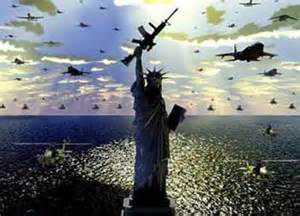
aa-American-Empire-statue-of-liberty-and-military

By Larry Chin

Source: Intrepid Report

On September 24, 2014, the United Nations passed a resolution paving the way to open-ended “anti-terror” warfare against the Islamic State (IS), the “network of death,” promising a war that will “last for years.”

The “war on the Islamic State” is a lie. It is the same fetid Big Lie that is the “war on terrorism,” reheated and updated with new, bloodier special effects, new propaganda, a familiar but revised cast of demonic villains and a new military attack calendar.

Three thousand lives were sacrificed on 9/11 for the fabricated “war on terrorism” against “Al-Qaeda” and Osama bin Laden. Now, thirteen years of continuous imperial onslaught and tens of thousands of deaths and atrocities later, the “Islamic State” escalation will topple Syria, Iran, transform Iraq, and provide yet another pretext to wreak havoc anywhere else the empire wishes.

But it is the same lie, built on the same propaganda cornerstones: the myth of the “outside enemy,” the threat of “Islamic terror,” eternal pretexts to galvanize public opinion behind an Anglo-American agenda of conquest and war that will never end.

It is the same lie, founded upon the idea that “Islamic terrorists” are enemies of the West, when, in amply documented fact, these terrorists are the West’s finest foot soldiers and military-intelligence assets.

The Islamic State, like Al-Qaeda and all entities that comprise the “Islamic Jihad” is a creation of the CIA and Anglo-American intelligence (Pakistan’s ISI, Saudi intelligence, British MI6, the Israeli Mossad, etc.). The various jihadist militias and military-intelligence assets and fronts—IS, Al-Qaeda, Al-Nusrah, etc.—are “American made,” openly supported and utilized by the United States and its allies, as they have been continuously from the Cold War to this very second. These forces are carefully manipulated and guided weapons for US-NATO. Terrorists are instrumental to the ongoing US-led covert and overt operations in Syria. Terrorists run by the US and CIA destabilized and toppled Libya, are integral to coming regime changes. Under both direct and indirect orders of US-NATO sponsors and handlers, these “demon hordes” are, and will continue to be, the leading military-intelligence assets behind every major geostrategic action in the region.

The IS joins Al-Qaeda as today’s favorite “boogeyman” target. The war masks the true intent, which is the toppling of Syria and Iran, and onward.

The “terrorists” are depicted in propaganda as either villains or “freedom fighters,” depending on the day and the military theater. The horrific acts of the death squads, including beheadings and other atrocities, are standard operating procedure in CIA black operations, terror techniques going back to the Vietnam War and the Phoenix Program, and are done upon orders of US and US-allied military-intelligence. Decapitations of Syrian civilians have been ongoing for years, to media silence. The recent spate of beheadings of Americans and British have been selectively carried out (and in some cases staged) for propaganda purposes. Political theater designed to galvanize the dimwitted, ignorant masses to support massive retaliatory war.

According to recent polls, four out of five registered American voters overwhelmingly support military attacks against the Islamic State. The acquiescent, ignorant American masses, still irretrievably pacified by the propaganda “shock and fear” effect of 9/11, enthusiastically back any “retaliation” against “bad guys who cut off heads” and “threaten America,” and have no problem sending American youth to the front lines to be cannon fodder. They are “defending freedom.” The American sheeple believe—even love to believe—the Big Lie. Whereas the citizens of Hong Kong and in other countries take passionately to the streets to fight for their democracy, the average American has long abdicated his and her duty as an informed, vigilant citizen. Far too busy shooting nude selfies on handheld gadgets—their brains addled by inane entertainment, and Hollywood celebrations of the national security apparatus—to care.

So-called liberals and progressives also back action against the Islamic State. The few who have any inkling that Islamic terror is a product of the US war machine wind up wringing their sweaty hands over the red herring of “blowback”: the tired idea that the US created but lost control of a Jihadist force that it now must contain. It is bogus. These militias are the American empire’s key foot soldiers and operatives, the leading force behind plans to topple Syria, just as they were in Libya. This is not blowback, but a well orchestrated military-intelligence operation, cloaked beneath a criminal conspiracy that is maintained by an ironclad elite consensus.

Islamic terrorism “stops” the minute that its sponsors at CIA, MI, ISI, etc. stop using it. The war itself stops when the elites who have planned this Final Solution to seize control of the last remaining oil supplies on the planet—the very life blood of the Anglo-American empire—stop, and give up their war of conquest and greed. The entire apparatus collapses. But this will not happen in this lifetime. Not even in the event of planetary calamity.

To threaten humanity, to pretend to wage war against boogeyman that they themselves created, and continue to support and use, only those of world class evil could conceive of and carry out this horror.

The American network of death goose-steps to the abyss

With each passing day, more of the Anglo-American empire’s veneer falls away, revealing the violence at its core.

Leading the charge in front of the United Nations, the mendacious President Barack Obama thundered: “No God condones this terror. There can be no reasoning—no negotiation—with this brand of evil. The only language understood by killers like this is the language of force.”

Here was a performance directly out of the playbook of the Third Reich and Bush/Cheney, brimming with threats, false morality, pseudo-religious claptrap, and invective directed against the perceived enemies. Here was Obama being who he really is, a war criminal. The ghost of Hitler has to be envious.

No God condones deceit. No God condones the terror of the Anglo-American empire’s war of conquest. No God condones the extermination of tens of thousands of lives in more than a decade of imperial conquest for oil.

There is no reasoning—no negotiation—with the criminal leadership of an empire that will thrash and kill to the brink of extinction. There is no reasoning—no negotiation—with warmongers who have wiped out entire swaths of humanity.

There is no reasoning—no negotiation—with an empire so desperate and out of answers that gangsterism replaces the rule of law, and false flag operations constitute foreign policy. There is no reasoning with those who could, in the span of just a few months, set off false flag destabilizations in Syria, false flag operations in support of a neo-Nazi cabal in Ukraine, plan and cover up the false flag shootdown of Flight MH-17 (blamed on Russia), support the bombing and conquest of Gaza by Israel (blamed on Hamas, in the wake of the murder of Israeli teenagers by ISIL terrorists), and set off the “sudden” rise of the Islamic State.

There is no reasoning—no negotiation—with an empire that must and will stop at nothing to control every inch of the Eurasian subcontinent, and destroy all opposition along the way, including potential nuclear confrontations with Russia and China.

There is no reasoning—no negotiation—with the functionaries and enablers of this empire in governments, in media, everywhere. There is also no reasoning—no negotiation—with the cognitively impaired sheeple.

There is no reasoning—no negotiation—with the killers, the world planning orchestrators speaking the “language of force”; these “great men and women” who hold humanity in contempt.

There is, indeed, no reasoning—no negotiation—with this brand of evil.

Larry Chin is an Associate Editor of Intrepid Report.