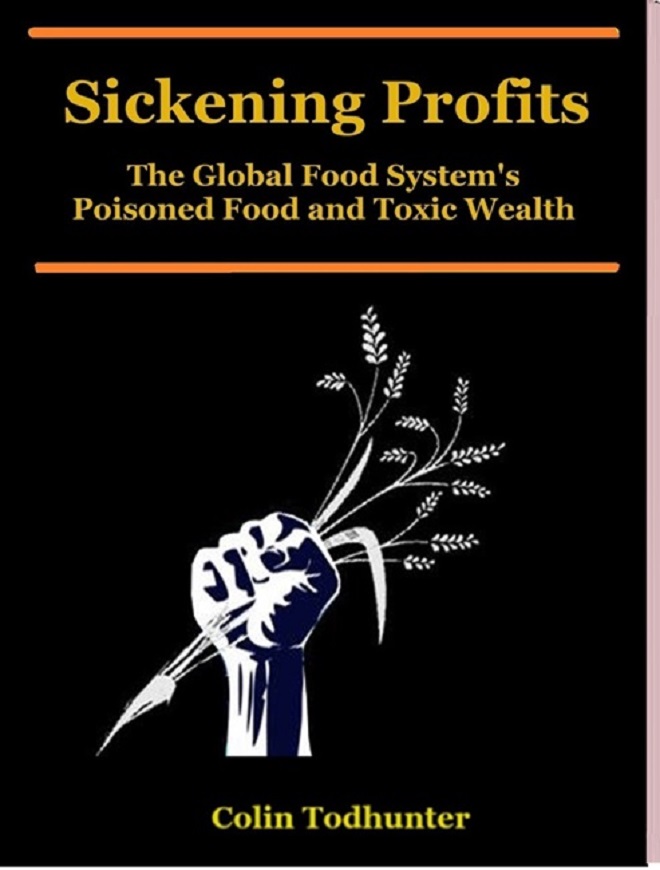
Sickening Profits — The Global Food System’s Poisoned Food and Toxic Wealth

By Colin Todhunter

Source: Off-Guardian

The modern food system is being shaped by the capitalist imperative for profit. Aside from losing their land to global investors and big agribusiness concerns, people are being sickened by corporations and a system that thrives on the promotion of ‘junk’ (ultra-processed) food laced with harmful chemicals and cultivated with the use of toxic agrochemicals.

It’s a highly profitable situation for investment firms like BlackRock, Vanguard, State Street, Fidelity and Capital Group and the food and agribusiness conglomerates they invest in. But BlackRock and others are not just heavily invested in the food industry. They also profit from illnesses and diseases resulting from the food system by having stakes in the pharmaceuticals sector as well. For them, it’s a win-win situation.

Lobbying by agrifood corporations and their well-placed, well-funded front groups ensures this situation prevails. They continue to capture policy-making and regulatory space at international and national levels and promote the (false) narrative that without their products the world would starve.

They are now also pushing a fake-green, ecomodernist agenda and rolling out their new proprietary technologies in order to further entrench their grip on a global food system that produces poor food, illness, environmental degradation, dependency and dispossession.

The prevailing globalised agrifood model is built on unjust trade policies, the leveraging of sovereign debt to benefit powerful interests, population displacement and land dispossession. It fuels export-oriented commodity monocropping and regional food insecurity.

This model is responsible for increasing rates of illness, nutrient-deficient diets, a narrowing of the range of food crops, chemical runoffs, increasing levels of farmer indebtedness and the eradication of biodiversity. And it relies on a policy paradigm that privileges urbanisation, global markets and agrifood corporations’ needs ahead of rural communities, local markets, on-farm resources and food sovereignty.

In addition, there are also the broader geopolitical aspects of food and agriculture in a post-COVID world characterised by food inflation, hardship and multi-trillion-dollar global debt.

There are huge environmental, political, social and health issues that stem from how much of our food is currently produced and consumed. A paradigm shift is required.

All of this is set out in Sickening Profits: The Global Food System’s Poisoned Food and Toxic Wealth (December 2023), published as an open-access (free) e-book by Global Research (it can be read directly on the Global Research website or downloaded as a pdf) and is a follow up to the author’s book Food, Dispossession and Dependency: Resisting the New World Order (2022).

That book contains substantial sections on the agrarian crisis in India and issues affecting the agriculture sector. Aruna Rodrigues — prominent campaigner and lead petitioner in the GMO Mustard Public Interest Litigation in the Supreme Court of India — stated the following about the book:

This is graphic, a detailed horror tale in the making for India, an exposé on what is planned, to hand over Indian sovereignty and food security to big business.”

‘Sickening Profits’ continues in a similar vein. By describing situations in Ukraine, India, the Netherlands and elsewhere, it is another graphic horror tale in the making that is being intensified across the globe. The question is: Can it be stopped?

Slouching Towards the Final Solution

By Pepe Escobar

Source: The Unz Review

You have stolen the orchards of my ancestors
And the land that I cultivated
And you left nothing for us
Except for these rocks…
If I become hungry
The usurper’s flesh will be my food.

– Palestinian national poet Mahmoud Darwish

It’s by now confirmed that Egyptian intel warned their Israeli counterparts only 3 days before Al-Aqsa Flood that something “big” was coming from Hamas. Tel Aviv, its multi-billion dollar security apparatus and the IDF, “the strongest army in the world”, chose to ignore it.

That configures two key vectors.

1) Tel Aviv get its “Pearl Harbor” pretext to implement a remixed “war on terror” plus a sort of Final Solution to the “Gaza problem” (already in effect).

2) The Hegemon abruptly changes the narrative away from the incoming, inevitable, cosmic joint humiliation of the White House and NATO in the steppes of Novorossiya – a strategic defeat that configures the previous humiliation in Afghanistan as a masked ball in Disneyland.

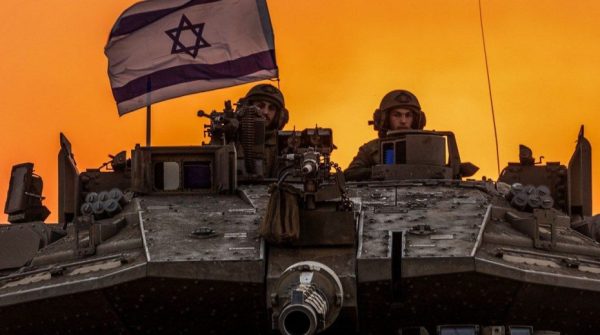
The total blockade of “human animals” (copyright Israeli Defense Ministry) in Gaza, in fact a civilian population of 2.3 million, has been imposed this past Monday. No food, no water, no fuel, no essential commodities.

That’s a war crime and a crime against humanity, thrashing the four basic principles of the

Law of Armed Conflict (LOAC) – everything duly applauded or at best completely ignored by NATOstan and its assorted oligarch-controlled mainstream media.

Christians, Muslims, Jews and other ethnic groups lived peacefully in Palestine for centuries until the imposition of the racist Zionist Project – complete with all the Divide and Rule attributes of settler colonialism.

The Nakba is an old memory of 75 years ago. We are now way beyond apartheid – and entering total exclusion and expulsion of Palestinians from their homeland.

In January 2023, Israeli Prime Minister Netanyahu himself stressed, “the Jewish people have an exclusive and unquestionable right to all areas of the Land of Israel.”

Now, the IDF sent no less than an order to the UN to completely evacuate all residents of northern Gaza – 1.1 million people – to southern Gaza, close to Rafah, the only border crossing with Egypt.

This forced mass deportation of civilians would be the prelude to raze all of northern Gaza to the ground, coupled with expulsion and confiscation of ancestral Palestinian land – edging closer to a Zionist Final Solution.

Welcome to Sociopaths United

Netanyahu, a sociopath with a proven track record, can only get away with serial war crimes because of total support by the White House, the “Biden” combo and the State Department – not to mention inconsequential EU vassals.

We just witnessed a U.S. Secretary of State – a low-IQ functionary out of his depth on every single issue – going to Israel to support collective punishment “as a Jew as well”.

He said his grandfather “fled pogroms in Russia” (that was in 1904). Then came the direct – Nazi – connection to “my stepfather survived Auschwitz, Dachau and Majdanek”. Impressive, that’s three concentration camps in a row. The secretary is obviously oblivious to the fact that the USSR liberated all three.

Then came the connection Russia-Nazis-Hamas. At least it’s all clear.

Internally, Netanyahu is only able to stay as Prime Minister because of especially two rabid ultra-Zionist, racist, supremacist coalition partners. He named Itamar Ben-Gvir as National Security Minister and Bezalel Smotrich as Finance Minister – both de facto in charge of proliferating settlements all across the West Bank in industrial scale.

Smotrich has been on the record saying that “there is no such thing as Palestinians because there is no such thing as a Palestinian people”.

Ben-Gvir and Smotrich, in record time, are on their way to double the settler population in the cantons across the West Bank from 500,000 to one million. Palestinians – de facto non-citizens – number 3.7 million. lllegal settlements – not formally approved by Tel Aviv – are popping up all across the spectrum.

In Gaza – where poverty hovers at 60% and youth unemployment is massive – UN agencies desperately warn of an impending humanitarian catastrophe.

Over 1 million people in Gaza, mostly women and children, depend on UN food assistance. Tens of thousands of kids go to UNRWA schools (UNRWA is the agency for Palestinian refugees).

Tel Aviv is now killing them – softly. At least 11 UNRWA workers have been killed this past week (including teachers, a doctor and an engineer), at least 30 kids, plus 5 members of the International Red Cross and Red Crescent.

To top it all up, there’s the Pipelineistan angle – as in stealing Gaza gas.

At least 60% of the vast gas reserves discovered in 2000 along the Gaza-Israel coastline legally belong to Palestine.

A key consequence of the Final Solution applied to Gaza translates as sovereignty over the gas fields switched to Israel – in yet another massive trampling of international law.

The Global Majority is Palestine

Amid the horrifying prospect of Israel depopulating the entire northern half of Gaza, live on TV and cheered on by hordes of NATOstan zombies, it’s not far-fetched to consider the possibility of Turkiye, Egypt, Syria, Iraq, Iran, Lebanon, Yemen and the Gulf monarchies joining together, at various levels, to create overwhelming pressure against the implementation of the Zionist Final Solution.

Virtually the whole Global South/Global Majority is with Palestine.

Turkiye, problematically, is not an Arab nation and has been too ideologically close to Hamas in the recent past. Assuming the current Netanyahu gang would engage in diplomacy, the possible best mediation team would be formed by Saudi Arabia, Qatar and Egyptian diplomacy.

India has just stabbed itself in the head as a leader of the Global Majority: their leadership does seem to get a hard on when facing Israel.

Then there are the Big Sovereigns: the Russia-China strategic partnership.

Russia-Iran are themselves connected by a strategic partnership – including at all state of the art military levels. The Iran-Saudi rapprochement mediated and clinched by China has led, this week, to Mohammad bin Salman and Ebrahim Raisi on the phone, for the first time ever, coordinating their unwavering support to the legitimate rights of the Palestinian people. Syria’s Bashar al-Assad has just visited China, received with full honors.

China’s trademark diplomatic sophistication – way beyond Al-Aqsa Flood – amounts to supporting legitimate Palestinian rights. The whole Arab world and the lands of Islam clearly feel it – while Israel and NATOstan are impervious to nuance.

With Russia we reach heavy metal territory. Earlier this week, Israel’s ambassador to Russia, Alexander Ben Zvi, was finally received, after several attempts by Deputy Foreign Minister Mikhail Bogdanov. It was Israel who practically begged for a meeting.

Bogdanov cut to the chase, bluntly: Ben Zvi was warned that the IDF plan to literally destroy Gaza, expel the indigenous population and practice the ethnic cleansing of those “human animals” was “fraught with the most devastating consequences for the humanitarian situation in the region.”

That advances a quite possible scenario – whose consequences can be equally devastating: Moscow – in collaboration with Ankara – launching a Global South-supported blockade-busting operation against Israel.

It’s no secret – apart from the modus operandi – that Putin and Erdogan have discussed a possible Turkish humanitarian naval convoy to Gaza, which would be protected from an Israeli attack by the Russian Navy out of its Tartous base in Syria and the Russian air Force out of Hmeimim. That would raise the stakes to unforeseen levels.

What’s clear already is that the Hegemon proxy war against Russia in Ukraine and the Israeli “war on terror” remixed in Gaza are just parallel fronts of a single, horrifyingly evolving, global war.

Meet the New Normal, Same as the Old Normal: You Are Still the Enemy Within

By Colin Todhunter

Source: Off-Guardian

Today, we are witnessing the nudging (manipulation) of the population to accept a ‘new normal’ based on a climate emergency narrative, restrictions on movement and travel, programmable digital money, ‘pandemic preparedness’ courtesy of the World Health Organization’s tyrannical pandemic treaty, unaccountable AI and synthetic ‘food’.

Whether it involves a ‘food transition’, an ‘energy transition’, 15-minute cities or some other benign-sounding term, all this is to be determined by a supranational ‘stakeholder’ elite with ordinary people sidelined in the process. An undemocratic agenda designed to place restrictions on individual liberty, marking a dramatic shift towards authoritarianism.

In the 1980s, to help legitimise the deregulation-privatisation neoliberal globalisation agenda, government and media instigated an ideological onslaught, driving home the primacy of ‘free enterprise’, individual rights and responsibility and emphasising a shift away from the role of the state, trade unions and the collective in society.

We are currently seeing another ideological shift: individual rights and freedoms are said to undermine the wider needs of society and the planet – in a stark turnaround – personal freedom is now said to pose a threat to national security, public health or the climate.

As in the 1980s, this messaging is being driven by an economic impulse. This time, the collapsing neoliberal project.

In the UK, poverty is increasing in two-thirds of communities, food banks are now a necessary part of life for millions of people and living standards are plummeting. Indeed, the poorest families are enduring a ‘frightening’ collapse in living standards, resulting in life-changing and life-limiting poverty).

In the US, around 30 million low-income people are on the edge of a ‘hunger cliff’ as a portion of their federal food assistance is taken away. In 2021, it was estimated that one in eight children were going hungry in the US. Small businesses are filing for bankruptcy in the US at a record rate.

The Bank of England’s chief economist, Huw Pill, says that people should ‘accept’ being poorer. This is similar to the response of Rob Kapito, co-founder of the world’s biggest asset management firm, BlackRock. In 2022, the unimaginably rich and entitled Kapito said that a “very entitled” generation of (ordinary working) people who have never had to sacrifice would soon have to face shortages for the first time in their lives.

While business as usual prevails in Kapito’s world of privilege and that of major armsenergypharmaceuticals and food companies, whose megarich owners continue to rake in massive profits, Kapito and Pill tell ordinary people to get used to poverty and the ‘new normal’ as if we are ‘all in it together’ – billionaires and working class alike. They conveniently use COVID and the situation in Ukraine as cover for the collapsing neoliberalism.

But this is part of the hegemonic agenda that seeks to ensure that the establishment’s world view is the accepted cultural norm. And anyone who challenges this world view – whether it involves, for instance, questioning climate alarmism, the ‘new normal’, the nature of the economic crisis, the mainstream COVID narrative or the official stance on Ukraine and Russia – is regarded as a spreader of misinformation and the ‘enemy within’.

Although the term ‘enemy within’ was popularised by Margaret Thatcher during the miners’ strike in 1984-85 to describe the striking miners, it is a notion with which that Britain’s rulers have regarded protest movements and uprisings down the centuries. From the Peasants’ Revolt in 1381 to the Levellers and Diggers in the 17th century, it is a concept associated with anyone or any group that challenges the existing social order and the interests of the ruling class.

John Ball, a radical priest, addressed the Peasants’ Revolt rebels with the following words:

Good friends, matters cannot go well in England until all things be held in common; when there shall be neither vassals nor lords; when the lords shall be no more masters than ourselves.”

The revolt was suppressed. John Ball was captured and hung, drawn and quartered. Part of the blood-soaked history of the British ruling class.

Later on, the 17th-century Diggers movement wanted to create small, egalitarian rural communities and farm on common land that had been privatised by enclosures.

The 1975 song ‘The world Turned Upside Down’ by Leon Rosselson commemorates the Diggers. His lyrics describe the aims and plight of the movement. In Rosselson’s words, the Diggers were dispossessed via theft and murder but reclaimed what was theirs only to be violently put down.

Little surprise then that, in the 1980s, Margaret Thatcher used the state machinery to defeat the country’s most powerful and trade union and the shock troops of the labour movement, the National Union of Mineworkers – ‘the enemy within’. She needed to do this to open the gates for capital to profit from the subsequent deindustrialisation of much of the UK and the dismantling of large parts of the welfare state.

And the result?

A hollowed-out, debt-bloated economy, the destruction of the social fabric of entire communities and the great financial Ponzi scheme – the ‘miracle’ of deregulated finance – that now teeters on the brink of collapse, leading the likes of Kapito and Pill to tell the public to get ready to become poor.

And now, in 2023, the latest version of the ‘enemy within’ disseminates ‘misinformation’ – anything that challenges the official state-corporate narrative. So, this time, one goal is to have a fully controlled (censored) internet.

For instance, US Special Operations Command (USSOCOM) recently awarded Accrete a contract for Argus to detect disinformation threats from social media. Argus is AI software that analyses social media data to predict emergent narratives and generate intelligence reports at a speed and scale to help neutralise viral disinformation threats.

Accrete AI is a leading dual-use enterprise AI company. It deployed its AI Argus software for open-source threat detection with the US Department of Defense in 2022.

In a recent press release, Prashant Bhuyan, founder and CEO of Accrete, boasts:

Social media is widely recognised as an unregulated environment where adversaries routinely exploit reasoning vulnerabilities and manipulate behaviour through the intentional spread of disinformation. USSOCOM is at the tip of the spear in recognising the critical need to identify and analytically predict social media narratives at an embryonic stage before those narratives evolve and gain traction. Accrete is proud to support USSOCOM’s mission.”

‍This is about predicting wrong think on social media. But control over the internet is just part of a wider programme of establishment domination, surveillance and dealing with protest and dissent.

The recent online article ‘How the Government Weaponizes Surveillance to Silence Its Critics’ notes that, on any given day, the average person in the US is monitored, spied on and tracked in more than 20 different ways.

The authors of the article ask us to consider some of the ways the US government is weaponizing its surveillance technologies to flag citizens as a threat to national security, whether or not they have done anything wrong – from flagging citizens as a danger based on their feelings, phone and movements to their spending activities, social media activities, political views and correspondence.

The elite has determined that the existential threat is you. The article ‘Costs of War: Peterloo’, written by UK Veterans for Peace member Aly Renwick, details the history of the brutal suppression of protesters by Britain’s rulers. He also strips away any notion that some may have of a benign, present-day ruling elite with democratic leanings. The leopard has not changed its spots.

As we saw during COVID, the thinking is that hard-won rights must be curtailed, freedom of association is reckless, free thinking is dangerous, dissent is to be stamped on, impartial science is a threat and free speech is deadly. Government is ‘the truth’, Fauci (or some similar figure) is ‘the science’ and censorship is for your own good.

None of this was justified. It only begins to make sense if we regard the COVID restrictions in terms of trying to deal with an economic crisis by closing down the global economy under cover of a public health crisis (see the online articles ‘What Was Covid Really About? Triggering a Multi-Trillion Dollar Global Debt Crisis’ and ‘Italy 2020: Inside Covid’s Ground Zero’ which outline how COVID policies can be explained by economic factors not health concerns).

The economic crisis is making many people poorer, so they must be controlled, monitored and subjugated.

The transitions mentioned at the start of this article along with the surveillance agenda (together known as the ‘Great Reset’) are being accelerated at this time of economic crisis when countless millions across the West are being impoverished. The collapsing financial system is resulting in an interrelated global debt, inflation and ‘austerity’ crisis and the biggest transfer of wealth to the rich in history.

As a result, the powers that be fear that the masses might once again pick up their pitchforks and revolt. They are adamant that the peasants must know their place.

But the flame of protest and dissent from centuries past still inspires and burns bright. So, with that in mind, let’s finish with Leon Rosselson’s lyrics in reference to the Diggers movement (Billy Bragg’s version of the song can be found on YouTube):

In sixteen forty-nine
To St. George’s Hill
A ragged band they called the Diggers
Came to show the people’s will
They defied the landlords
They defied the laws
They were the dispossessed reclaiming what was theirs

We come in peace they said
To dig and sow
We come to work the lands in common
And to make the waste grounds grow
This earth divided
We will makе whole
So it will be
A common treasury for all

Thе sin of property
We do disdain
No man has any right to buy and sell
The earth for private gain
By theft and murder
They took the land
Now everywhere the walls
Spring up at their command

They make the laws
To chain us well
The clergy dazzle us with heaven
Or they damn us into hell
We will not worship
The God they serve
The God of greed who feed the rich
While poor man starve

We work we eat together
We need no swords
We will not bow to masters
Or pay rent to the lords
We are free men
Though we are poor
You Diggers all stand up for glory
Stand up now

From the men of property
The orders came
They sent the hired men and troopers
To wipe out the Diggers’ claim
Tear down their cottages
Destroy their corn
They were dispersed
Only the vision lingers on

You poor take courage
You rich take care
The earth was made a common treasury
For everyone to share
All things in common
All people one
We come in peace
The order came to cut them down
We come in peace
The order came to cut them down

Summer of the Hawks

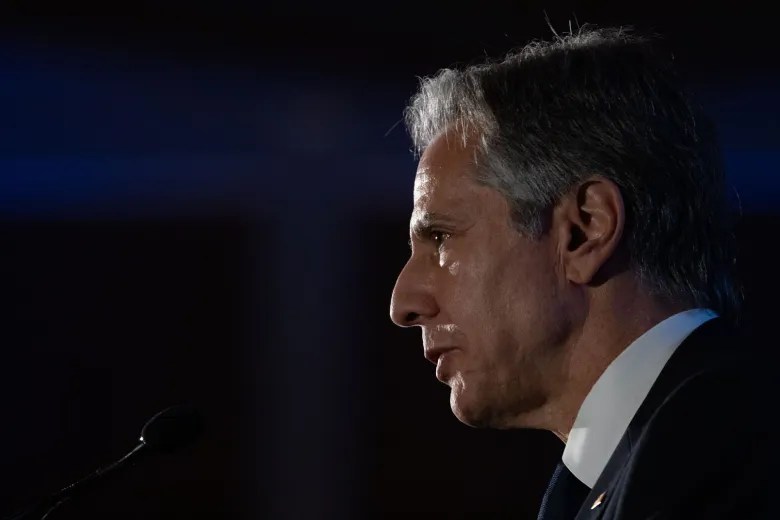
Secretary of State Antony Blinken speaks during the Mandela Washington Fellowship Summit for Young African Leaders in Washington, DC, August 2, 2023. (Official State Department photo by Chuck Kennedy)

By Seymour Hersh

Source: Rise Up Times

It’s been weeks since we looked into the adventures of the Biden administration’s foreign policy cluster, led by Tony Blinken, Jake Sullivan, and Victoria Nuland. How has the trio of war hawks spent the summer?

Sullivan, the national security adviser, recently brought an American delegation to the second international peace summit earlier this month at Jeddah in Saudi Arabia. The summit was led by Crown Prince Mohammed bin Salman, known as MBS, who in June announced a merger between his state-backed golf tour and the PGA. Four years earlier MBS was accused of ordering the assassination and dismemberment of the journalist Jamal Khashoggi at the Saudi consulate in Istanbul, for perceived disloyalty to the state.

As unlikely as it sounds, there was such a peace summit and its stars did include MBS, Sullivan, and President Volodymyr Zelensky of Ukraine. What was missing was a representative of Russia, which was not invited to the summit. It included just a handful of heads of state from the fewer than fifty nations that sent delegates. The conference lasted two days, and attracted what could only be described as little international attention.

Reuters reported that Zelensky’s goal was to get international support for “the principles” that that he will consider as a basis for the settlement of the war, including “the withdrawal of all Russian troops and the return of all Ukrainian territory.” Russia’s formal response to the non-event came not from President Vladimir Putin but from Deputy Minister of Foreign Affairs Sergei Ryabkov. He called the summit “a reflection of the West’s attempt to continue futile, doomed efforts” to mobilize the Global South behind Zelensky.

India and China both sent delegations to the session, perhaps drawn to Saudi Arabia for its immense oil reserves. One Indian academic observer dismissed the event as achieving little more than “good advertising for MBS’s convening power within the Global South; the kingdom’s positioning in the same; and perhaps more narrowly, aiding American efforts to build consensus by making sure China attends the meeting with . . . Jake Sullivan in the same room.”

Meanwhile, far away on the battlefield in Ukraine, Russia continued to thwart Zelensky’s ongoing counteroffensive. I asked an American intelligence official why it was Sullivan who emerged from the Biden administration’s foreign policy circle to preside over the inconsequential conference in Saudi Arabia.

“Jeddah was Sullivan’s baby,” the official said. “He planned it to be Biden’s equivalent of [President Woodrow] Wilson’s Versailles. The grand alliance of the free world meeting in a victory celebration after the humiliating defeat of the hated foe to determine the shape of nations for the next generation. Fame and Glory. Promotion and re-election. The jewel in the crown was to be Zelensky’s achievement of Putin’s unconditional surrender after the lightning spring offensive. They were even planning a Nuremberg type trial at the world court, with Jake as our representative. Just one more fuck-up, but who is counting? Forty nations showed up, all but six looking for free food after the Odessa shutdown”—a reference to Putin’s curtailing of Ukrainian wheat shipments in response to Zelensky’s renewed attacks on the bridge linking Crimea to the Russian mainland.

Enough about Sullivan. Let us now turn to Victoria Nuland, an architect of the 2014 overthrow of the pro-Russian government in Ukraine, one of the American moves that led us to where we are, though it was Putin who initiated the horrid current war. The ultra-hawkish Nuland was promoted early this summer by Biden, over the heated objections of many in the State Department, to be the acting deputy secretary of state. She has not been formally nominated as the deputy for fear that her nomination would lead to a hellish fight in the Senate.

It was Nuland who was sent last week to see what could be salvaged after a coup led to the overthrow of a pro-Western government in Niger, one of a group of former French colonies in West Africa that have remained in the French sphere of influence. President Mohamed Bazoum, who was democratically elected, was tossed out of office by a junta led by the head of his presidential guard, General Abdourahmane Tchiani. The general suspended the constitution and jailed potential political opponents. Five other military officers were named to his cabinet. All of this generated enormous public support on the streets in Niamey, Niger’s capital—enough support to discourage outside Western intervention.

There were grim reports in the Western press that initially viewed the upheaval in East-West terms: some of the supporters of the coup were carrying Russian flags as they marched in the streets. The New York Times saw the coup as a blow to the main US ally in the region, Nigerian President Bola Ahmed Tinubu, who controls vast oil and gas reserves. Tinubu threatened the new government in Niger with military action unless they returned power to Bazoum. He set a deadline that passed without any outside intervention.

The revolution in Niger was not seen by those living in the region in east-west terms but as a long needed rejection of long-standing French economic and political control. It is a scenario that may be repeated again and again throughout the French-dominated Sahel nations in sub-Saharan Africa.

There are distinctions that do not bode well for the new government in Niger. The nation is blessed, or perhaps cursed, by having a significant amount of the remaining natural uranium deposits in the world. As the world warms up, a return to nuclear generated power is seen as inevitable, with obvious implications for the value of the stuff underground in Niger. The raw uranium ore, when separated, filtered and processed is known worldwide as yellowcake.

The corruption so often “talked about in Niger is not about petty bribes by government officials, but about an entire structure—developed during French colonial rule—that prevents Niger from establishing sovereignty over its raw materials and over its development,” according to a recent analysis published by Baltimore’s Real News Network. Three out of four laptops in France are powered by nuclear energy, much of which is derived from uranium mines in Niger effectively controlled by its former colonial overlord.

Niger is also the home of three American drone bases targeting Islamic radicals throughout the region. There  are also undeclared Special Forces outposts in the region, whose soldiers receive double pay while on their risky combat assignments. The American official told me that “the 1,500 US troops now in Niger are exactly the number of American troops who were in South Vietnam at the time John F. Kennedy took over the presidency in 1961.”

Into this scene came Victoria Nuland, who must have drawn the short straw inside the Biden Administration. She was sent to negotiate with the new regime and to arrange a meeting with the ousted President Bazoum, whose life remains under constant threat from the governing junta. The New York Times reported that she got nowhere after talks she described as “extremely frank and at times quite difficult.” The intelligence official put her remarks to the Times in American military lingo: “Victoria set out to save the Niger uranium owners from the barbaric Russians and got a huge single-finger salute.”

Quieter in recent weeks than Sullivan and Nuland has been Secretary of State Tony Blinken. Where was he? I asked that question of the official, who said that Blinken “has figured out that the United States”—that is, our ally Ukraine—“will not win the war” against Russia. “The word was getting to him through the Agency [CIA] that the Ukrainian offense was not going to work. It was a show by Zelensky and there were some in the administration who believed his bullshit.

“Blinken wanted to broker a peace deal between Russia and Ukraine as Kissinger did in Paris to end the Vietnam war.” Instead, the official said, “it was going to be a big lose and Blinken found himself way over his skis. But he does not want to go down as the court jester.”

It was at this moment of doubt, the official said, that Bill Burns, the CIA director, “made his move to join the sinking ship.” He was referring to Burns’s speech earlier this summer at the annual Ditchley conference near London. He appeared to put aside his earlier doubts about expanding NATO to the east and affirmed his support at least five times for Biden’s program.

“Burns does not lack self-confidence and ambition,” the intelligence official said, especially when Blinken, the ardent war hawk, was suddenly having doubts. Burns served in a prior administration as deputy secretary of state and running the CIA was hardly a just reward.

Burns would not replace a disillusioned Blinken, but only get a token promotion: an appointment to Biden’s cabinet. The cabinet meets no more than once a month and, as recorded by C-SPAN, the meetings tend to be tightly scripted affairs and to begin with the president reading from a prepared text.

Tony Blinken, who publicly vowed just a few months ago that there would be no immediate ceasefire in Ukraine, is still in office and, if asked, would certainly dispute any notion of discontent with Zelensky or the administration’s murderous and failing war policy in Ukraine.

So the White House’s wishful approach to the war, when it comes to realistic talk to the American people, will continue apace. But the end is nearing, even if the assessments supplied by Biden to the public are out of a comic strip.

This piece is from Seymour Hersh’s Substack, you may subscribe to it here.

BRICS 11 – Strategic Tour de Force

By Pepe Escobar

Source: The Unz Review

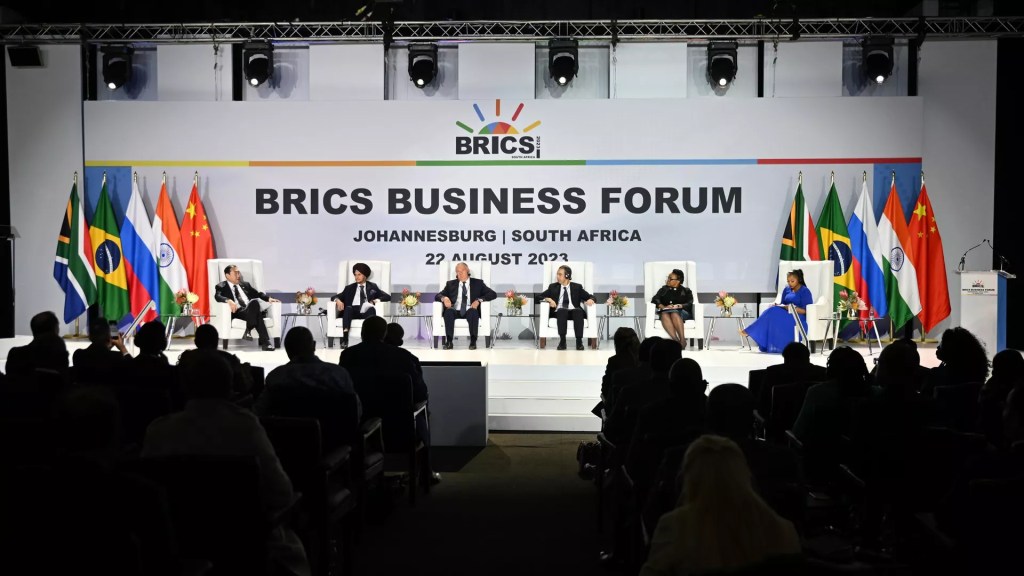
Chinese President Xi Jinping defined all the major decisions embedded in the 15th BRICS summit in South Africa as “historic”. That may be seen as an understatement.

It will take time for the Global South, or Global Majority, or “Global Globe” (copyright President Lukashenko), not to mention the stunned collective West, to fully grasp the enormity of the new strategic stakes.

President Putin, for his part, described the negotiations on BRICS expansion as quite difficult. By now a relatively accurate picture is emerging of what really went down on that table in Johannesburg.

India wanted 3 new members. China wanted as many as 10. A compromise was finally reached, with 6 members: Egypt, Iran, Saudi Arabia, United Arab Emirates (UAE), Argentina and Ethiopia.

So from now on it’s BRICS 11. And that’s just the beginning. Starting with the rotating Russian presidency of BRICS on January 1, 2024, more partners will be progressively included, and most certainly a new round of full members will be announced at the BRICS 11 summit in Kazan in October next year.

So we may soon progress to BRICS 20 – on the way to BRICS 40. The G7, for all practical purposes, is sliding towards oblivion.

Bur first things first. At that fateful table in Johannesburg, Russia supported Egypt. China went all out for Persian Gulf magic: Iran, UAE and the Saudis. Of course: Iran-China are already deep into a strategic partnership, and Riyadh is already accepting payment for energy in yuan.

Brazil and China supported Argentina, Brazil’s troubled neighbor, running the risk of having its economy fully dollarized, and also a key commodity provider to Beijing. South Africa supported Ethiopia. India, for a series of very complex reasons, was not exactly comfortable with 3 Arab/Muslim members (Saudi Arabia, UAE, Egypt). Russia assuaged New Delhi’s fears.

All of the above respects geographic principles and imprints the notion of BRICS representing the Global South. But it goes way beyond that, blending cunning strategy and no-nonsense realpolitik.

India was mollified because Russian Foreign Minister Sergey Lavrov, at the table in Johannesburg negotiating on behalf of President Putin, and highly respected by New Delhi, fully understood that a new, single BRICS currency is a long way away. What really matters, short and medium term, is expanding intra-BRICS trade in their national currencies.

That was stressed by New Development Bank (NDB) president Dilma Rousseff in her report to the South African summit hosts – even as Brazilian President Lula once again emphasized the importance of setting up a work group to discuss a BRICS currency.

Lavrov understood how New Delhi is absolutely terrified of secondary sanctions by the US, in case its BRICS role gets too ambitious. Prime Minister Modi is essentially hedging between BRICS and the completely artificial imperial obsession embedded in the terminology “Indo-Pacific” – which masks renewed containment of China. The Straussian neo-con psychos in charge of US foreign policy are already furious with India buying loads of discounted Russian oil.

New Delhi’s support for a new BRICS currency would be interpreted in Washington as all-out trade war – and sanctions dementia would follow. In contrast, Saudi Arabia’s MbS doesn’t care: he’s a top energy producer, not consumer like India, and one of his priorities is to fully court his top energy client, Beijing, and pave the way for the petroyuan.

It Takes Just a Single Strategic Move

Now let’s get into the strategic stakes. For all practical purposes, in Eurasian terms, BRICS 11 is now on the way to lord over the Arctic Sea Route; the International North South Transportation Corridor (INSTC); BRI’s East West Corridors; the Persian Gulf; the Red Sea; and the Suez Canal.

That blends several overland corridors with several nodes of the Maritime Silk Roads. Nearly total integration in the Heartland and the Rimland. All with just a single strategic move in the geopolitical/geoeconomic chessboard.

Much more than an increase of BRICS 11 collective GDP to 36% of the world’s total (already larger than the G7), with the group now encompassing 47% of the world’s population, the top geopolitical and geoeconomic breakthrough is how BRICS 11 is about to literally break the bank on the energy and commodities market fronts.

By incorporating Iran, Saudi Arabia and the UAE, BRICS 11 instantly shines on as an oil and gas powerhouse. BRICS 11 now controls 39% of global oil exports; 45.9% of proven reserves; and at least 47.6% of all oil produced globally, according to InfoTEK.

With BRICS 11 possibly including Venezuela, Algeria and Kazakhstan as new members as early as in 2024, it may control as much as 90% of all oil and gas traded globally.

Inevitable corollary: operations settled in local currencies bypassing the US dollar. And inevitable conclusion: petrodollar in a coma. The Empire of Chaos and Plunder will lose its free lunch menu: control of global oil prices and means to enforce “diplomacy” via a tsunami of unilateral sanctions.

Already in the horizon, direct BRICS 11-OPEC+ symbiosis is inevitable. OPEC+ is effectively run by Russia and Saudi Arabia.

A ground-shaking geoeconomic reorientation is at hand, involving everything from routes plied by global supply chains and new BRICS roads to the progressive interconnection of BRI, the Saudi Vision 2030 and massive port expansion in the UAE.

By choosing Ethiopia, BRICS expands its African reach on mining, minerals and metals. Ethiopia is rich in gold, platinum, tantalum, copper, niobium and offers vast potential in oil and natural gas exploration. Saudi Arabia and the UAE, incidentally, are also involved in mining.

This all spells out fast, progressive integration of North Africa and West Asia.

How Diplomacy Goes a Long Way

The BRICS 11 Shock of the New, in the energy sphere, is a sharp historical counterpoint to the 1973 oil shock, after which Riyadh started wallowing in petrodollars. Now Saudi Arabia under MbS is operating a tectonic shift, in the process of becoming strategically aligned with Russia-China-India-Iran.

Diplomatic coup does not even begin to describe it. This is the second stage of the Russian-initiated and Chinese-finalized rapprochement between Riyadh and Tehran, recently sealed in Beijing. The Russia-China strategic leadership, working patiently in synch, never lost sight of the ball.

Now compare it with collective West’s “strategies”, such as the G7-imposed oil price cap. Essentially the G7 “coalition of the willing” self-imposed a price cap on Russian crude imported by sea. The result is that they had to start buying way more oil products from Global South nations which ignored the price cap and duly increased their purchase of Russian crude.

Guess who are the top two: BRICS members China and India.

After wallowing in several stages of denial, the collective West may – or may not – realize it’s a fool’s dream to attempt to “de-couple” the West-ruled part of the global economy from China, whatever is spewed out by Washington.

BRICS 11 now shows, graphically, how the “Global South/Global Majority/”Global Globe” is more non-aligned with the West than anytime in recent history.

By the way, the president of the G77, Cuban leader Diaz-Canel, was at the BRICS summit representing the de-facto new Non-Aligned Movement (NAM): the G77 actually incorporates no less than 134 nations. Most are African. Xi Jinping in Johannesburg met in person with the leaders of most of them.

The collective West, in panic, regards all of the above as “dangerous”. So the last refuge is, predictably, rhetorical: “de-coupling”, “de-risking”, and similar idiocies.

Yet that may also get practically dangerous. As in the first ever trilateral summit in Camp David on August 18 between the Empire and two Asian vassals, Japan and South Korea. That may be interpreted as the first move towards a military-political Asian NATO even more toxic than Quad or AUKUS, obsessed to simultaneously contain China, Russia and the DPRK.

The Collective Outstripping of the Global North

The UN lists 152 nations in the world as “developing countries”. BRICS 11 is aiming at them – as they outstrip the Global North on everything from population growth to overall contribution to global GDP growth measured by PPP.

In the past 10 years since the announcement of BRI first in Astana and then in Jakarta, Chinese financial institutions have lent nearly $1 trillion for infrastructure connectivity projects across the Global South. The upcoming BRI forum in Beijing will signal a renewed drive. That’s the BRI-BRICS symbiosis.

In the G20 last year, China was the first nation to lobby for the inclusion of the 55-member African Union (AU). That may happen at the G20 summit next month in New Delhi; in that case, Global South representation will be close to parity with the Global North.

Claims that Beijing was organizing a malign conspiracy to turn BRICS into a weapon against the G7 are infantile. Realpolitik – and geoeconomic indicators – are dictating the terms, configuring the Shock of the New: the G7’s irreversible irrelevance with the rise of BRICS 11.

The BRICS Reshape the Global Geopolitical Map

By Manuel F. Diaz

Source: InfoBrics.org

Thirty years ago, pluripolarity was far from a reality in a world that had been under U.S. hegemony since the collapse of the Soviet Union in 1991. Today, however, humanity is taking important steps toward forming a plural geopolitics whose protagonists are the emerging countries that challenge Western power.

The turning point towards a new form of integration, which will generate a new world political balance, occurred in 2009 when Brazil, Russia, India, and China held the first BRIC summit.

After the incorporation of South Africa to this group in 2010, the BRICS has generated such real prospects that other nations with productive capacity and diversified economies have expressed interest in joining. Among them are Saudi Arabia, Algeria, Argentina, the United Arab Emirates, and Mexico.

In the article “Can the BRICS Trump the IMF and the World Bank?,” Palestinian-American journalist Ramzy Baroud noted that “one of the biggest opportunities and challenges” the BRICS now faces is expanding its membership while maintaining its current growth.

Recent financial reports revealed that the BRICS have the world’s largest gross domestic product (GDP) and that economic bloc contributes 31.5 percent of global GDP, while the Group of Seven (G7) stuck at 30.7 percent.

The International Monetary Fund (IMF) and the World Bank (WB) are known for providing financial support to developing countries under conditions that, under the pretext of defending human rights or democracy, seek to favor the privatization of public goods and the opening of domestic markets for Western foreign investors.

Due to these politically-driven conditionalities, the struggle for alternatives to the IMF-WB mechanisms becomes a political task. The Global South requires international institutions that are not interested in indirectly manipulating or controlling national economies.

That is the call for the BRICS to evolve towards integration schemes that go beyond the exclusively economic realm, although the basis of the fight against the U.S.-controlled institutions is the formation of an alternative economy.

Recently, the BRICS placed a capital of US$50 billion for the launch of their New Development Bank (NDB), which will be chaired by former Brazilian president Dilma Rousseff.

This happened at a time when presidents Xi Jinping (China) and Lula da Silva (Brazil) showed a shared interest in influencing the peaceful solution of the Ukrainian conflict.

Under these circumstances, to argue that the BRICS are a group with purely economic interests is to ignore much of the its history.

“The timing of the BRICS expansion, the stern political discourse of its members, potential members and allies, the repeated visits by top Russian and Chinese diplomats to Africa and other regions of the Global South, etc… indicate that the BRICS have become the new geopolitical, economic and diplomatic platform for the countries of the South,” said Baroud.

Meanwhile, the Western powers, whose economies are struggling to stay afloat, are closely and suspiciously watching the changes taking place in the Global South at the hands of the BRICS.

The Hegemon Will Go Full Hybrid War Against BRICS+

The Hybrid War 2.0 against the Global South has not even started. Swing states, you have all been warned.

By Pepe Escobar

Source: Global Research

U.S. Think Tank Land hacks are not exactly familiar with Montaigne: “On the highest throne in the world, we still sit only on our own bottom.”

Hubris leads these specimens to presume their flaccid bottoms are placed high above anyone else’s. The result is that a trademark mix of arrogance and ignorance always ends up unmasking the predictability of their forecasts.

U.S. Think Tank Land – inebriated by their self-created aura of power – always telegraphs in advance what they’re up to. That was the case with Project 9/11 (“We need a new Pearl Harbor”). That was the case with the RAND report on over-extending and unbalancing Russia. And now that’s the case with the incoming

American War on BRICS as outlined by the chairman of the New York-based Eurasia Group.

It’s always painful to suffer through the intellectually shallow Think Thank Land wet dreams masquerading as “analyses” but in this particular case key Global South players need to be firmly aware of what awaits them.

Predictably, the whole “analysis” revolves around the imminent, devastating humiliation to the Hegemon and its vassals: what happens next in country 404, also known – for now – as Ukraine.

Brazil, India, Indonesia and Saudi Arabia are dismissed as “four major fence-sitters” when it comes to the U.S./NATO proxy war against Russia. It’s the same old “you’re with us or against us” trope.

But then we are presented with the six major Global South culprits: Brazil, India, Indonesia, Saudi Arabia, South Africa and Turkey.

In yet another crude, parochial remix of a catch phrase referring to the American elections, these are qualified as the key swing states the Hegemon will need to seduce, cajole, intimidate and threaten to assure its dominance of the “rules-based international order”.

Saudi Arabia and South Africa are added to a previous report focused on the “four major fence sitters”.

The swing state manifesto notes that all of them are G-20 members and “active in both geopolitics and geoeconomics” (Oh really? Now that’s some breaking news). What it does not say is that three of them are BRICS members (Brazil, India, South Africa) and the other three are serious candidates to join BRICS+: deliberations will be turbo-charged in the upcoming BRICS summit in South Africa in August.

So it’s clear what the swing state manifesto is all about: a call to arms for the American war against the BRICS.

So BRICS packs no punch

The swing state manifesto harbors wet dreams of near-shoring and friend-shoring moving away from China. Nonsense: enhanced intra-BRICS+ trade will be the order of the day from now on, especially with the expanded practice of trade in national currencies (see Brazil-China or within ASEAN), the first step towards widespread de-dollarization.

The swing states are characterized as “not a new incarnation” of the Non-Aligned Movement (NAM), or “other groupings dominated by the Global South, such as the G-77 and BRICS.”

Talk about exponential nonsense. This is all about BRICS+ – which now has the tools (including the NDB, the BRICS bank) to do what NAM could never accomplish during the Cold War: establish the framework of a new system bypassing Bretton Woods and the interlocking coercion mechanisms of the Hegemon.

As for stating that BRICS has not “packed much punch” that only reveals U.S. Think Tank Land’s cosmic ignorance of what BRICS + is all about.

The position of India is only considered in terms of being a Quad member – defined as a “U.S.-led effort to balance China”. Correction: contain China.

As for the “choice” of swing states of choosing between the U.S. and China on semiconductors, AI, quantum technology, 5G and biotechnology, that’s not about “choice”, but to what level they are able to sustain Hegemon pressure to demonize Chinese technology.

Pressure on Brazil, for instance, is much heavier than on Saudi Arabia or Indonesia.

In the end though, it all comes back to the Straussian neocon obsession: Ukraine. The swing states, in varying degrees, are guilty of opposing and/or undermining the sanctions dementia. Turkey, for instance, is accused of channeling “dual-use” items to Russia. Not a word on the U.S. financial system viciously forcing Turkish banks to stop accepting Russian MIR payment cards.

On the wishful thinking front, this pearl stands out among many: “The Kremlin seems to believe it can make a living by turning its trade south and east.”

Well, Russia is already making excellent living all across Eurasia and a vast expanse of the Global South.

The economy has re-started (drivers are domestic tourism, machine building and the metals industry); inflation is at only 2.5% (lower than anywhere in the EU); unemployment is at only 3.5%; and head of the Central Bank Elvira Nabiullina said that by 2024 growth will be back to pre-SMO levels.

U.S. Think Tankland is congenitally incapable of understanding that even if BRICS+ nations may still have some serious trade credit issues to iron out, Moscow has already shown how even an implied hard backing of a currency can turn out to be an instant game changer. Russia is at the same time backing not only the ruble but also the yuan.

Meanwhile, the Global South de-dollarization caravan moves on relentlessly – as much as the proxy war hyenas may keep howling in the dark. When the full – staggering – scale of NATO’s humiliation in Ukraine unfolds, arguably by mid-summer, the de-dollarization high-speed train will be fully booked, non-stop.

“Offer you can’t refuse” rides again

If all of the above was not already silly enough, the swing state manifesto doubles down on the nuclear front, accusing them of “future (nuclear) proliferation risks”: especially – who else – Iran.

By the way, Russia is defined as a “middle power, but one in decline”. And “hyper-revisionist” to boot. Oh dear: with “experts” like this, the Americans don’t even need enemies.

And yes, by now you may be excused to roar with laughter: China is accused of attempting to direct and co-opt BRICS. The “suggestion” – or “offer you can’t refuse”, Mafia-style – to the swing states is that you cannot join a “Chinese-directed, Russian-assisted body actively opposing the United States.”

The message is unmistakable: “The threat of a Sino-Russian co-optation of an expanded BRICS—and through it, of the global south—is real, and it needs to be addressed.”

And here are the recipes to address it. Invite most swing states to the G-7 (that was a miserable failure). “More high-level visits by key U.S. diplomats” (welcome to cookie distributor Vicky Nuland). And last but not least, Mafia tactics, as in a “nimbler trade strategy that begins to crack the nut of access to the U.S. market.”

The swing state manifesto could not but let the Top Cat out of the bag, predicting, rather praying that “U.S.-China tensions rise dramatically and turn into a Cold War-style confrontation.” That’s already happening – unleashed by the Hegemon.

So what would be the follow-up? The much sought after and spun-to-death “decoupling”, forcing the swing states to “align more closely with one side or the other”. It’s “you’re with us or against us” all over again.

So there you go. Raw, in the flesh – with inbuilt veiled threats. The Hybrid War 2.0 against the Global South has not even started. Swing states, you have all been warned.

How the US is blackmailing countries that buy American weapons

By Vladimir Platov

Source: New Eastern Outlook

Economic sanctions and blackmail have long been the preferred methods of conducting foreign policy and advancing the United States’ own geopolitical interests.

In 2018, the US withdrew from the agreement on Iran’s nuclear program signed in May 2015, following which Washington began to implement the “maximum pressure” strategy on Iran.

In 2019, the US government imposed a slew of restrictions on the Chinese firm Huawei, which is widely regarded as a leader in digital technologies, particularly in the deployment of 5G networks. Following that, Washington began to intercept Huawei’s foreign market as a result of an open competitive struggle.

And Russia’s gas squeeze in Europe, orchestrated by the US, exacerbated an already obvious economic and financial crisis for Europeans, resulting in total population impoverishment against the backdrop of America reaping additional superprofits from the sale of expensive American LNG instead of cheap Russian gas to Europe.

Sanctions, including secondary ones, become a tool for seizing funds and assets and bankrupting competitors, and are used by the United States to strengthen its global dominance.

Although the definition of extortion as a common law crime in US criminal law varies across states, both in wording and substance, it is nevertheless recognized everywhere as a serious offense and prosecuted under domestic law. In recent years, in an effort to introduce “rules” unilaterally favorable to the United States in place of international law, Washington’s policy has begun to carry the principle of “extraterritorial” sanctions into the international arena when the United States imposes them and openly extorts not only US legal subjects but also foreign ones, including independent states.

The fact that under these conditions, the US uses the dominant role of the US dollar, blackmail, and economic sanctions as the main instruments of foreign policy (the use of sanctions almost tripled in 2009-2019 alone) makes many countries think about possible alternatives. One of them is already the increasing use of national currencies in bilateral trade.

Washington’s abuse of such criminal policies and blatantly illegal pressures are causing resentment even among the United States’ allies. It is no coincidence that in 2019 the chairman of the United Kingdom’s central bank, Mark Carney, called for the creation of an international digital currency that would weaken the dominant role of the US dollar in international trade.

Washington is increasingly using outright blackmail, not just in the political, economic, and trade spheres. It is also used in the military sphere, with the sale and subsequent use of American weapons directly threatening the national security of countries that purchase US weapons.

And one of the many egregious examples of this is the events of 2016, when the US attempted to stage a coup in Turkey by killing President Erdoğan with American weapons and preventing Turkish authorities from using US air defenses to prevent them from shooting down F-16 aircraft flying from the US military base at Incirlik. And it was only thanks to the intervention of Russian politician Alexander Dugin (against whom, by the way, Ukrainian accomplices of the United States committed an act of terrorism in 2022 and killed his daughter) and the Russian military at the behest of President Vladimir Putin that this sinister plan of Washington was foiled. The arrested Turkish coup plotters themselves have given detailed accounts of it. In particular, about how the Russian military, using seven Russian fighter jets and two S-400 missile systems in northern Syria, warned the coupist aircraft that if the radar showed any indication of their suspicious or improper actions, they would be hit directly. As a result, the Turkish F-16s could only track Erdoğan’s plane and not attack it. In addition to the testimony of the Turkish participants in this failed American coup attempt, those interested can learn more from a Turkish report published on Odatv.com on September 21, 2016.

This blackmail of Ankara with US weapons continues even now, as pointed out in particular by Bloomberg the other day, which reported that the US will not supply Turkey with F-16s until it agrees to admit Sweden to NATO.

Even if Turkey, under pressure from Washington, agrees to admit Finland and Sweden to NATO, which the United States is trying hard to push into the alliance, Turkey will never be able to use those aircraft or other American weapons unless such use would be advantageous to the White House.

And the US decision in April 2021 to withdraw US Patriot air defense batteries from the Persian Gulf region after the White House deteriorated relations with the Saudi monarchy is proof of that.

The threat from Washington to restrict the use of purchased US weapons has become increasingly serious for many countries recently. Especially considering that it is the US that sells twice as many weapons as Russia and six times as many as China, thus dominating the market for weapons of death, destruction and protection of many states from external threats, the vast majority of which are also initiated by Washington. Here one can also see the recent White House game of supplying Greece with more and more offensive weapons against Turkey, whose relations with both Athens and Washington have recently deteriorated significantly.

Washington has made similar attempts at blackmail in its arms supplies to the other two rival parties to the conflict in South Asia – Pakistan and India. Therefore, despite Washington’s blatant blackmail and intimidation of New Delhi, India continues to focus on buying arms from Russia rather than the United States. In the meantime, India has two important defense needs: the availability of weapons and their quality. In its preferential treatment of Russia on this issue, Indian leaders assume that if the country begins to buy weapons from the West, it will strengthen its autonomy but sacrifice these two needs, since Western systems are many times more expensive but inferior to Russian ones.