
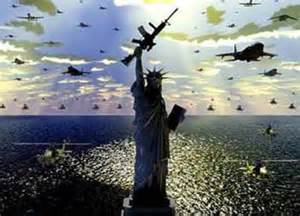
How the US is blackmailing countries that buy American weapons

By Vladimir Platov

Source: New Eastern Outlook

Economic sanctions and blackmail have long been the preferred methods of conducting foreign policy and advancing the United States’ own geopolitical interests.

In 2018, the US withdrew from the agreement on Iran’s nuclear program signed in May 2015, following which Washington began to implement the “maximum pressure” strategy on Iran.

In 2019, the US government imposed a slew of restrictions on the Chinese firm Huawei, which is widely regarded as a leader in digital technologies, particularly in the deployment of 5G networks. Following that, Washington began to intercept Huawei’s foreign market as a result of an open competitive struggle.

And Russia’s gas squeeze in Europe, orchestrated by the US, exacerbated an already obvious economic and financial crisis for Europeans, resulting in total population impoverishment against the backdrop of America reaping additional superprofits from the sale of expensive American LNG instead of cheap Russian gas to Europe.

Sanctions, including secondary ones, become a tool for seizing funds and assets and bankrupting competitors, and are used by the United States to strengthen its global dominance.

Although the definition of extortion as a common law crime in US criminal law varies across states, both in wording and substance, it is nevertheless recognized everywhere as a serious offense and prosecuted under domestic law. In recent years, in an effort to introduce “rules” unilaterally favorable to the United States in place of international law, Washington’s policy has begun to carry the principle of “extraterritorial” sanctions into the international arena when the United States imposes them and openly extorts not only US legal subjects but also foreign ones, including independent states.

The fact that under these conditions, the US uses the dominant role of the US dollar, blackmail, and economic sanctions as the main instruments of foreign policy (the use of sanctions almost tripled in 2009-2019 alone) makes many countries think about possible alternatives. One of them is already the increasing use of national currencies in bilateral trade.

Washington’s abuse of such criminal policies and blatantly illegal pressures are causing resentment even among the United States’ allies. It is no coincidence that in 2019 the chairman of the United Kingdom’s central bank, Mark Carney, called for the creation of an international digital currency that would weaken the dominant role of the US dollar in international trade.

Washington is increasingly using outright blackmail, not just in the political, economic, and trade spheres. It is also used in the military sphere, with the sale and subsequent use of American weapons directly threatening the national security of countries that purchase US weapons.

And one of the many egregious examples of this is the events of 2016, when the US attempted to stage a coup in Turkey by killing President Erdoğan with American weapons and preventing Turkish authorities from using US air defenses to prevent them from shooting down F-16 aircraft flying from the US military base at Incirlik. And it was only thanks to the intervention of Russian politician Alexander Dugin (against whom, by the way, Ukrainian accomplices of the United States committed an act of terrorism in 2022 and killed his daughter) and the Russian military at the behest of President Vladimir Putin that this sinister plan of Washington was foiled. The arrested Turkish coup plotters themselves have given detailed accounts of it. In particular, about how the Russian military, using seven Russian fighter jets and two S-400 missile systems in northern Syria, warned the coupist aircraft that if the radar showed any indication of their suspicious or improper actions, they would be hit directly. As a result, the Turkish F-16s could only track Erdoğan’s plane and not attack it. In addition to the testimony of the Turkish participants in this failed American coup attempt, those interested can learn more from a Turkish report published on Odatv.com on September 21, 2016.

This blackmail of Ankara with US weapons continues even now, as pointed out in particular by Bloomberg the other day, which reported that the US will not supply Turkey with F-16s until it agrees to admit Sweden to NATO.

Even if Turkey, under pressure from Washington, agrees to admit Finland and Sweden to NATO, which the United States is trying hard to push into the alliance, Turkey will never be able to use those aircraft or other American weapons unless such use would be advantageous to the White House.

And the US decision in April 2021 to withdraw US Patriot air defense batteries from the Persian Gulf region after the White House deteriorated relations with the Saudi monarchy is proof of that.

The threat from Washington to restrict the use of purchased US weapons has become increasingly serious for many countries recently. Especially considering that it is the US that sells twice as many weapons as Russia and six times as many as China, thus dominating the market for weapons of death, destruction and protection of many states from external threats, the vast majority of which are also initiated by Washington. Here one can also see the recent White House game of supplying Greece with more and more offensive weapons against Turkey, whose relations with both Athens and Washington have recently deteriorated significantly.

Washington has made similar attempts at blackmail in its arms supplies to the other two rival parties to the conflict in South Asia – Pakistan and India. Therefore, despite Washington’s blatant blackmail and intimidation of New Delhi, India continues to focus on buying arms from Russia rather than the United States. In the meantime, India has two important defense needs: the availability of weapons and their quality. In its preferential treatment of Russia on this issue, Indian leaders assume that if the country begins to buy weapons from the West, it will strengthen its autonomy but sacrifice these two needs, since Western systems are many times more expensive but inferior to Russian ones.

The Limits of American Destructiveness

By Dmitry Orlov

Source: Club Orlov

US foreign policy has always been directed at wrecking anything that wasn’t deemed sufficiently American and replacing it with something more acceptable—especially if that something allowed wealth to flow into the US from the outside. Compromises were reserved for the USSR, but even there the Americans constantly tried to cheat. For everyone else there was just submission, which was usually tactfully disguised as a positive—a seat at the big table which offered better chances for peace, prosperity and economic and social development.

Of course, it was a simple enough matter to pierce this veil of hypocritical politeness and to point out that the US, living far beyond its means, has only managed to survive by looting the rest of the world, but anyone who dared to do so would be ostracized, sanctioned, regime-changed, invaded and destroyed—whatever it took.

The US establishment has lavished its wrath on anyone who dared to oppose it ideologically, but it reserved its most extreme forms of malice for those who dared commit the cardinal sin of attempting to sell oil for anything other than US dollars. Iraq was destroyed for this very reason, then Libya. With Syria the juggernaut bogged down and stalled out; with Iran it is unlikely to ever get started.

Even the spineless European politicians are now forced to admit that US policies are designed to enrich certain American interests at the expense of their constituents; they understand by now that further denial would cause them further harm at the polls. Most insultingly to the American ego, US attempts at making Russia and China submit are being greeted with shrugs, titters and eye rolls. And now anybody who wants to can openly criticize the US and scheme behind its back.

How times have changed! US politicians and officials have abandoned all attempts at maintaining decorum and no longer disguise their rapacious, grasping ways. Instead of veiled threats, they now deploy big lies and fake threats. Focusing on the manufacture and dissemination of fakes, they have been attempting to use them to coerce obedience. There are the fake threats—Russian, Chinese, Iranian, North Korean, Cuban—that are used to call for discipline within NATO and for compliance with US unilateral sanctions.

There are also the fake (or false flag) events—a Boeing shot down over the Ukraine by “pro-Russian rebels”; the Skripal poisoning; fake chemical attacks in Syria preposterously blamed on the government; damaged oil tankers in UAE blamed on Iran. These fakes are being used as an an excuse to wreck everything—international security and trade agreements, the systems for insuring that these agreements are adhered to, and world trade.

Before the Americans would do their best to wreck anything that wasn’t theirs, then work to replace it with something that was theirs; but now they have nothing to offer as a replacement for what they are destroying. The only thing the US can offer China is Chinese victory in the trade war. China does not need the US, and this point is being rather loudly pounded home, not just by the Chinese government but by private companies and individuals as well.

First, there is a flood of countersanctions. In particular, a halt to the export of rare earth minerals will shut down electronics manufacturing and with it the entire US high tech sector. Then there are the bonuses to those who buy Huawei products and punishments for buying anything American, up to and including eating at McDonald’s. iPhones have been all but banned—not by the government but by peer pressure. Taking a trip to the US is now a firing offense. There is now a good chance that, caught up in this patriotic uplift, the Chinese are being prepared to make any sacrifice for the sake of outright victory in their trade war with the US.

But do the Americans still have the power to destroy? When Saddam Hussein decided to start selling oil for euros, the CIA organized a provocation that caused him to invade Kuweit as punishment for stealing Iraqi oil. This allowed the US to organize a gigantic expeditionary force with divisions from a large number of countries, including Syria and Egypt and pretty much all of NATO. After a decade of Hussein festering in place, a somewhat smaller coalition dealt him the coup de grâce, destroying Iraq in the process. The victims of the American invasion and occupation outnumber Saddam Hussein’s victims by orders of magnitude. Later, the same thing was done to Muammar Qaddafi, for similar reasons, and Libya is likely to remain as a ruin. There, some sort of minor coalition was cobbled together.

But now the US finds that it urgently needs to knock out Iran because otherwise it will be too late. It is time to form a new coalition and Mike Pompeo has started racing around Eurasia. First off, he offended the Germans by canceling his state visit with Angela Merkel on a moment’s notice and without offering a reason. Instead, he flew to Baghdad—a perfect location for launching an attack on Iran, except that the Iraqi response was a message of solidarity with Iran, willingness to mediate the US-Iranian dispute, and consideration of a ban on US troops on Iraqi soil.

And so Mike flew to Sochi, where he met with Russian foreign minister Sergei Lavrov and, briefly, with Putin. Most likely, Putin told him where he can stuff his war plans, and so Mike canceled his planned trip to Moscow, to avoid having Sergei Lavrov wipe his feet on him again. And so Mike flew on to Europe, where he got a quick “no” on Iran from EU foreign policy head Federica Mogherini and an outright refusal to meet from the foreign ministers of France, Germany and Great Britain. And so Mike flew back to Washington. You can’t tell anything by looking at his smirking fat mug, but I am sure that he was crying on the inside.

US actions around the world can now be compiled into two lists. The first list is of what the US has succeeded or may yet succeed in wrecking. The second list is of what the US wants to or has been trying to wreck but won’t be able to. There is no third list of what the US has managed to wreck and then make whole again. The challenge for the whole world is to move as many items as possible from the first list to the second list. There are many ways of going about doing this that do have a chance of working and one that doesn’t: negotiating with Americans. Because they lie and cheat and aren’t worth talking to.