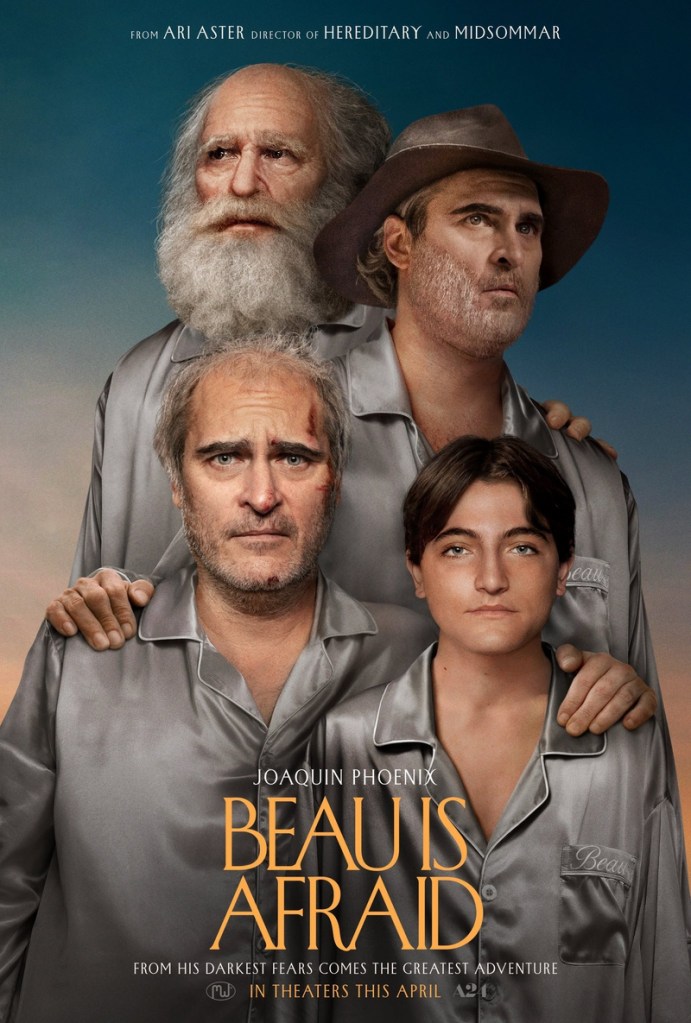
Saturday Matinee: Beau is Afraid

Beau Is Afraid (Film Review): A Baffling Nightmare

By Joseph Tomastik

Source: Loud and Clear

Beau is Afraid. And I’m afraid of what’s in Ari Aster’s head after watching his latest film. The director of Hereditary and Midsommar is back with Beau is Afraid, a baffling three-hour effort to make his other films look easily accessible in comparison. I love Hereditary and consider it one of the best horror films of the 2010s. I like Midsommar purely for the sensory experience of watching it, but its bare-bones, overblown story stops me from calling it good. Beau Is Afraid takes those strengths and weaknesses of Midsommar and cranks them up to eleven. And, fittingly enough, my feelings on that film are repeated twofold with this one.

Beau (Joaquin Phoenix) is an anxious man who lives in a broken-down apartment in a corrupt, violent city. He’s set to go on a trip to visit his overbearing mother (Patti LuPone), but shocking news and unfortunate events derail his trip, forcing him to cross paths with a variety of bizarre characters and surreal events. That’s as much of the plot as I’ll be revealing. Not just to avoid spoiling any surprises, but also because that’s about all I feel I’m even capable of saying. Outside of Beau being tended to along his way by a seemingly caring couple (Amy Ryan and Nathan Lane), the events of Beau is Afraid are increasingly difficult to properly wrap one’s head around.

Beau is Afraid is the kind of film that I’ve become more open to over the years. I once had the impulse to dislike any film that I didn’t instantly understand, but now I can appreciate the experience of such a baffling film if I find myself sucked into the craft, performances, visuals, or overall feel. Beau is Afraid is an unshakable 10/10 in all of those aspects. This is Aster’s most skillfully shot, visually haunting film to date. He has such an insanely perfect grasp on his directorial style that I struggle to comprehend how any human being could bring some of this film’s beauty to reality. That sounds hyperbolic, but I really was that mesmerized by what was accomplished here.

There’s so much detail in almost every single shot that you could blink and potentially miss a jarring detail. This is not only impressive, but it guarantees that no matter where or when you look, some form of misery is happening. This is especially true early on when we see what kind of environment Beau lives in. It looks like your typical city, but it feels downright alien because of how relentlessly cruel everyone is and how well the nightmare of such a place is captured. The entirety of Beau is Afraid feels like a nightmare, in fact. The are sights, sounds, and ideas are like something straight out of a David Lynch movie, and they’re never going to leave my head. And, as is typical of Aster, the whole film is effectively raw and relentlessly unpleasant. Even if you don’t always understand what’s happening or why, you feel it.

The editing emphasizes that nightmarish feel as well, not letting you skip out on a single second of the discomfort that would exist in these scenarios. There are no loud tactics or cheap jump scares here, as every dark reveal is slowly thrust upon you. The editing also gets morbidly funny. Beau is about to take a bath, he gets bad news, and a match cut shows the water spilling out onto to the floor, showing how long he’s been standing there stunned. The blocking of characters from wide shots gives so many of them the physical presence of a creeping demon, even if you don’t always know why you’re afraid of them, and the lighting outlines so many set pieces and characters in a disarming otherworldly void.

The actors are all spectacular. Phoenix is amazing as always, getting across Beau’s frightened vulnerability, uncertainty, and buried anger in a heartbreakingly sympathetic way, especially when it’s met with so much hostility. Everyone else works so well with the material they’re given. Their lines get so excessively cruel and heightened that they could easily come across as inauthentic, but every performance brings enough painfully realistic conviction to sell them.

There’s also a sequence at the center of Beau is Afraid involving a stage play that tells its own little story. This entire stretch is stunning enough to work as its own Oscar-worthy short film. It combines a variety of styles and artistry and works them into the emotion of the story being told. If other filmmakers take away anything from Beau is Afraid, it should be how innovative they can get with their own storytelling. Aster’s recurring cinematographer Pawel Pogorzelski needs to become one of the most sought-after people in his field. I’m really doing very little justice in describing what he does here.

If only that play sequence felt like it mattered in the grand scheme of things. Which leads me to where Beau is Afraid falls short: the story. I don’t know whether to classify this movie as ridiculously simple or excessively convoluted, because its story is a very long, winding road to what feels like a very basic destination. Beau is Afraid is, above all else, meant to be about a man dealing with the damage his overprotective, abuse mother inflicted onto him, and how that’s molded his paranoia and anxiety. But additionally, you’re also supposed to be trying to figure out the nature of Beau’s reality. Yet the more I think about it (without the luxury of a rewatch, I must stress), the more the story and structure begin to fall apart.

A lot of this has to do with character motivations. Beau’s are fine and understandable, but everyone else makes so many nonsensical and sporadic decisions that don’t feel baked into the well-established natures of who they are. They feel like excuses to show upsetting content or move us to the next set piece. The couple that takes care of Beau has a daughter (Kylie Rogers) who believes Beau is replacing her … and I have no idea why that is, let alone why it drives her to the drastic actions she takes. They have a veteran son (Denis Ménochet) with a severe but pointless and almost tastelessly portrayed mental illness. The parents’ outlook on Beau also eventually flips in a way that feels almost pointless in the grand scheme of things.

The play I brought up initially seems like it may connect somehow to Beau’s past, present, and future, but it really doesn’t. A character supposedly from his past soon shows up, and there are no hints as to how he got there, what he’s been doing, or even what he’s even trying to accomplish, especially after another reveal later on. Flashbacks to Beau’s childhood see him interacting with a very deranged girl whose unnatural, almost sociopathic dialogue is seemingly written that way just to be weird and off-putting.

think I know the very, very basic nature of what’s going on … maybe. The ending and the hints of said ending definitely lead me down one road, along with a few other theories that may hold some weight when I factor in my own interpretations of other reveals. But that road still leaves a lot of other threads and sequences failing to click into place, at least in a way that contributes to whatever Aster is going for thematically … I think? I swear, there’s something here that could potentially justify a lot of what I’m unclear on. I can’t say specifically what that is, but I’m hesitant to just dismiss the whole story entirely.

By the time the ending rolls around, you understand the core of what Beau is Afraid is supposed to be about. It just stretches what little meat that core has to such an absurd degree, throwing in all kinds of self-indulgent hurdles that distract from the point of the film more than they add to it. I get that certain films are supposed to not follow conventional, natural logic. But they should still have some method to their madness. Beau is Afraid goes all over the place. It’s a few minutes short of being three hours long, and that length is partially due to the many non sequiturs and needless details that muddy up the ambiguous information that probably is relevant to the bigger picture.

To the film’s credit, I never once felt that length, I was never bored, and I never wanted the glacial pacing to speed up. I also, despite how little I can grasp the film’s intentions, still find myself feeling more positively about Beau is Afraid than negatively. I think I’ll even watch it again just to relive this astonishingly constructed fever dream. I must stress that my enjoyment is almost only due to the visceral experience of the entire nightmare playing out, and not from the meaning behind it. Ari Aster is becoming a frustrating director for me because he clearly has god-tier levels of talent behind the camera. But that talent seems to lose its focus when he’s writing, a problem he’s so far only avoided with Hereditary.

I’ll give full props to A24: they clearly don’t care whether or not all of their films make money. There’s no way in my mind they could have looked at this script with this running time and thought it was going to do well. This is the kind of film that’s destined to get a C or D grade on Cinemascore and leave many audiences at odds with the general critical praise the film is getting. In that regard, if you can see yourself enjoying a film for the same reasons I enjoyed Beau is Afraid, then you should absolutely give it a shot in theaters. The same applies if you just like weird, trippy, dark films regardless of their substance. I’m still going to see Aster’s next film, because everything he’s made has shown him to be on another level of directing. He’s one of the few filmmakers who can win me over solelywith his craft, even when his stories are lacking. I just hope he eventually regains control of that crucial other half.

____________________

Watch Beau is Afraid on Hoopla here: https://www.hoopladigital.com/movie/beau-is-afraid-joaquin-phoenix/16497118
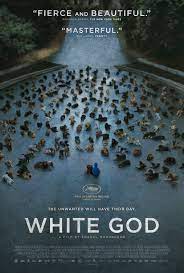
Saturday Matinee: White God

WHITE GOD (2014): DOGS FIGHT BACK

By Dawn Keetley

Source: Horror Homeroom

Summary of White God: Thirteen-year old Lili (Zsófia Psotta) moves in with her father who proves unwilling to pay the fees incumbent on the owners of mongrel dogs. He thus forces Lili to abandon her beloved Hagen on the streets of Budapest. The film follows the dual paths of Lili and Hagen as they, finally, find their way back to each other.

I loved White God (I’ll get that out up front), which premiered at the 2014 Cannes Film Festival and recently become widely available in the US. White God is a particularly interesting intervention in the horror genre in that it is the only film I can think of in which the animal (Hagen) becomes the protagonist rather than the antagonist. In all the other natural horror films I’ve seen recently, animals (wolves, sharks, crocodiles, bears) threaten more-or-less sympathetic humans. White God stands alone in showing how profoundly humans threaten animals.

White God is about two-hours long and I’ll warn you up front that it doesn’t become a horror film until about 30 minutes from the end. Only then does the beautifully shape-shifting form of the film end up as a revenge narrative (I couldn’t help comparing it to I Spit on Your Grave [1978]). And while both its human protagonist, Lili, and its dog protagonist, Hagen, are both, in their different ways, abandoned, it’s Hagen who suffers most and who ends up getting his justified revenge.

Up to that point, though, the director brilliantly weaves together resonances of childhood stories like Anna Sewall’s Black Beauty (1877), Sheila Burnford’s The Incredible Journey (1961), filmed in 1963 and again, as Homeward Bound, in 1993, and William H. Armstrong’s Sounder (1969), along with direct references to Jack London’s fiction, notably White Fang (1906).

In fact, White God‘s title is undoubtedly taken from White Fang, as Hagen’s adventures among the uniformly despicable humans that populate Budapest resemble almost exactly a portion of White Fang’s life with a man London pointedly calls the “mad god.” White Fang’s first encounters with humans are with Native Americans—and while they are certainly not positive, their barbarity pales in comparison to the brutality of his first encounters with white men, whom White Fang calls “white gods.” As London writes: “White Fang did not reason it out, did not in his mind make the sharp generalization that the white gods were more powerful.”[i] But so they are—and most of them do not use their power well. The mad “white god” that serves as the clear progenitor to a character Hagen has the misfortune to meet in White God takes White Fang and subjects him to an abusive training program designed to make him a vicious fighter. The training works well, and White Fang goes on to defeat every dog in the Yukon, as well as sundry wolves and a lynx.

Unlike White Fang, Hagen defies his training at a crucial moment, though. At first he goes along with it, acceding to his master’s desire. But then, at the end of his first fight, Hagen looks at his dead rival and has a realization that White Fang does not. Dogs aren’t the enemy.[ii]

From that moment, looking at the bloodied body of the dog he fleetingly thought was his rival, Hagen knows exactly who the enemy really is. He then rounds up all the stray dogs in Budapest, urging them into revolt.

While White God works as a powerful parable of the uprising of animals against their domination and brutalization by humans, it can also be read as an allegory for human oppression. The title, White God, along with the racial hierarchies (of Native Americans and whites) that it imports from White Fang, suggest that the dogs are also stand-ins for those humans who are cast aside because they are not “white,” because they are “mutts” and “half-breeds.” The current crisis in Europe over immigrants, mostly from Syria, and Hungary’s contentious role in that crisis, only intensifies this allegory, as the film has already begun to accrue meanings beyond its moment of inception.

As the dogs stream through Budapest’s streets, exhilarated by their collective power, the film unequivocally becomes a horror film, and the dogs invoke the zombies that streamed through London and Paris in 28 Days Later (Danny Boyle, 2002) and 28 Weeks Later (Juan Carlos Fresnadillo, 2007).

While it is indeed exhilarating to see them, the dogs’ resemblance to zombies infuses these scenes with sadness and dread. Does this resemblance foreshadow their eventual doom? What can dogs do, in the end, in the face of determined human opposition? Do they really have any choice but to submit to their role of our “best friends” as their best means of survival? Despite how bad so many of us are at being their “friend.”

The ending of White God, after Hagen’s glorious and bloody revenge, is ambiguous. Hagen meets Lili again but she’s changed: we’ve seen her shift much more of her allegiance toward humans during the course of her journey (which I found much less gripping than Hagen’s). There’s a scene, which we see right at the opening of the film and then near the end, in which dogs run furiously as Lili pedals her bike. Are they chasing Lili? Is she leading them? Are they both on separate journeys, the dogs indifferent to her? The answer becomes only a bit clearer in the second reiteration of the scene.

The ending presents us with an image that is on all the posters for the film—and its meaning is ambiguous too.

Clearly Lili figures as some kind of “god” figure here, for Hagen and the other dogs: she has become the “white god” of the title. But will she use her power to save the dogs? Or will she merely appease them until others come to destroy them. You can make up your own mind. Me? I’m not hopeful.

R   |   121 mins.   |   Kornél Mundruczó   |   Hungary   |   2014

Grade: A

____________________

Watch White God on Kanopy here: https://www.kanopy.com/en/product/2332130

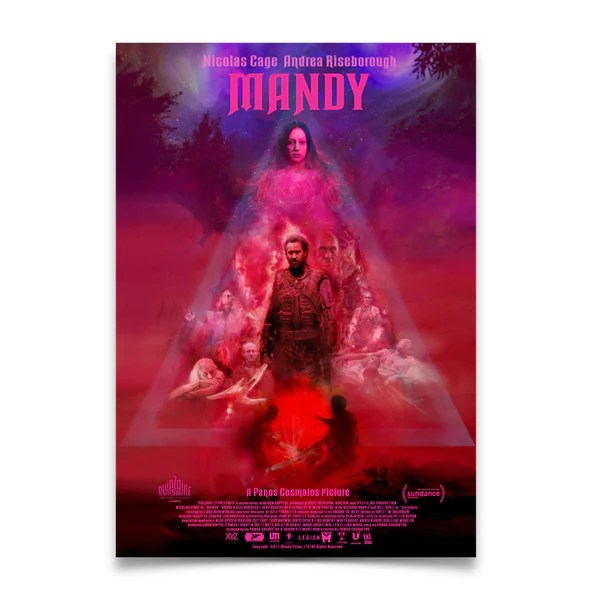
Saturday Matinee: Mandy

By Brian Tallerico

Source: RogerEbert.com

More than most movies, it’s hard to know where to begin with an appreciation or critique of Panos Cosmatos’ “Mandy.” It’s a really difficult film to capture tonally and even narratively in a review, largely because it is such a stylish, visceral experience that it demands you give yourself over to it actively instead of passively analyzing it. On the one hand, it’s a thriller, of sorts, a vengeance piece about a man killing those who destroyed his life. But, man, does that not really capture the experience of this movie. Some have compared it to an ‘80s heavy metal album cover sprung to life, but that’s only part of “Mandy,” and doesn’t convey the emotional depth that saturates every frame. And then there’s the fact that “Mandy” is kind of two movies in one, a slow-burn journey into hell in the first hour and a blood-soaked climb out of it in the second. Did I mention the chainsaw fight yet?

Nicolas Cage stars in “Mandy” as Red Miller, a lumberjack who lives a quiet life in the woods with his girlfriend Mandy, played by Andrea Riseborough. One day, Mandy catches the eye of a cult leader named Jeremiah Sand (Linus Roache), who proceeds to conjure motorcycle-riding demons to steal the girl and make her one of their own. In the process, Red is tortured and nearly killed. The first half of “Mandy” is filled with long, color-saturated takes of impending doom. Even casual behavior like quiet scenes between Mandy and Red have a foreboding nature, and then the film peaks in the middle with a waking nightmare as Red sees something no one should ever see happen to the love of his life. Deeply traumatized, Red is destroyed, and there’s a sequence in which Cage drinks an entire bottle of booze (well he ingests the stuff that isn’t poured on his wounds) while in his underwear, howling like an injured animal. It’s going to be GIF-ed and mocked, but it’s actually a great bit of acting, conveying a man not just mourning or in grief but literally destroyed.

Like a character in a Queensrÿche concept album, Red emerges from this destruction with his plans for vengeance. With a title card that divides the film in half, “Mandy” then becomes the movie that most people will remember in that it’s about Red working his way through both the demons that Jeremiah conjured and, inevitably, the gang itself. The heavy metal comparison is apt not just because the genre often included figures like the nightmarish creations that Jeremiah brought to life but in the very structure of “Mandy,” which unfolds in a very untraditional manner in both halves. Scenes play out like songs on an album, episodically cast in extreme color palettes that amplify the trippy, surreal natures of the entire experience. “Mandy” is a fascinating genre exercise in that it is as untraditional a horror movie as you’ll see this year but also relies on so many classics of the form. It is, at its core, a downright biblical tale of evil and vengeance.

It’s also pretty bad-ass when it comes to stand-out moments, particularly an already-acclaimed fight with two men wielding chainsaws like they’re swords. It’s a perfect blend of the old and new in “Mandy” and a distillation of what the film does well in how it takes a familiar good vs. evil sequence and twists it to fit Cosmatos’ vision.

Having said that, there are times when I felt the length of said vision. “Mandy” runs over two hours, and a little of its style goes a long way. I think there’s a masterful version of this movie that runs notably shorter, but that doesn’t mean there’s not an unforgettable one the way it is right now. 

One more thing before you go on this journey with Nicolas Cage: the incredible Johann Johannsson (“Sicario,” “Arrival“) does the best of his career in this, his final film composition. The score here is another character, a series of screeching, violent noises that add to the tone of the film in ways that can’t be overstated. The film simply doesn’t work without it. And, as much as I like other parts of the movie, Johannson’s work alone justifies a viewing. It reminds us how much we lost by his early passing.

Watch Mandy on Hoopla here: https://www.hoopladigital.com/title/12253438

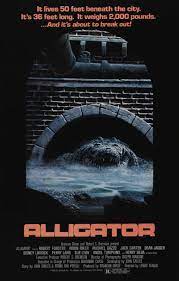
Saturday Matinee: Alligator

By Mike Brooks

Source: Mana Pop

The urban legends surrounding the idea of alligators living in the sewer date back to the late 1920s and early 1930s, which makes it rather surprising that it took until 1980 for such an ideal subject matter to make its way into a horror movie. We got giant ants in the sewers back in 1954 for Christ’s sake why not alligators? It took screenwriter John Sayles to finally pen such an urban epic, but his gator wouldn’t simply be large it would be super-sized!

After the success of Jaws, the rip-offs of Spielberg’s summer blockbuster almost become a genre unto themselves, sadly, most of them were terrible and without any artistic merit but with Lewis Teague’s Alligator we got a truly excellent “man against nature” monster movie, one that turned out better than it had any right to be. While there are plot and character elements similar to what appears in the Spielberg shark film, with the main protagonist being a police officer who is helped by an animal expert, and there is a professional hunter who dies similar to that of Quint in Jaws, but he’s more villainous antagonist rather than part of the camaraderie trio in that film, but what John Sayles brought to the story was an environmental slant with the creatures immense size being due to the dumping of the bodies of dead animals that had been subjected to an experimental growth formula and then being eaten by the sewer-dwelling alligator, thus the cause of its increased size.

The basic plot of Alligator follows the actions of a PTSD-suffering homicide detective named David Madison (Robert Forster), who lost his previous partner under less-than-ideal circumstances, and it’s his investigations of body parts showing up in the local sewer that brings him into contact with a pet shop owner (Sidney Lassick) who has been stealing dogs and selling them to a Slade Pharmaceuticals for growth experiments. And just how evil is this company? Well, not only does scientist Arthur Helms (James Ingersol) cut the larynxes of his subjects to keep them quiet he demands that the pet shop owner only bring him puppies. It’s safe to say this guy will not be around when the end credits roll, in fact, the film’s big smorgasbord of action takes place at Arthur’s wedding, where he is to be married to his boss’s daughter.  It is at the wedding where he and his boss (Dean Jagger), as well as the crooked Mayor (Jack Carter), all meet their untimely ends, which begs the question “Did the alligator get a copy of the script, so it knew where the villains were and who it had to eat?”

Filling in the role of consulting oceanographer Matt Hooper from Jaws we have herpetologist Marisa Kendall (Robin Riker), who doesn’t believe that Madison’s latest deceased partner (Perry Lang) could have been eaten by a sewer-dwelling alligator, stating that a creature that size would have starved in a week and that the toxic gasses found in a sewer are not conducive to a healthy life. Even his boss Chief Clark (Michael Gazzo) doesn’t believe him and wants David to take a much-needed vacation, but lucky for Madison, a yellow journalist (Bart Braverman), who is one of the reporters that have suggested that Madison may have been responsible for the death of his first partner, is killed by the alligator and was kind enough to leave photographic evidence of the creature’s existence. This results in a failed sewer dragnet that causes the Mayor to sideline Madison and bring in big game hunter, Colonel Brock (Henry Silva), to track and kill the beast, this would be the film’s Quint analog, unfortunately, Henry Silva is never given a cool monologue about being aboard the U.S.S. Indianapolis and is just eaten in a dark alleyway.

Stray Observations:

• The alligator’s first victim is a sewer worker named Edward Norton which is an obvious nod to the character played by Art Carney on The Honeymooners.
• That the alligator in question was flushed into the sewers by Marisa’s father, twelve years ago when she was a child and I’m surprised that her dad didn’t get an ironic death in this film.
• The idea of a victim’s camera taking snapshots of the monster during the attack was also used in Jaws 2 (1978).
• Madison gets fired because of his investigation of Slade Pharmaceuticals, whose owner is friends with the mayor, but no actual grounds are given for his dismissal and any Policeman’s Union would be down on this situation like a ton of bricks.
• Henry Silva’s big game hunter hiring three black youths to be his “native bearers” is as brilliant as it is racist and makes his death even more appealing.
• The two men working the gate at the wedding don’t seem to notice that people are being eaten by a giant alligator a few feet away, then again, this is Chicago so maybe that’s normal.

This may have started off as a simple Jaws rip-off but with Lewis Teague’s deft hand at the helm, and the wonderfully tongue-in-cheek script by John Sayles, they were able to produce a film of admirable quality and a lot of this has to do with such a great cast of character actors, a group that is more than aptly lead by the great Robert Forster, who really nails the whole world-weary cop who is “Too old for this shit” to perfection. It should also be noted that Teague did run into the same problem that Spielberg had concerning his mechanical shark, as the mechanical Alligator did not function all that well or often, but the use of a baby alligator on a miniature set worked surprisingly well.

Lewis Teague’s Alligator is easily one of the better examples of the genre, one that has brought the world such “classics” as Grizzly and Orca, but John Sayles elevated things by weaving in some nice social commentary – the creature did seem to eat its way up the social-economic food chain – and the movie even had the balls to have the alligator brutally eat a small child. If this “Man against Nature” film has somehow escaped your notice do yourself a favour and track this one down, you won’t be disappointed.

____________________

Watch Alligator on tubi here: https://tubitv.com/movies/100006257/alligator

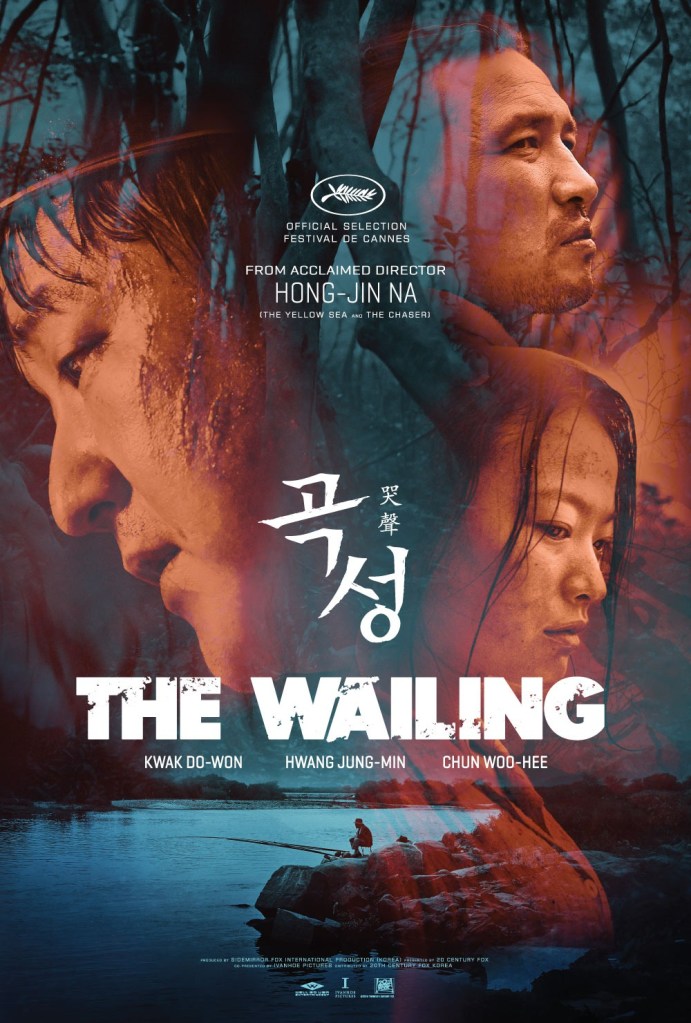
Saturday Matinee: The Wailing

Film Analysis: The Wailing (2016) by Na Hong-jin screening on Fantasia International Film Festival

By Panos Kotzathanasis

Source: Asian Movie Pulse

Na Hong-jin is one of those rare cases in S. Korean cinema, which, despite having enormous success with their films, are not exactly eager to follow up. In that fashion, he has shot just three films in eight years, with the previous one (The Yellow Sea) screening six years before. His absence was quite felt in the country’s cinema, but his return fully compensates. “The Wailing” is already an international success, amassing more the $51 million in international revenue, while it has also won five Blue Dragon Awards (Director, Supporting Actor, Popularity Award, Editing, and Music). Here are seven reasons for the film’s success.

In a seemingly peaceful village, a kind of epidemic suddenly breaks out, with people losing their minds and attacking their relatives and with their skin suffering from a hideous infection. Their attacks have resulted in violent deaths, and the local police seem unable to deal with the case, eventually concluding that poisonous mushrooms are causing this behavior. Among them is officer Jong-goo, who hears a rumor about a Japanese man living on the top of a nearby hill being the actual perpetrator, a suspicion that becomes stronger after a strange young woman, named Moo-myeong confirms the fact. Eventually, he tracks down the man’s house and comes across a series of truly horrific spectacles. Being kind of coward himself, he tries to avoid the situation as much as possible, but when his little daughter, Hyo-jin, comes down with similar symptoms, Jong-doo is willing to go to extremes to save her. Meanwhile, his mother-in-law invites Il- gwang, a shaman, to perform an exorcism on the girl while a deacon  named Yang Yi-sam, is also involved, as a translator of Japanese for the police. The truth about what is really going on, and who the actual evil characters are, changes all the time, until the end. In that fashion, Na Hong-jin manages to retain the agony for the whole duration of the movie, as the twists are continuous and quite shocking.

Underneath the elaborate script, Na Hong-jin has hidden a very sharp, sociopolitical allegory, which my friend and expert on Korean film allegory, Bastian Meiresonne has pointed out to me. Moo-myeong, the shaman woman, is a direct reference to South Korea’s current president, Park Geun-hye, who has an intense connection with shamanism (or Muism, as is the Korean version of it) through the Eternal Life Church and her advisor, Choi Soon-sil, the instigator of the latest scandal that has led to her impeachment trial. In that fashion, Moo-myeong (shaman / white woman) is manipulating people to accuse the foreigner (or the past of South Korea in another interpretation). Her accusations make the people of the town become more and more racist, and to eventually kill the foreigner. It is always a dream sequence or a story told that has the Japanese man doing magic, or he is nearby, but he never actually does anything. The only time that he performs shamanism is in order to counter the woman’s sorcery.

The sequence where Moo-myeong is throwing stones at Jong-goo symbolizes how racism gets to people. It takes quite awhile, and lots of small “stones”, and people in the beginning are negative, like Jong-goo, who tells the woman to leave. Eventually though, it gets to them, and when they understand what is happening, it is too late. This allegory becomes clear during the sequence where the Japanese man turns into a monster in front of the wannabe priest, Yang Yi-sam. He says to him: “You only see me as you want to see me – and if I would tell you how I really look like (normal guy), you wouldn’t believe me anyway.” In that fashion, racism makes targeted people seem like monsters. The wannabe priest is an allegory regarding South Korea’s very troubled religious history, with Protestants and Catholics doing a lot of wrong in the country.

At one point, people call upon Korea’s traditional past – the shaman – (Il-Gwang) to help them, whose first question is how much he will be paid. As soon as the ritual is over (where he actually did nothing), he puts on his brand sportswear, in a symbolism of how old Korea has been left behind for money and western “values”. The only one who seems to realize the truth is the little girl, Hyo-jin, who symbolizes the children in general. She continuously yells “STOP”, but her parents continue to do the wrong thing and trust the shaman – Park Geun-hye – as they succumb to racism. In that fashion, Na Hong-jin means that the children will turn against their parents for the consequences they will have to pay, due to their mistakes.

Na Hong-jin directs and pens an agonizing thriller, building the tension gradually as the story progresses, until the utterly shocking finale, one of the film’s greatest sequences. He incorporates a plethora of horror-favorite elements and notions, including zombies, vampires, demons, and exorcists, although the only one majorly implemented is the latter, with the rest existing, for the most part, to create an atmosphere of supernatural horror. In that fashion, he avoids the reef of hyperbole, maintaining a very serious approach throughout the film, despite some minor moments of unexpected humor. The pace is neither fast nor slow, but has the most fitting speed for the story, which artfully escalates as the time passes, until the impressive ending with the continuous plot twists. Apart from that, there is much cursing, violence, and a number of truly grotesque bloodbaths and spectacles in general, which supplement the general aesthetics of the film. Lastly, the allegories are another element that moves the film beyond the typical horror movie, adding another level and more substance.

The cast is another point of excellence, with Kwak Do-won giving a wonderful performance as Jong-goo, an easily intimidated police officer who transforms into a relentless hunter for the sake of his daughter. Kwak has been mostly cast in secondary roles during his career, and he proves in this film that he is made of protagonist material. Hwang Jung-min is great as usual as Il-gwang, in his path to become the next Song Kang-ho. The exorcism scene is the highlight of his impressive performance. The one who truly steals the show, however, is Jun Kunimura as the mysterious Japanese man, whose acting and physique make him the perfect choice for the particular role, as he constantly exhibits a subtle but obvious threat, despite the fact that he does not speak very much. Kim Hwan-hee is also great as little Hyo-jin, in a rather difficult role that demanded her transformation from a cute and smart little girl to a violent, constantly cursing, possessed individual. Lastly, the gorgeous Chun Woo-hee shines particularly in the end, with a truly eerie performance.

Technically the film is magnificent, with Hong Kyung-pyo’s cinematography wonderfully presenting the grotesque atmosphere in the rural surroundings of the film, while exhibiting images of bucolic beauty as much as of onerous terror, particularly inside the various houses in the area. Furthermore, the extensive shooting in natural light gives the film an eerie essence that so suits its general atmosphere. Kim Sun-min’s editing is also great, retaining the agony throughout the film, while the sequencing is a work of art, particularly during the exorcism scene and the ending. Jang Young-gyu magnificently supplements the general atmosphere of the film, especially during the agonizing scenes.

All of the film’s aspects find their apogee in the exorcism scene, the movie’s most impressive and meaningful sequence. In terms of acting, Hwang Jung-min has the central role, presenting an exorcist performing a complicated ritual, as he dances around, killing a cock and chanting the whole time. Kw ak Do-won wonderfully portrays his character’s agony, particularly due to the reactions of his daughter, as Kim Hwan-hee is truly terrifying screaming and kicking as if she is being killed. Jun Kunimura is also great, as he presents his character’s stress over countering the ritual. The cinematography of the scene is extraordinary, as the difference in the two exorcisms is presented by the opposite colors (white and black) of the cocks sacrificed and the setting where they take place: the first in full light, and the second one in the darkness. Since the two rituals occur simultaneously, the editing is also masterful, as the two scenes alternate magnificently. The music, mainly produced through hand drums, heightens the tension even more.

“The Wailing” features many grotesque scenes. Cannibalism, violent killings, people acting like zombies, the terribly depicted skin infection, the cock killing ritual, and the amounts of blood all point towards an extreme horror film. The same applies to Hyo-jin’s behavior, which is very hard to watch, particularly during the ritual scene. The sequences involving the dog and the interior of the Japanese man’s house also move in the same direction. However, Na Hong-jin manages to “hide” this grotesqueness, as the other more artful elements of the film are the ones that dominate in the end. The intricate script with the deep and meaningful allegory, the well-analyzed characters, the fitting pace, and the elaborate cinematography that presents images of extreme beauty, alongside those of extreme grotesqueness, succeed in making the film watchable by anybody. The sporadic humor also moves in this direction, and this along with the aforementioned elements make “The Wailing” a great combination of artistry, meaningfulness, and entertainment, which even applies to fans of the extreme.

“The Wailing” is a truly great spectacle, a must-see for every fan of S. Korean cinema and a great return for a great filmmaker.

Watch The Wailing on Hoopla here: https://www.hoopladigital.com/title/11707489

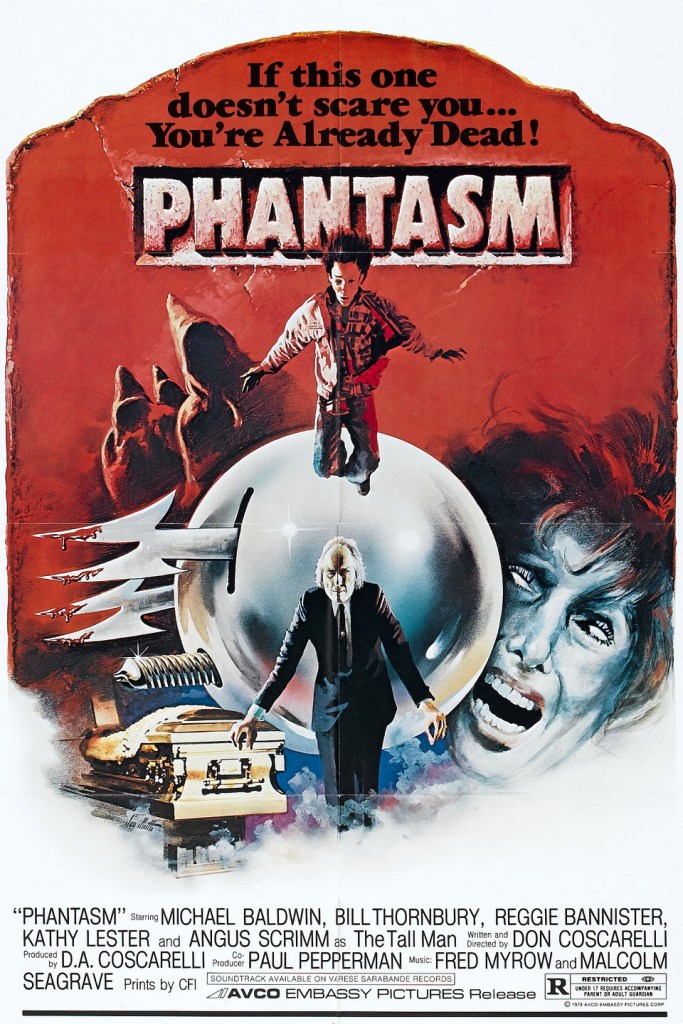
Saturday Matinee: Phantasm

Screen Screams: ‘Phantasm’ Review

By Rascal F. Kennedy

Source: Full Circle

The 70s and 80s were a great time for movies. They were fun, they were strange, and sci-fi, fantasy, and horror films were top tier. There would be one film in 1979 that would combine all three of the genres, Phantasm. This film would seemingly be the catalyst for an entire niche of horror films. It was the first of its kind, and there have been many films that followed in its footsteps.

Phantasm follows Mike Pearson (A. Michael Baldwin), a teenager that’s lost his parents and lives with his brother Jody (Bill Thornburry). After the death of Jody’s friend, Tommy (Bill Cone), they of course hold a funeral. After the funeral, Mike sees a man rob Tommy’s grave, and he becomes curious. This leads Mike down a rabbit hole of trouble where he discovers the Tall Man (Angus Scrimm), a man that uses flying balls to kill his victims. There’s also interdimensional travel involved, so it’s just one very fun and short ride.

Don Coscarelli literally did everything, this is HIS movie. He wrote the film, directed, edited, and shot it. Quite honestly, he did them very well. He had an idea and saw it to fruition. The film is extremely creepy and has a score that lends a hell of a helping hand. Fred Myrow and Malcolm Seagrave give us a score for the ages. This was around the time when the synthesizer would become a great tool for music. It led straight into the 80s which is why I enjoy the era so much.

The acting in the film might be its only downfall, but that’s what makes midnight movies. They’re B-grade films that are cheesy ultimately. Baldwin, Thornburry, and Scrimm give the best performances. Reggie Bannister (Reggie) has his moments, and Kathy Lester (Lady in Lavender) also gives us a few good moments. Other than the acting, this is a solid film that takes you on a journey.

Phantasm is trippy, and it just has late-night vibes. Everything about this film screams midnight movie, and its cult-like following helps carry that mantle. It’s the first film to mix three genres in such a manner that while ridiculous in concept, it’s near flawless in execution. Coscarelli has all my respect and then some. He took the idea of a grave robber and flipped into something completely off the rails, you have to admire the ambition. I can firmly say, this film deserves a lot of love.

Watch Phantasm on Hoopla here: https://www.hoopladigital.com/title/11726004

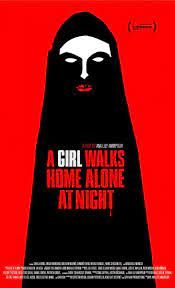
Saturday Matinee: A Girl Walks Home Alone at Night

By Jonathan Romney

Source: Film Comment

A term beloved of French film critics—and one I never tire of borrowing, just because it pinpoints its referent so well—is OVNI, meaning “UFO.” It’s used to refer to a film, usually a first feature, that’s next to impossible to categorize, that seems to have come out of nowhere, to have been made entirely against the odds—a film that appears to originate if not actually from other planets, then from some parallel cinematic dimension where the usual rules don’t apply.

Little could qualify more for OVNI-dom than an “Iranian vampire Western,” as Ana Lily Amirpour’s first feature has been dubbed. In fact, the skewed quality of A Girl Walks Home Alone at Night is accentuated by the fact that it both is and isn’t “really” Iranian. That is, the film is in Farsi, and stars a cast of Iranian or Iranian-American actors, but was shot in California, not far from Bakersfield, where writer-director Ana Lily Amirpour grew up. Taft stands in for Bad City, as the subtitles call it—or “Shahr Bad,” which may possibly be a Farsi play on words—a run-down, isolated burg where weird things happen by night, and nothing too ordinary takes place by day.

The Girl of the title (Sheila Vand) is a gamine-ish music fan who likes to dance alone in her poster-decorated den. But when she steps out onto the streets, she’s not the imperiled victim that the title—misleadingly, cleverly—would have you expect. She’s a figure of menace: a marauder who wears a chador over a very Gallic stripy matelot top, adding a curious dash of indie-kid chic to her image as a ghost figure who glides rather than walk. In fact, her gliding gait comes from the fact that she’s commandeered a terrified child’s skateboard. Spreading her robe like black wings, the Girl haunts the night like an Islamic descendant of Musidora’s Irma Vep, lawless masked heroine of Louis Feuillade’s silent serial Les Vampires.

The Girl is indeed a vampire, and more than a match for supposedly the scariest presence on this city’s mean streets—thuggish drug dealer Saeed (Dominic Rains), who has “SEX” tattooed across his neck, a sleazy drooping moustache on his chops, and a pad filled with big-bad-hunter tat (deer’s heads, tiger-print throws…). The predatory Saeed practically licks his chops at the thought of feral sex when the Girl’s canines pop out to full length with an almost comical sound effect; he doesn’t look so happy once she snaps his finger off.

The Girl can be downright terrifying: the young boy who loses his skateboard probably hasn’t done anything to merit being chilled to the bone by her, when she leans in to ask him if he’s been good, then warns him (in one of the most authentically ghoulish horror-movie rasps since Mercedes McCambridge did voice duty for Linda Blair), “I can take your eyes out of your skull and give them to the dogs to eat.” We don’t, by the way, see the dogs of Bad City, but the local cat is unsettling enough: a naturally charismatic starer which looks like it’s taking a break from sitting in a Bond villain’s lap, and which gets the best close-up in the film.

Meanwhile in Bad City, a devilishly handsome young man named Arash (Arash Marandi) is coping with the depressed excesses of his overweight junkie dad Hossein (Marshall Manesh), and working as gardener and handyman to a rich family whose spoiled daughter, the recent recipient of a nose job, sees him as her latest toy.

Things take an overtly comic turn when Arash—something of a sweet-natured dork despite his quiffed rebel demeanor—attends a Halloween party as Dracula. Walking home the worse for wear in a too-baggy cape and really ill-fitting fangs, he meets the Girl, who “lures” him to her den—or rather, wheels her decidedly floppy prospective beau back to her place on the skateboard. Things turn romantic, at once chastely and very sensually, in a beautiful extended take, as Arash approaches her and she closes in—not, as you’d expect, on his neck, but on his chest. It all happens in swoony slow motion, but with a mirror ball spinning round and filling the room with sparkles at crazy speed: a magnificent, and inexplicably romantic, paradox of pacing that adds to the eerie romance of the scene.

The couple later tryst at dead of night at the local power plant, itself lit up like a jeweled city. Why at the power plant? For the chiaroscuro, of course—that seems to be what motivates Amirpour most. This is one of those films that are shot in black and white because a director is genuinely in love with the affective and expressive possibilities of that visual choice, and especially with its ability to draw magic out of night scenes: I’m reminded of another piece of black-and-white small-town dream romance, Eric Mendelsohn’s Judy Berlin (99), which used an eclipse as the narrative excuse for its midsummer night’s encounters. In her own nightscapes, Amirpour doesn’t mess around with half-measures: DP Lyle Vincent saturates his shadows with the inkiest of blackness (as does the graphic novel that Amirpour has created to accompany the film).

A Girl Walks Home Alone at Night is a wayward, genuinely oneiric creation—look at its sudden arresting focus-pull on some oil derricks, and its graceful, gratuitous interlude of a transgender cowgirl figure dancing with a helium balloon. It manages to be tender, chilly, comic, and willfully bizarre all at once, but never has you wishing it would choose one register and stick to it. In his very enthusiastic recent review, David Thomson invokes not only David Lynch, but Vigo, Cocteau, and Buñuel, no less. Perhaps more modestly, A Girl Walks reminded me most of early Jarmusch, and of the general spirit of  late-Seventies/early-Eighties punk-influenced U.S. cinema (names like Scott B and Beth B, Amos Poe, Slava Tsukerman of Liquid Sky), because of Amirpour’s brisk disregard for genre norms, for the sense that she’s up for telling whatever story she wants to tell, any way she wants to tell it. While manifestly very polished and composed, the film nevertheless gives the impression that it’s making itself up—or dreaming itself into being—as it goes along.

There’s an oddly innocent blazing-youth romanticism about it, especially when the Girl and Arash bond over music. That feeling comes across all the more strongly because non-Farsi speakers will depend on the subtitles: it adds a tender but absurd irony to the revelation that the last song the Girl listened to was, of all things, Lionel Richie’s “Hello.” Fortunately, there’s cooler stuff on the soundtrack: the Tom-Waits-in-Tehran opening number by Iranian band Kiosk, and some Morricone-ish fanfare by Federale, a group from Portland.

A Girl Walks Home Alone at Night is bound to cause a stir in academic circles for the way that it blurs its Eastern and Western codes so thoroughly: making manifestly American settings stand in for an imaginary Iran, playing provocatively on the chador as Islamic garment and as vampire-cape substitute, having its heroine at once tender lover and murderous monster in a way that neither Anne Rice nor Stephenie Meyer would quite recognize. Overall, Amirpour’s film feels like an elaborately punkish code-scrambling gesture rather than a fully formed organic statement, but that doesn’t matter—it has style, grace, and imagination, and as artistic gestures go, could hardly be more devil-may-care. By the time it takes a final Aldrich-esque drive into the shadows, A Girl Walks Home has more than earned your attention—and got you wondering where that shadow-steeped road leads, either for its romantic duo or for Amirpour as audacious writer-director.

Watch A Girl Walks Home Alone at Night on Kanopy here: https://www.kanopy.com/product/girl-walks-home-alone-night

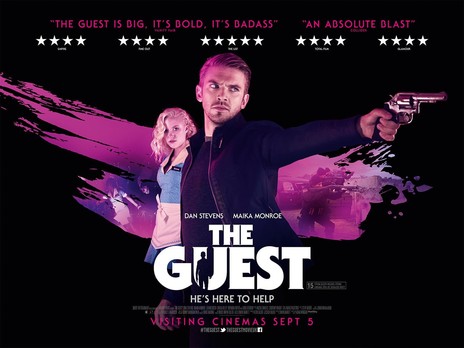
Saturday Matinee: The Guest

The Guest review: A super-sleeper of a black-comedy thriller

By Tara Brady

Source: The Irish Times

Film Title: The Guest

Director: Adam Wingard

Starring: Dan Stevens, Maika Monroe, Brendan Meyer, Lance Reddick

Genre: Crime

Running Time: 99 min

Blue-eyed soldier boy David (Dan Stevens) arrives in a small New Mexican town to visit the family of a fallen comrade. The grieving mom (Sheila Kelley) notices that the young Iraq War veteran has appeared, as if from nowhere, but David’s “yes ma’am” manners soon put her at ease. The family are not in great emotional shape: dad has hit the bottle, teenager Luke is sullen and withdrawn, and his older goth sister Anna (Maika Monroe) stays in her room making mix-tapes.

Might their new guest allow the healing to begin? Perhaps. David soon makes himself useful by tackling Luke’s schoolyard tormentors, hanging out the household washing and carrying kegs around a party Anna attends. But Anna continues to suspect that David is not all that he seems to be.

She has no idea.

Adam Wingard is the mumblegore horror hotshot behind the better bits of the V/H/S portmanteau horror and the 2011 cult favourite You’re Next. The latter’s hefty profit margin – $25 million back from six figures – has allowed the hyphenate director, editor, cinematographer and writer to move up divisions with a budget of more than $1 million.

Being accustomed to producing his earlier, murkier movies for $20,000 or so, Mr Wingard knows well how to get more bang for your buck. Armed with something approaching a real budget, he now puts on one hell of a show. The Guest, a thriller that becomes a horror that transitions into a hilarious truncation of every 1980s action picture and back again, is as extravagant and ambitious a film as you’ll see all year. Picture Commando as a psychological thriller. Imagine Halloween as a theme park ride. Think Drive as a comedy.

A cleverly picked constellation of TV favourites – Downton Abbey’s Dan StevensLA Law’s Sheila KelleyFringe’s Lance Reddick – add some star wattage to an outrageous and outrageously entertaining hybrid.

Stevens keeps a poker-straight face as he delivers some of the year’s funniest lines. Maika Monroe’s screen magnetism is enough to keep Scar-Jo and J-Law awake during the long winter nights.

If Luc Beeson’s Lucy has left you jonesing for something that stands apart from the superheroes and straight-world toughs that populate the movieverse, then The Guest is a most welcome imposition.


Watch the film on Hoopla here: https://www.hoopladigital.com/title/13703180