Monsanto Sues Maui for Direct Democracy, Launches New PR Campaign

maui monsanto protest

By Rebekah Wilce

Source: PR Watch

Residents of Maui County, Hawai’i voted on November 4 to ban the growing of genetically modified (GMO) crops on the islands of Maui, Lanai, and Molokai until scientific studies are conducted on their safety and benefits. Monsanto and Dow Chemical’s unit Mycogen Seeds have sued the county in federal court to stop the law passed by the people.

In Vermont, the Grocery Manufacturers Association (GMA, of which Monsanto and Dow were recently listed as members) has sued the state over its law requiring GMO labels. And Monsanto has a history of suing to prevent consumer labeling regarding its products. The company sued a number of dairies in the 1990s and 2000s for labeling milk free from recombinant bovine growth hormone (rBGH), which Monsanto developed and marketed as Posilac® (sold to Eli Lilly in 2008), the only commercially approved form. Vermont itself is no stranger to such suits. The International Dairy Foods Association sued Vermont for passing a law requiring labeling of milk containing rBGH (Monsanto wrote an amicus brief in support of the plaintiff, and GMA was a plaintiff-appellant) — and it won in federal court.

On the same day that Monsanto said it would challenge the decision of Maui’s citizens to regulate their own land and environment in court, the company also launched a new national advertising campaign as part of an effort to improve the image of the widely reviled company.

The glossy ads portray families of many cultures sitting down to eat gorgeous foods, invoking images more often seen in the pages of Saveur than in the hallways of one of the world’s largest chemical companies.

In addition to print ads in several national magazines and TV ads airing on national cable networks and several local stations in coastal cities, the campaign includes a slick new website launched in September, Discover.Monsanto.com.

The website invites questions from the public. The vast majority are skeptical, if not hostile. Others sound like they were written by Monsanto staff. Predictably, some of the hardest questions, like the one posed by Tim H., “In 2013, how much money has Monsanto spent on lobbyists in DC? What laws were these lobbyists attempting to create/amend and why?” are given short shrift.

Monsanto’s pretty TV ads target moms and millenials, according to the company’s corporate brand lead, Jessica Simmons. Monsanto has even hired a new “director of millenial engagement,” Vance Crowe, 32. He represented the company at a recent South by Southwest Eco conference in Austin, where revelations that Monsanto had paid for a panel of farmers to attend and present generated some excitement, as Tom Philpott reports in Mother Jones.

Crowe told NPR‘s “The Salt” blog, “[T]he challenge with something like SXSW Eco is that it doesn’t do anybody any good if people are so passionate that they’re yelling. The challenge is how can we enter the conversation so that people don’t feel like they have to yell to be heard?” Apparently, Crowe hopes to “enter the conversation” one party at a time. He enthusiastically describes how he and a gay colleague attended sessions on “sustainable fashion” and got invited to parties where they won fans and accolades.

Coincidentally, the front page of Discover.Monsanto.com contains, under “Here’s where we work,” a picture of corn crops being tended in Maui, with the text, “Hawaii’s unique climate allows for three to four growing seasons a year, reducing the time it takes us to develop new products. Our island roots go back more than 45 years.”

The marketing text may indicate the issue at the heart of Monsanto’s lawsuit against Maui. Those multiple growing seasons mean that “about 90 percent of all corn grown in the U.S. is genetically engineered and has been developed partially at Hawaii farms,” according to the Associated Press. Monsanto and the rest of the seed crop industry reap $146.3 million a year in sales from their activities in the state, according to a 2009 USDA report. Now Monsanto would have to substantially downsize its activity in Maui County in order to follow the new law, according to its lawsuit.

Monsanto’s new PR campaign seeks to make its brand approachable to the American consumer. Yet, with 92 percent of Americans demanding that GMO foods be labelled, according to a new Consumer Reports poll, Monsanto and its new millenial hires have their work cut out for them.

Consumer Reports recently put out a study on where GMOs are hiding in your food, including in packages labeled “natural.” You can access the report here.

Rebekah Wilce is a reporter and researcher who directs CMD’s Food Rights Network project.

GMOs: the ‘right to know’ campaign is winning

did-you-know-graph

By Ralph Nader

Source: The Ecologist

Campaigners for the labeling of GMOs in food are winning their battle against corporate America, writes Ralph Nader. No wonder the corporations are fighting back with lawsuits and scare stories … they’re on the back foot, and they know it.

Let us celebrate today the latest initiatives of our nation’s growing food safety movement.

Across the country, consumers are demanding the right to know what is in their food, and labeling of genetically engineered food.

It’s a vibrant and diverse coalition: mothers and grandmothers, health libertarians, progressives, foodies, environmentalists, main street conservatives and supporters of free-market economics.

Last year, a New York Times poll found that a near-unanimous 93% of Americans support such labeling.

FDA: GMO food not proven safe

This is no surprise. Genetically engineered food has yet to be proven safe. In 1998, the US Food and Drug Administration (FDA) admitted in court that it had reached “no dispositive scientific findings” about the risks of genetically engineered foods.

There is no scientific consensus about the risks of eating genetically engineered food, according to a statement last year signed by nearly 300 scientists.

The scientists agree that “Concerns about risks are well-founded” and that a “substantial number” of “animal feeding studies and reviews of such studies … found toxic effects and signs of toxicity” in animals fed genetically engineered food, compared with controls. “Some of the studies give serious cause for concern.”

For example, a review of 19 studies on mammals, published in Environmental Sciences Europe, found that the “data appear to indicate liver and kidney problems” arising from diets of genetically engineered food.

According to Consumers Union senior scientist Michael Hansen PhD, the ability of genetically engineered crops to induce allergic reactions is a major food safety concern.”

GMO risks – many questions, few answers

When it comes to genetically engineered food, there are questions about risks, but no convincing answers. There is no mandatory pre-market safety testing for genetically engineered food.

These questions of risks and safety have festered for years because the big agrichemical companies use their intellectual property rights to deny independent scientists the ability to test genetically engineered crops, or to report their results.

Scientific American called these restrictions on free inquiry “dangerous”. “In a number of cases”the magazine reports“experiments that had the implicit go-ahead from the seed company were later blocked from publication because the results were not flattering.”

When scientists do publish studies adverse to the interests of the big agrichemical companies, they are met with vicious attacks on their credibility, their science and even in their personal lives.

Sixty-four nations have already required labeling of genetically engineered food, including the members of the European Union, Australia, Brazil, Turkey, South Africa, even Russia and China.

Nestlé: it’s no longer business as usual

The food industry is feeling the pressure. Paul Bulcke, CEO of Nestle, the world’s largest food and beverage company, said that “It is not business as usual anymore. Pressure is mounting from all sides and angles.”

Despite the overwhelming popularity of labeling, Congress refused to act, so citizens took up the cause in their own states.

Under heavy corporate lobbying and deceptive TV ads, ballot initiatives for labeling of genetically engineered food were narrowly defeated by 51% – 49% in both California and Washington State. In May, legislation in the California Senate led 19-16, but failed without the 21 vote majority needed for passage.

Finally, on May 8, in a major victory, Vermont approved the first unconditional statewide labeling law for genetically engineered food.“Vermonters take our food and how it is produced seriously, and we believe we have a right to know what’s in the food we buy”, said Gov. Peter Shumlin.

Since then, the food and agrichemical industries have escalated to a full panic. On June 13, the Grocery Manufacturers Association and three other trade associations – the heart of the junk food industry – filed a lawsuit in federal court to block the new Vermont labeling law.

The good news is that people are rushing to Vermont’s defense, including Ben & Jerry’s ice cream, which will re-name one of its flavors ‘Food Fight! Fudge Brownie’ to help fund a vigorous legal defense of Vermont’s new labeling law.

No, GMO labeling will not increase food prices

Elsewhere, industry is spending lavishly against the food movement. In New York State, the Daily News reported that “Trade organizations, farm groups and corporate giants such as Coca-Cola and Kraft have spent millions of dollars on lobbyists and campaign contributions to defeat” labeling of genetically engineered food.

The food industry is quick to scare consumers with the canard that labeling of genetically engineered food will raise food prices. But manufacturers change their labels often, so their claim doesn’t make sense.

It has been debunked in an study by Joanna Shepherd Bailey, a professor at Emory University School of Law, who found that“consumers will likely see no increases in prices” as a result of labeling genetically engineered food.

In Congress, US Rep Mike Pompeo (R-KS) introduced a bill at the behest of the Grocery Manufacturers Association – dubbed by its consumer opponents the ‘Deny Americans the Right-to-Know (DARK) Act’ – to block any federal or state action for labeling of genetically engineered food.

Sometimes, politics is drearily predictable: Can you guess Rep. Pompeo’s largest campaign contributor? You got it: Koch Industries.

Left and Right united can defat the corporate lobbies

But the shame is fully bipartisan: sleazy Democratic lobbyists like former US Senator Blanche Lincoln and Steve Elmendorf are plying their trade for Monsanto and the Grocery Manufacturers Association to keep you from knowing what’s in your food.

Meanwhile, the food disclosure movement is going full speed ahead with ballot initiatives for GMO labeling in Oregon and Colorado, as well aslegislative efforts in many other states.

There’s a great lesson in all this: when left and right join together, they can defeat big corporations and their subservient politicians. That’s the theme of my new book, Unstoppable: The Emerging Left-Right Alliance to Dismantle the Corporate State.

Food labeling is hardly a radical idea. Conservative economists are quick to point out that the free exchange of information about products is crucial to the proper functioning of a free market.

Even Monsanto supported labeling of genetically engineered food in Britain. But it spends millions to oppose labeling here in America. Such is corporate patriotism in the 21st Century: St. Louis-based Monsanto believes the British deserve more consumer rights than Americans do.

Not worried? You ought to be …

There are other reasons to be concerned about genetically engineered crops.

Genetically engineered crops have led to increased use of pesticides. For example, a study by Professor Chuck Benbrook of Washington State University found that between 1996 and 2011, genetically engineered crops have brought an increased use of more than 400 million pounds of pesticides.

Mutating weed resistance is requiring the Monsantos to sell even more powerful herbicides. More details on these backfiring GMO crop technologies are contained in the new book titled The GMO Deceptionedited by Professor Sheldon Krimsky and Jeremy Gruber.

Perhaps most alarming is the corporate control of agriculture in the hands of the world’s largest agrichemical companies – Monsanto, DuPont, Syngenta, Dow, Bayer and BASF.

“The Big 6 chemical and seed companies are working diligently to monopolize the food system at the expense of consumers, farmers and smaller seed companies”said Philip H. Howard, an associate professor at Michigan State University.

Food is love

These companies may be meeting their match in the mothers and grandmothers who have powered the movement for labeling of genetically engineered food. Like Pamm Larry, the pioneering grandmother who came up with the spreading idea reflected by the California ballot initiative for labeling.

Mothers know that food is love. Certainly, my mother did. She taught me early and often about how important it is to eat healthy food. She even wrote about these values in the book, It Happened in the Kitchen.

I’d like to think that she’d feel right at home with the mothers and grandmothers of today’s food movement. I sure do. In some ways, that’s the point: a movement that makes you feel at home, no wonder it is so popular.


Ralph Nader’s latest book is: Unstoppable: the Emerging Left-Right Alliance to Dismantle the Corporate State.


Monsanto’s Dream Bill is a Nightmare for State GMO Labeling Efforts

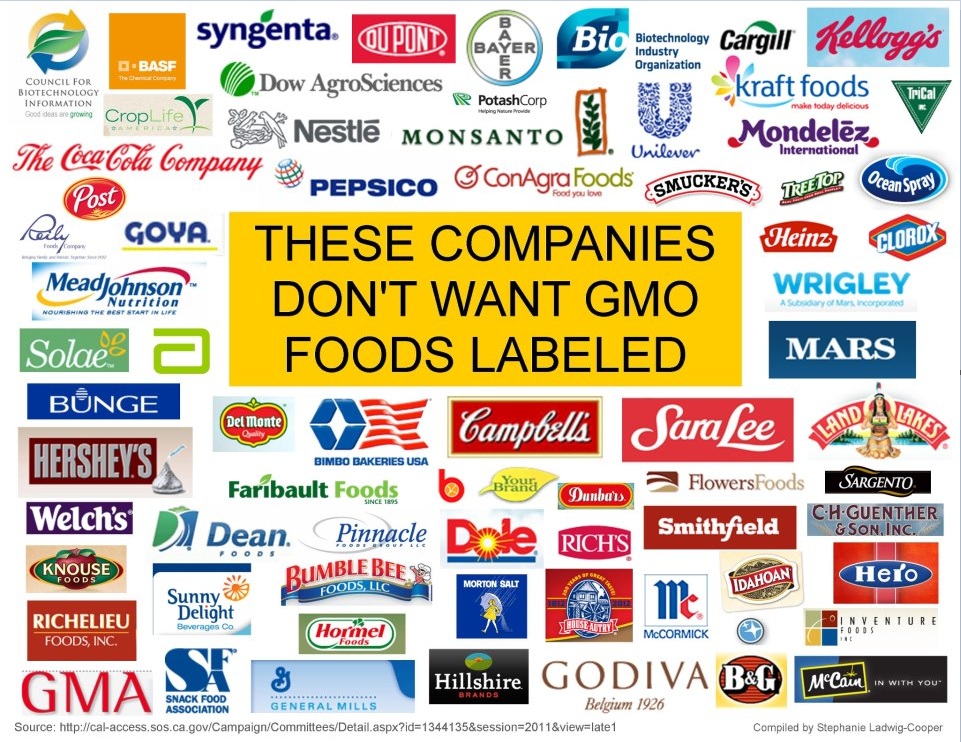
anti_gmo_labeling_companies_0

By Genna Reed

Source: Food & Water Watch

Last week, Representative Mike Pompeo (R-KS) introduced the “Safe and Accurate Food Labeling Act of 2014” (HR 4432), a brainchild of the Grocery Manufacturers Association (GMA) that would serve as a real road block to the thousands of people who have been fighting for the right to know what’s in their food. This piece of legislation would make voluntary (not mandatory) labeling for genetically engineered foods the national standard, ensure that GMOs can be ambiguously labeled as “natural,” create its own rules for non-GMO labeling and, most heinously, preempt all state efforts to require labeling of GMO foods.

We have been aware of the GMA’s plot to move into the GMO labeling policy world since Politico leaked its proposed bill language in January and then the GMA launched its “Safe and Affordable Food Coalition” in February. Unsurprisingly, the GMA found a sponsor who would support all of its original intended language in the bill, resulting in an extremely industry-friendly final version.

So, what is the GMA and why is it so powerful that congressmen do its bidding? Well, this massive trade organization represents 300 of the world’s biggest food and beverage companies as well as agribusinesses like Monsanto, Dow AgroSciences and Syngenta. The GMA and its member companies have poured over $50 million into political action committees to help block GMO labeling ballot initiatives in California and Washington state over the past two years. To illustrate the type of political power GMA is wielding with its big pockets, here’s a paragraph from Food & Water Watch’s new profile on the GMA:

“Between 2001 and 2012, the GMA political action committee donated more than $1 million to federal candidates, political parties and other campaign committees. But it is a much bigger presence roaming the halls of Congress. From 2004 to 2013, the GMA spent $38.9 million lobbying the U.S. Congress and federal officials. In 2013 alone, the GMA spent $14.3 million lobbying on food labeling, country-of-origin labeling, labeling foods with genetically engineered ingredients (commonly known as GMO labeling), food marketing to children and other regulations affecting the food and beverage industry.” 

This kind of spending activity on the GMA’s part makes the food movement’s state-level efforts that much more significant. Not only does it show that grassroots organizing is working to hold elected officials accountable on food issues, but it also shows how work in the states is truly bothering the industry and impacting national policy. It gives us even more reason to keep pressuring our lawmakers to protect consumers because they want the right to know if GMOs are in their food. What consumers definitely don’t want is a voluntary labeling policy created by the very companies who have kept that information from them for 20 years.

Now is the time to stop the GMA from getting its way and fueling its own profit-driven interests. Food & Water Watch will continue to work with the grassroots movement to fight for  GMO labeling around the country. You can take action by telling your members of Congress not to pass Monsanto’s dream bill. For more information on the GMA, you can view our industry profile, here.


Lessons From Washington’s GMO Labeling Campaign

ballot-box-money

As ballots in Washington state are still being counted, current results show that No votes for Ballot Initiative 522 (which would requiring labeling of foods containing GMOs) are leading the Yes votes 54.8% to 45.2%. Though at this point it’s still too close to call, no matter what the outcome there’s important lessons we can learn from the campaign.

Despite increasing awareness of the real dangers of GMOs, thanks largely to independent media and grass-roots organizations, huge influxes of corporate cash can cloud the issue and sway public opinion in an incredibly short period of time. As reported by Al Jazeera:

…in Washington, where television ads of varying levels of accuracy have been running since early September, pro-labeling sentiment has dropped roughly 41 percent in less than 60 days.

Obviously, biotech and processed food companies are extremely alarmed by the notion of people knowing what foods contain GMOs. They must realize there’s enough awareness of the dangers of GMOs for a significant percentage of the population to act on such information and hurt their profits. Why else would they spend a record amount of money in Washington state elections (over $21 million) to defeat I-522? The average donation against I-522 was more than 20,000 times larger than the average donation in support of it. Not surprisingly, the largest percentage was spent by Monsanto. Emma Goldman famously said: “If voting changed anything, they’d make it illegal”. There’s definitely some truth to that, but on the other hand if voting did nothing, corporations like Monsanto wouldn’t spend so much money to influence the outcome.

Not only do they not want the public to know what’s in their foods, they don’t want the public to know who’s spending the money to keep them in the dark. The Grocery Manufacturer’s Association refused to reveal the names of their anti-GMO labeling corporate donors until they were forced to by a lawsuit from the WA State Attorney General. Storylink.com published the following list with respective donation amounts and contact information links:

PepsiCo, Inc. – $1,620,899
Nestle USA Inc. – $1,052,743
The Coca-Cola Company – $1,047,332
General Mills Inc. – $598,819
ConAgra Foods – $285,281
Campbell Soup Company – $265,140
The Hershey Company – $248,305
The J.M. Smucker Company – $241,091
Kellogg Company – $221,852
Mondelez Global LLC – $144,895
Flowers Foods Inc. – $141,288
Abbott Nutrition – $127,459
Pinnacle Foods Group LLC – $120,846
Dean Foods Company – $120,245
McCormick & Company Inc – $102,208
Land O’Lakes, Inc. – $99,803
Cargill Inc. – $98,601
The Hillshire Brands Company – $97,398
Bunge North America, Inc. – $94,993
Bimbo Bakeries USA – $94,693
Del Monte Foods Company – $86,576
Ocean Spray Cranberries Inc. – $55,313
Hormel Foods Corporation – $52,908
Bumble Bee Foods LLC – $36,073
Welch Foods, Inc. $28,859
Shearer’s Foods, Inc. $25,251
Rich Products Corporation – $24,049
Clement Pappas & Company Inc. – $21,043
Sunny Delight Beverages Company – $21,043
Bush Brothers & Company – $16,233
Knouse Foods Cooperative Inc. – $14,429
The Clorox Company – $12,024
Bruce Foods Corporation – $3,006
Moody Dunbar Inc. – $1,804

As can be deduced from this list, there’s probably a lot more GMOs in supermarkets than most people realize. With or without GMO labeling, if one is concerned for personal and planetary health it’d be best to get into the practice of avoiding all processed foods as much as possible and look specifically for foods labeled as “non-GMO”.

As an alternative to the GMO labeling movement, activists such as Jon Rappoport, Mike Adams and others have suggested organizing around banning GMOs as 26 countries have already done and the Los Angeles City Council has recently proposed.

On the lighter side, this should come as no surprise to anyone, but corporate assholes apparently don’t know how to throw a party. While they should’ve been celebrating last night, this is what Seattle’s weekly alternative paper The Stranger reported:

·
MONSANTO DOES NOT KNOW HOW TO THROW A PARTY

8:16 PM
Screen_shot_2013-11-05_at_8.19.36_PM.png

The No on GMO labeling campaign is supposedly hosting a party at the Westin Hotel. They have burned some serious bucks opposing Initiative 522, almost all of it coming from out of state. As for the party? No one is here. There is bottled water, Coca Cola, and cookies on a table. No real food. Seriously, three people in the room—one from Seattle Times. It’s all very strange.

THE MONSANTO MORGUE
8:58 PM

Screen_shot_2013-11-05_at_8.19.36_PM.png

This is what it must feel like to be in a conference room in the Death Star. No one has anything to do. No one is around. But those checking names at the door have to wait and wait like something might happen. Power functions with no one. Power does not need people. People are democracy.