
The Impending Economic Collapse – A Cause of Current Conflict

By Phil Butler

Source: New Eastern Outlook

Brazil’s Luiz Inacio Lula da Silva has called on BRICS nations to create an alternative to replace the dollar in foreign trade. Other experts suggest President Joe Biden’s policies will destroy America’s middle class for good. The news comes when China and Russia strengthen ties with Brazil and Latin America. Brazil’s leader questioned the institution of the U.S. dollar as the world’s trade currency in the first place and asked why each country could not trade in its currency.

This brings to the forefront the historical moment when the gold standard was abolished in favor of the current system. When President Richard Nixon moved to abolish the gold standard as a commitment mechanism, his administration ushered in decades of relative volatility and made hard currency.

The exchange of gold was severely curtailed through the Bretton Woods international monetary agreement of 1944. When the International Monetary Fund was established, the U.S. Dollar became the most potent currency in the world. Initially, the role of the IMF was only to assist with international transactions, but as we see today, that institution has far overstepped its original purpose. Today, the IMF is a leverage arm for the United States and a few European nations to fund countries/regimes that align with its policy. The U.S., for instance, has an almost 20% share of contributions to the fund.

The primary purpose of remaining off the gold standard is that the government can print money endlessly, with two primary goals. First, a massive defense budget and needless proxy wars would not be possible if the United States were on the gold standard. Secondly, the people who control the central banks cannot extract interest on national debts that are currently out of control. So, the fiat currency supposedly backed by the “full faith and credit” of the government, the dollar, is worth what lying politicians and finance ministers say it is.

One look at the worldwide bond market reveals a disturbing imbalance. The U.S., which now has over $51 trillion in outstanding debt, has borrowed more to finance wars and programs than China, Japan, Germany, Italy, France, the U.K., and Canada combined. The American taxpayer is responsible for almost 40% of all the foreign debt in the world. And the outlook for the short and long-term future could be better.

President Joe Biden wants to borrow even more when his administration conducts a proxy war against Russia in Ukraine. With billions flowing into Europe’s most corrupt country, Americans are on the precipice of an economic catastrophe not seen since the Great Depression.

According to the Bipartisan Policy Center in Washington and the Congressional Budget Office, the government will no longer be able to pay everyone — including bondholders, Social Security recipients, and federal employees — sometime this summer or early this fall. A New York Times report from late March outlines the situation. But the problem is far worse than many experts suggest. No matter which way lawmakers move, the U.S. has almost insurmountable fiscal issues. The ramifications will be dire whether or not they raise the debt limit. And if the BRICS countries go off the dollar as a trade currency… Well.

Many experts predict that American greenbacks won’t be worth the printed paper if the world stops using the U.S. dollar as its world currency reserve. Moreover, if the dollar loses its value significantly, every American who owes a credit card loan or a home mortgage will find it ten times harder to pay off those debts.

To make matters worse, millions of jobs will be sacrificed for the Federal Reserve to get any financial stability. Analysis from RSM International shows that the central banks must “induce” a recession to get America’s economic situation in check. And the dollar being made useless by the larger world community was not a factor in their analysis.

The bottom line is if we were still on the gold standard, this would be fine. The gold standard reduced the risks of such economic crises and recessions. Income levels were higher when we were on the bullion-backed system. More importantly, the gold standard created hard limits on printing money and limiting military spending. For more intuition on this, this Barron’s report reveals how our current failing system came into being. The information also serves as a crystal ball for what will happen.

As confidence in the dollar wanes and U.S. policy overseas gets more aggressive toward BRICS nations and others, the tipping point of the American hegemony draws closer.

“The Great Reset” Already Happened

By Charles Hugh Smith

Source: Of Two Minds

Put another way: the elites have cannibalized the system so thoroughly that there’s nothing left to steal, exploit or cannibalize.

The global elites’ techno-fantasy of a completely centralized future, The Great Reset, is addressed as a future project. Too bad it already happened in 2008-09. The lackeys and toadies tasked with spewing the PR are 12 years too late, and so are the critics listening to the PR with foreboding.

Simply put, events outran our understanding of them. The future already manifested while we were trying to cram the present arrangement into an obsolete conceptual framework.

In broad-brush, the post-World War II era ended around 1970. The legitimate prosperity of 1946-1970 was based on cheap oil controlled by the U.S. and the hegemony of the U.S. dollar. Everything else was merely decoration.

The Original Sin to hard-money advocates was America’s abandonment of the gold standard in 1971, but this was the only way to maintain hegemony. Maintaining the reserve currency is tricky, as the nation issuing the reserve currency has to supply the global economy with enough of the currency to grease commerce and stock central bank reserves around the world.

As the global economy expanded, the only way the U.S. could send enough dollars overseas was to run trade deficits, which in a gold standard meant the gold reserves would go to zero as trading partners holding dollars would exchange the currency for gold.

So the choice was: give up the reserve currency and the hegemony of the U.S. dollar by jacking up the dollar’s value so high that imports would collapse, or accept that hegemony was no longer compatible with the gold standard. It wasn’t a difficult decision: who would give up global hegemony, and for what?

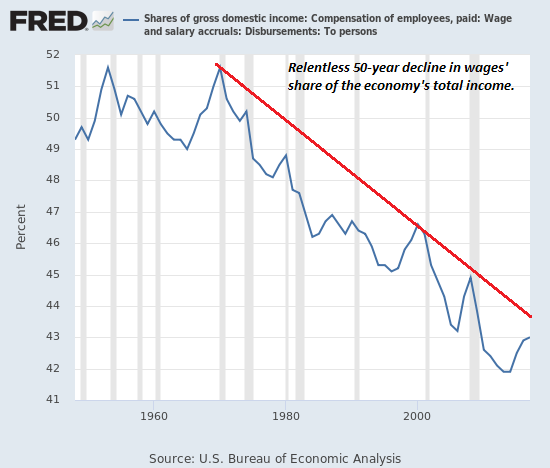
Many other dynamics changed around the same time: social, cultural, political. These charts reflect the end of the postwar era and the ushering in of a new era.

Again in broad-brush, the key economic dynamic was the decline of labor’s share of the economy in favor of capital. Those who had only their labor to sell lost purchasing power, while those who could borrow or access capital benefited enormously. The charts below tell the story: labor’s share of the national income has stairstepped lower for 50 years (since 1970) while the super-wealthy’s share has outpaced everyone else 15-fold.

The dominance of financial capital is visible in the third chart, as private-sector financial assets are now 6 times the nation’s GDP, double the percentage of the postwar era.

This capital-friendly era was rocket-boosted by financialization in the 1980s, technology in the 1990s and globalization in the early 21st century. You can see each advance of capital’s top tier–the top 0.1%–in the chart below: the top 0.1% first pulled away in the 1980s financialization, stutter-stepped in the early 1990s and then exploded higher as technology fueled capital’s leverage and exposure to the gains reaped by computers and the Internet.

Alas, these extremes are not stable or sustainable, and so each wave ends in a devastating crash. The income of the top 0.1% took a hit as the dotcom bubble burst, but then China’s entry into the WTO saved the day as rampant globalization and additional extremes of financial leverage and fraud boosted their fortunes in the 2000s.

The dual extremes of financialization and globalization created the 2008 bubble, and its collapse almost took down the entire global capital house of cards. Central banks, ultimately financed by the Fed to the tune of $29 trillion, twice the size of America’s entire GDP, instituted The Great Reset under the usual guise of “emergency measures” which then became permanent policies.

The Great Reset led to the hyper-centralization of control over the global economy’s money as central banks coordinated unprecedented money-printing and financial repression, which includes zero-interest rate policies (ZIRP), as the debt-bubble would pop if rates aren’t nailed down to zero.

All the PR being spewed about The Great Reset is the final frantic flailing of a system that’s drowning in its own excesses. The 50-year long era of the few enriching themselves as the expense of the many has ended, for the same reason eras of extreme exploitation always end–the elites got too greedy and overshot the economy’s ability to sustain their rapidly expanding share of the income and wealth.

Put another way: the elites have cannibalized the system so thoroughly that there’s nothing left to steal, exploit or cannibalize. The hyper-centralized global money control has run out of rope as the cheap oil is gone, debts have ballooned to the point there is no way they’ll ever be paid down, and the only thing staving off collapse is money-printing, which holds the seeds of its own demise.

Allow me to summarize the only way The Great Reset envisioned by global elites can actually manifest: The Martians arrive towing huge meteorites of pure lithium and gold, and rather than incinerating the global elites, they hand the global elites the meteorites to further their concentration of wealth and power.

Short of that science fiction, this sucker’s going down. The Great Reset has already run its course after 12 long years of artifice, fraud and trickery. So global elite shills, lackeys, factotums, toadies and apparatchiks–prepare for your Wil-E-Coyote moment of truth.