
Hang onto your wallets: Negative interest, the war on cash, and the $10 trillion bail-in

global-economic-crisis

By Ellen Brown

Source: Intrepid Report

Remember those old ads showing a senior couple lounging on a warm beach, captioned “Let your money work for you”? Or the scene in Mary Poppins where young Michael is being advised to put his tuppence in the bank, so that it can compound into “all manner of private enterprise,” including “bonds, chattels, dividends, shares, shipyards, amalgamations . . .”?

That may still work if you’re a Wall Street banker, but if you’re an ordinary saver with your money in the bank, you may soon be paying the bank to hold your funds rather than the reverse.

Four European central banks—the European Central Bank, the Swiss National Bank, Sweden’s Riksbank, and Denmark’s Nationalbank—have now imposed negative interest rates on the reserves they hold for commercial banks; and discussion has turned to whether it’s time to pass those costs on to consumers. The Bank of Japan and the Federal Reserve are still at ZIRP (Zero Interest Rate Policy), but several Fed officials have also begun calling for NIRP (negative rates) [update: Bank of Japan implemented a negative interest rate 1/29/16].

The stated justification for this move is to stimulate “demand” by forcing consumers to withdraw their money and go shopping with it. When an economy is struggling, it is standard practice for a central bank to cut interest rates, making saving less attractive. This is supposed to boost spending and kick-start an economic recovery.

That is the theory, but central banks have already pushed the prime rate to zero, and still their economies are languishing. To the uninitiated observer, that means the theory is wrong and needs to be scrapped. But not to our intrepid central bankers, who are now experimenting with pushing rates below zero.

Locking the door to bank runs: The cashless society

The problem with imposing negative interest on savers, as explained in the UK Telegraph, is that “there’s a limit, what economists called the ‘zero lower bound.’ Cut rates too deeply, and savers would end up facing negative returns. In that case, this could encourage people to take their savings out of the bank and hoard them in cash. This could slow, rather than boost, the economy.”

Again, to the ordinary observer, this would seem to signal that negative interest rates won’t work and the approach needs to be abandoned. But not to our undaunted central bankers, who have chosen instead to plug this hole in their leaky theory by moving to eliminate cash as an option. If your only choice is to keep your money in a digital account in a bank and spend it with a bank card or credit card or checks, negative interest can be imposed with impunity. This is already happening in Sweden, and other countries are close behind. As reported on Wolfstreet.com:

The War on Cash is advancing on all fronts. One region that has hogged the headlines with its war against physical currency is Scandinavia. Sweden became the first country to enlist its own citizens as largely willing guinea pigs in a dystopian economic experiment: negative interest rates in a cashless society. As Credit Suisse reports, no matter where you go or what you want to purchase, you will find a small ubiquitous sign saying “Vi hanterar ej kontanter” (“We don’t accept cash”) . . .

The lesson of Gesell’s decaying currency

Whether negative interests will actually stimulate an economic recovery, however, remains in doubt. Proponents of the theory cite Silvio Gesell and the Wörgl experiment of the 1930s. As explained by Charles Eisenstein in Sacred Economics:

The pioneering theoretician of negative-interest money was the German-Argentinean businessman Silvio Gesell, who called it “free-money” (Freigeld). . . . The system he proposed in his 1906 masterwork, The Natural Economic Order, was to use paper currency to which a stamp costing a small fraction of the note’s value had to be affixed periodically. This effectively attached a maintenance cost to monetary wealth.

. . . [In 1932], the depressed town of Wörgl, Austria, issued its own stamp scrip inspired by Gesell. . . . The Wörgl currency was by all accounts a huge success. Roads were paved, bridges built, and back taxes were paid. The unemployment rate plummeted and the economy thrived, attracting the attention of nearby towns. Mayors and officials from all over the world began to visit Wörgl until, as in Germany, the central government abolished the Wörgl currency and the town slipped back into depression.

. . . [T]he Wörgl currency bore a demurrage rate [a maintenance charge for carrying money] of 1 percent per month. Contemporary accounts attributed to this the very rapid velocity of the currencies’ circulation. Instead of generating interest and growing, accumulation of wealth became a burden, much like possessions are a burden to the nomadic hunter-gatherer. As theorized by Gesell, money afflicted with loss-inducing properties ceased to be preferred over any other commodity as a store of value.

There is a critical difference, however, between the Wörgl currency and the modern-day central bankers’ negative interest scheme. The Wörgl government first issued its new “free money,” getting it into the local economy and increasing purchasing power, before taxing a portion of it back. And the proceeds of the stamp tax went to the city, to be used for the benefit of the taxpayers. As Eisenstein observes:

It is impossible to prove . . . that the rejuvenating effects of these currencies came from demurrage and not from the increase in the money supply. . . .

Today’s central bankers are proposing to tax existing money, diminishing spending power without first building it up. And the interest will go to private bankers, not to the local government.

Consumers today already have very little discretionary money. Imposing negative interest without first adding new money into the economy means they will have even less money to spend. This would be more likely to prompt them to save their scarce funds than to go on a shopping spree.

People are not keeping their money in the bank today for the interest (which is already nearly non-existent). It is for the convenience of writing checks, issuing bank cards, and storing their money in a “safe” place. They would no doubt be willing to pay a modest negative interest for that convenience; but if the fee got too high, they might pull their money out and save it elsewhere. The fee itself, however, would not drive them to buy things they did not otherwise need.

Is there a bigger threat than a sluggish economy?

The scheme to impose negative interest and eliminate cash seems so unlikely to stimulate the economy that one wonders if that is the real motive. Stopping tax evaders and terrorists (real or presumed) are other proposed justifications for going cashless. Economist Martin Armstrong goes further and suggests that the goal is to gain totalitarian control over our money. In a cashless society, our savings can be taxed away by the banks; the threat of bank runs by worried savers can be eliminated; and the too-big-to-fail banks can be assured that ample deposits will be there when they need to confiscate them through bail-ins to stay afloat.

And that may be the real threat on the horizon: a major derivatives default that hits the largest banks, those that do the vast majority of derivatives trading. On November 10, 2015, the Wall Street Journal reported the results of a study requested by Senator Elizabeth Warren and Rep. Elijah Cummings, involving the cost to taxpayers of the rollback of the Dodd-Frank Act in the “cromnibus” spending bill last December. As Jessica Desvarieux put it on the Real News Network, “the rule reversal allows banks to keep $10 trillion in swaps trades on their books, which taxpayers could be on the hook for if the banks need another bailout.”

The promise of Dodd-Frank, however, was that there would be “no more taxpayer bailouts.” Instead, insolvent systemically-risky banks were supposed to “bail in” (confiscate) the money of their creditors, including their depositors (the largest class of creditor of any bank). That could explain the push to go cashless. By quietly eliminating the possibility of cash withdrawals, the central bank can make sure the deposits are there to be grabbed when disaster strikes.

If central bankers are seriously trying to stimulate the economy with negative interest rates, they need to repeat the Wörgl experiment in full. They need to first get some new money into the economy, money that goes directly to the consumers and local businessmen who will spend it. This could be achieved in a number of ways: with a national dividend; or by using quantitative easing for infrastructure or low-interest loans to states; or by funding free tuition for higher education. Consumers will hit the malls when they have some new discretionary income to spend.

Ellen Brown is an attorney, founder of the Public Banking Institute, and author of twelve books including the best-selling Web of Debt. Her latest book, The Public Bank Solution, explores successful public banking models historically and globally. Her 300+ blog articles are at EllenBrown.com. Listen to “It’s Our Money with Ellen Brown” on PRN.FM.

Global House Price Crash Led by Major Cities And Rapid Exit Of Investors

property-market-crash-investwithalex

By Graham Vanbergen

Source: TruePublica

The global house price crash is being led by the most important cities in the world and where they are not falling yet, they soon will be.

The fault lies directly in the lap of central banks as quantitative easing caused an enormous injection of cash into economies, forcing interest rates to fall the their lowest levels in history. This knee-jerk over-reaction effectively halted price corrections that should have fully unfolded but didn’t and put rocket boosters under house price inflation the world over.

With banks and their financial services operations now seen by the public as nothing more than criminal gangs operating with impunity, both legally saved money and laundered cash needed a safe haven. Normal people know nothing about derivatives, day-trading and the like. Property is something most people know something about. Criminals just want to harbour ill gotten gains.

With institutional investors, individuals looking to boost pension incomes, criminals with global reach and an aspirational general public all combined, mountains of cash found their way into property. The international property bubble inflated as the market uncoupled from both the economy and reality.

In Britain, a blinkered Chancellor, unable to see the obvious, supported naive first time buyers in various ways all at the expense of the taxpayer in the hope of winning votes in his 2020 bid. By then the housing market in Britain will have crashed and all his first time buyer voters will be in negative equity for another decade.

It now takes an average skilled worker 14 years to buy a 600q ft one bed apartment in London, the equivalent of renting it for 30 years. What could go wrong?

Sales in London have now dropped by a quarter, prices are already deflating with some commentators blaming new stamp duty/taxation rules imposed for April this year. This is just another reason for the impending decline soon to engulf London and then ripple out to the rest of the country. The average price of a property in Britain is 300 per cent higher today than 20 years ago and that includes the biggest financial crash since the Great Depression.

Hong Kong is experiencing property price falls with most commentators expecting declines of 20 per cent, some at 30 per cent and a few at 40 per cent. The government backed builders to construct rented property to ease the ridiculous prices required to buy an apartment. It took ten years and now rental prices have fallen back just as property investment has taken a nosedive.

In Sydney there’s been a total collapse of business investment and corresponding increase in property investment as Australians got on the ‘get-rich-quick’ bandwagon. Prices are now falling at around 1.5 per cent a month. Not much you might think but by mid 2016, prices could easily be off 12 per cent with no indication of the bottom.

So over-stretched are they in Vancouver it is estimated that a normal price correction of 20 per cent would completely wipe out ten per cent of homeowners. Not surprising as house prices there are by some estimates now 30 per cent overvalued.

America’s most important housing market, San Fransico is about the feel the big house price chill after its epic over-heating. It managed an eye-watering 103 per cent increase in some plush areas in just four years. Affordability has tanked and only the top 10 per cent of earners in the city can now afford to own a home there. If prices fall back to 2008 levels, the 60 to 70 per cent average increase in prices since then could dive with catastrophic consequences.

In The Netherlands just 7 per cent of properties sell for more than the asking price – about the norm for the country. In Amsterdam that figure is about 60 per cent. Housing stock has vaporised and prices today have shot past the 2008 peak. These are the ominous signs of a price correction. Amsterdam may continue to rise for a short while but soon the party will be over.

In Geneva, Switzerland 90 per cent of all household debt is mortgaged. Since 2008, property prices have increased what some might say is a modest 24.3 per cent. Price falls are expected for several reasons; the imposition of a countercyclical capital buffer (CCB) to prevent the real estate market from further overheating, other stricter (mortgage) lending controls and a squeeze on immigration which was causing house price inflation. Switzerland’s mortgage market is 140 per cent of GDP. Expectations are that prices will deflate more slowly, but deflate they will.

The French property market had the dubious distinction of being the most overvalued in Europe in 2011. Even the OECD gave a stern warning that Paris was about to implode – it probably knew best as that is where it’s office are located. Property prices in Paris rose 278 per cent in eleven years to 2011 with two well known French economists predicting steady house price falls for the next ten years totalling 35 per cent to 2025 and a best case scenario of falls until 2020.

What all this says now is obvious. The financial crash in 2008 was caused by reckless banks deliberately overextending mortgage lending that led to the public speculating in the property market. Central banks then pumped trillions of dollars, euros and pounds into the market in order to save the banks. It saved them in part by deliberately inflating property prices.

Investors are now getting out of the game. They know the QE scam is over. As ZeroHedge reportsHow Billionaires Are Investing In 2016: “The Only Winning Move Is Not To Play The Game“. Here they report that the rich and powerful have ended their investment strategies; the only way now is to hold cash, duck and see what happens as the global markets in all asset classes unravel. It confirms what is being said here; that all this ‘funny money’ has created growing distortions in nearly all asset prices—from stocks to bonds to real estate.

The UBS global real estate bubble index for 2016 makes for sobering reading, predicting falls in 10 major cities this year. Fortune reports that the “world is headed for disaster, and will take the prices of equities down with it. How much? Edwards predicts the U.S. stock market could plunge as much as 75%. That would be worse than during the financial crisis, in which stocks from their peak to trough dropped a brutal 62%.”

Even the Oracle of Omaha, Warren Buffet has got this all wrong as his stock is heading south and about to enter ‘bear’ territory.

Bloomberg agrees: “Fed Up Investors Yank Cash From Almost Everything Just Like 2008“.

And what they mean by everything is not just stocks and bonds. The FTGlobal property bubble fears mount as prices and yields spike”. Here the FT reports that returns for rental income (globally) has collapsed when a crash in massively overleveraged property triggered the 2008 international banking crash. Time to get out.

Everyone got into property because prices were expected to beat bond prices, and they did.

When the worlds biggest, wealthiest and most powerful start losing their shirts they rapidly divest to save the proverbial bacon. Result? Asset prices fall and house prices with it. The global house price crash is on and coming to a town near you.

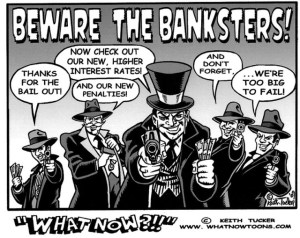
Bank Crimes Pay: Under the Thumb of the Global Financial Mafiocracy

banksters-too-big-to-fail-640x509

By Andrew Gavin Marshall

Source: Occupy.com

On Nov. 13, the United Kingdom’s Serious Fraud Office (SFO) announced it was charging 10 individual bankers, working for two separate banks, Deutsche Bank and Barclays, with fraud over their rigging of the Euribor rates. The latest announcement shines the spotlight once again on the scandals and criminal behavior that have come to define the world of global banking.

To date, only a handful of the world’s largest banks have been repeatedly investigated, charged, fined or settled in relation to a succession of large financial scams, starting with mortgage fraud and the Libor scandal in 2012, the Euribor scandal and the Forex (foreign exchange) rate rigging. At the heart of these scandals, which involve the manipulation of interest rates on trillions of dollars in transactions, lie a handful of banks that collectively form a cartel in control of global financial markets – and the source of worldwide economic and financial crises.

Banks such as HSBC, JPMorgan Chase, Barclays, Bank of America, Citigroup, Deutsche Bank, Royal Bank of Scotland and UBS anchor the global financial power we have come to recognize as fraud. The two, after all, are not mutually exclusive. In more explicit terms, this cartel of banks functions as a type of global financial Mafia, manipulating markets and defrauding investors, consumers and countries while demanding their pound of flesh in the form of interest payments. The banks force nations to impose austerity measures and structural reforms under the threat of cutting off funding; meanwhile they launder drug money for other cartels and organized crime syndicates.

Call them the global Mafiocracy.

In May, six major global banks were fined nearly $6 billion for manipulation of the foreign exchange market, which handles over $5 trillion in daily transactions. Four of the six banks pleaded guilty to charges of “conspiring to manipulate the price of U.S. dollars and euros exchanged.” Those banks were Citigroup, JPMorgan Chase, Barclays and Royal Bank of Scotland, while two additional banks, UBS and Bank of America, were fined but did not plead guilty to the specific charges. Forex traders at Citigroup, JPMorgan Chase and other banks conspired to manipulate currency prices through chat room groups they established, where they arrogantly used names like “The Mafia” and “The Cartel.”

The FBI said the investigations and charges against the big banks revealed criminal behavior “on a massive scale.” The British bank Barclays paid the largest individual fine at around $2.3 billion. But as one trader at the bank wrote in a chat room conversation back in 2010, “If you aint cheating, you aint trying.” The total fines, while numerically large, were but a small fraction of the overall market capitalization of each bank – though the fine on Barclays amounted to some 3.4% of the bank’s market capitalization, the highest percentage by far among the group.

Despite the criminal conspiracy charges covering the years 2007 through 2013, the banks and their top officials continue to lay the blame squarely at the feet of individual traders. Axel Weber, the former president of the German Bundesbank (the central bank of Germany), who is now chairman of Switzerland’s largest bank, UBS, commented that “the conduct of a small number of employees was unacceptable and we have taken appropriate disciplinary actions.”

Looking at the larger scale of bank fines and fraud in the roughly eight years since the global financial crisis, the numbers increase substantially. In addition to a 2012 settlement for mortgage-related fraud in the U.S. housing market, which amounted to some $25 billion, several large banks paid individual fines related to mortgage and foreclosure fraud – including a $16 billion fine for Bank of America, and $13 billion for JPMorgan Chase. Added to these are fines related to the rigging of the Libor rate (the interest rate at which banks lend to each other) and the Forex rigging, as well as money laundering, violating sanctions, manipulating the price of gold, manipulating the U.S. electricity market and assisting tax evasion, among other crimes.

According to a research paper published in June, the total cost of litigation (fines, penalties, settlements, etc.) paid by 16 major global banks since 2010 has reached more than $300 billion. Bank of America paid the most, amounting to more than $66 billion, followed by JPMorgan Chase, Lloyds, Citigroup, Barclays, RBS, Deutsche Bank, HSBC, BNP Paribas, Santander, Goldman Sachs, Credit Suisse, UBS, National Australia Bank, Standard Chartered and Société Générale.

Virtually all of these banks also appear on a list of data, compiled through 2007, revealing them to be among the most interconnected and powerful financial institutions in the world. This core group of corporations forms part of a network of 147 financial institutions that Swiss scientists refer to as the “super-entity,” which, through their various shareholdings, collectively controland own each other and roughly 40% of the world’s 43,000 largest transnational corporations.

In other words, the big banks – along with large insurance companies and asset management firms – do not simply act as a cartel in terms of engaging in criminal activities, but they form a functionally interdependent network of global financial and corporate control. Further, the banks work together in various industry associations and lobbying groups where they officially represent their collective interests.

The largest European banks and financial institutions are represented by the European Financial Services Round Table (EFR), whose membership consists of the CEOs or Chairmen of roughly 25 of the top financial institutions on the continent, including Deutsche Bank, AXA, HSBC, Allianz, RBS, ING, Barclays, BNP Paribas, UBS, and Credit Suisse, among others.

In the United States, the Financial Services Forum (FSF) represents the largest American along with some European banks and financial institutions. The Forum’s membership consists of less than 20 executives, including the CEOs or Chairmen of such firms as Bank of America, Morgan Stanley, JPMorgan Chase, Goldman Sachs, Citigroup, UBS, HSBC, AIG, Bank of New York Mellon, State Street Corporation, Deutsche Bank and Wells Fargo, among others.

And on a truly global scale, there is the Institute of International Finance (IIF), the premier global association representing the financial industry, with a membership of nearly 500 different institutions from more than 70 countries around the world, including banks, insurance companies, asset management firms, sovereign wealth funds, central banks, credit ratings agencies, hedge funds and development banks.

In addition to these various groups and associations, many of the same large banks and their top executives also serve as members, leaders or participants in much more secretive groups and forums – for example, the International Monetary Conference (IMC), a yearly meeting of hundreds of the world’s top bankers hosted by the American Bankers Association, which invites selected politicians, central bankers and finance ministers to attend their off-the-record discussions. In addition, there is the Institut International d’Etudes Bancaires (International Institute of Banking Studies), or IIEB, which brings together the top officials from dozens of Europe’s major financial institutions for discussions with central bankers, presidents and prime ministers in “closed sessions” with virtually no coverage in the media.

These financial institutions are major owners of government debt, which gives them even greater leverage over the policies and priorities of governments. Exercising this power, they typically demand the same thing: austerity measures and “structural reforms” designed to advance a neoliberal market economy that ultimately benefits those same banks and corporations. The banks in turn create the very crises that require governments to bail them out, racking up large debts that banks turn into further crises, pressuring economic reforms in return for further loans. The cycle of crisis and control continues, and all the while, the big banks and financial institutions engage in criminal conspiracies, fraud, manipulation and money-laundering on a massive scale, including acting as the financial services arm of the world’s largest drug cartels and terrorists organizations.

Welcome to the world governed by the global financial Mafiocracy – because if you’re not concerned, you’re not paying attention.