The Ukrainian Solidarity Network: The Highest Stage of White Western Social Imperialism

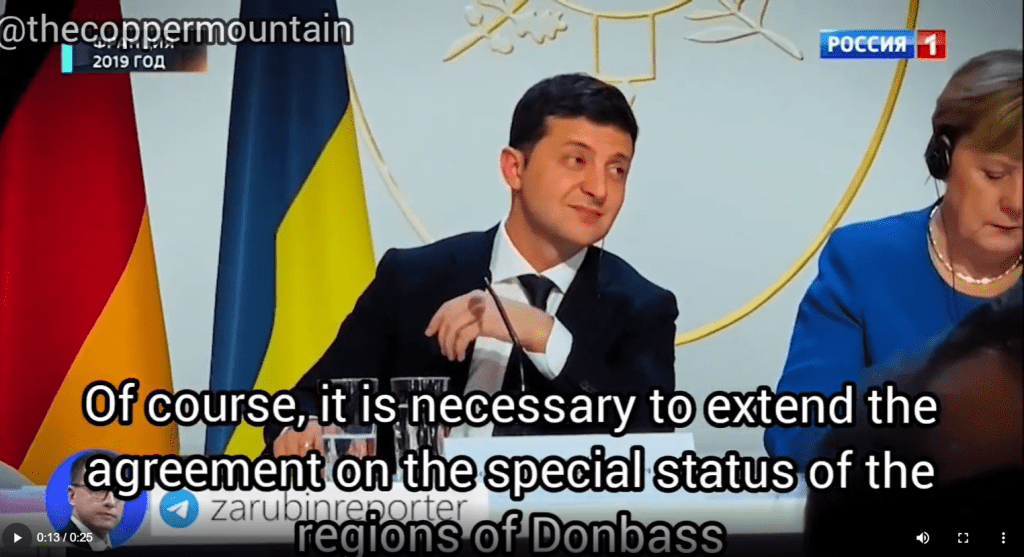
Volodomyr Zelensky smirks at December 2019 meeting in Paris as Vladimir Putin discusses the Minsk Agreement (Image: Telegram Zarubin Reporter)

By Ajamu Baraka

Source: Black Agenda Report

The Ukraine conflict was caused by the U.S. backed right wing coup in 2014 and the duplicity of Europeans who claimed to be working for peace. Anyone who supports these actions but claims leftist credentials must be challenged. 

“It is urgent to end this war as soon as possible. This can only be achieved through the success of Ukraine’s resistance to Russia’s invasion. Ukraine is fighting a legitimate war of self-defense, indeed a war for its survival as a nation. Calling for “peace” in the abstract is meaningless in these circumstances.”(Ukrainian Solidarity Network )

“Social-imperialists,’ that is, socialists in words and imperialists in deeds ( V.I. Lenin) 

“The Western social-imperialist left that is still addicted to its material privileges and illusions of being a part of something called the “West” has a choice that it must make: either you abandon privilege and whiteness and join as class combatants against your bourgeoisie, or you will be considered part of the enemy.” (A.Baraka, The Western Imperial Left’s Collaboration with the Western Bourgeoisie )

The clear implication from this statement issued by the newly formed Ukrainian Solidarity Network is that military victory is the only solution for resolving the conflict in Ukraine. The fact that many of the individuals supporting this network self-identify as leftists, represents a new, perhaps higher form of collaboration with Western and U.S. imperialism that may have ever developed since the end of the second imperialist war in 1945.  I issued an excerpt of my statement in response to the emergence of this network that caused a stir. Here is my statement in full.  

One of the most positive things to emerge from the Collective West’s war in Ukraine is that it helped to expose elements of the U.S. left that have always had a soft, sentimental spot for the West. The arrogance of these Westerners who signed on to this call for more war (see below) is reflected in the fact that they don’t even feel compelled to explain how their morally superior commitment to Ukrainian self-determination against “Putin’s” war is reconciled with the various statements from former German Chancellor Angela Merkel, former French President Francois Hollande and before them, former Ukrainian president Petro Poroshenko revealing that the Minsk agreement was just a delaying tactic to prepare for war. 

We ask the Network as we have been asking Zelensky and Biden, the co-coordinators of the White Lives Matter More Movement, how this phase of the conflict that started in 2014 became Putin’s war? Do we just dismiss as Kremlin propaganda that the Russian Federation felt threatened by what appeared to be the de-facto incorporation of Ukraine into NATO as the Ukrainian army was built into the most formidable fighting force in Europe outside of Russia?

Did the Russians not have any legitimate security concerns with NATO missiles facing them from Romania and Poland, a mere six minutes away from Moscow, and that Ukraine was also making a pitch for “defensive” missiles in Ukraine? And how does the Network characterize the conflict in Eastern Ukraine that started in 2014 and produced over 14,000 deaths when the Ukrainian coup government attacked its own citizens, if the current conflict started in February 2022? What happened to the fascist issue in Ukraine that was written about for years but with even more urgency after the coup in 2014? Did the Kremlin plant those stories in the Western press? 

We understand that these are questions that the organizers of the Ukrainian Network will never answer because they do not have to.  As Westerners they can just postulate an assertion and it is accepted. The Network and the Western bourgeoisie declare that the war in Ukraine is Putin’s war and it becomes objective truth – because that is what the West can do and can get away with. It’s called power – white power perhaps? 

The Ukrainian Solidarity Network is the ultimate expression of social imperialism that has become so normalized in the U.S. and Western Europe that it is no longer even recognized. An example from the statement makes the argument that Ukraine has the “right to determine the means and objectives of its own struggle.” That is a recognized left position. But the social imperialists of the West do not extend that principle and right to nations in the global South. In fact, we ask the signers of this call to explain when the coup government of Ukraine became the representatives of the Ukrainian nation and recognized the sovereign will of the people? 

Therefore, it is not a mere coincidence that the main signatories of this Network statement pledging undying support to Ukraine and its project, are also some of the same “left” forces in the forefront of giving left legitimacy to the charge leveled by Western imperialism that the struggling socialist oriented national liberationist states like Venezuela, Nicaragua, Bolivia are nothing more than “authoritarian” states more interested in power than socialist construction. Some of those forces also cheered on the NATO attack against Libya, passionately defended Western intervention in Syria and have been silent on Western plans to violently invade Haiti. 

For the contemporary neocons in the leadership of the Ukrainian network, their commitment to abstract principles, and certainty that they know more than everyone else, objectively place them in the same ideological camp with Obama, Biden, NATO strategists, the Zelensky clown, and Boris Johnson. But they will argue that their positions are different, since they represent something they call the left. 

For a number of individuals who signed on to this pro-Western, pro-war letter, they are in a familiar place. However, I suspect a few of the individuals on that list were probably confused or not paying attention, not thinking about who they would be affiliated with when they signed on.

That of course, is not the case for some of the key supporters of this initiative. Individuals like the Green Party’s Howie Hawkins, Eric Draitser of Counterpunch, and Bill Fletcher who normally I would not name specifically but because these individuals and the tendency they represent embody the worst of the arrogant, Western left that in so many cases (not all) objectively provides ideological cover ( rightism with left phraseology) for the imperialist program of Western capital –  they should not be allowed continued left respectability without challenge.

These individuals certainly have not hesitated in offering criticisms of those of us who never wavered from our strategic priority to defeat our primary enemy – the Western white supremacist colonial/capitalist patriarchy. For us everything else represents secondary contradictions at this specific historical moment. And is why we reject the arguments these forces advance about fighting dual imperialisms as anti-dialectical nonsense and a political cover.  

History has demonstrated that it would be a complete disaster if the “collective West” secured a military victory in its proxy war with Russia. For the U.S. empire it would validate their doctrine of “Full spectrum dominance” and the wisdom of their commitment to a military-first strategy to support that doctrine. It would mean that war with China was a certainty.

The commitment to global hegemony by the Western colonial/capitalist elite by any means necessary is why the U.S./EU/NATO Axis of Domination represents an existential threat to the vast majority of humanity. A “left” position on Ukraine should at best be to support a negotiated settlement to end the war before the Dr. Strangeloves making policy in the U.S. create the circumstances that will lead to a nuclear confrontation with either Russia or China. 

The position of support for more war guided by the white-boy fantasy of military victory in Ukraine is madness. For Africans/Black folks, we ask, what self-respecting African would consciously place themselves on the same side with NATO, Europe, and the U.S. settler-state in any conflict? The fact that some continue to end up on the same side with our enemies only affirms that they have made a choice, and that choice is to collaborate with our enemies – which sadly, also makes them the enemy.
How America Is Crushing Europe

By Eric Zuesse

Source: Modern Diplomacy

America creates, imposes, and enforces the sanctions against Russia, which are forcing up energy-prices in Europe, and are thereby driving Europe’s corporations to move to America, where taxes, safety-and-environmental regulations, and the rights of labor, are far lower, and so profits will be far higher for the investors. Furthermore, America can supply its own energy. Therefore, supply-chains are less dicey in the U.S. than in Europe. There is less and less reason now for a firm to be doing anything in Europe except selling to Europeans, who are becoming increasingly desperate to get whatever they can afford to buy, now that Russia, which had been providing the lowest-cost energy and other commodities, is being strangled out of European markets, by the sanctions. Money can move even when its owner can’t. The European public will now be left farther and farther behind as Europe’s wealth flees — mainly to America (whose Government had created this capital-flight of Europe’s wealth).

Europe’s leaders have cooperated with America’s leaders, to cause this European decline (by joining, instead of rejecting, America’s sanctions against Russia), but Germany’s companies can also enjoy significant benefits from relocating or expanding in America. Germany’s business daily newspaper, Handlelsblatt, reported, on September 25th, “More and more German companies are expanding their locations in North America: Washington attracts German companies with cheap energy and low taxes. This applies above all to the southern states. Berlin is alarmed – and wants to take countermeasures.” (Original: “Immer mehr deutsche Unternehmen bauen ihre Standorte in Nordamerika aus: Washington lockt deutsche Firmen mit billiger Energie und niedrigen Steuern. Das gilt vor allem für die Südstaaten. Berlin ist alarmiert – und will gegensteuern.”) It says that “Numerous German companies are planning to set up or expand their U.S. locations. … U.S. states such as Virginia, Georgia, and Oklahoma, show increasing interest” in offering special inducements for these firms to relocate, or to at least expand, their production in the U.S. For example, Pat Wilson, Commissioner of the Georgia Department of Economic Development, tells German companies that, “Our energy costs are low, and the networks are stable. … Companies coming to Georgia [from Germany] are reducing their carbon footprint.” Considering that one of the major reasons why Germany’s Government is squeezing-out Russia’s fuel-supplies (other than to ‘support democracy in Ukraine’, etc.) is that those Russian supplies are fossil fuels, an important benefit by which America can attract European firms (even on the basis of ‘Green’ arguments) is by advertising bigger ‘energy efficiency’ than in Europe — not necessarily in a strictly environmental sense, but definitely in the bottom-line sense, of lowered energy-costs, since America’s regulations are far less strict than in the EU. 

Also on the 25th, the Irish Examiner bannered “European industry buckles under weight of soaring energy prices: Volkswagen, Europe’s biggest carmaker, warned last week that it could reallocate production out of Germany and eastern Europe if energy prices don’t come down.”

Also on the 25th, Oil Price dot com headlined “Europe Faces An Exodus Of Energy-Intensive Industries”, and mentioned especially that “the U.S. Steel giant ArcelorMittal said earlier this month that it would slash by half production at a steel mill in Germany and a unit at another plant, also in Germany. The company said it had based the decision on high gas prices. … ArcelorMittal earlier this year announced it had plans to expand a Texas operation.”

On September 26th, the New York Times bannered “Factory Jobs Are Booming Like It’s the 1970s: U.S. manufacturing is experiencing a rebound, with companies adding workers amid high consumer demand for products.” In total, “As of August this year, manufacturers had added back about 1.43 million jobs, a net gain of 67,000 workers above prepandemic levels.” And this is only the start of America’s re-industrialization and economic recovery, because the hemorrhaging of jobs from Europe has only just begun. These German firms are getting in on the ground floor in America, leaving Europe’s workers behind, to swim or sink on their own (the ones that can).

Also on September 26th, Thomas Fazi at unherd dot com headlined “The EU is sleepwalking into anarchy: Its sanctions are crippling the bloc’s working class”, and documented that this hollowing-out of Europe’s economies is being experienced the most by Europe’s lower economic classes, who are the least capable of dealing with it but are being abandoned by the higher-wealth group, the investors, who are sending their money abroad, like banana-republic oligarchs do, and who might easily relocate themselves there too. 

On September 19th, the New York Times headlined “‘Crippling’ Energy Bills Force Europe’s Factories to Go Dark: Manufacturers are furloughing workers and shutting down lines because they can’t pay the gas and electric charges.” For example, a major employer in northern France, Arc International glass factory, doesn’t know whether they will survive: “Nicholas Hodler, the chief executive, surveyed the assembly line, shimmering blue with natural gas flames [gas that came from Russia and that now costs ten times as much as just a year ago]. For years, Arc had been powered by cheap energy that helped turn the company into the world’s largest producer of glass tableware. … But the impact of Russia’s abrupt cutoff of gas to Europe [forced by the sanctions] has doused the business with new risks. Energy prices have climbed so fast that Mr. Hodler has had to rewrite business forecasts six times in two months. Recently, he put a third of Arc’s 4,500 employees on partial furlough to save money. Four of the factory’s nine furnaces will be idled; the others will be switched from natural gas to diesel, a cheaper but more polluting fuel.” The “Green” Parties throughout Europe, such as in the persons of Germany’s Foreign Minister Annalena Baerbock, and Germany’s Minister for Economic Affairs and Climate Action Robert Habeck, had led the European movement against importing Russian fuels, and could turn out to have led Europe actually to increase its carbon footprint, if the end result turns out to be to switch to more coal and diesel fuels, as they now are doing.

It could not have happened without the leaderships both in America and in Europe, who are leading the way for Europe’s economies to decline, and for America’s to boom from this — attracting more and more investors, and their investments, into America, from the U.S. regime’s vassal-nations (such as Germany and France), especially in the EU and NATO (these new banana-republics). The beneficiaries of all this are not only America’s weapons-manufacturing firms, such as Lockheed Martin, and extraction firms such as ExxonMobil, that are growing because of the plunge in Europe that’s due to Europe’s cutting itself off from the cheap energy that it had formerly enjoyed. The future is opening up again, for investors in the United States. It’s come-one, come-all, to investors from Europe, and leaving everyone else in Europe simply to sink, if they can’t get out. 

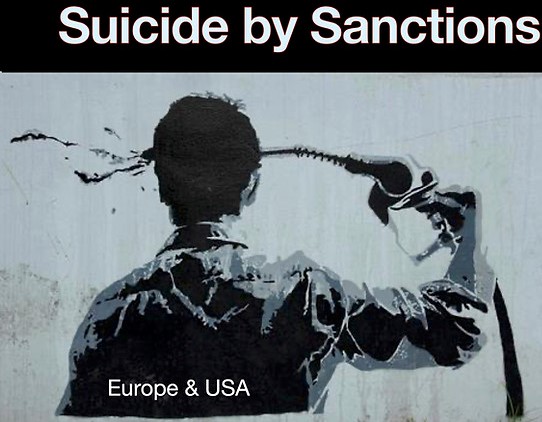
Europe Commits Suicide-By-Sanctions

Relentless Ukraine reporting helps conceal other conflicts

By Ron Paul

Source: Eurasia Review

A Swiss billboard is making the rounds on social media depicting a young woman on the telephone. The caption reads, “Does the neighbor heat the apartment to over 19 degrees (66F)? Please inform us.” While the Swiss government has dismissed the poster as a fake, the penalties Swiss citizens face for daring to warm their homes are very real. According to the Swiss newspaper Blick, those who violate the 66 degree heating limit could face as many as three years in prison!

Prison time for heating your home? In the “free” world? How is it possible in 2022, when Switzerland and the rest of the political west have achieved the greatest economic success in history, that the European continent faces a winter like something out of the dark ages?

Sanctions.

While long promoted – often by those opposed to war – as a less destructive alternative to war, sanctions are in reality acts of war. And as we know with interventionism and war, the result is often unintended consequences and even blowback.

European sanctions against Russia over its invasion of Ukraine earlier this year will likely go down in history as a prime example of how sanctions can result in unintended consequences. While seeking to punish Russia by cutting off gas and oil imports, European Union politicians forgot that Europe is completely dependent on Russian energy supplies and that the only people to suffer if those imports are shut down are the Europeans themselves.

The Russians simply pivoted to the south and east and found plenty of new buyers in China, India, and elsewhere. In fact, Russia’s state-run Gazprom energy company has reported that its profits have increased by 100 percent in the first half of this year.

Russia is getting rich while Europeans are facing a freezing winter and economic collapse. All because of the false belief that sanctions are a cost-free way to force other countries to do what you want them to do.

What happens when the people see dumb government policies making energy bills skyrocket as the economy grounds to a halt? They become desperate and take to the streets in protest.

This weekend thousands of Austrians took to the streets in a “Freedom Rally” to demand an end to sanctions and the opening of Nord Stream II, the gas pipeline on the verge of opening earlier this year. Last week an estimated 100,000 Czechs took to the streets of Prague to protest NATO and EU policy. In France, the “Yellow Vests” are back in the streets protesting the destruction of their economy in the name of “defeating” Russia in Ukraine. In Germany, Serbia, and elsewhere, protests are gearing up.

Even the Washington Post was forced to admit that sanctions on Russia are not having the intended effect. In an article yesterday, the paper worries that sanctions are inflicting “collateral damage in Russia and beyond, potentially even hurting the very countries that impose them. Some even worried that the sanctions intended to deter and weaken Putin could end up emboldening and strengthening him.”

This is all predictable. Sanctions kill. Sometimes they kill innocents in the country targeted for destruction and sometimes they kill innocents in the country imposing them. The solution, as always, is non-intervention. No sanctions, no “color revolutions,” no meddling. It’s really that simple.

‘Rublegas:’ the world’s new resource-based reserve currency

The Russian ruble is sitting pretty right now, having regained its pre-sanctions value and set to become a major commodity currency.Photo Credit: The Cradle

Rublegas is the commodity currency du jour and it isn’t nearly as complicated as NATO pretends. If Europe wants gas, all it needs to do is send its Euros to a Russian account inside Russia.

By Pepe Escobar

Source: The Cradle

Saddam, Gaddafi, Iran, Venezuela – they all tried but couldn’t do it. But Russia is on a different level altogether.

The beauty of the game-changing, gas-for-rubles, geoeconomic jujitsu applied by Moscow is its stark simplicity.

Russian President Vladimir Putin’s presidential decree on new payment terms for energy products, predictably, was misunderstood by the collective west. The Russian government is not exactly demanding straightforward payment for gas in rubles. What Moscow wants is to be paid at Gazprombank in Russia, in its currency of choice, and not at a Gazprom account in any banking institution in western capitals.

That’s the essence of less-is-more sophistication. Gazprombank will sell the foreign currency – dollars or euros – deposited by their customers on the Moscow Stock Exchange and credit it to different accounts in rubles within Gazprombank.

What this means in practice is that foreign currency should be sent directly to Russia, and not accumulated in a foreign bank – where it can easily be held hostage, or frozen, for that matter.

All these transactions from now on should be transferred to a Russian jurisdiction – thus eliminating the risk of payments being interrupted or outright blocked.

It’s no wonder the subservient European Union (EU) apparatus – actively engaged in destroying their own national economies on behalf of Washington’s interests – is intellectually unequipped to understand the complex matter of exchanging euros into rubles.

Gazprom made things easier this Friday, sending official notifications to its counterparts in the west and Japan.

Putin himself was forced to explain in writing to German Chancellor Olaf Scholz how it all works.

Once again, very simple: Customers open an account with Gazprombank in Russia. Payments are made in foreign currency – dollars or euros – converted into rubles according to the current exchange rate, and transferred to different Gazprom accounts.

Thus it is 100 percent guaranteed that Gazprom will be paid.

That’s in stark contrast to what the United States was forcing the Europeans to do: pay for Russian gas in Gazprom accounts in Europe, which would then be instantly frozen. These accounts would only be unblocked with the end of Operation Z, Russia’s military ops in Ukraine.

Yet the Americans want the war to go on indefinitely, to “bog down” Moscow as if this was Afghanistan in the 1980s, and have strictly forbidden the Ukrainian Comedian in front of a green screen somewhere – certainly not Kiev – to accept any ceasefire or peace deal.

So Gazprom accounts in Europe would continue to be frozen.

As Scholz was still trying to understand the obvious, his economic minions went berserk, floating the idea of nationalizing Gazprom’s subsidiaries – Gazprom Germania and Wingas – in case Russia decides to halt the gas flow.

This is ridiculous. It’s as if Berlin functionaries believe that Gazprom subsidiaries produce natural gas in centrally heated offices across Germany.

The new rubles-for-gas mechanism does not in any way violate existing contracts. Yet, as Putin warned, existing contracts may indeed be stopped: “If such [ruble] payments are not made, we will consider this to be the buyers’ failure to perform commitments with all ensuing implications.”

Kremlin spokesman Dmitri Peskov was adamant that the mechanism will not be reversed under the current, dire circumstances. Still that does not mean that the gas flow would be instantly cut off. Payment in rubles will be expected from ‘The Unfriendlies’ – a list of hostile states that includes mostly the US, Canada, Japan and the EU – in the second half of April and early May.

For the overwhelming majority of the Global South, the overarching Big Picture is crystal clear: an Atlanticist oligarchy is refusing to buy the Russian gas essential to the wellbeing of the population of Europe, while fully engaged in the weaponization of toxic inflation rates against the same population.

Beyond Rublegas

This gas-for-rubles mechanism – call it Rublegas – is just the first concrete building block in the construction of an alternative financial/monetary system, in tandem with many other mechanisms: ruble-rupee trade; the Saudi petroyuan; the Iran-Russia SWIFT- bypassing mechanism; and the most important of all, the China-Eurasia Economic Union (EAEU) design of a comprehensive financial/monetary system, with the first draft to be presented in the next few days.

And all of the above is directly linked to the stunning emergence of the ruble as a new, resource-based reserve currency.

After the predictable initial stages of denial, the EU – actually, Germany – must face reality. The EU depends on steady supplies of Russian gas (40 percent) and oil (25 percent). The sanction hysteria has already engineered certified blowback.

Natural gas accounts for 50 percent of the needs of Germany’s chemical and pharmaceutical industries. There’s no feasible replacement, be it from Algeria, Norway, Qatar or Turkmenistan. Germany is the EU’s industrial powerhouse. Only Russian gas is capable of keeping the German – and European – industrial base humming and at very affordable prices in case of long-term contracts.

Disrupt this set up and you have horrifying turbulence across the EU and beyond.

The inimitable Andrei Martyanov has summed it up this way: “Only two things define the world: the actual physical economy, and military power, which is its first derivative. Everything else are derivatives but you cannot live on derivatives.”

The American turbo-capitalist casino believes its own derivative “narrative” – which has nothing to do with the real economy. The EU will eventually be forced by reality to move from denial to acceptance. Meanwhile, the Global South will be fast adapting to the new paradigm: the Davos Great Reset has been shattered by the Russian Reset.

Sit back and watch Europe commit suicide

Washington’s competition with rising power Russia is so fierce, it is willing to sacrifice Europe.Photo Credit: The Cradle

If the US goal is to crush Russia’s economy with sanctions and isolation, why is Europe in an economic free fall instead?

By Pepe Escobar

Source: The Cradle

The stunning spectacle of the European Union (EU) committing slow motion hara-kiri is something for the ages. Like a cheap Kurosawa remake, the movie is actually about the US-detonated demolition of the EU, complete with the rerouting of some key Russian commodities exports to the US at the expense of Europeans.

It helps to have a 5th columnist actress strategically placed – in this case astonishingly incompetent European Commission head Ursula von der Lugen – with her vociferous announcement of a crushing new sanctions package: Russian ships banned from EU ports; road transportation companies from Russia and Belarus prohibited from entering the EU; no more coal imports (over 4.4 billion euros a year).

In practice, that translates into Washington shaking down its wealthiest western clients/puppets. Russia, of course, is too powerful to directly challenge militarily, and the US badly needs some of its key exports, especially minerals. So, the Americans will instead nudge the EU into imposing ever-increasing sanctions that will willfully collapse their national economies, while allowing the US to scoop everything up.

Cue to the coming catastrophic economic consequences felt by Europeans in their daily life (but not by the wealthiest five percent): inflation devouring salaries and savings; next winter energy bills packing a mean punch; products disappearing from supermarkets; holiday bookings almost frozen. France’s Le Petit Roi Emmanuel Macron – perhaps facing a nasty electoral surprise – has even announced: “food stamps like in WWII are possible.”

We have Germany facing the returning ghost of Weimar hyperinflation. BlackRock President Rob Kapito said, in Texas,“for the first time, this generation is going to go into a store and not be able to get what they want.” African farmers are unable to afford fertilizer at all this year, reducing agricultural production by an amount capable of feeding 100 million people.

Zoltan Poszar, former NY Fed and US Treasury guru, current Credit Suisse grand vizir, has been on a streak, stressing how commodity reserves – and, here, Russia is unrivaled – will be an essential feature of what he calls Bretton Woods III (although, what’s being designed by Russia, China, Iran and the Eurasia Economic Union is a post-Bretton Woods).

Poszar remarks that wars, historically, are won by those who have more food and energy supplies, in the past to power horses and soldiers; today to feed soldiers and fuel tanks and fighter jets. China, incidentally, has amassed large stocks of virtually everything.

Poszar notes how our current Bretton Woods II system has a deflationary impulse (globalization, open trade, just-in-time supply chains) while Bretton Woods 3 will provide an inflationary impulse (de-globalization, autarky, hoarding of raw materials) of supply chains and extra military spending to be able to protect what will remain of seaborne trade.

The implications are of course overwhelming. What’s implicit, ominously, is that this state of affairs may even lead to WWIII.

Rublegas or American LNG?

The Russian roundtable Valdai Club has conducted an essential expert discussion on what we at The Cradle have defined as  Rublegas – the real geoeconomic game-changer at the heart of the post-petrodollar era. Alexander Losev, a member of the Russian Council for Foreign and Defense Policy, offered the contours of the Big Picture. But it was up to Alexey Gromov, Chief Energy Director of the Institute of Energy and Finance, to come up with crucial nitty-gritty.

Russia, so far, was selling 155 billion cubic meters of gas to Europe each year. The EU rhetorically promises to get rid of it by 2027, and reduce supply by the end of 2022 by 100 billion cubic meters. Gromov asked “how,” and remarked, “any expert has no answer. Most of Russia’s natural gas is shipped over pipelines. This cannot simply be replaced by Liquified Natural Gas (LNG).”

The risible European answer has been “start saving,” as in “prepare to be worse off” and “reduce the temperature in households.” Gromov noted how, in Russia, “22 to 25 degrees in winter is the norm. Europe is promoting 16 degrees as ‘healthy’, and wearing sweaters at night.”

The EU won’t be able to get the gas it needs from Norway or Algeria (which is privileging domestic consumption). Azerbaijan would be able to provide at best 10 billion cubic meters a year, but “that will take 2 or 3 years” to happen.

Gromov stressed how “there’s no surplus in the market today for US and Qatar LNG,” and how prices for Asian customers are always higher. The bottom line is that “by the end of 2022, Europe won’t be able to significantly reduce” what it buys from Russia: “they might cut by 50 billion cubic meters, maximum.” And prices in the spot market will be higher – at least $1,300 per cubic meter.

An important development is that “Russia changed the logistical supply chains to Asia already.” That applies for gas and oil as well:  “You can impose sanctions if there’s a surplus in the market. Now there’s a shortage of at least 1.5 million barrels of oil a day. We’ll be sending our supplies to Asia – with a discount.” As it stands, Asia is already paying a premium, from 3 to 5 dollars more per barrel of oil.

On oil shipments, Gromov also commented on the key issue of insurance: “Insurance premiums are higher. Before Ukraine, it was all based on the Free on Board (FOB) system. Now buyers are saying ‘we don’t want to take the risk of taking your cargo to our ports.’ So they are applying the Cost, Insurance and Freight (CIF) system, where the seller has to insure and transport the cargo. That of course impacts revenues.”

An absolutely key issue for Russia is how to make the transition to China as its key gas customer. It’s all about the Power of Siberia 2, a new 2600-km pipeline originating in the Russian Bovanenkovo and Kharasavey gas fields in Yamal, in northwest Siberia – which will reach full capacity only in 2024. And, first, the interconnector through Mongolia must be built – “we need 3 years to build this pipeline” – so everything will be in place only around 2025.

On the Yamal pipeline, “most of the gas goes to Asia. If the Europeans don’t buy anymore we can redirect.” And then there’s the Arctic LNG 2 project – which is even larger than Yamal: “the first phase should be finished soon, it’s 80 percent ready.” An extra problem may be posed by the Russian “Unfriendlies” in Asia: Japan and South Korea. LNG infrastructure produced in Russia still depends on foreign technologies.

That’s what leads Gromov to note that, “the model of mobilization-based economy is not so good.” But that’s what Russia needs to deal with at least in the short to medium term.

The positives are that the new paradigm will allow “more cooperation within the BRICS (the emerging economies of Brazil, Russia, India, China and South Africa that have been meeting annually since 2009);” the expansion of the International North South Transportation Corridor (INSTC); and more interaction and integration with “Pakistan, India, Afghanistan and Iran.”

Only in terms of Iran and Russia, swaps in the Caspian Sea are already in the works, as Iran produces more than it needs, and is set to increase cooperation with Russia in the framework of their strengthened strategic partnership.

Hypersonic geoeconomics

It was up to Chinese energy expert Fu Chengyu to offer a concise explanation of why the EU drive of replacing Russian gas with American LNG is, well, a pipe dream. Essentially the US offer is “too limited and too costly.”

Fu Chengyu showed how a lengthy, tricky process depends on four contracts: between the gas developer and the LNG company; between the LNG company and the buyer company; between the LNG buyer and the cargo company (which builds vessels); and between the buyer and the end user.

“Each contract,” he pointed out, “takes a long time to finish. Without all these signed contracts, no party will invest – be it investment on infrastructure or gas field development.” So actual delivery of American LNG to Europe assumes all these interconnected resources are available – and moving like clockwork.

Fu Chengyu’s verdict is stark: this EU obsession on ditching Russian gas will provoke “an impact on global economic growth, and recession. They are pushing their own people – and the world. In the energy sector, we will all be harmed.”

It was quite enlightening to juxtapose the coming geoeconomic turbulence – the EU obsession in bypassing Russian gas and the onset of Rublegas – with the real reasons behind Operation Z in Ukraine, completely obscured by western media and analysts.

A US Deep State old pro, now retired, and quite familiar with the inner workings of the old OSS, the CIA precursor, all the way to the neocon dementia of today, provided some sobering insights:

“The whole Ukraine issue is over hypersonic missiles that can reach Moscow in less than four minutes. The US wants them there, in Poland, Romania, Baltic States, Sweden, Finland. This is in direct violation of the agreements in 1991 that NATO will not expand in Eastern Europe. The US does not have hypersonic missiles now but should – in a year or two. This is an existential threat to Russia. So they had to go into the Ukraine to stop this.  Next will be Poland and Romania where launchers have been built in Romania and are being built in Poland.”

From a completely different geopolitical perspective, what’s really telling is that his analysis happens to dovetail with Zoltan Poszar’s geoeconomics: “The US and NATO are totally belligerent. This presents a real danger to Russia. The idea that nuclear war is unthinkable is a myth. If you look at the firebombing of Tokyo against Hiroshima and Nagasaki, more people died in Tokyo than Hiroshima and Nagasaki. These cities were rebuilt. The radiation goes away and life can restart. The difference between firebombing and nuclear bombing is only efficiency. NATO provocations are so extreme, Russia had to place their nuclear missiles on standby alert. This is a gravely serious matter. But the US ignored it.”

Creating New Enemies

SHANGHAI, CHINA – MAY 20: Russian President Vladimir Putin (L) and Chinese President Xi Jingping (R) attend a welcoming ceremony on May 20, 2014 in Shanghai, China. Putin is on a two day visit to China (Photo by Sasha Mordovets/Getty Images)

By Philip Giraldi

Source: The Unz Review

It should come as no surprise that many observers, from various political perspectives, are beginning to note that there is something seriously disconnected in the fumbling foreign policy of the United States. The evacuation failure in Afghanistan shattered the already waning self-confidence of the American political elite and the continuing on-again off-again negotiations that were by design intended to go nowhere with Iran and Russia provide no evidence that anyone in the White House is really focused on protecting American interests. Now we have an actual shooting war in Ukraine as a result, a conflict that might easily escalate if Washington continues to send the wrong signals to Moscow.

To cite only one example of how outside influences distort policy, in a phone call on February 9th, Israeli Prime Minister Naftali Bennett advised President Joe Biden not to enter into any non-proliferation agreement with Iran. Biden was non-committal even though it is an actual American interest to come to an agreement, but instead he indicated that as far as the US is concerned, Israel could exercise “freedom of action” when dealing with the Iranians. With that concession has ended in all probability the only possible diplomatic success that the Administration might have been able to point to.

The Biden Administration’s by default global security policy is currently reduced to what some critics have described as “encirclement and containment.” That is why an overstretched US military is being tasked with creating ever more bases worldwide in an effort to counter perceived “enemies” who often are only exercising their own national sovereignty and right to security within their own zones of influence. Ironically, when nations balk at submitting to Washington’s control, they are frequently described as “aggressors” and “anti-democratic,” the language that has most particularly been used relating to Russia. The Biden policy, such as it actually exists, appears to be a throwback to the playing field in 1991-2 when the Soviet empire collapsed. It is all about maintaining the old American dream of complete global dominance coupled with liberal interventionism, but this time around the US lacks both the resources and the national will to continue in the effort. Hopefully the White House will understand that to do nothing is better than to make empty threats.

Meanwhile, as the situation continues to erode, it is becoming more and more obvious that the twin crises that have been developing over Ukraine and Taiwan are “Made in Washington” and are somewhat inexplicable as the US does not have a compelling national interest that would justify threats to “leave on the table” military options as a possible response. The Administration has yet again responded to Russian moves by initiating devastating sanctions. But Russia also has unconventional weapons in its arsenal. It can, for starters, shift focus away from Ukraine by intervening much more actively in support of Syria and Iran in the Middle East, disrupting feeble American attempts to manage that region to benefit Israel.

According to economists, Russia has also been effectively sanction-proofing its economy and is capable of selective reverse-sanctioning of countries that support an American initiative with any enthusiasm. Such a response would likely hurt the Europeans much more than it would damage the leadership in the Kremlin. Barring Russian gas from Europe by shutting down Nord Stream 2 would, for example, permit increased sales to China and elsewhere in Asia and would inflict more pain on the Europeans than on Moscow. Shipping US supplied liquid gas to Europe would, for example, cost more than twice the going rate being offered by the Kremlin and would also be less reliable. The European NATO members are clearly nervous and not fully behind the US agenda on Ukraine, largely because there is the legitimate concern that any and possibly all options being considered by Washington could easily produce missteps that would escalate into a nuclear exchange that would be catastrophic for all parties involved.

Apart from the real immediate danger to be derived from the fighting currently taking place in Ukraine, the real long-term damage is strategic. The Joe Biden Administration has adroitly maneuvered itself into a corner while America’s two principal adversaries Russia and China have drawn closer together to form something like a defensive as well as economic relationship that will be dedicated to reducing and eventually eliminating Washington’s assumed role as the global hegemon and rules enforcer.

In a recent article in the New Yorker foreign affairs commentator Robin Wright, who might reasonably described as a “hawk,” declares the new development to be “Russia and China Unveil[ing] a Pact Against America and the West.” And she is not alone in ringing the alarm bell, with former Donald Trump National Security Council (NSC) Russia watcher Anita Hill warning that the Kremlin’s intention is to force the United States out of Europe while former NSC Ukrainian expert Alexander Vindman is advising that military force be used to deter Russia now before it is too late.

Wright provides the most serious analysis of the new developments. She argues that “Vladimir Putin and Xi Jinping, the two most powerful autocrats, challenge the current political and military order.” She describes how, in a meeting between the two leaders before the Beijing Olympics, they cited an “agreement that also challenges the United States as a global power, NATO as a cornerstone of international security, and liberal democracy as a model for the world.” They pledged that there would be “No ‘forbidden’ areas of cooperation” and a written statement that was subsequently produced declared that “Russia and China stand against attempts by external forces to undermine security and stability in their common adjacent regions, intend to counter interference by outside forces in the internal affairs of sovereign countries under any pretext, oppose color revolutions, and will increase cooperation.” Wright notes that there is considerable strength behind the agreement, “As two nuclear-armed countries that span Europe and Asia, the more muscular alignment between Russia and China could be a game changer militarily and diplomatically.” One might add that China now has the world’s largest economy and Russia has a highly developed military deploying new hypersonic missiles that would give it the advantage in any conflict with NATO and the US. Both Russia and China, if attacked, would also benefit because they would be fighting close to their bases on interior lines.

And, of course, not everyone agrees that nudging the United States out of its self-proclaimed hegemonic role would be a bad thing. Former British diplomat Alastair Crooke argues that there will be perpetual state of crisis in the international order until a new system emerges from the status quo that ended the Cold War, and it would be minus the United States as the semi-official transnational rules maker and arbiter. He observes that “The crux of Russia’s complaints about its eroding security have little to do with Ukraine per se but are rooted in the Washington hawks’ obsession with Russia, and their desire to cut Putin (and Russia) down to size – an aim which has been the hallmark of US policy since the Yeltsin years. The Victoria Nuland clique could never accept Russia rising to become a significant power in Europe – possibly eclipsing the US control over Europe.”

What is happening in Europe and Asia should all come down to a very simple realization about the limits of power: America has no business in risking a nuclear war with Russia over Ukraine or with China over Taiwan. The United States has been fighting much of the world for over two decades, impoverishing itself and killing millions in avoidable wars starting with Iraq and Afghanistan. The US government is cynically exploiting memories of old Cold War enemy Russia to create a false narrative that goes something like this: “If we don’t stop them over there, they will be in New Jersey next week.” It is all nonsense. And besides, who made the US the sole arbiter of international relations? It is past time Americans started asking what kind of international order is it that lets the United States determine what other nations can and cannot do.

Worst of all, the bloodshed in Ukraine has all been unnecessary. A little real diplomacy with honest negotiators weighing up real interests could easily have come to acceptable solutions for all parties involved. It is indeed ironic that the burning desire to go to war with Russia demonstrated in the New York Times and Washington Post as well as on Capitol Hill has in fact created a real formidable enemy, tying Russia and China together in an alliance due to their frustration at dealing with a Biden Administration that never seems to know what it is doing or where it wants to go.

Russian bear wants justice

By Batko Milacic for the Saker Blog

Source: The Saker

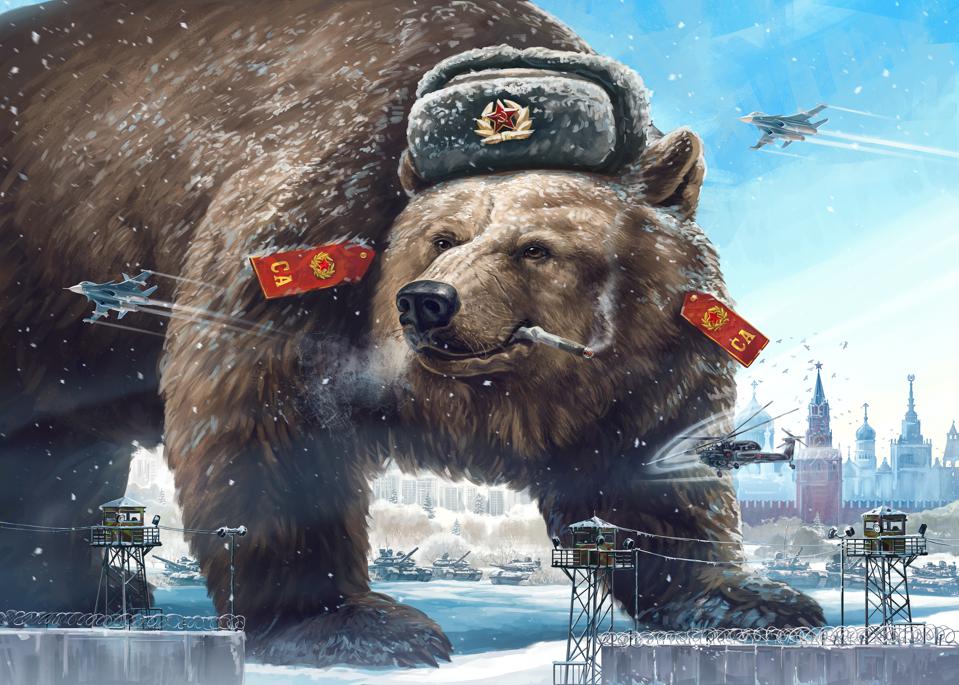
Despite possible sanctions and their hard-hitting economic consequences, the hunted Russian bear has got out of the den and is going after the hunters. Until recently, Russians, Ukrainians, and Europeans believed that there would be no war. What we see now, however, is a full-scale Russian intervention and quite a successful one too. Where are the Russian troops going, and most importantly, why? And where will they stop?

Strengthened since the breakup of the Soviet Union, Russia was quite content with its new status of a leading regional power, and only verbally recalled its glorious imperial past. During the early 2000s, Russia even mulled the possibility of integrating into NATO and the EU, only to see its natural and legitimate interests repeatedly and shamelessly ignored. Millions of Russian-speakers living in the post-Soviet republics were deprived of their right to use their native language, while the Baltic countries and Ukraine profited from the transit of gas, oil, and raw materials. There was even a new “policy of gas pipelines,” when Russia was pressured into make concessions in exchange for being allowed to build a gas pipeline or simply put a stop to the syphoning off of its pipeline gas.

In fact, a resurgent Russia was gradually being presented as a “potential enemy” for the sake of reiterating NATO’s role as a defender against the imagined Russian threat. All this resulted in the 2013 events in Ukraine where nationalists came to power not without outside help, flatly refusing to safeguard the interests of the country’s Russian-speaking population, primarily in eastern Ukraine. Facing the risk of losing its naval base in Sevastopol (existing there since the 18th century) and wishing to protect the Russian-speaking people living in Ukraine, Russia, with the full support of the local population, re-absorbed Crimea and supported the separatists of Donbass. This was followed by Kiev’s ban on the use of the Russian language in the country (not entirely successful, though, since it was the main spoken language of Ukraine) and police persecution of those who advocated a dialogue with Moscow. In its effort to support Ukraine, the West introduced a series of anti-Russian sanctions, which seriously damaged the Russian economy. Still, for the past eight years, Russia was ready for dialogue. In exchange for autonomy for Russian-speakers and guarantees of non-deployment of a NATO infrastructure in eastern Ukraine, Moscow was prepared to roll back its support for the separatists and, possibly, even hold a new referendum in Crimea on its reunification with Russia.

However, during all these eight years, people continued to die along the disengagement line in Donbass, separating Kiev’s armed forces and the separatists (at the rate of more than 100 a year). Meanwhile, Russia was officially branded by Kiev as an “aggressor,” and those in power in Ukraine started to busily prepare for a big war, demanding military and financial assistance from the EU and Washington. And while President Zelensky’s predecessor, the millionaire Petro Poroshenko, was still able to maintain a dialogue with Moscow with the help of the oligarchs, the current president, who came to power on the strength of promises to seek peace and reconciliation, was trying hard to enter NATO and was threatening Russia with missiles deployed near Chernigov (750 km from Moscow). As for the Kremlin, it has spent the past six months trying to negotiate with Brussels, Washington and Zelensky himself. All that Putin was asking for were security guarantees for Russia. In fact, Moscow never really threatened Ukraine but was still being systematically pushed towards a military solution.

It should be noted that prior to the intervention, Putin explained in great detail to his compatriots what was going on, recalling how the borders of the Soviet republics had been cut and how Russian-speaking territories had been handed over to Ukraine. He also made it clear that one cannot talk about a violation of international law after the invasion of Iraq, the bombing of Serbia, the recognition of Kosovo and NATO’s move to the Russian borders.

Let’s be honest: a bear sleeping peacefully in its den was smoked out of there by being poked with a stick, and now they are wondering why it is chasing those who did that. Moscow has been pushed into a corner and is now demonstrating its strength and standing up for its interests. Now Putin will at best be satisfied with a change of guard in Kiev, and at worst, Ukraine as a state will disappear from the map of Europe. Is it possible to justify an aggression that has been provoked for a long time? This is a matter of a lengthy discussion. One thing is clear: 20 years ago, Russia could and wanted to join NATO and united Europe. However, the latter chose to make Russia an enemy…

Related Articles:

From the Black Sea to the East Med, Don’t Poke the Russian Bear – By Pepe Escobar

Scholz Caves on Nord Stream While Putin Throws Donbass a Lifeline – By Mike Whitney

You will NEVER be “fully vaccinated”

It’s time everyone realised they are chasing an impossible goal that will be pushed back over the horizon, forever.

By Kit Knightly

Source: Off-Guardian

Yesterday, in a statement to Parliament on the UK’s planned “vaccine passport”, Health Secretary Sajid Javid admitted the NHS Pass would require three shots for you to be considered “fully vaccinated”.

“Once all adults have had a reasonable chance to get their booster jab, we intend to change this exemption to require a booster dose,”

While many of us predicted this would be the case, it is the first time any British politician has actually said it out loud, and in front of parliament too.

This incredibly cynical “evolving definition” of “fully vaccinated” is not a new phenomenon, and is not isolated to the UK either.

Israel changed their definition of “fully vaccinated” to include the booster months ago. New Zealand’s ministry of health is “considering” doing the same, as is Australia.

The EU isn’t far behind either, with proposals in place to make travel dependent on having a third dose.

The US hasn’t formally adopted a new definition yet, but you’d have to be blind not to see the signs. Just yesterday the LA Times headlined:

Should the definition of ‘fully vaccinated’ be changed to include a booster shot?

An article on Kaiser Health News asks the same thing.

Tony Fauci is quoted in the Independent as saying it’s only a matter of time before the definition is updated:

“It’s going to be a matter of when, not if” getting a booster shot will be considered being “fully vaccinated,” Dr Fauci said.

Opinion pieces are already appearing asking is it safe to hangout with the unboosted”? (This headline was so unpopular, the Atlantic changed it only a couple of hours after it was published).

All in all it seems pretty clear that, by the time 2022 rolls around, most of the Western world will require three shots in order to qualify as “fully vaccinated”.

It’s also clear that this won’t stop at three. Already, just last week, Pfizer were claiming they may need to “move up the timeline” for a fourth vaccine dose.

This change is being blamed on Omicron, with articles warning the “new variant” can “hit” the vaccinated. Fortune reports:

Omicron is making scientists redefine what it means to be ‘fully vaccinated’ against COVID

So, the third (and maybe fourth) doses are (allegedly) for Omicron…but that model can extend to perpetuity. In order to go to five, six or seven they’ll only need to “discover” more “new variants”.

It will just keep going and going.

But there is good news in all this, every time the powers-that-shouldn’t-be change the rules in the middle of the game, it’s a chance to knock people out of their media-induced hypnosis.

There are promising signs that millions of already-vaccinated will reject the booster. We can build on that.

So tell your single and double jabbed friends, try to open their eyes to the path they are starting down.

They may consider themselves “fully vaccinated”, but the government doesn’t, and never will.