
By PM Beers
Source: AntiMedia
All cops are bastards because all cops, if ordered to, will enforce laws that oppress poor people.
Many people would like to believe that there are good cops and bad cops. I’m going to explain why this is simply not true. When we are children, we are ingrained with the belief that police officers are good people who want to help us. Children are taught that if they need help, they should ask a police officer. These early beliefs are so deeply ingrained that it is very hard to shake them off. For me, it took over two years to finally understand the concept of ACAB—all cops really ARE bastards, even if they believe themselves to be good people.
When you learn the history of policing, you will better understand the need to dismantle the inherently racist institution. When we were new to the anti-police brutality movement, we all thought there were good cops and bad cops. As with most binary thinking, this is incorrect. All cops are indeed bastards as they blindly enforce laws which were written to oppress poor people, such as laws against feeding the homeless. The primary role of the first police departments was to catch runaway slaves. Racism is ingrained in policing. Racism is the root cause of police brutality.
There are no good cops. Laws and ethics are not the same thing. Laws don’t prevent crime from happening—people having their needs met does. One cannot be a good person and enforce unjust laws.
Someone once asked me, “But how is the statement ‘ALL cops are bastards’ any different from ‘ALL priests are pedophiles,’ or ‘All women are lousy drivers?’“ Another friend replied, “Nobody is born a cop. Joining that institution is a choice. It’s more akin to saying ‘all KKK are bastards.” Priests are not required to molest children, but cops are required to follow orders which oppress poor people and target people of color.
Every cop must obey orders without question. They are required to enforce unethical laws or risk losing a job that provides them with a comfortable income if they refuse. In the rare occasion that a cop does blow the whistle on an injustice, the thin blue line is immediately invoked and the seemingly well-intentioned cops are ostracized by their peers, almost always neutralizing their intentions.
Some cops think they are actually good people. Of course, they have to think they are good to rationalize what they are doing since in our society, one’s occupation is one’s identity.
We all know that many cops have done horrible things. They have abused their power, murdered people, and attempted to cover up those murders with lies. I’m not going to talk about those obvious injustices that we are already so aware of. I’m going to talk about more subtle ways that cops do unethical things under the color of law. The job of the police is not to protect people but to protect corporate assets.
When a person becomes a police officer, their job is to enforce the laws. Not all laws are good. Police are unthinking, unquestioning robots protecting a corrupt, unjust state. They simply do as they are told without question. The institution of policing is inherently corrupt because they enforce laws which have nothing to do with ethics and everything to do with serving corporate interests.
If your job requires you to do unethical things and you continue to do that job for a paycheck, you have sold out and can no longer consider yourself an ethical person. Every cop has sold their soul for a middle class income. Their price is low.
But wait…what about that one cop who bought groceries for a mom who stole food for her kids?
Yes, that cop did a good thing. That doesn’t erase the unethical things the cop does or would do if given the order. I like to call these types of news stories #copaganda because they are often played by mainstream media to try to get us to think that cops are good people, when in reality, the news stations want to appease police departments so that they can keep access to information for their news stories. TV news folks do unethical things for money, as well, and that’s a whole other rant for another day. If cops did these kinds of things on a daily basis, they wouldn’t be newsworthy. Cops are not as lovely as the TV would have us think they are.
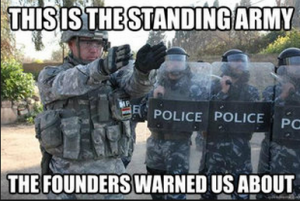
When protests are held, police say they are there to make sure no one gets hurt. Yet on most occasions, they are the ones hurting protesters with batons, “less lethal” bullets, and tear gas. Sometimes, undercover cops are placed into crowds and are sometimes suspected by protesters of being the ones agitating the police. They use actions, such as throwing bottles, in order to give the police an excuse to become violent with the protesters.
Police have to enforce other unjust laws, like the criminalization of the medical use a cannabis. Smoking cannabis harms no one and is a victimless crime. Is it even a crime at all? Filling up jails with pot smokers only has negative consequences on society, as taxpayers are burdened and people prosecuted for drug offenses often have a difficult time finding employment after being released from prison. Children also suffer under the burden of having one less parent to care for them. This lack of need fulfillment leads to more crime as children mature.
Further, according to the LAPD, all cars are now under investigation. License plate scanners mounted on police cars and on light poles track drivers all over Los Angeles. The ACLU and the Electronic Frontier Foundation are currently suing the LAPD to find out how the technology is being used. There is no probable cause to collect such data, making this practice a violation of our civil rights.
Police enforce unjust laws that harass and criminalize people who have no home. Sleep is a primary human need like air, food, and water. Is it ethically permissible to wake someone up at six AM because the only place they can afford to sleep is the sidewalk? Would a good cop do that?
In the summer of 2012, I participated in a sleepful protest in downtown Los Angeles in support of rights for people who didn’t have homes. Every morning, Officer Massey would come honk his horn to wake us up at 6 AM. He was baffled at why I would scream at him every morning. He thought he was a good cop. He had no clue that waking up unhoused people at 6 AM is an unethical thing to do. In his mind, he was just doing his job—just following orders. Officer Massey tried his best to be polite, but what he was doing was still wrong. Is he going to quit his job? What other job is he even qualified to do that can still provide him such a comfortable middle-class income? He is not going to quit his job. Instead, he will rationalize in his mind that he is a good cop. He never once kicked an unhoused person, so isn’t he lovely?
The police are an inherently violent institution where force is used to extort money from poor people and property is stolen. The racism and bias against the oppressed and poor is pervasive. The entire institution is so corrupt and violent that participating in it makes one corrupt and violent by silent consent. It is impossible to be a good person and participate in violence and oppression.
For example, a person unable to pay $150 for a car registration will have that car stolen from them with the assistance of the police. The car will then be held for ransom. If the person who was too poor to pay the $150 can’t pay the ransom, then the car, which has a value of thousands of dollars, will be sold and the state will profit off of the backs of the poor. Anyone willingly accepting money from such an institution that extorts poor people is by default not a good person.
People want to believe they are good without challenging their false beliefs. There are no good cops. Ethical and legal are completely separate things—therefore, there are no good cops as they are required to enforce unethical laws.
Are there decent individuals that become cops? Of course. However, the institution of policing means police officers, by default, are oppressors by occupation—meaning there truly are no good active-duty cops.
What is the alternative to policing? Community policing by the people who live in the community is a viable solution. Further, the situation will be improved by legalizing victimless crimes, making sure everyone’s needs are met, and reducing income inequality.
A conscious cop would think about quitting, realize they are not qualified for any other job that pays anything even close to what they currently get, and would quickly adjust their thinking back into justifying what they are doing.
All cops oppress poor people and are therefore evil. All cops make threats of death and are therefore evil.
Dismantling the institution of policing does not mean anarchy in the context of chaos. The word “anarchy” is a beautiful thing when used in certain contexts where people understand what the word actually means. For me, anarchy means equality, horizontalism, and no false authority. Communities can and should police themselves.
This article (#ACAB: Why the Institution of Policing Makes All Cops Bastards) is free and open source. You have permission to republish this article under a Creative Commons license with attribution to the author and theAntiMedia.org. Tune in! Anti-Media Radio airs Monday through Friday @ 11pm Eastern/8pm Pacific. Help us fix our typos:edits@theantimedia.org.
PM Beers joined Anti-Media as an independent journalist in April of 2014. Her topics of interest include mental illness, neurology, quantum physics, Tourette’s, Autism, compassionate parenting, horizontal democracy, activism, and art. Born in Long Beach, California, she currently resides in Los Angeles, California. Learn more about Beers here!

 After the Crash