By Leanne Italie, AP
Are we naturally good or naturally evil? Cognitive scientist Paul Bloom argues in a new book that we’re both.
In “Just Babies: The Origins of Good and Evil” (Crown), the developmental psychologist and Yale professor takes on the nature of morality and vast research spanning evolutionary biology to philosophy, drawing on everyone from Sigmund Freud to Louis C.K.
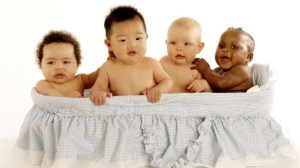
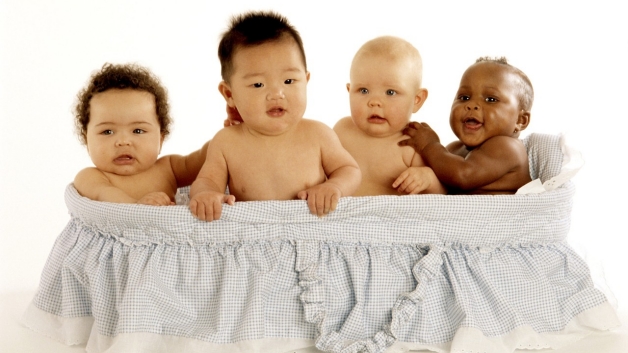
His conclusion? Babies have the capacity for empathy and compassion, possess a limited understanding of justice and have the ability to judge. Yet they navigate not along colour lines but as Us versus Them, usually landing squarely in the Us camp.
A conversation with Paul Bloom:
AP: What light do you shed on the “moral sense” of babies?
Bloom: We’re born with this extraordinary moral sense. A sense of right and wrong just comes naturally to humans and shows up in the youngest babies we can study. But this morality is limited. I think tragically limited. So we are morally attuned to those around us, to our kin, to our friends, to those we interact with, and we are utterly cold-blooded toward strangers. To some extent I think babies are natural-born bigots. They are strongly attuned to break the world into Us versus Them and have no moral feelings at all toward the Them, and this shows up all through development.
So in some way, although a lot of morality is inborn, I think the great success of humans … is expanding and transcending this inborn morality. You and I believe that, you know, not only is it wrong to kill somebody, it’s wrong to kill somebody from anywhere around the world. We might also agree that we’re obliged to help people in trouble, even if they look different from us or are from a different land.
We have notions of fairness and equity and justice that, again, extend more broadly, and although we might favour our own group in some ways, consciously or unconsciously, we’re probably not racist. We probably think that racism is wrong, and that a good moral system should treat all humans more or less the same, but none of that is present in the mind of a baby.
AP: Is it a revelation that we create the environments that can transform a partially moral baby into a very moral adult?
Bloom: I think in some sense it is not. I think any good parent knows that you raise a kid into a moral kid not by, you know, imparting moral lessons and making moral pronouncements, but by shaping the environment in ways that bring out our better selves. When you want to make people good people you don’t just say, ‘Oh, try real hard.’ You try to structure their environment so as to bring out their better aspects.
AP: Is that surprising?
Bloom: I think it’s surprising the extent to which it works and the extent to which the alternative fails. So, for instance, many people believe that giving people moral stories, expressing through literature moral values, has a profound effect on people’s lives. The actual evidence says it has no effect at all. It’s just zero. In fact, there are some studies showing that if you give kids stories about being generous and kind it paradoxically makes them a little bit meaner, roughly between the ages of 4 and 10. Preaching in general with kids often backfires.
AP: Where do serial killers come from?
Bloom: Serial killers are very unusual people. … We know that there’s genetic differences in people’s empathy, in people’s compassion and how much they care about other people, in their ability to control violent rages, for example, and I’m sure a serial killer is somebody who has the genetic short end of the stick. Then you toss in certain environments. Your typical serial killer had a very unhappy childhood.
AP: What about being hard-wired at birth?
Bloom: Some people are more likely to be serial killers than other people due to accidents of genes. I am far more likely to be a murderer or a rapist or a serial killer than you are because I’m a man. There’s some evidence that people who turn out to be psychopaths, even murderous psychopaths, have the short end of the genetic stick but there’s all sorts of environmental factors. … Fifty years ago, slapping one’s wife or raping one’s wife would be viewed as comical, legitimate, certainly not a crime. Now it’s the sort of thing that only a monster would do, and so we have tremendous evidence for profound changes that have nothing to do with genes.
AP: You discuss “hodgepodge morality.” Is there such a thing in babies?
Bloom: I think we naturally have multiple moral systems, multiple responses. Some of our responses are created by disgust, some by empathy, some by a sense of justice, some by a sense of fairness, some by self-interest. We respond to kin, to our family members in different ways than we respond to strangers in all sorts of ways that don’t fall into any elegant philosophical theory. And I think this is true for babies, too.
Babies are moral beings but they aren’t moral philosophers. They don’t have some sort of coherent theory. Rather they have a series of gut reactions, a series of moral triggers that they respond to. What we find in our research is all sorts of moral capacities on the part of babies. What we don’t find is some kind of careful, contemplative theory.
AP: Is that a bad thing?
Bloom: It isn’t. It’s the way we are, one way or another, but if you set yourself the task of constructing a society where everybody lives and everybody follows the same rules and adheres to the same notions, then you do want to some degree a consistent and coherent theory.
So it may be a good theory of psychology to say that a white person naturally cares a lot more toward another white person than toward a black person, and that’s an instinctive response that could develop in certain societies, but from the standpoint of constructing a theory of what actually is good, how we should live our lives, we would say, ‘Well that’s too hodgepodge for us. It’s inconsistent. It’s actually a cruel way for the mind to work.’
AP: You write about conflicts in research on racial bias in young children.
Bloom: For kids there’s a lot of evidence that they’re very strongly biased on Us versus Them if you get them to do it on the basis of things like different colored T-shirts, for example, but race and skin colour isn’t an automatic way of dividing up the world. So you take a two- or three-year-old and typically a two- or three-year-old shows no signs of being racist in any way. When you get older, if kids are in an environment when blacks and whites interact and they’re totally mellow with each other and there’s not much conflict, they’ll see black and white but it won’t matter at all. If you’re in an environment where it matters then it will matter.
Children are extremely prone and very ready to divide the world into groups, but the groups that they focus on is determined through learning.

 After the Crash