
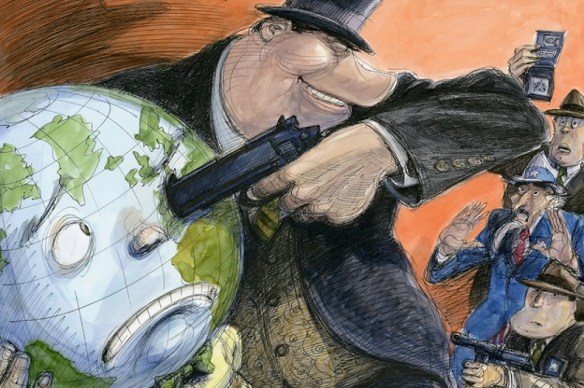
Stagflation Subterfuge: The Real Disaster Hidden By The Pandemic

By Brandon Smith

Source: Alt-Market.us

In recent economic news, headlines are being dominated by concerns over rising bond yields. Increased bond yields are a sign of a possible spike in inflation and, logically, they call for the Federal Reserve to raise interest rates in order to prevent that inflation.

Higher bond yields also mean there is a competitive alternative to stocks for investors – both factors that could trigger a plunge in the stock market.

If one studies the real history behind the stock market crash during the Great Depression, they will find that it was the Federal Reserve’s interest rate hikes that caused and prolonged the disaster after they had created an environment of cheap and easy money throughout the 1920s. Former Chairman Ben Bernanke openly admitted the Fed was responsible back in 2002 in a speech honoring Milton Friedman. He stated:

“In short, according to Friedman and Schwartz, because of institutional changes and misguided doctrines, the banking panics of the Great Contraction were much more severe and widespread than would have normally occurred during a downturn. Let me end my talk by abusing slightly my status as an official representative of the Federal Reserve. I would like to say to Milton and Anna: Regarding the Great Depression. You’re right, we did it. We’re very sorry. But thanks to you, we won’t do it again.”

This then raises the question – inflation or deflation? Will the Fed “do it again?”

Probably not in exactly the same way, but we will see elements of both inflation and deflation soon in the form of stagflation.

It’s a Catch-22 that the central bank has created, and many (including myself) believe that the Fed has created the conundrum deliberately. All central banks are tied together by the Bank for International Settlements (BIS) and the BIS is a globalist institution through and through. The globalist agenda seeks to trigger what they call the “Great Reset,” a complete reformation of the global economy and capitalism into a single one world socialist system… managed by the globalists themselves, of course.

In my view the Fed has always been a kind of institutional suicide bomber; its job is to self-destruct at the right moment and take the U.S. economy down with it, all in the name of spreading its cult-like globalist ideology.

The only unknown at this point is how they will go about their sabotage. Will the central bank continue to allow inflation to explode the cost of living in the U.S., or will they intervene with higher interest rates and allow stock markets to crash?

Either way, we face a serious economic crisis in the near future.


Increasing Inflation Means Economic Recovery?

Mainstream economists will often argue that rising yields and inflation are a “good thing.” They claim this is a sign of rapid economic recovery. I disagree.

If “inflation” was the same as “recovery,” then there would not have been total economic collapses in Argentina in 2002, in Yugoslavia in 1994, or in Weimar Germany in the early 1920s.

I do not see recovery. What I see is the rapid devaluation of the dollar’s buying power due to massive fiat printing through stimulus measures. The Fed and the U.S. government are buying a short-term surge in economic activity, but at a hidden cost. This is a condition that the Dollar Index does not even begin to address, but obvious in prices of necessary goods and commodities.

Keep in mind that all of this is being done in the name of responding to the pandemic. The pandemic is the ultimate excuse for the active destruction of the U.S. economy. Stimulus measures have devolved into helicopter money being thrown about haphazardly as billions are siphoned primarily by major corporations and through fraud. People who are clamoring for a $2,000 relief check from the government have no idea that corporate welfare has been ongoing for the past year along with billions in retroactive tax refunds. All of that money printing is going to cause damage somewhere. It cannot be avoided.


It’s Not About The Pandemic

Let’s make something clear first: The pandemic is NOT the reason for the stimulus flood. The pandemic did very little to hurt actual business in the U.S. Rather, it was the lockdowns that did most of the damage.

Think about that for a moment – federal and state governments crushed the economy through lockdowns, then offered the solution of vast stimulus measures. This in turn is destroying financial stability and generating rapid price inflation.

Conservative states and counties that refused to shut down are recovering at a much faster pace than leftist states which imposed draconian restrictions on citizens. Yet, the lockdowns did nothing to stop the spread of COVID-19 in blue states. So, the lockdowns accomplished no discernible advantage for the public, but they did give the central bank a perfect rationale to further erode the dollar.

This resulting price inflation is something that not even the red states can escape.

For example, home prices are rapidly expanding beyond the market bubble of 2006. This is partially due to millions of people participating in perhaps the largest migration in the U.S. since the Great Depression. Anyone who is able is moving away from major cities into suburban and rural areas. But, home prices also have a historic habit of inflating along with currency devaluation. The cost of maintaining and remodeling an older home, or building a new home, rises as the prices of commodities like lumber inflate.

And lumber prices are certainly inflating! Softwood lumber prices are up at least 110% from a year ago, and are climbing as much as 10% in a week.

Home rentals also do not escape inflation, as the rising cost of maintaining properties forces landlords to increase rents. The only places where rents are decreasing are major cities that Americans are seeking to flee, such as New York and San Francisco.


Inflation In More Than Just Housing

The majority of commodities continue to see price inflation across the board. Food and energy prices have been creeping higher for the past year. Governments are once again blaming the pandemic and “stresses on the supply chain,” which may have been a believable claim nine months ago, but not today. Anything to hide the fact that all that stimulus has inflationary consequences.

Dollar devaluation is the most visible in terms of imported goods. In other words, it costs more dollars to buy goods outside the U.S. as the value of the dollar falls. And since the majority of U.S. retail is supplied by foreign producers, this means that average American consumers will suffer the brunt of inflationary consequences. Public stress and anger will be high.


Pandemic Lockdowns Are Just An Excuse

This is why the COVID-19 lockdowns must continue and the pandemic fear factory must remain active. The globalists need a cover event for the Reset and they need to keep the citizenry under control, and the pandemic can be blamed for just about anything. I think this is why we are already seeing the media hyping the existence of “COVID mutations.” Do not be surprised if the Biden Administration tries to implement a national lockdown sometime this year in the name of stopping the spread of a “more deadly” COVID-19 variant.

It won’t matter that the previous lockdowns were useless and all the data shows that keeping the economy open is a superior policy. It might seem like logic is going completely out the window, but there is a very logical reason for what is happening in the minds of globalists.

Stagflation comes into play through losses in certain sectors of the economy, high unemployment and the inability of wages to keep up with costs.

There is the continued dismantling of the small business sector, which, again, I believe is being destroyed deliberately. It’s not a mistake that small businesses were predominantly targeted as “non-essential” during the lockdowns. It’s also not a coincidence that the majority of COVID-19 PPP loans went to big box corporations while small businesses received almost nothing. The small business sector is being erased, leaving only the corporate sector to provide for consumers.

This may be why Democrats are so adamant about raising the federal minimum wage to $15 an hour. Wages are already rising according to market demand and region. The average non-skilled worker in the U.S. is making around $11 an hour. There is no need for the government to interfere, unless they have ulterior motives.

A $15 minimum wage would likely crush what’s left of small businesses, and only corporations that are receiving the bulk of stimulus dollars will be able to afford to pay workers the higher rate. On top of that, years from now the government could claim they “took action” to front-run stagflation by increasing people’s pay. But a $15 minimum wage is most useful to the establishment in the short term because it muddies the waters on the inflation issue.

Prices will continue to rise due to dollar devaluation, but the media and government will say that it has nothing to do with the dollar and everything to do with companies raising shelf prices to offset increased labor costs.


The Biggest Threat In The History Of American Society

I suspect that the establishment will do everything in its power to distract the public from the biggest threat in the history of American society – the stagflationary time bomb.

If they admit to its existence then the public could prepare for it, and they don’t want that. If Americans were to decentralize their local economies, support local small businesses instead of big box retailers, start producing necessities for themselves, and if they started developing currency alternatives like local scrip backed by commodities… then they would be able to survive a national financial crisis.

In fact, I guarantee that any community, county or state that takes these steps will immediately be targeted by the federal government, further revealing the truth: The establishment wants the public to suffer.

They want economic disaster. They do not want people to have the option of taking care of themselves. They need people scared, desperate and malleable, or they will never achieve their Reset agenda.

Hang onto your wallets: Negative interest, the war on cash, and the $10 trillion bail-in

global-economic-crisis

By Ellen Brown

Source: Intrepid Report

Remember those old ads showing a senior couple lounging on a warm beach, captioned “Let your money work for you”? Or the scene in Mary Poppins where young Michael is being advised to put his tuppence in the bank, so that it can compound into “all manner of private enterprise,” including “bonds, chattels, dividends, shares, shipyards, amalgamations . . .”?

That may still work if you’re a Wall Street banker, but if you’re an ordinary saver with your money in the bank, you may soon be paying the bank to hold your funds rather than the reverse.

Four European central banks—the European Central Bank, the Swiss National Bank, Sweden’s Riksbank, and Denmark’s Nationalbank—have now imposed negative interest rates on the reserves they hold for commercial banks; and discussion has turned to whether it’s time to pass those costs on to consumers. The Bank of Japan and the Federal Reserve are still at ZIRP (Zero Interest Rate Policy), but several Fed officials have also begun calling for NIRP (negative rates) [update: Bank of Japan implemented a negative interest rate 1/29/16].

The stated justification for this move is to stimulate “demand” by forcing consumers to withdraw their money and go shopping with it. When an economy is struggling, it is standard practice for a central bank to cut interest rates, making saving less attractive. This is supposed to boost spending and kick-start an economic recovery.

That is the theory, but central banks have already pushed the prime rate to zero, and still their economies are languishing. To the uninitiated observer, that means the theory is wrong and needs to be scrapped. But not to our intrepid central bankers, who are now experimenting with pushing rates below zero.

Locking the door to bank runs: The cashless society

The problem with imposing negative interest on savers, as explained in the UK Telegraph, is that “there’s a limit, what economists called the ‘zero lower bound.’ Cut rates too deeply, and savers would end up facing negative returns. In that case, this could encourage people to take their savings out of the bank and hoard them in cash. This could slow, rather than boost, the economy.”

Again, to the ordinary observer, this would seem to signal that negative interest rates won’t work and the approach needs to be abandoned. But not to our undaunted central bankers, who have chosen instead to plug this hole in their leaky theory by moving to eliminate cash as an option. If your only choice is to keep your money in a digital account in a bank and spend it with a bank card or credit card or checks, negative interest can be imposed with impunity. This is already happening in Sweden, and other countries are close behind. As reported on Wolfstreet.com:

The War on Cash is advancing on all fronts. One region that has hogged the headlines with its war against physical currency is Scandinavia. Sweden became the first country to enlist its own citizens as largely willing guinea pigs in a dystopian economic experiment: negative interest rates in a cashless society. As Credit Suisse reports, no matter where you go or what you want to purchase, you will find a small ubiquitous sign saying “Vi hanterar ej kontanter” (“We don’t accept cash”) . . .

The lesson of Gesell’s decaying currency

Whether negative interests will actually stimulate an economic recovery, however, remains in doubt. Proponents of the theory cite Silvio Gesell and the Wörgl experiment of the 1930s. As explained by Charles Eisenstein in Sacred Economics:

The pioneering theoretician of negative-interest money was the German-Argentinean businessman Silvio Gesell, who called it “free-money” (Freigeld). . . . The system he proposed in his 1906 masterwork, The Natural Economic Order, was to use paper currency to which a stamp costing a small fraction of the note’s value had to be affixed periodically. This effectively attached a maintenance cost to monetary wealth.

. . . [In 1932], the depressed town of Wörgl, Austria, issued its own stamp scrip inspired by Gesell. . . . The Wörgl currency was by all accounts a huge success. Roads were paved, bridges built, and back taxes were paid. The unemployment rate plummeted and the economy thrived, attracting the attention of nearby towns. Mayors and officials from all over the world began to visit Wörgl until, as in Germany, the central government abolished the Wörgl currency and the town slipped back into depression.

. . . [T]he Wörgl currency bore a demurrage rate [a maintenance charge for carrying money] of 1 percent per month. Contemporary accounts attributed to this the very rapid velocity of the currencies’ circulation. Instead of generating interest and growing, accumulation of wealth became a burden, much like possessions are a burden to the nomadic hunter-gatherer. As theorized by Gesell, money afflicted with loss-inducing properties ceased to be preferred over any other commodity as a store of value.

There is a critical difference, however, between the Wörgl currency and the modern-day central bankers’ negative interest scheme. The Wörgl government first issued its new “free money,” getting it into the local economy and increasing purchasing power, before taxing a portion of it back. And the proceeds of the stamp tax went to the city, to be used for the benefit of the taxpayers. As Eisenstein observes:

It is impossible to prove . . . that the rejuvenating effects of these currencies came from demurrage and not from the increase in the money supply. . . .

Today’s central bankers are proposing to tax existing money, diminishing spending power without first building it up. And the interest will go to private bankers, not to the local government.

Consumers today already have very little discretionary money. Imposing negative interest without first adding new money into the economy means they will have even less money to spend. This would be more likely to prompt them to save their scarce funds than to go on a shopping spree.

People are not keeping their money in the bank today for the interest (which is already nearly non-existent). It is for the convenience of writing checks, issuing bank cards, and storing their money in a “safe” place. They would no doubt be willing to pay a modest negative interest for that convenience; but if the fee got too high, they might pull their money out and save it elsewhere. The fee itself, however, would not drive them to buy things they did not otherwise need.

Is there a bigger threat than a sluggish economy?

The scheme to impose negative interest and eliminate cash seems so unlikely to stimulate the economy that one wonders if that is the real motive. Stopping tax evaders and terrorists (real or presumed) are other proposed justifications for going cashless. Economist Martin Armstrong goes further and suggests that the goal is to gain totalitarian control over our money. In a cashless society, our savings can be taxed away by the banks; the threat of bank runs by worried savers can be eliminated; and the too-big-to-fail banks can be assured that ample deposits will be there when they need to confiscate them through bail-ins to stay afloat.

And that may be the real threat on the horizon: a major derivatives default that hits the largest banks, those that do the vast majority of derivatives trading. On November 10, 2015, the Wall Street Journal reported the results of a study requested by Senator Elizabeth Warren and Rep. Elijah Cummings, involving the cost to taxpayers of the rollback of the Dodd-Frank Act in the “cromnibus” spending bill last December. As Jessica Desvarieux put it on the Real News Network, “the rule reversal allows banks to keep $10 trillion in swaps trades on their books, which taxpayers could be on the hook for if the banks need another bailout.”

The promise of Dodd-Frank, however, was that there would be “no more taxpayer bailouts.” Instead, insolvent systemically-risky banks were supposed to “bail in” (confiscate) the money of their creditors, including their depositors (the largest class of creditor of any bank). That could explain the push to go cashless. By quietly eliminating the possibility of cash withdrawals, the central bank can make sure the deposits are there to be grabbed when disaster strikes.

If central bankers are seriously trying to stimulate the economy with negative interest rates, they need to repeat the Wörgl experiment in full. They need to first get some new money into the economy, money that goes directly to the consumers and local businessmen who will spend it. This could be achieved in a number of ways: with a national dividend; or by using quantitative easing for infrastructure or low-interest loans to states; or by funding free tuition for higher education. Consumers will hit the malls when they have some new discretionary income to spend.

Ellen Brown is an attorney, founder of the Public Banking Institute, and author of twelve books including the best-selling Web of Debt. Her latest book, The Public Bank Solution, explores successful public banking models historically and globally. Her 300+ blog articles are at EllenBrown.com. Listen to “It’s Our Money with Ellen Brown” on PRN.FM.

The U.S. Is At The Center Of The Global Economic Meltdown

maxresdefault

By Brandon Smith

Source: Alt-Market.com

While the economic implosion progresses this year, there will be considerable misdirection and disinformation as to the true nature of what is taking place. As I have outlined in the past, the masses were so ill informed by the mainstream media during the Great Depression that most people had no idea they were actually in the midst of an “official” depression until years after it began. The chorus of economic journalists of the day made sure to argue consistently that recovery was “right around the corner.” Our current depression has been no different, but something is about to change.

Unlike the Great Depression, social crisis will eventually eclipse economic crisis in the U.S. That is to say, our society today is so unequipped to deal with a financial collapse that the event will inevitably trigger cultural upheaval and violent internal conflict. In the 1930s, nearly 50% of the American population was rural. Farmers made up 21% of the labor force. Today, only 20% of the population is rural. Less than 2% work in farming and agriculture. That’s a rather dramatic shift from a more independent and knowledgeable land-utilizing society to a far more helpless and hapless consumer-based system.

What’s the bottom line? About 80% of the current population in the U.S. is more than likely inexperienced in any meaningful form of food production and self-reliance.

The rationale for lying to the public is certainly there. Economic and political officials could argue that to reveal the truth of our fiscal situation would result in utter panic and immediate social breakdown. When 80% of the citizenry is completely unprepared for a decline in the mainstream grid, a loss of savings through falling equities and a loss of buying power through currency destruction, their first response to such dangers would be predictably uncivilized.

Of course, the powers-that-be are not really interested in protecting the American people from themselves. They are interested only in positioning their own finances and resources in the most advantageous investments while using our loss and fear to extract more centralization, more control and more consent. Thus, the hiding of economic decline is enacted because the decline itself is useful to the elites.

And just to be clear for those who buy into the propaganda, the U.S. is indeed in a speedy decline.

In ‘Lies You Will Hear As The Economic Collapse Progresses’, published in summer of last year, I predicted that “Chinese contagion” would be used as the scapegoat for the downturn in order to hide the true source: American wealth destruction. Today, as the Dow and other markets plummet and oil markets tank due to falling demand and glut inventories, all we seem to hear from the mainstream talking heads and the people who parrot them in various forums is that the U.S. is the “only stable economy by comparison” and the rest of the world (mainly China) is a poison to our otherwise exemplary financial health. This is delusional fiction.

The U.S. is the No. 1 consumer market in the world with a 29% overall share and a 21% share in energy usage, despite having only 5 percent of the world’s total population. If there is a global slowdown in consumption, manufacturing, exports and imports, then the first place to look should be America.

Trucking freight in the U.S. is in steep decline, with freight companies pointing to a “glut in inventories” and a fall in demand as the culprit.

Morgan Stanley’s freight transportation update indicates a collapse in freight demand worse than that seen during 2009.

The Baltic Dry Index, a measure of global freight rates and thus a measure of global demand for shipping of raw materials, has collapsed to even more dismal historic lows. Hucksters in the mainstream continue to push the lie that the fall in the BDI is due to an “overabundance of new ships.” However, the CEO of A.P. Moeller-Maersk, the world’s largest shipping line, put that nonsense to rest when he admitted in November that “global growth is slowing down” and “[t]rade is currently significantly weaker than it normally would be under the growth forecasts we see.”

Maersk ties the decline in global shipping to a FALL IN DEMAND, not an increase in shipping fleets.

This point is driven home when one examines the real-time MarineTraffic map, which tracks all cargo ships around the world. For the past few weeks, the map has remained almost completely inactive with the vast majority of the world’s cargo ships sitting idle in port, not traveling across oceans to deliver goods. The reality is, global demand has fallen down a black hole, and the U.S. is at the top of the list in terms of crashing consumer markets.

To drive the point home even further, the U.S. is by far the world’s largest petroleum consumer. Therefore, any sizable collapse in global oil demand would have to be predicated in large part on a fall in American consumption. Oil inventories are now overflowing, indicating an unheard-of crash in energy use and purchasing.

U.S. petroleum consumption was actually lower in 2014 than it was in 1997 and 25% lower than earlier projections predicted. A large part of this reduction in gas use has been attributed to fewer vehicle miles traveled. Though oil markets have seen massive price cuts, the lack of demand continued through 2015.

This collapse in consumption is reflected partially in newly adjusted 4th quarter GDP forecasts by the Federal Reserve, which are now slashed down to 0.7%.  And remember, Fed and government calculate GDP stats by counting government spending of taxpayer money as “production” or “commerce”.  They also count parasitic programs like Obamacare towards GDP as well.  If one were to remove government spending of taxpayer funds from the equation, real GDP would be far in the negative.  That is to say, if the fake numbers are this bad, then the real numbers must be horrendous.

And finally, let’s talk about Wal-Mart. There is a good reason why mainstream pundits are attempting to marginalize Wal-Mart’s sudden announcement of 269 store closures, 154 of them within the U.S. with at least 10,000 employees being laid off. Admitting weakness in Wal-Mart means admitting weakness in the U.S. economy, and they don’t want to do that.

Wal-Mart is America’s largest retailer and largest employer. In 2014, Wal-Mart announced a sweeping plan to essentially crush neighborhood grocery markets with its Wal-Mart Express stores, building hundreds within months. Today, those Wal-Mart Express stores are being shut down in droves, along with some supercenters. Their top business model lasted around a year before it was abandoned.

Some in the mainstream argue that this is not necessarily a sign of economic decline because Wal-Mart claims it will be building 200 to 240 new stores worldwide by 2017. This is interesting to me because Wal-Mart just suffered its steepest stock drop in 27 years on reports that projected sales will fall by 6% to 12% for the next two years.

It would seem to me highly unlikely that Wal-Mart would close 154 stores in the U.S. (269 stores worldwide) and then open 240 other stores during a projected steep crash in sales that caused the worst stock trend in the company’s history. I think it far more likely that Wal-Mart executives are attempting to appease shareholders with expansion promises they do not plan to keep.

I am going to call it here and now and predict that most of these store sites will never see construction and that Wal-Mart will continue to make cuts, either with store closings, employee layoffs or both.

As the above data indicates, global demand is disintegrating; and the U.S. is a core driver.

The best way to sweep all these negative indicators under the rug is to fabricate some grand idea of outside threats and fiscal dominoes. It is much easier for Americans to believe our country is being battered from without rather than destroyed from within.

Does China have considerable fiscal issues including debt bubble issues? Absolutely. Is this a catalyst for global collapse? No. China’s problems are many but if there is a first “domino” in the chain, then the U.S. economy claims that distinction.

China is the largest exporter in the world, not the largest consumer. If anything, a crash in China’s economy is only a REFLECTION of an underlying collapse in U.S. demand for Chinese goods (among others). That is to say, the mainstream dullards have it backward; a crash in China is a herald of a larger collapse in U.S. markets. A crash in China is a symptom of the greater fiscal disease in America. The U.S. is the primary cause; it is not the victim of Chinese contagion. And the crisis in the U.S. will ultimately be far worse by comparison.

I wrote in ‘What Fresh Horror Awaits The Economy After Fed Rate Hike?’, published before Christmas:

“Market turmoil is a guarantee given the fact that banks and corporations have been utterly reliant on near-zero interest rates and free overnight lending from the Fed. They have been using these no-cost and low-cost loans primarily for stock buybacks, purchasing back their own stocks and reducing the number of shares on the market, thereby artificially elevating the value of the remaining shares and driving up the market as a whole. Now that near-zero lending is over, these banks and corporations will not be able to afford constant overnight borrowing, and the buybacks will cease. Thus, stock markets will crash in the near term.

This process has already begun with increased volatility leading up to and after the Fed rate hike. Watch for far more erratic stock movements (300 to 500 points or more) up and down taking place more frequently, with the overall trend leading down into the 15,000-point range for the Dow in the first two quarters of 2016. Extraordinary but short lived positive increases in the markets will occur at times (Christmas and New Year’s tend to result in positive rallies), but shock rallies are just as much a sign of volatility and instability as shock crashes.”

Markets moved immediately into crash territory after the new year began. This was an easy prediction to make and one that I have been reiterating for months — just as the timing of the Fed rate hike was an easy prediction to make, based on the Fed’s history of deliberately increasing instability through bad policy as the economy moves into deflationary spirals. The Fed did it during the Great Depression and is doing it again today.

It is no coincidence that global markets began to tank after the first Fed rate hike; no-cost overnight lending to banks and corporations was the key to maintaining equities in a relatively static position.  As the U.S. loses momentum, the world loses momentum.  As the Fed ends outright stimulation and manipulation, the house of cards falls.

I have said it many times and I’ll say it yet again: If you think the Fed’s motivation is to prolong or protect the U.S. economy and currency, then you will never understand why it takes the policy actions it does. If you understand and accept the fact that the Fed is a saboteur working carefully and incrementally toward the destruction of the U.S. to make way for a new globally centralized system, everything falls into place.

To summarize, the U.S. economy as we know it is not slated to survive the next few years. Read my article ‘The Economic Endgame Explained’ for more in-depth information on why a collapse is being engineered and what the openly admitted goal is, including the referenced 1988 article from The Economist titled “Get Ready A World Currency In 2018,” which outlines the plan for a reduction of the dollar and the U.S. system in order to make way for a global basket reserve currency (Special Drawing Rights).

It is astonishingly foolish to assume that even though the U.S. has held the title of king of global consumption share for decades, that our economy is somehow not a primary faulty part in the sputtering global economic engine.  Economies are falling because demand is falling.   Demand is falling because Americans are not buying.  Americans are not buying because Americans are broke. Americans are broke because central bank policy has created an environment of wealth destruction. This wealth destruction in the U.S. has been ongoing, but only now is it becoming truly visible.  The volatility we see in developing nations is paltry compared to the financial chaos we now face.  Anyone who attempts to dismiss the dangers of a U.S. breakdown or the threat to the unprepared public is either an idiot, or they are trying to divert and distract you from reality. The coming months will undoubtedly verify this.