
Alleged Salas Family Assailant Previously Worked for US/Israeli Intelligence-Linked Firm

The alleged gunmen who killed the son of Esther Salas, the judge recently assigned to the Epstein-Deutsche Bank case, worked for a company of corporate spies and mercenaries with ties to intelligence and also to Deutsche Bank.

By Whitney Webb

Source: Unlimited Hangout

The news of the shooting of the husband and son of Esther Salas, the judge recently assigned to oversee the Jeffrey Epstein – Deutsche Bank case, caused shock and confusion while also bringing renewed scrutiny to the Epstein scandal just a week after Epstein’s main co-conspirator, Ghislaine Maxwell, was denied bail in a separate case.

The case Salas is set to oversee is a class action lawsuit brought by Deutsche Bank investors who allege that Deutsche Bank “failed to properly monitor customers that the Bank itself deemed to be high risk, including, among others, the convicted sex offender Jeffrey Epstein.” The case came after the New York state Department of Financial Services had settled with Deutsche Bank over the bank’s failure to cut ties with Epstein-linked accounts, resulting in Deutsche Bank paying a $150 million fine. Deutsche Bank, unlike other financial institutions, failed to close all of its accounts linked to Epstein until less than a month prior to his arrest last year, even though the bank had identified him as “high risk” years before.

Beyond the tragedy of Sunday’s shooting, which claimed the life of Salas’ only child, the quick discovery of the death of the main suspect, Roy Den Hollander, of a “self-inflicted” gunshot to the head before he could be arrested or questioned by authorities has led to speculation that there is more to the official narrative of the crime than meets the eye.

With law enforcement sources now claiming that Esther Salas was not the intended target of the attack and some media reports now suggesting that Den Hollander’s motive was related to his dislike of feminism, it appears there are efforts underway to distance Sunday’s tragic shooting from Salas’ recent assignment to the Epstein case, which occurred just four days before the tragic shooting.

The most likely reason for any such “damage control” effort lies in the fact that both U.S. law enforcement investigations and mainstream media reports have consistently downplayed the connections of Jeffrey Epstein’s sexual trafficking and financial crimes to intelligence agencies in the U.S. and Israel. Similarly, Roy Den Hollander previously worked for a New York firm has been described as a “private CIA” with ties to those countries’ intelligence agencies and, also, ties to Deutsche Bank.

A Private CIA

According to his website, Den Hollander once worked for Kroll Associates Moscow Office, where he “managed and upgraded Kroll’s delivery of intelligence and security in the former Soviet Union” from 1999 to 2000. A few years prior, Kroll had won a considerable bid from the Russian government to locate money allegedly “spirited out of the country by the directors of state enterprises when they realized that privatization was inevitable.” The Kroll executives in charge of the Russian portfolio prior to Den Hollander were E. Norbett Garrett, a former CIA station chief in Cairo and Kuwait, and Joseph Rosetti, former chief of security for IBM. During that period and prior to his hiring at Kroll, Den Hollender worked as a lawyer in Russia regarding “legal and business issues, including international financing and marketing” and married a Russian woman he met during his time there that he subsequently claimed was part of the “Russian mafia.”

Founded by Jules Kroll in 1972, Kroll Associates would later become known as the “CIA of Wall Street” and “Wall Street’s Private Eye” and was alleged to be an actual front for the CIA by French intelligence agencies, according to theWashington Post. Part of the reason for this nickname, which was once a boasting point for top Kroll executives, owes to the fact that the firm frequently hired former CIA and FBI officers, as well as former members of MI6 and Mossad. K2 Intelligence, the successor to Kroll Associates founded by Jules Kroll and his son Jeremy in 2009, has similar hiring practices, counting former FBI and NSA officials among its ranks alongside former high-ranking members of the Israel Defense Forces (IDF) and Shin Bet, Israel’s domestic intelligence agency. Kroll also boasted ties to the Bush family, with Jonathan Bush (George Bush Sr.’s brother) serving on its corporate advisory board, and Kroll was also employed by Bill Clinton’s first presidential campaign.

Though it is mainly involved in corporate security and investigations, Kroll has also frequently investigated targets of Washington foreign policy, including Saddam Hussein, and was also the company tapped to “reorganize” Enron in 2002. Kroll Associates also has long been a subject of scrutiny for those that question the official narrative on the attacks of September 11, 2001, given that the company was put in charge of security for the World Trade Center complex from 1993 bombing up through the 2001 attacks and has no shortage of ties to companies and individuals that profited from the attacks. Kroll itself experienced a “surge in business” following the events of 9/11, a day when its top executives all avoided going to work despite ostensibly providing security for the complex.

A similar “surge in business” for Kroll followed the 2003 U.S. invasion of Iraq after the company’s investigations into Saddam Hussein’s and the Bath Party’s finances had been used as partial justification for the military incursion. Kroll became a major provider of mercenaries along with companies like Blackwater and DynCorp to the U.S. invasion and subsequent occupation through its subsidiary Kroll Security International. Its clients included the United States Agency for International Development (USAID), which has long fronted for the CIA, and also provided mercenaries for the war in Afghanistan.

Kroll executives over the years have commented to the press on their reputation as a “private CIA” and have also noted the advantages of being a “private” as opposed to “public” intelligence agency. For instance, E. Norbett Garrett, the former CIA official turned Kroll executive, told The New Yorker in 2009 the following:

“Garrett explained the disparity between what Kroll could do and what the C.I.A. could in a place like Sudan. “They have to rely on public and covert sources,” he said. “But we can go straight to Salah Idris. He’s our client, after all. We can go straight to his friends. We can be manipulated, of course, shown incomplete information, and sometimes we have to walk away from a case if we don’t trust somebody. But we definitely have some advantages.”

Kroll Associates and the Epstein Network

Aside from Kroll Associates’ own role as a private intelligence firm, it is also worth pointing out that Jules Kroll had an odd meeting with Robert Maxwell, Ghislaine Maxwell’s father, shortly before his death, alleged by most Maxwell biographers and his family to have been a homicide. Roughly two weeks before his death, Kroll met with Maxwell at New York’s Helmsley Palace Hotel. According to a 1992 article in Vanity Fair, “Maxwell had ushered Kroll and two other men out onto the patio so that their conversation could not be overheard or bugged,” with Maxwell allegedly seeking to hire Kroll to uncover “people out to get him, to destroy his empire, to cripple him financially, and to destroy his life and business in any way they could.”

The article further notes that “the meeting broke up with Maxwell’s promising that he would send Kroll what he called “a memorandum of suspicions and unexplained events.” “Maxwell was working on this compendium,” said the  [anonymous] participant [in the meeting], “when he met his death.” Kroll Associates was never formally hired.”

Much more recently Kroll came under scrutiny after being hired by disgraced media mogul Harvey Weinstein alongside the “private Mossad for hire” firm Black Cube. Weinstein had been instructed to hire Black Cube by Ehud Barak, the former Israeli military intelligence head and Israeli Prime Minister with close ties to Jeffrey Epstein and a frequent visitor of Epstein’s residences. Weinstein hired Kroll to harass and cyberstalk women who had accused him of sexual assault. Weinstein was a one-time business partner of Jeffrey Epstein’s and the testimony of Epstein victim Maria Farmer strongly implies that Ghislaine Maxwell and Epstein “shared” women, and potentially underage girls, with the film producer. The Daily Beast later reported that Epstein had used his ties to Weinstein to impress and recruit potential victims and at least one of those victims landed a role in a film produced by a Weinstein-owned company due to Epstein’s ties to Weinstein.

In addition, Kroll’s long-time executive Vice President for Operations, James Bucknam, was previously chief adviser to former FBI director Louis Freeh and is now CEO of the Freeh Group. Freeh has since become notorious for having been hired by Epstein associate, lawyer Alan Dershowitz, to “investigate” the Epstein scandal, and was also involved in the cover-up of the Penn State child molestation and abuse scandal. Freeh was also director of the FBI when the Bureau declined to investigate accusations regarding Leslie Wexner, Ghislaine Maxwell and Jeffrey Epstein and their involvement in the sex trafficking of minors, first reported to the FBI in 1996 by Maria Farmer.

The Kroll – Deutsche Bank “Revolving Door”

After “retiring” from Kroll associates, Jules Kroll created a credit-rating agency, a field he had called just years earlier “a heck of a racket.” Named the Kroll Bond Rating Agency (KBRA), the firm was envisioned by Kroll as a “credit-rating agency on steroids,” but has failed to make a dent in the market shares of the so-called “Big Three” credit-rating agencies: Standard & Poor’s, Moody’s Investors Service, and Fitch Ratings.

Though it hasn’t managed to become a dominant force in credit ratings, KBRA has managed to be profitable and to have produced something of a “revolving door” between its senior management and Deutsche Bank executives. For instance, KBRA’s top executive in Europe, Mauricio Noé, had previously been a Managing Director of Deutsche Bank’s London branch. In another example, Vice President for Credit Structuring at Deutsche Bank in New York, Ian Ross, was previously employed by KBRA and Yee Cent Wong, managing director of KBRA for CMBS, was previously Vice President of the Credit Solutions Group at Deutsche Bank Securities. Another managing director of KBRA, Bill Baneky, had previously served as Deutsche Bank’s Vice President and National Relationship Manager. One of KBRA’s senior managing directors, Rosemary Kelley, is also a former Deutsche Bank Vice President, while another, Ken Kockenmeister, was Deutsche Bank’s Director for Large Loan Securitization and Underwriting.

While they may not be the “biggest” credit-rating agency, KBRA analysts and executives frequently speak to media outlets where they comment on the state of various businesses, Deutsche Bank among them. Given the amount of overlap between Deutsche Bank and KBRA, it is unsurprising that KBRA has lobbied in the press on Deutsche’s behalf. For instance, KBRA analyst Christopher Whalen told Business Insider in 2016 that “The problem with Deutsche Bank may be the end of Merkel’s career,” adding that “The question is does she want to be remembered for doing the right thing — which is to provide support for the bank and diffuse the situation — or does she want to be remembered for standing by when one of the largest banks in Europe failed?”

Jeffrey Epstein’s ties to Deutsche Bank go back decades, and potentially earlier. After working for Bear Stearns earlier in his career and then as a so-called “financial bounty hunter” with ties to intelligence-linked arms dealers and Wall Street, Epstein set up a Ponzi scheme with Steve Hoffenberg called Tower Financial, which collapsed in 1993 and subsequently landed Hoffenberg 20 years in prison. Epstein’s name, despite being a clear co-conspiractor, was suspiciously dropped from the case during the trial. Hoffenberg subsequently alleged that Epstein used his ill-gotten gains from Tower Financial alongside a series of suspect loans from Deutsche Bank to create his investment company.

Hoffenberg subsequently told The Observer the following:

“His lead bank is Deutsche Bank, Germany, that runs the lead on his financial trust company. They run the platform in the trading of the currencies for Epstein and with Epstein. He’s never disclosed to the investors that provide the money to Deutsche Bank his true legacy, that’s securities fraud.”

Following that point, Epstein’s financial activities, aside from his Deutsche Bank-enabled investment vehicle, were publicly conducted through Bear Stearns (until its 2008 collapse) and J.P. Morgan. When J.P. Morgan dropped Epstein as a client, he again turned to Deutsche Bank in 2013, becoming a client of the bank’s private wealth division in New York. Anti-money laundering compliance officers at the bank’s branches in New York and Florida subsequently flaggedEpstein’s accounts in 2015, in 2016 and again in 2019, creating suspicious activity reports regarding the movements of large amounts of funds tied to Epstein-linked accounts outside of the U.S.

However, the bank did not fully terminate their relationship with Epstein until June 2019, just a few weeks prior to his arrest last year. Epstein was believed to have dozens of accounts with the bank at one point and those accounts were shut down slowly over a period of several months beginning in late 2018.

Ties that Bind

The narrative emerging that Den Hollander was motivated to kill Esther Salas’ husband and sons due to his hatred of feminism is a rapid attempt to explain away a story that clearly warrants further investigation, albeit into avenues that mainstream media and powerful individuals in the public and private sectors prefer remain untouched.

As the heinous act targeting the Salas family has shown, individuals with a lot to lose are willing to go to the farthest extremes to keep the ties of Epstein to the financial sector and to intelligence out of sight and out of mind. Indeed, just last December, Epstein’s personal banker at Deutsche Bank, Thomas Bowers, the chief of Deutsche Bank’s Private Wealth Management division in New York from 2012 to 2015, was found dead in his home. His death was quickly ruled a suicide by hanging. Bowers had also signed off on “unorthodox” loans, not just for Epstein, but Donald Trump, who has his own ties to the Epstein scandal.

While some have been quick to point out that Trump (as well as his son-in-law Jared Kushner) could stand to lose from potential revelations in the Epstein-Deutsche Bank trial, there are other key power-brokers tied to both Epstein and Deutsche Bank who could also be feeling the heat. For instance, Lynn Forester de Rothschild, who became close to Epstein in the early 1990s and subsequently connected him to the Clinton White House and later to Alan Dershowitz, is intimately involved in the Deutsche Bank Microfinance Consortium.

Aside from Epstein’s use of the money, Deutsche Bank has been notorious for years as a cesspool of money launderingfor organized crime networks, paying $14.5 billion in fines in just seven years for official action taken against the bank by several governments. It is highly likely that the brutality of what happened outside the Salas family home on Sunday is more related to Deutsche Bank than Epstein, as numerous powerful individuals have ties to the embattled bank.

Even the recent move by Attorney General William Barr to remove SDNY District Attorney Geoffrey Berman from his post appears to be more related to Berman’s efforts to investigate Deutsche Bank than the Epstein scandal, as some have alleged. This is because Barr’s new pick for Berman’s old job counts Deutsche Bank among his former clients and notably defended the bank in a recent anti-money laundering probe, whereas Berman was investigating the bank (albeit for political reasons that took aim at the bank’s dealings with Trump).

While Epstein’s egregious and criminal actions targeting minors have now become public knowledge, in role in facilitating white collar crime, money laundering and financial frauds on behalf of corporations, governments and oligarchs remains sorely under-covered, despite his role in such activities preceding and continuing after his involvement in an intelligence-linked sexual blackmail operation.

It arguably remains one of the key components of the Epstein scandal, yet the most poorly understood and most under-investigated. If anything, the tragic events at the Salas family home on Sunday, and what appears to be a rapid yet shoddy cover-up of the shooter’s ties to Kroll Associates and actual motives, reveal that Epstein’s financial ties are more frightening to certain powerful individuals and institutions than his trove of sexual blackmail.
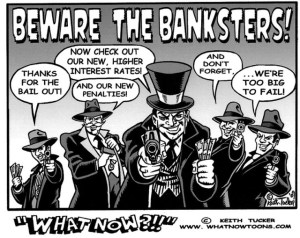
Bank Crimes Pay: Under the Thumb of the Global Financial Mafiocracy

banksters-too-big-to-fail-640x509

By Andrew Gavin Marshall

Source: Occupy.com

On Nov. 13, the United Kingdom’s Serious Fraud Office (SFO) announced it was charging 10 individual bankers, working for two separate banks, Deutsche Bank and Barclays, with fraud over their rigging of the Euribor rates. The latest announcement shines the spotlight once again on the scandals and criminal behavior that have come to define the world of global banking.

To date, only a handful of the world’s largest banks have been repeatedly investigated, charged, fined or settled in relation to a succession of large financial scams, starting with mortgage fraud and the Libor scandal in 2012, the Euribor scandal and the Forex (foreign exchange) rate rigging. At the heart of these scandals, which involve the manipulation of interest rates on trillions of dollars in transactions, lie a handful of banks that collectively form a cartel in control of global financial markets – and the source of worldwide economic and financial crises.

Banks such as HSBC, JPMorgan Chase, Barclays, Bank of America, Citigroup, Deutsche Bank, Royal Bank of Scotland and UBS anchor the global financial power we have come to recognize as fraud. The two, after all, are not mutually exclusive. In more explicit terms, this cartel of banks functions as a type of global financial Mafia, manipulating markets and defrauding investors, consumers and countries while demanding their pound of flesh in the form of interest payments. The banks force nations to impose austerity measures and structural reforms under the threat of cutting off funding; meanwhile they launder drug money for other cartels and organized crime syndicates.

Call them the global Mafiocracy.

In May, six major global banks were fined nearly $6 billion for manipulation of the foreign exchange market, which handles over $5 trillion in daily transactions. Four of the six banks pleaded guilty to charges of “conspiring to manipulate the price of U.S. dollars and euros exchanged.” Those banks were Citigroup, JPMorgan Chase, Barclays and Royal Bank of Scotland, while two additional banks, UBS and Bank of America, were fined but did not plead guilty to the specific charges. Forex traders at Citigroup, JPMorgan Chase and other banks conspired to manipulate currency prices through chat room groups they established, where they arrogantly used names like “The Mafia” and “The Cartel.”

The FBI said the investigations and charges against the big banks revealed criminal behavior “on a massive scale.” The British bank Barclays paid the largest individual fine at around $2.3 billion. But as one trader at the bank wrote in a chat room conversation back in 2010, “If you aint cheating, you aint trying.” The total fines, while numerically large, were but a small fraction of the overall market capitalization of each bank – though the fine on Barclays amounted to some 3.4% of the bank’s market capitalization, the highest percentage by far among the group.

Despite the criminal conspiracy charges covering the years 2007 through 2013, the banks and their top officials continue to lay the blame squarely at the feet of individual traders. Axel Weber, the former president of the German Bundesbank (the central bank of Germany), who is now chairman of Switzerland’s largest bank, UBS, commented that “the conduct of a small number of employees was unacceptable and we have taken appropriate disciplinary actions.”

Looking at the larger scale of bank fines and fraud in the roughly eight years since the global financial crisis, the numbers increase substantially. In addition to a 2012 settlement for mortgage-related fraud in the U.S. housing market, which amounted to some $25 billion, several large banks paid individual fines related to mortgage and foreclosure fraud – including a $16 billion fine for Bank of America, and $13 billion for JPMorgan Chase. Added to these are fines related to the rigging of the Libor rate (the interest rate at which banks lend to each other) and the Forex rigging, as well as money laundering, violating sanctions, manipulating the price of gold, manipulating the U.S. electricity market and assisting tax evasion, among other crimes.

According to a research paper published in June, the total cost of litigation (fines, penalties, settlements, etc.) paid by 16 major global banks since 2010 has reached more than $300 billion. Bank of America paid the most, amounting to more than $66 billion, followed by JPMorgan Chase, Lloyds, Citigroup, Barclays, RBS, Deutsche Bank, HSBC, BNP Paribas, Santander, Goldman Sachs, Credit Suisse, UBS, National Australia Bank, Standard Chartered and Société Générale.

Virtually all of these banks also appear on a list of data, compiled through 2007, revealing them to be among the most interconnected and powerful financial institutions in the world. This core group of corporations forms part of a network of 147 financial institutions that Swiss scientists refer to as the “super-entity,” which, through their various shareholdings, collectively controland own each other and roughly 40% of the world’s 43,000 largest transnational corporations.

In other words, the big banks – along with large insurance companies and asset management firms – do not simply act as a cartel in terms of engaging in criminal activities, but they form a functionally interdependent network of global financial and corporate control. Further, the banks work together in various industry associations and lobbying groups where they officially represent their collective interests.

The largest European banks and financial institutions are represented by the European Financial Services Round Table (EFR), whose membership consists of the CEOs or Chairmen of roughly 25 of the top financial institutions on the continent, including Deutsche Bank, AXA, HSBC, Allianz, RBS, ING, Barclays, BNP Paribas, UBS, and Credit Suisse, among others.

In the United States, the Financial Services Forum (FSF) represents the largest American along with some European banks and financial institutions. The Forum’s membership consists of less than 20 executives, including the CEOs or Chairmen of such firms as Bank of America, Morgan Stanley, JPMorgan Chase, Goldman Sachs, Citigroup, UBS, HSBC, AIG, Bank of New York Mellon, State Street Corporation, Deutsche Bank and Wells Fargo, among others.

And on a truly global scale, there is the Institute of International Finance (IIF), the premier global association representing the financial industry, with a membership of nearly 500 different institutions from more than 70 countries around the world, including banks, insurance companies, asset management firms, sovereign wealth funds, central banks, credit ratings agencies, hedge funds and development banks.

In addition to these various groups and associations, many of the same large banks and their top executives also serve as members, leaders or participants in much more secretive groups and forums – for example, the International Monetary Conference (IMC), a yearly meeting of hundreds of the world’s top bankers hosted by the American Bankers Association, which invites selected politicians, central bankers and finance ministers to attend their off-the-record discussions. In addition, there is the Institut International d’Etudes Bancaires (International Institute of Banking Studies), or IIEB, which brings together the top officials from dozens of Europe’s major financial institutions for discussions with central bankers, presidents and prime ministers in “closed sessions” with virtually no coverage in the media.

These financial institutions are major owners of government debt, which gives them even greater leverage over the policies and priorities of governments. Exercising this power, they typically demand the same thing: austerity measures and “structural reforms” designed to advance a neoliberal market economy that ultimately benefits those same banks and corporations. The banks in turn create the very crises that require governments to bail them out, racking up large debts that banks turn into further crises, pressuring economic reforms in return for further loans. The cycle of crisis and control continues, and all the while, the big banks and financial institutions engage in criminal conspiracies, fraud, manipulation and money-laundering on a massive scale, including acting as the financial services arm of the world’s largest drug cartels and terrorists organizations.

Welcome to the world governed by the global financial Mafiocracy – because if you’re not concerned, you’re not paying attention.

25 Signs That The Global Elite’s Ship Is About To Sink

225473091_Rats_300x231_xlarge

By Lance Schuttler

Source: The Mind Unleashed

Make no mistake about it. The tide has turned on the global elite and there will be no going back. A new day is rising for humanity as those who have planned for complete control are now being exposed, cornered and investigated from many different angles. There is no need to buy into the fear-based propaganda the major media and even several alternative media outlets dispense. Very good things are happening and even better things are coming. Let’s take a look at some of the major stories that have occurred in the last 8 weeks alone. Piecing the puzzle together, we see that the jig is up and the events surrounding it are growing in size and speed.

1. 57 Nations approved as founding members of the China-led Asian Infrastructure Investment Bank. Notable countries who signed on June 29th, 2015 include Russia, India, Iran, Switzerland, Germany, France, Saudi Arabia, Australia, Indonesia, the UK, Italy and Austria. Notables who did not join are the U.S. and Japan.

2. May 12th, 2015: Russia asks Greece to join the BRICS Alliance. Notice the BRICS trend in the stories to follow.

3. May 24th, 2015: The Pentagon released documents to Judicial Watch, a government watchdog law firm,
proving that the US Government played a central role in creating ISIL. Interestingly, the mainstream media failed to cover this story. A few weeks later, ex US Intelligence officials confirm the report.

4. May 31st, 2015: Greece’s Prime Minister Alexis Tsipras writes an open letter, warns European leaders they are “making a grave mistake,” and suggests they re-read Hemingways’s “For Whom The Bell Tolls.”

5. June 2nd, 2015: The U.S. Federal Government was hacked as the personal data of 4 million current, former and prospective employees believed to have been breached. 3 weeks later FBI Director James Comey told US Senators the actual number could be 18 million. Some believe the hack was coordinated to gather further evidence
of crimes by certain government officials. More on that further down.

6. June 2nd, 2015: Kentucky Senator Rand Paul calls for the U.S. Government to declassify 28 pages in the 9/11 attack report that the Bush Administration blacked out.

7. June 3rd, 2015: Famous musician Akon announces his Solar Academy will bring solar power to over 600 million people in Africa. A major victory for clean energy and humanity.

8. June 4th, 2015: Whistle-blower Edward Snowden says a “profound difference” had occurred since releasing the NSA documents and that the balance of power has shifted in our world.  Is he referring to the BRICS Alliance?

9. June 5th, 2015: “There Will Be A Reset of The Financial Industry.” The International Monetary Fund says the Chinese yuan is no longer undervalued. This sets the stage for the yuan to be recognized as a global reserve currency, something the U.S. Dollar (which is backed by war and oil) does not like.

10. June 7, 2015: Deutsche Bank, one of the world’s largest banks, co-CEO’s Jain and Fitschen resign. Two days later, German prosecutors raided the Bank’s headquarters in a criminal tax-fraud probe.

11. June 15, 2015: China says the G-7 Summit in Germany was a “gathering of debtors.” They mean this literally as the Bretton Woods western financial system is based on debt. And in fact, the entire western financial system has been running illegally and is technically bankrupt. For more on the real history of Bretton Woods and its connection to JFK, The Global Collateral Accounts and the gold standard, read here.

12. June 17th, 2015 is quite the day with the next four stories all being reported at that time. First, JP Morgan’s number 2, the Vice Chairman Jimmy Lee, suddenly and unexpectedly passes over. Since late 2013, the list of high-level banking officials to have passed over has grown to 70. Clearly, something is happening.

13. June 17, 2015: Russia and China announced that all natural gas and crude oil sales between
the two countries will now be done in Chinese yuan( formerly the U.S. Dollar) and will be convertible into Russian Rubles. The U.S. Dollar hegemony is waning.

14. June 17, 2015: The State of Texas has signed a bill that calls for the repatriation of their gold from the Federal Government. When asked what would happen if the government tried to steal back the gold, State Representative Giovanni Capriglione said this: There is a motto in the office of almost every state legislator in Texas, and it’s a flag that we have [from the Texas Revolution], it’s below a cannon and what the motto says is, “Come and Take it.”

15. June 17, 2015: Greece’s Hellenic Parliament’s Debt Truth Committee released a report stating that the debt Greece “owes” is illegal, illegitimate and odious, according to international law. Further, they stated the IMF and ECB ( European Central Bank) having illegally and knowingly imposed these illegitimate debts upon Greece and other nations. A direct call out to the global banking cartel.

16. June 18th, 2015: Baron David de Rothschild has been indicted by a French court over financial fraud. French police have been ordered by the court to track down Baron. The Rothschild family has long been viewed as the family sitting atop the global financial ponzi scheme. Lawyer Antonio Flores told reporters, ” it’s a real breakthrough moment for everyone involved.”

17. June 18, 2015: In a 2-1 ruling, the 2nd Circuit U.S. Court of Appeals says Bush era officials can be held liable for detaining innocent people after the 9/11 attack. Will this lead to some major arrests?

18. June 19, 2015: While European leaders try to save face on the debt crisis, Greek PM Alexis Tsipras was in Russia and gave a speech at the St. Petersburg Economic Forum, stating that “the economic center of the planet has already shifted” and that new powers are playing an “important role on an economic and geopolitical level.” * Reread story header number 8…BRICS, anyone? Oh, and Greece and Russia signed a €2 billion gas pipeline deal that day too…a strategic economic and geopolitical game-changer.

19. July 5th, 2015: Greece votes “NO” to the creditors’ bailout offer. This is a massive stance for humanity that Greece just took against the banking elite. As of this writing, a “deal” has been reached but is expected to fall apart in the coming days. Kicking the can down the road does not solve the issue, but rather speeds up the revolution mindset of many frustrated Greek citizens. September/October is when many financial experts are saying that some fireworks are to be expected. 

20. July 7th, 2015: The BRICS Bank officially opens for business.

21. July 8th, 2015: On this day, several strange events occurred. The NYSE was taken down for multiple hours, the Wall Street Journal was taken offline just after the stock exchange went down, United Airlines was forced to ground all of its flights nationwide due to computer “issues,” and 2,500 people losing power in Washington D.C. This whistle-blower journalist just wrote that his Pentagon sources said the Pentagon/BRICS Alliance took it down as a “dry run.”

22. July 7th, 2015: Backing up one day we see that the hacking group Anonymous tweeted this on the evening prior to the stock exchange hack: Wonder if tomorrow is going to be bad for Wall Street….we can only hope. 
David Wilcock has previously written a detailed document stating that Anonymous is working with certain patriotic US Military forces to legally take down the banking elite.. This aligns nicely with what the whistle-blower journalist, Benjamin Fulford, just wrote this week about the Pentagon and BRICS Alliance in the previous story.

23. July 14th, 2015: Iran, China, Russia, France, Germany, the U.K. and the U.S. reach a historic deal on Iran’s nuclear program. Entire books could be written on the geopolitical, financial and technological implications of this move. There are also reports that the reality of this situation is that Iran has free energy technology and will be using this to help bring down the banking/political/oil industry elite. This would make sense as the strongest opponents to this deal have been Israel and its Prime Minister and several American politicians like the Bushes, Marco Rubio and Ted Cruz. 

24. July 15th, 2015: Santa Cruz County votes to stop doing business with 5 major banks, including JP Morgan Chase, Barclays, Citigroup, Royal Bank of Scotland and UBS. Watch this set off a chain reaction in those who will follow suit.

25. Now: You are here on the planet at this time to make a wonderful contribution. Please continue playing your role for the benefit of us all.

It is clear that something big is happening. Use this information to move forward with optimism and hope. Share with your friends. Discuss with your friends. Continue to search and dig for the truth. Two people I strongly suggest the reader looking into are Benjamin Fulford, the whistleblower who was the Asia Pacific Bureau Chief for Forbes Magazine and is listed in stories number 21 and 22, and Neil Keenan, who is working with many well connected sources to open up the global collateral accounts. These accounts are what President Kennedy was assassinated over and are what the banking elite does not want the public to know exists. This revolution WILL NOT be televised.