Saturday Matinee: Real Genius

By Roger Ebert

Source: RogerEbert.com

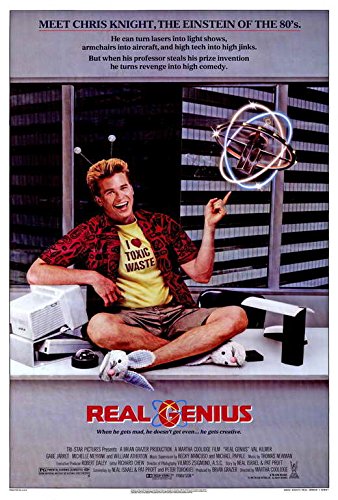
The movie involves the saga of Mitch (Gabe Jarret), a brilliant high school student whose Science Fair project has revised the theory of laser beam technology. He is personally recruited by Professor Hathaway (William Atherton), a famous physics professor who wants the kid to work in his personal laboratory. Once on campus, the kid meets the legendary Chris Knight (Val Kilmer), the most brilliant freshman in history who is now a junior whose mind is beginning to be cluttered by mischief. The two students room together, and there seems to be a third person in the room: a strange, wraith-like bearded figure who disappears into the clothes closet, and doesn’t seem to be there when the door is flung open.

The professor is running a scam. He has a Defense Department contract for a sophisticated laser device so accurate that it could incinerate a single man on Earth from a base in orbit. The professor is using his students as slave labor to do most of the work on the project, while ripping off the government grant to build himself a new house. The students, meanwhile, have no idea they’re working on a weapons system, and are more interested in using laser beams to lead everyone to a “Tanning Invitational” they’ve set up by turning a lecture hall into a swimming pool.

“Real Genius” allows every one of its characters the freedom to be complicated and quirky and individual. That’s especially true of Jordan (Michelle Meyrink), a hyperactive woman student who talks all the time and never sleeps and knits things without even thinking about it, and follows Mitch into the john because she’s so busy explaining something that she doesn’t even notice what he’s doing. I recognize students like this from my own undergraduate days. One of the most familiar types on campus (and one of the rarest in the movies) is the self-styled eccentric, who develops a complex of weird personality traits as a way of clearing space and defining himself.

“Real Genius” was directed by Martha Coolidge, who made “Valley Girl,” one of the best and most perceptive recent teenage movies. What I like best about her is that she gives her characters the freedom to be themselves. They don’t have to be John Belushi clones, or fraternity jocks, or dumb coeds. They can flourish in all of their infinite variety, as young people with a world of possibilities and a lot of strange, beautiful notions. “Real Genius” contains many pleasures, but one of the best is its conviction that the American campus contains life as we know it.

Saturday Matinee: Greener Grass

By Sheila O’Malley

Source: RogerEbert.com

There’s a scene in “Greener Grass,” written and directed by Jocelyn DeBoer and Dawn Luebbe (who also co-star), where four families in golf carts sit at a four-way intersection. Everyone gestures at everybody else: “You go,” “Oh, no, you go, I insist…” And so they sit at the intersection forever, smiles frozen on their faces, in a standoff of psychotic politeness. If you’re at a four-way intersection, someone has to go first, someone has to allow themselves to be waved on through. In “Greener Grass,” nobody dares.

DeBoer and Luebbe have created a psychotic suburban world where surface conformity is all, where everyone strives to look and be the same. The smiling faces perch on top of roiling emotions, not even necessarily anti-social emotions, just regular ones, like need, loss, pain. “Keeping up with the Joneses” is pushed to its most surreal extreme. Everyone in the town has braces. Everyone dresses the same, in pinks and light blues and light purples. Everyone drives golf carts. It’s like they live in a mini village placed on a country club golf course somewhere. 

The golf cart scene is an excellent example of what “Greener Grass” is attacking, and it’s a sharp and subversive critique: it would be great to live in a more civil world, but too much civility leads to golf carts stalled at a four-way intersection. In another scene, when two meals end up on the ground after a collision between two waiters, the patrons hasten to eat the food off the floor. To say, “Please bring me another meal” would just not be done. Every single interaction in “Greener Grass” is “competitive,” but it’s competition tamped down by friendly beaming smiles. These people live in an agony of one-upmanship.

“Greener Grass” starts out strong and strange in the first scene. Lisa (Luebbe) and Jill (DeBoer) sit in a group of parents on a blazing sunny day, watching their kids play soccer. Both women are immaculately dressed and made up, braces on their teeth. Jill holds a newborn baby and Lisa compliments the baby on being “cute.” Jill immediately hands the baby over to Lisa. Nobody seems to find this strange, not even Jill’s husband (Beck Bennett). Lisa wanted the baby, and so it’s polite to hand it over, it would be selfish to hang onto it. Later on, a neighbor (Mary Holland) expresses resentment that Jill didn’t give the baby to her. Jill clearly has mixed feelings about what she has done, and yet “mixed feelings” are not allowed in the world of “Greener Grass.” Jill’s remaining son (Julian Hilliard) is a handful, a bedwetter and a perceptive observer. His surprising transformation is matched by Jill’s total personality-disintegration.

Both DeBoer and Luebbe have performed with the improv comedy troupe Upright Citizens Brigade for over a decade. They bring that experience to their creation of this alternate universe, an unholy mix of “Blue Velvet,” “Invasion of the Body Snatchers,” and “The Stepford Wives.” The characters in “Greener Grass” watch a lot of television and DeBoer and Luebbe have a lot of fun creating these alternate-history shows, fake commercials, fake reality shows and soap operas. “Greener Grass” displays its sketch comedy origins, and sometimes the “bits” stand out as not fitting altogether properly, maybe not as fleshed out as they should be. This is a very unsettling film, with a color palette that manages to be blazing-vivid and dreary-muted at the same time, as though it’s all a regurgitated idea of an already-regurgitated idea. (That idea of regurgitation is made explicit in one of the fake television commercials.)

There are very funny details throughout. Pay close attention to the production design. The houses all look like toy houses, with interchangeable decor. People are just “playing house,” they don’t actually live there. In the grocery store, a sign is placed in a prominent position: “Not responsible for stolen lives.” In one surreal moment, Jill and Lisa make out with each others’ husbands, not even realizing their mistake. “Greener Grass” feels a little bit like a comedy sketch drawn out past its capabilities, but the film’s target is always clear.

Like all good satires, “Greener Grass” trucks in exaggeration. Anyone “getting ahead” of anyone else is looked on with suspicion. Personal relationships have a generic quality because if you say you’re “best friends” with someone, someone else might feel left out. Being “unselfish” can be a competition, especially when done performatively. In the leveling world of “Greener Grass,” “standing out” is terrifying. It’s Tall Poppy Syndrome on amphetamines. Even as Jill deteriorates, there’s no sense here of a possible escape to another place where things are different. In “Greener Grass,” Sylvia Plath’s suffocating “bell jar” covers the whole world.

Saturday Matinee: Riders of Justice

By Matt Zoller Seitz

Source: RogerEbert.com

Brutal, sad, funny, and disarmingly sweet-natured, “Riders of Justice” is not so much a revenge movie as a movie about revenge. That might seem like a distinction without a difference until you get to the end of this surprising feature from writer/director Anders Thomas Jensen (“After the Wedding,” “Red Road,” “The Salvation“) and look back on every place that it has taken you. 

The story starts a few days before Christmas in Estonia. A girl walking along a holiday-decorated street with her grandfather spots a red bicycle offered for sale by a street vendor but asks for a blue one instead. The vendor is part of a crime ring and calls an associate, who steals a blue bike belonging to Mathilde (Andrea Heick Gadeberg), which causes Mathilde’s mother Emma (Anne Birgitte Lind) to have to pick her up at the train station, only to have their car fail to start, which causes them to take a commuter train home. A statistics and probability expert named Otto (Nikolaj Lie Kaas) gives the girl’s mother his seat, and shortly after that, a freight train smashes into the commuter train and several passengers are killed, including Mathilde’s mother and a tattooed, bald, scowling fellow who was supposed to testify against a fearsome gang, Riders of Justice. Otto saw another man get off the train before the crash, oddly dropping a full beverage and a nearly uneaten sandwich in the trash on his way out, and becomes convinced that the crash was an assassination and the other victims were collateral damage. As it happens, Mathilde’s father is a stony-faced soldier named Markus (Mads Mikkelsen, a frequent leading man for the writer/director). 

If this were almost any other movie, you’d be able to write the rest of this review yourself. But you soon  figure out that this is not the sort of film that sets up the standard elements and switches to autopilot. For one thing, Jensen makes Otto not merely the messenger who sets the tale in motion and then disappears, but a crucial second lead, and part of a trio filled out by a fellow probability expert named Lennart (Lars Brygmann), whose secret manias and aversions are a constant source of plot complications; and a tightly wound, emotional computer hacker named Emmenthaler (Nicolas Bro). All three characters are written and performed with such skill that they form a comedy trio: a motor-mouthed intellectual answer to the Three Stooges. Like Mathilde, Markus, and everyone else who passes in front of Jensen’s viewfinder, Otto, Lennart and Emmenthaler are given endearing backstories that feed into the script’s fascination with fate, chance, justice, karma, and other subjects rarely discussed in films where the hero is a scary bald dude who can snap a man’s neck like a shingle.

“All events are products of a series of preceding events,” Otto tells an assembled panel of corporate clients who reject an algorithm he and Lennart are trying to sell them. “Because we often have insufficient data, we categorize events as coincidences.” His statement echoes through later scenes, including the church service where Mathilde’s mother and Markus’s wife is laid to rest. “When miracles happen,” the priest says, “we often attribute a divine character to them. However, when lightning strikes, when tragedy becomes reality, we have a hard time assigning a return address, and thus we refer to it as coincidence.” Once the stooges enter Markus’ life, bloodshed follows, but not in a lockstep, predictable way, thanks to the pinball-machine collisions of all the strong personalities involved (particularly Markus’s; he’s both hot-tempered and lethal, not an ideal combination).

The big question here is whether the train crash was a premeditated crime or the culmination of a series of things that quite simply happened. A large part of the charm of “Riders of Justice” (what an ironic title, in retrospect!) comes from the way that it keeps us guessing as to what side of the equation, so to speak, it’ll come down on, or whether it’ll take a position at all. What are we to make, for instance, of a seemingly precise calculation by Otto that the odds of that crash with that outcome were 234,287,121 to one? Or, for that matter, the movie’s wry awareness that no matter how bad things get, they could always be worse? “Only thing is, after all this crap, it’s unlikely more is going to happen,” Mathilde tells Otto. “That’s not how things work,” Otto replies. “A lot of awful things can happen in your life.” 

Plots like the one that drive “Riders of Justice” tend to appear in crash-and-burn action thrillers wherein a curtain-raising death or atrocity is there to give the hero (or heroes) a pretext to embark on a spectacular and largely guilt-free rampage, stacking up bodies like firewood. Jensen and his cast and crew go in a different direction, creating a cast of main characters (and several colorful minor characters) with complex, contradictory psychologies that are unveiled a layer at a time, each revelation informing our understanding of what they did in a prior scene, or what they may be capable of later on. It’s hard to imagine the improvisatory, digressive, character-focused filmmaker Mike Leigh (“Secrets and Lies“) making a revenge thriller, but if he did, it might look like this. Sometimes the tangents are so out-of-nowhere, and are developed in such detail, that you and the characters sorta forget about the vengeance thing, which is the entire point.

This is a film that teaches you how to watch it. Once you’ve gotten acclimated, you understand that when a major character makes a decision that seems massively stupid—or simply counter to their self-interest—it’s always rooted in a traumatic past incident or secret, and they had no conscious control over it: it was something that had to happen, thanks to how they’re wired. Mikkelsen, the most still and reactive performer, seems a granite-faced question mark until you spend a bit of time with his character and understand the origins of his stoicism as well as his eruptions of fury. Unexpected connection points are made between him and the stooges and, more pointedly, between Mathilde and Emmenthaler, who are both sensitive about their weight; and Mathilde, Otto and Markus, who have a specific type of loss in common, and fill voids in each other’s lives. 

Any of these characters could’ve been the main character in his or her own project, so attentive is the screenplay to the nuances of personality. Emmenthaler, especially, is one of the great secondary characters in action thrillers, up there with Al Powell from the original “Die Hard“—a sensitive man who sheds an angry tear when a friend makes fun of his weight, and has clearly been carrying around an unexploded bomb of suppressed rage throughout his life. He’s the first of the stooges to ask for weapons training.  

But even that thread doesn’t go the way you anticipate, because this is a genre picture in which story is driven by characterization rather than the other way around. Not only are there no easy answers, the film goes out of its way to make you think it’s going to tie something off neatly, only to confound you by asking, “What would happen if these characters actually existed?” and doing that instead. 

“Did a therapist write this?” is not a sentence once expects to see in one’s notes on a movie where Mads Mikkelsen guns men down with an assault rifle. But it’s consistent with the apparent mission statement of this odd, beguiling film, which is filled with philosophical, theological, moral, and ethical notions (and takes care to distinguish between them) and that weaves images of churches and snippets of religious chorales throughout its running time, as if to remind us of the Christian ideals of grace, healing, and redemption that, for many characters, remain just out of reach. The movie’s contextual scaffolding is constructed with such care that when a character insists that chess is the only game ever invented where luck isn’t a factor, your instinct is to think, “Is that true?” It is, and it isn’t. The closest Jensen gets to summing everything up is Mathilde’s statement that life “is just easier when there’s someone you can get mad at.” 

What are we left with? In the best of all possible worlds, a line from Otto, offered when the gang is en route to a bloody showdown: “Let’s get this over with as a team so we can go home and eat banana cake.”

____________________

Watch Riders of Justice on Kanopy here: https://www.kanopy.com/en/product/12898202

A Pigeon Sat on a Branch Reflecting on Existence

By Simon Abrams

Source: RogerEbert.com

Swedish comedy “A Pigeon Sat on a Branch Reflecting On Existence” has a very particular style of deadpan humor and an equally specific morbid sense of empathy. As in his previous two films, writer/director Roy Andersson (“Songs from the Second Floor,” “You, The Living”) presents several thematically-united sketches of life as it’s experienced by the meek, and the suffering, two groups of people who are (according to Andersson’s films) doomed to inherit nothing. “A Pigeon Sat on a Branch Reflecting on Existence” is, in that sense, a kind of alarmist comedy. It’s a series of comedic sketches about people who are too self-involved to empathize with each other. It’s also a plaintively blunt wake-up call, and an effective demand for viewers’ vigilant sensitivity.

I’m writing this review as a series of direct free-associations because that’s essentially how “A Pigeon Sat on a Branch Reflecting On Existence” presents itself. Like Andersson’s other recent films, “Pigeon” is a movie that’s so viscerally effective that it doesn’t really matter how hard individual scenes clobber you over the head with Andersson’s humanist message: by choosing to isolate ourselves from each other, we die a thousand little absurd deaths every day without ever really moving on.

“A Pigeon Sat On a Branch Reflecting on Existence” doesn’t really have a plot, but it does feature two recurring characters: Jonathan (Holger Andersson) and Sam (Nils Westblom) sell novelty items, but aren’t very good at it. They’re shy and tactless, as we see in any scene where they try to pitch people who could clearly care less about plastic vampire fangs, and rubber Halloween masks. But Jonathan, who is repeatedly teased for being over-sensitive, also suffers from a vague sinking feeling that something is wrong with his life, and that leads to problems with Sam later on.

To be fair, Jonathan’s not completely blameless. In one scene, we see him bullying a store-owner who is too anxious and depressed to address Jonathan and Sam when they demand payment for novelty items that were bought on credit. It’s an awkwardly heated argument since Jonathan and Sam have to argue with their client through a third party: the store-owner’s wife. Jonathan and Sam’s seeming lack of empathy is what unites them with the various other people in “A Pigeon Sat On a Branch Reflecting on Existence.” Several characters receive phone calls that lead them to miss whatever situation is happening right in front of their eyes, like the callous scientist who ignores a monkey she’s performing electroshock therapy on or the desperate barber who doesn’t see his reluctant (and only) client leaving his barber shop. Each time this happens, the person on the phone ironically says “I’m glad that you’re doing fine,” reminding viewers that the opposite is actually true, and that a state of un-fine-ness is actually what passes for normalcy in Andersson’s film.

Andersson is not however a pessimist nor is “A Pigeon Sat On A Branch Reflecting on Existence” a cynical film. On the contrary, “Pigeon” leads viewers through a series of comically bleak vignettes towards a hopefully open-ended conclusion. In a 2009 interview published in MuBI by former “At the Movies” co-host Ignatiy Vishnevetsky, Andersson describes his simultaneously unsparing but ennobling sensibility as “a light without mercy.” Vishenvetsky correctly adds that “There’s a difference between being ‘without mercy’ and being cruel.” You can see exactly what Vishnevetsky means in the most confrontational scene in “Pigeon:” a dream sequence wherein white blue bloods set a giant container full of black slaves on fire, and watch as the container revolves slowly and makes music. The painfully deliberate pacing of this scene makes it surprisingly shocking. You realize what’s happening well before the scene is over, but by the time the scene ends, you’ll also realize that you’ve just seen the most serious scene in “Pigeon.” It’s a howl of inflexible indignation that informs the rest of the film’s slippery pre-apocalyptic comedy.

Andersson is able to essentially lecture his audience into laughing at his funhouse reflections of human insensitivity because he has a very exact style, one that he’s honed after directing hundreds of equally surreal commercials. Andersson takes his time behind the camera. He typically reshoots scenes that feature only a handful of dialogue over and over again, sometimes several dozen times. He doesn’t agonize over shots, according to line producer John Carlsson, but rather just chooses them at his own pace. That sensitivity shows in “Pigeon”‘s sets: life-like models and fixtures that make you feel like you’re looking at street scenes when in fact you’re looking at vividly detailed interior sets that also retain a magical kind of artificiality. The film’s interiors are similarly shot like tableaux vivants that just barely come alive whenever a zombie-like protagonist trudges through. The world of “A Pigeon Sat on a Branch Reflecting on Existence” is, in that sense, fragile, but not really moribund. Andersson’s hysterically impotent characters may, in other words, be perpetually on the verge of a spiritual breakdown, but they never completely fall apart. That kind of mulishly stubborn resilience is very human, and also very funny.

Saturday Matinee: The Square

By Freda Cooper

Source: Flickering Myth

SYNOPSIS:

A museum curator is preparing to launch a major art exhibition.  He sees himself as having a social conscience, but when his wallet and phone are stolen, the other side of his character emerges and he badly mis-handles the situation – and does the same thing when it comes to promoting his new show.

A film from Ruben Ostlund isn’t going to be cozy.  Compelling and fascinating, yes, but never easy and sometimes impenetrable.  His previous offering, Force Majeure, was well received and won the Un Certain Regard prize at Cannes in 2014.  His latest, The Square, went one step further and scooped the Palme D’Or last year.

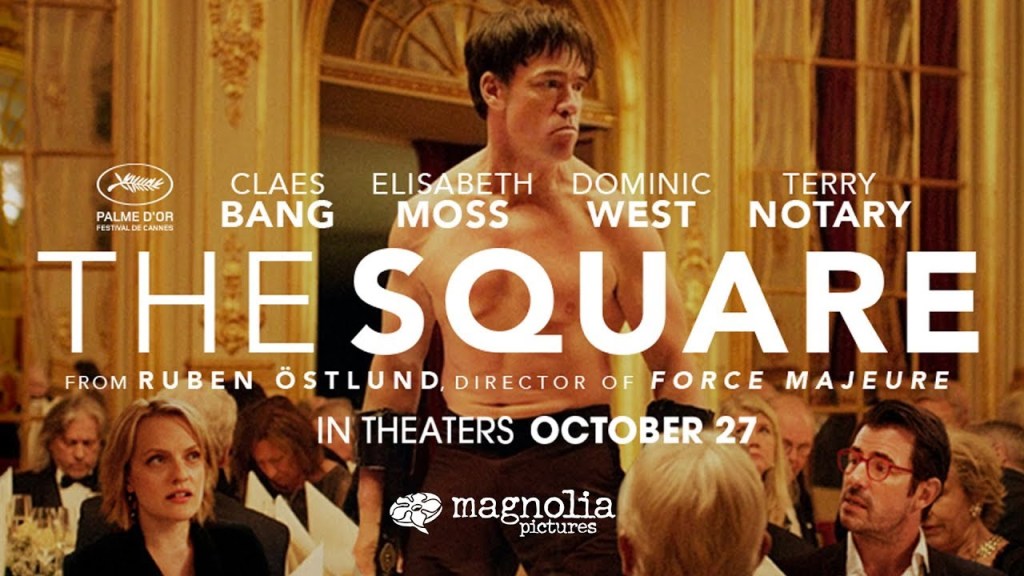
Force Majeure centred on a spontaneously cowardly act by a father.  This has another act from another father at its centre, but this time one that’s thought out.  Badly.  And it’s followed by a second one, which is equally ill-considered.   The Square of the title is an art installation, the centrepiece of an exhibition supervised by museum curator Christian (Claes Bang).  He’s a man under pressure, both professionally and domestically, but still believes he has a social conscience – until his wallet and phone are stolen.  His reaction is extreme, a more accurate reflection of the real man, and he’s responsible for something equally rash when it comes to launching his beloved exhibition.

That’s putting it simply.  Ostlund has a number of targets for what is, at times, a savage satire.  At the heart of it is how those with money treat others – the homeless, the poor or those who are just not as wealthy.  Society encourages tolerance and kindness, but it’s easier to ignore them.  “Would you take a moment to save a life?” asks a charity worker and everybody who walks past her says no.  Are they just saying no to her or to her actual question?  Or both?

The art establishment, in the form of The Square installation, comes in for attack as well.  It’s meant to represent a space where everybody is safe and responsible for each other – but that can apply to any space, from a circle to a pentagon. It’s nonsense.  As are some of the other exhibits, especially one made up of conical piles of gravel.  It’s no surprise that some are accidently vacuumed up by the cleaner.  The exhibition’s marketing team is equally ridiculous, but also irresponsible in its creation of a promotional video of a little, impoverished girl.  It goes viral and causes an outcry – all because Christian doesn’t take the time to think it through properly.

Much of this creates uncomfortable laughter, but lurking in the background in the museum is another installation featuring an ape like man, brought to life by a performance artist.  His actual appearance at the exhibition launch is breath-stoppingly unsettling, as he lumbers around the room, aggressively whooping and pawing at the guests.  The end of the scene is even more deeply disturbing.  Yet again, the idea is mis-judged, with the guests initially alarmed and scared and then turning on the man in the most vicious of ways.

That scene marks a change in tone, but it’s also where the film starts to unravel.  Christian delivers a speech, videoed on his phone, which essentially explains the plot.  Except that, by that stage, the point is already clear, so it’s hardly necessary.   His explanation of the marketing video to a packed press conference is equally superfluous and more than a little disingenuous.  But Claes Bang holds both halves of the film together with the arrogant, flawed but not wholly unlikeable Christian, although talents like Dominic West and Elizabeth  Moss are under-used and have only a handful of scenes apiece.  Terry Notary, in that exhibition launch sequence delivers the piece of acting that sticks in your mind and, disturbing as  it is, it’s powerfully excellent.

The Square doesn’t have the clarity of Force Majeure, but it does have the ability to grab the audience firmly by the shoulders for the duration.  Given the complexity and occasional obscurity of the story, the film needs it.  It isn’t always satisfying, but it is never less than compelling.

____________________

Watch The Square on Tubi here: https://tubitv.com/movies/590338/the-square?start=true

Saturday Matinee: A Man Called Ove

By Odie Henderson

Source: RogerEbert.com

“A Man Called Ove” tells the familiar story of the curmudgeonly old man whose grumpy life is brightened by forces beyond his control. These forces take the guise of a much younger person who provides a sense of purpose for the old hero. A film like this rises or falls not only with its central performance, but also with its ability to engage the viewer’s emotions in a credible, honest fashion. Movies like this tend to get dismissed as “manipulative” because audience sympathy for the protagonist is at least partially elicited by flashbacks to a litany of tragic or unfair past events. But all movies are manipulative by default; the effectiveness of that manipulation is the more valid measurement to inspect. On that scale, “A Man Called Ove” is a morbidly funny and moving success.

Adapting Frederick Backman’s Swedish best seller, writer/director Hannes Holm doesn’t veer too far from the storytelling structure we’ve come to expect. Instead, he tweaks expectations with the way he presents the material, and his grip on the film’s tricky, tragicomic tone is masterful. For example, several flashbacks are cleverly presented as the “life flashing before one’s eyes” moments triggered by the suicide attempts of Ove (Rolf Lassgård). Ove is a widower whose daily visits to his recently deceased wife’s gravesite end with his verbal promise to join her in the afterlife. His failures of self-annihilation are due more to bad timing than botched attempts—he is constantly interrupted by neighbors or some distracting event going on in his housing complex. Priding himself on his reliability, Ove feels compelled to stop killing himself to address each interruption.

Keep in mind that the black humor in this situation doesn’t arise from any mockery of Ove’s pain over missing his spouse. That is presented as real, understandable pain. Instead, the humor comes from Ove’s stubbornness as a creature of habit. Perpetually enforcing neighborhood rules nobody cares about nor adheres to, Ove can’t resist the opportunity to scold those who violate them. Yet, for all his crabbiness, there’s a level of selflessness inherent in Ove’s character, a trait he finds infuriating yet he begrudgingly accepts. His wife, Sonja, played as a young woman in the flashbacks by Ida Engvoll, sees this in the younger version of Ove (Filip Berg), and the much older Ove acknowledges it after much bitching and griping. It’s almost as if Sonja is sending him interruptions from beyond the grave just so he can have an excuse to complain to her like he’s done every day since her passing. This compulsive adherence to routine will keep Ove distracted.

Also distracting Ove is the new, young family who moves next door to him. They start off on the wrong foot by crushing his mailbox while ignoring his sign about not driving in the area, and the noise from their young kids is a major annoyance to the childless Ove. Though the husband is originally from the area, his pregnant wife Parvaneh (Bahar Pars) is of Iranian descent and new to the country. It is she who constantly irritates Ove while simultaneously endearing herself and her family to him. Many of his suicide attempts are interrupted by her, and their eventual father-daughter style bond is often predicated on Ove’s opinion that his help is required because he thinks her husband is an idiot.

“You survived struggle in Iran, moving here and learning a new language, and being married to that idiot,” Ove tells her after taking up the task of her driving instructor, “driving a car should be no problem!” Of course, she can’t drive it wherever Ove has those “no driving” signs everybody else ignores.

Admittedly, “A Man Called Ove” throws everything but the kitchen sink at poor Ove. There’s a shocking death early on that haunts him (and us), and he is the recipient of several slights by higher ups at work and in the government. The marriage between the shy Ove and the jovial Sonja is full of love but fraught with personal tragedies. There’s an almost Job-like mercilessness to some of the fates that befall him, yet the film never dwells on them. Instead, they’re presented rather stoically and serve as a means for us to understand why Ove is who he is. This is a movie that softens its hero by giving him a cat, which sounds syrupy until you see how jacked up and scraggly this cat is. “He likes to shit in private,” says Ove to Parvaneh. “Please give him that courtesy.”

One gets the sense that the novel (and the award-winning film version) is so beloved because Ove represents a Scandinavian everyman who saunters on no matter what life throws at him. His admirable resilience toughens like leather, and his love of Saab and hatred of Volvo plays like a beautiful in-joke aimed straight at the hearts of his compatriots. That rivalry even costs him a friendship, though that same friend’s subplot also presents Ove angrily battling the unfeeling agents of bureaucracy that caused him such agony as a young man. Holm pulls everything together in a well-crafted, satisfying package that is nicely balanced between comedy and pathos.

As Ove, Lassgård gives one of the year’s best performances. He’s well supported by the other actors (and the aforementioned cat), but this is a rich, complex performance that is both funny and moving. It would have been easy to just let Ove coast by on his amusing grouchiness, but Lassgård lets us see so deeply under that protective exterior. We feel as if we’ve walked a mile in Ove’s shoes and absorbed his catharsis as our own.

Watch A Man Called Ove on Kanopy here: https://www.kanopy.com/en/product/5563258

Saturday Matinee: The Little Hours

A raunchy convent comedy loosely based on The Decameron, a 14th century classic

By Frederic and Mary Ann Brussat

Source: Spirituality & Practice

The Decameron by Giovanni Bocccaccio is a literary classic written in medieval times; it’s a bawdy collection of humorous and irreverent tales.
The unconventional Italian director Pier Paolo Pasolini took a crack at this erotic material with his 1971 film. Now Jeff Baena (the writer of I Heart Huckabees) has come up with a convent comedy based on some of the same material. It focuses on the uncontrollable sexual urges of three rowdy nuns. In one of the first scenes, they unleash a torrent of abusive rants on the gardener; this is not language you’d expect from women in habits!

The young nuns are out-of-control women who really do not belong in the convent. Sister Alessandra (Alison Brie) is anxiously awaiting her father (Paul Reiser) to pay her dowry so she can get married. Sister Generva (Kate Micucci) is an unruly woman addicted to gossip, and Sister Fernanda (Aubrey Plaza) is a wild explorer of witchcraft who participates in forbidden pagan rituals at night in the woods.

Trying to keep these three troublesome nuns in line proves to be an impossible task for Father Tommasso (John C. Reilly) who drinks too much, and Sister Marea (Molly Shannon), who has her own longings. All hell breaks loose when a handsome servant called Massetto (Dave Franco) arrives. He has just barely escaped the wrath of a nobleman (Nick Offerman) whose lusty wife (Lauren Weedman) had made him her sexual toy.

Father Tommasso takes this strapping young man under his wings. To keep him safe from the sisters, he suggests he act like he’s a deaf-mute. Massetto’s presence soon becomes a raunchy sex adventure for the three insatiable nuns who cannot get enough of him. When a puritanical Bishop (Fred Armisen) arrives, he is stunned and taken aback by the avid pursuit of pleasure at the convent. His tirades against “loving the world” fall on deaf ears.

This film is not for everyone, but given its source material, it is not likely to do much damage to the reputation of religious folk, and it actually might amuse quite a few of us!

Watch, The Little Hours on Kanopy here: https://www.kanopy.com/en/product/2257210

Saturday Matinee: Little Shop of Horrors (1986)

By Roger Ebert

Source: RogerEbert.com

At a time when so many movies show such cold-blooded calculation, here’s one heedless enough to be fun. “Little Shop of Horrors” arrives with enough baggage to make it into a thoroughly timid project – what is less likely to make a fresh movie than a long-running stage hit? – and yet the movie has the offhand charm of something that was concocted over the weekend.

This is not only a musical and a comedy, as we expected, but also a revue of sorts: Comic actors such as Bill Murray, John Candy and James Belushi have walk-ons, and Steve Martin almost steals the show as a sadistic, motorcycle-riding dentist. Yet at the heart of the movie is a basic sweetness, an innocence that extends even to the centerpiece of the story, which is a man-eating plant named Audrey II.

The plant makes its appearance one day in a flower shop window, having arrived from another planet. It immediately begins to grow, to look around itself, to attract attention and to exhibit an appetite for human blood. It also changes the lives of the three people who work in the store: the shop assistant, Seymour (Rick Moranis); the salesclerk, Audrey (Ellen Greene), and their kindly, blustering old boss, Mr. Mushnik (Vincent Gardenia). Suddenly, they have the sort of fame thrust on them that is usually reserved for lottery winners and people who survive freak accidents.

There are all sorts of people with ideas about how to exploit the wonderful plant, and others who wish it no good. The movie uses them as the occasion for gentle satire and broad comedy, and there’s the sense that “Little Shop” is amused by just about whatever comes into its mind. There is also a romance; Seymour falls in love with Audrey (I), but must win her away from the evil dentist (Martin), who roars around on a motorcycle and gives her black eyes.

Meanwhile, Audrey (II) inexorably grows, nourishing itself with blood from a nick on Seymour’s finger and developing a taste for human flesh. The progressive growth of the alien plant was, of course, one of the glories of the stage version of “Little Shop,” and the movie’s Audrey, designed by Lyle Conway and directed by Frank Oz, is a marvel of technique. The plant actually does seem to have a personality and is remarkably accomplished during its musical numbers.

Moranis also has developed a personality in this movie and, in a way, that’s as surprising as Audrey II’s achievement. After being typecast as a nerd on SCTV and in such limited and predictable films as “Strange Brew,” he emerges here as a shy, likable leading man in the Woody Allen mode. The movie sometimes makes his work look easy. But he has to carry a lot of the exposition and hold most of the conversations with the plant, and without him the movie might not have been half as confident.

Greene repeats her New York and London role as the human Audrey, and by now the wide-eyed, daffy blond with the pushup bra has become second nature. Her big musical number, “Suddenly Seymour,” has the bravado of a Broadway show-stopper even while undermining itself with satire.

The show is punctuated by musical commentary delivered by a Supremes-style trio (Tichina Arnold, Tisha Campbell and Michelle Weeks), that bounces around the flower shop’s inner-city neighborhood with a message of hope that seems somewhat optimistic, inspired as it is by a carnivorous plant, but fits right in with the movie’s good heart.

All of the wonders of “Little Shop of Horrors” are accomplished with an offhand, casual charm. The movie doesn’t labor its jokes or insist on its virtuoso special effects, but devotes its energies to seeming unforced and delightful. The big laughs, when they come, are explosive (such as the payoff of Martin’s big musical number), but the quiet romantic moments are allowed to have their coy innocence.

This is the kind of movie that cults are made of, and after “Little Shop” finishes its first run, I wouldn’t be at all surprised to see it develop into a successor to “The Rocky Horror Picture Show,” as one of those movies that fans want to include in their lives.

Watch Little Shop of Horrors for free here: https://soap2day.cool/watch-movie/watch-little-shop-of-horrors-free-10873.5306743