

New leaked documents show Reuters’ and the BBC’s involvement in covert UK FCO programs to effect “attitudinal change” and “weaken the Russian state’s influence,” alongside intel contractors and Bellingcat.
By Max Blumenthal
Source: The Grayzone
The UK Foreign and Commonwealth Office (FCO) have sponsored Reuters and the BBC to conduct a series of covert programs aimed at promoting regime change inside Russia and undermining its government across Eastern Europe and Central Asia, according to a series of leaked documents.
The leaked materials show the Thomson Reuters Foundation and BBC Media Action participating in a covert information warfare campaign aimed at countering Russia. Working through a shadowy department within the UK FCO known as the Counter Disinformation & Media Development (CDMD), the media organizations operated alongside a collection of intelligence contractors in a secret entity known simply as “the Consortium.”
Through training programs of Russian journalists overseen by Reuters, the British Foreign Office sought to produce an “attitudinal change in the participants,” promoting a “positive impact” on their “perception of the UK.”
“These revelations show that when MPs were railing about Russia, British agents were using the BBC and Reuters to deploy precisely the same tactics that politicians and media commentators were accusing Russia of using,” Chris Williamson, a former UK Labour MP who attempted to apply public scrutiny to the CDMD’s covert activities and was stonewalled on national security grounds, told The Grayzone.
“The BBC and Reuters portray themselves as an unimpeachable, impartial, and authoritative source of world news,” Williamson continued, “but both are now hugely compromised by these disclosures. Double standards like this just bring establishment politicians and corporate media hacks into further disrepute.”
Thomson Reuters Foundation spokesperson Jenny Vereker implicitly confirmed the authenticity of the leaked documents in an emailed response to questions from The Grayzone. However, she contended, “The inference that the Thomson Reuters Foundation was engaged in ‘secret activities’ is inaccurate and misrepresents our work in the public interest. We have for decades openly supported a free press and have worked to help journalists globally to develop the skills needed to report with independence.”
The tranche of leaked files closely resemble UK FCO-related documented released between 2018 and 2020 by a hacking collective calling itself Anonymous. The same source has claimed credit for obtaining the latest round of documents.
The Grayzone reported in October 2020 on leaked materials released by Anonymous which exposed a massive propaganda campaign funded by the UK FCO to cultivate support for regime change in Syria. Soon after, the Foreign Office claimed its computer systems had been penetrated by hackers, thus confirming their authenticity.
The new leaks illustrate in alarming detail how Reuters and the BBC – two of the largest and most distinguished news organizations in the world – attempted to answer the British foreign ministry’s call for help in improving its “ability to respond and to promote our message across Russia,” and to “counter the Russian government’s narrative.” Among the UK FCO’s stated goals, according to the director of the CDMD, was to “weaken the Russian State’s influence on its near neighbours.”
Reuters and the BBC solicited multimillion-dollar contracts to advance the British state’s interventionist aims, promising to cultivate Russian journalists through FCO-funded tours and training sessions, establish influence networks in and around Russia, and promote pro-NATO narratives in Russian-speaking regions.
In several proposals to the British Foreign Office, Reuters boasted of a global influence network of 15,000 journalists and staff, including 400 inside Russia.
The UK FCO projects were carried out covertly, and in partnership with purportedly independent, high-profile online media outfits including Bellingcat, Meduza, and the Pussy Riot-founded Mediazona. Bellingcat’s participation apparently included a UK FCO intervention in North Macedonia’s 2019 elections on behalf of the pro-NATO candidate.
The intelligence contractors that oversaw that operation, the Zinc Network, boasted of establishing “a network of YouTubers in Russia and Central Asia” while “supporting participants [to] make and receive international payments without being registered as external sources of funding.” The firm also touted its ability to “activate a range of content” to support anti-government protests inside Russia.
The new documents provide critical background on the role of NATO member states like the UK in influencing the color revolution-style protests waged in Belarus in 2020, and raise unsettling questions about the intrigue and unrest surrounding jailed Russian opposition figure Alexei Navalny.
Further, the materials cast serious doubt on the independence of two of the world’s largest and most prestigious media organizations, revealing Reuters and the BBC as apparent intelligence cut-outs feasting at the trough of a British national security state that their news operations are increasingly averse to scrutinizing.
Reuters solicits secret British Foreign Office contract to infiltrate Russian media
A series of official documents declassified in January 2020 revealed that Reuters was secretly funded by the British government throughout the 1960s and 1970s to assist an anti-Soviet propaganda organization run by the MI6 intelligence agency. The UK government used the BBC as a pass-through to conceal payments to the news group.
The revelation prompted a Reuters spokesman to declare that “the arrangement in 1969 [with the MI6] was not in keeping with our Trust Principles and we would not do this today.”
The Trust Principles outline a mission of “preserving [Reuters’] independence, integrity, and freedom from bias in the gathering and dissemination of information and news.”
In its own statement of values, the BBC proclaims, “Trust is the foundation of the BBC. We’re independent, impartial and honest.”
However, the newly leaked documents analyzed by The Grayzone appear to reveal that both Reuters and the BBC are engaged yet again in a non-transparent relationship with the UK’s foreign ministry to counter and undermine Russia.
In 2017, the non-profit arm of the Reuters media empire, the Thomson Reuters Foundation (TRF), delivered a formal tender offering to “enter into a Contract with the Secretary of State for Foreign Affairs, as represented by the British Embassy Moscow, for the provision of a project ‘Capacity Building in Russian Media.’” The letter was signed by Reuters CEO Monique Ville on July 31, 2017.
Reuters’ tender was a response to a call for bids by the FCO, which sought help in implementing “a programme of themed tours to the UK by Russian journalists and online influencers.” 
Working through the British Embassy in Moscow, the FCO sought to produce an “attitudinal change in the participants,” promoting a “positive impact” on their “perception of the UK.”

In 2019, the FCO put forward a similar initiative, this time articulating a more aggressive plan to “counter the Russian government’s narrative and domination of the media and information space.” In effect, the British government was seeking to infiltrate Russian media and propagate its own narrative through an influence network of Russian journalists trained in the UK.

Reuters responded to both calls by the FCO with detailed tenders. In its first bid, the media giant boasted of establishing a global network of 15,000 journalists and bloggers through “capacity building interventions.” In Russia, it claimed at least 400 journalists had been cultivated through its training programs.

Reuters claimed to have performed 10 previous training tours for 80 Russian journalists on behalf of the British embassy in Moscow. It proposed eight more, promising to promote “UK cultural and political values” and “create a network of journalists across Russia” bonded together by a shared “interest in British affairs.”

Reuters’ tender highlighted the institutional prejudices and interventionist agenda that underlined its training programs. Detailing a series of UK FCO-funded programs dedicated to “countering Russian state-funded propaganda,” Reuters conflated Russian government narratives with extremism. Ironically, it referred to its own efforts at weakening them as “unbiased journalism.”

At the same time, Reuters appeared to recognize that its covert collaboration with the British Embassy in Moscow was highly provocative and potentially destructive to diplomatic relations. Recounting a UK FCO-funded tour it ran for Russian journalists in the midst of the Sergei Skripal affair, after the British government accused Moscow of poisoning a turncoat Russian intelligence officer who spied for Britain, the tender stated, “[Thomson Reuters Foundation] was in constant communication with the British Embassy in Moscow, to assess levels of risk, including reputational risk to the embassy.”

The mention by Reuters of the Belarusian TV Station Belsat, and its particular relevance “to the UK Government Strategy’s capacity to detect and counter the spread of Russian information” was notable. While describing itself as “the first independent television channel in Belarus,” Belsat is, as the Reuters tender makes clear, a vehicle of NATO influence.
Based in Poland and funded by the Polish Foreign Ministry and other EU governments, Belsat played an influential role in promoting the color revolution-style protests that erupted in May 2020 to demand the ouster of Belarusian President Alexander Lukashenko.
Ultimately, Reuters’ bid appears to have been successful, as it received a July 2019 contract with the FCO’s Conflict, Stability & Security Fund (CSSF). But neither entity seemed to want the public to know about their collaboration on a project designed to counter Russia. The contract was marked “Strictly Confidential.”

“Weaken the Russian state’s influence”
The programs exposed through the latest leak of documents operate under the auspices of a shadowy division of the Foreign and Commonwealth Development Office called Counter Disinformation & Media Development (CDMD). Led by an intelligence operative named Andy Pryce, the program has shrouded in secrecy.
Indeed, the British government has denied freedom of information requests about the division’s budget and stonewalled members of parliament like Chris Williamson who sought data about its budget and agenda, citing national security to block their demands for information.
“When I tried to probe further,” former MP Williamson told The Grayzone, “ministers refused to let me have access to any documents or correspondence relating to this organization’s activities. I was told that releasing this information could ‘disrupt and undermine the program’s effectiveness.’”
During a meeting convened in London on June 26, 2018, Pryce outlined a new FCO program “to weaken the Russian State’s influence on its near neighbors.” He solicited a consortium of firms to assist the British state in establishing new and seemingly independent media outlets to counter Russian government-backed media in Moscow’s immediate sphere of influence, and to amplify the messaging of NATO-aligned governments.
Justified on the basis of Russia’s supposed intention to “sow disunity and course[sic] disruption to democratic processes,” the campaign Pryce laid out was more aggressive and far-reaching than anything Russia has been caught doing in the West.

Pryce emphasized that secrecy was of the essence, warning that “some grantees will not wish to be linked to the FCO.”

A year later, the FCO’s CDMD division outlined a program to run through 2022 at a cost of $8.3 million to the British taxpayer. It aimed to establish new outlets and support preexisting media operations “to counter Russia’s efforts to sow disunity” and “increase resilience to hostile Kremlin messaging in the Baltic states.”
Thus the British government set out with an array of intelligence contractors to dominate Baltic media with pro-NATO messaging – and perhaps sow some disunity of its own.

As seen below, the BBC placed an apparently successful bid to participate in the covert Baltic program through its non-profit arm, known as BBC Media Action.
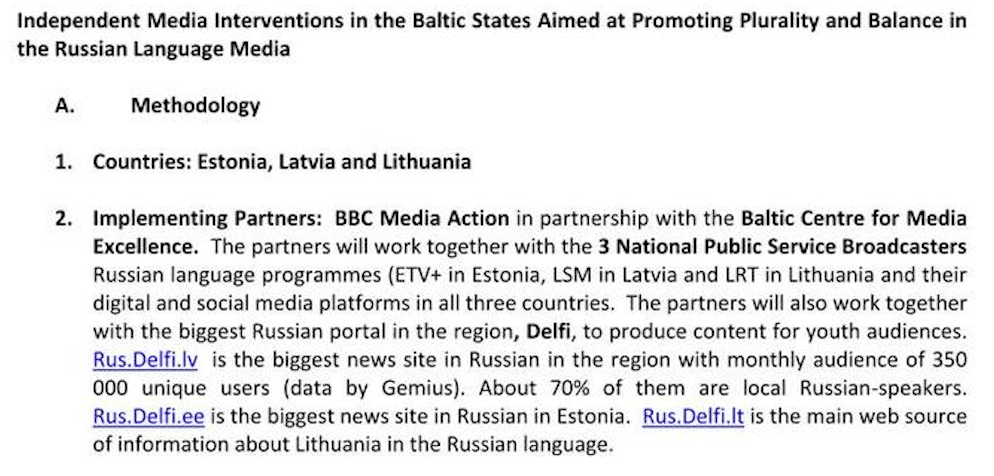
The BBC also proposed to participate in a separate UK FCO media propaganda program in Ukraine, Moldova, and Georgia. It named Reuters and a now-defunct intelligence contractor called Aktis Strategy, which participated in previous FCO CDMD programs, as key allies in its consortium.

The BBC identified local partners like Hromadske, a Kiev-based broadcast network born in the midst of the so-called Maidan “Revolution of Dignity” in 2014 that relied on ultra-nationalist muscle to remove an elected president and install a pro-NATO regime. Hromadske materialized almost overnight with seed money and logistical support from the US Agency for International Development (USAID) and billionaire media mogul Pierre Omidyar’s Network Fund.

BBC Media Action proposed working through Aktis to cultivate and grow pro-NATO media in conflict areas like the Donbas region of eastern Ukraine, where a proxy war has raged since 2014 between the Western-backed Ukrainian military and pro-Russian separatists. It was textbook information warfare, weaponizing broadcast media to turn the tide of battle in a protracted, grinding conflict.

The UK FCO propaganda campaign warned that “Kremlin-affiliated structures” could undermine the project if it was exposed. For a media organization that claims to place trust at the heart of its charter of values, the BBC was certainly operating under a high degree of secrecy.

The UK FCO’s meddling in Eastern Europe and the Baltics created a feeding frenzy among contractors seeking to provide “capacity building” and media development assistance on Russia’s periphery. Among the bidders were Reuters and veteran FCO contractors that had participated in an array of information warfare campaigns from Syria to the British home front.
The Consortium
Among the intelligence contractors bidding to participate in the UK FCO-funded Consortium were the Zinc Network and Albany Communications. As journalist Kit Klarenberg noted in a February 18 report on the recent FCO leaks, these firms “boast staff possessed of [security] clearances, individuals who previously served at the highest levels of government, the military and security services. They furthermore have extensive experience in conducting information warfare operations on London’s behalf the world over.”
Previously known as Breakthrough, Zinc has contracted for the UK Home Office to covertly implement media projects propagandizing British Muslims under the auspices of the Prevent de-radicalization initiative. In Australia, Zinc was caught running a clandestine program to promote support for government policies among Muslims.
Ben Norton reported for The Grayzone on Albany’s record of “secur[ing] the participation of an extensive local network of over 55 stringers, reporters and videographers” to influence media narratives and advance Western regime-change goals in Syria, while conducting public relations services on behalf of extremist Syrian militias funded by NATO member states and Gulf monarchies to destabilize the country.
In its bid for the UK FCO media program in the Baltic region, Albany proposed a series of satirical “interactive games” like “Putin Bingo” to encourage opposition to the Russian government and exploit “frustrations experienced by Russians in the EU.”
Albany pitched a Latvia-based outlet called Meduza as “a leading proponent of these games.” A top website among Russian opposition supporters, Meduza has received financial support from the Swedish government and several billionaire-backed pro-NATO foundations.

As a UK FCO contractor, the Zinc Network said it was “delivering audience segmentation and targeting support” not only to Meduza, but also to Mediazona, a supposedly independent media venture founded by two members of the anti-Kremlin performance art group Pussy Riot.
One of Mediazona’s founders, Nadya Tolokonnikova, shared a stage with former US President Bill Clinton at the Clinton Foundation’s 2015 conference. The following year, Tolokonnikova trashed now-imprisoned Wikileaks founder Julian Assange, claiming, “He’s connected with the Russian government, and I feel that he’s proud of it.”

Besides delivering “targeting support” for “independent” outlets pushing the right line against the Kremlin, Zinc proposed leveraging UK FCO funding into a program of direct payments and gaming Google search results in their favor. The intelligence cut-out was explicit about its desire to reduce the search visibility of the Russian government-backed broadcaster RT.com.

The UK covertly funded and managed a network of Russian YouTubers and “activated” anti-government protest content
In a document marked “private and confidential,” Zinc revealed the Consortium’s role in setting up a “YouTuber network” in Russia and Central Asia designed to propagate the message of the UK and its NATO allies.
According to Zinc, the Consortium was “supporting participants mak[ing] and receiv[ing] international payments without being registered as external sources of funding,” presumably to circumvent Russian registration requirements for foreign-funded media outfits.
Zinc also helped the YouTube influencers “develop editorial strategies to deliver key messages” while working “to keep their involvement confidential.” And it carried out its entire program of covert propaganda in the name of “promoting media integrity and democratic values.”

Perhaps the most prominent Russian YouTube influencer is Alexei Navalny, a previously marginal nationalist opposition figure who was nominated for a Nobel Prize after becoming the target of a high-profile poisoning incident that brought relations between Russia and the West to its post-Cold War nadir.
The Russian government’s sentencing of Navalny to a 2.5-year prison term for evading parole has inspired a new wave of anti-government protests. Back in 2018, Navalny personally co-sponsored national demonstrations against the banning of the encrypted messaging app Telegram.
In its bid for a UK FCO contract, Zinc revealed that it played a behind-the-scenes role “to activate a range of content within 12 hours of the recent telegram protests.” Whether those activities involved Navalny or his immediate network was unclear, but the private disclosure by Zinc appeared confirm that British intelligence played a role in amplifying the 2018 protests.

Russian intelligence services have released sting video footage showing Vladimir Ashurkov, the executive director of Navalny’s FBK anti-corruption organization, meeting in 2013 with a suspected British MI6 agent named James William Thomas Ford, who was operating out of the British embassy in Moscow. During the rendezvous, Ashurkov can be heard asking for 10 to 20 million dollars to generate “quite a different picture” of the political landscape.

In 2018, Ashurkov’s name appeared in leaked documents exposing a covert, UK FCO influence network called the Integrity Initiative. As The Grayzone reported, the Integrity Initiative operated behind the cover of a think tank called the Institute for Statecraft, which concealed its own location through a fake office in Scotland.
Run by a group of military intelligence officers, the secret propaganda group worked through clusters of media and political influencers to escalate tensions between the West and Russia. Listed among the London cluster of anti-Russian influencers was Ashurkov.
The Integrity Initiative’s military directors outlined their agenda in stark, unequivocal terms. As the leaked memo below illustrates, they aimed to exploit the media, think tanks and their influence network to stir up as much hysteria about Russia’s supposedly malign influence as possible. Since they embarked on their covert campaign, nearly all their wishes have come true.

Bellingcat joins the Zinc Network, allegedly meddles in Moldova’s elections
After Alexei Navalny’s poisoning, he collaborated with the UK-based “open source” journalism outfit Bellingcat to pin the crime on Russia’s FSB intelligence services. Though it is well established that Bellingcat is funded by the National Endowment for Democracy, a US government entity that supports regime-change operations around the globe, the fact has never appeared in the reams of fawning profiles that corporate media outlets, including Reuters, have published about the organization.
Bellingcat’s role as a partner in the Zinc Network’s UK FCO-funded EXPOSE Consortium may add an additional layer of suspicion about the outlet’s claim to independence.
Indeed, Bellingcat was listed in leaked 2018 documents as a key member of Zinc’s “Network of NGOs.” Among the members in the network was the Institute for Statecraft, the front for the Integrity Initiative.

Bellingcat founder Eliot Higgins has vehemently denied accepting funding from the UK FCO or collaborating with it. But after Zinc documents leaked in early 2019, Higgins disclosed that some version of the Zinc proposal had received the green light from the Foreign Office.
Christian Triebbert, a Bellingcat staff member who was named as a potential trainer by the Zinc documents, and who now heads the New York Times’ video investigations unit, claimed the program consisted of benign workshops on “digital research and verification skills.”
What he and Higgins did not mention, however, was that Bellingcat had apparently been dispatched by the Zinc Network to “respond” to the 2019 parliamentary elections in North Macedonia. Stakes were high as the elections were likely to determine whether the tiny country would enter NATO and join the EU. The pro-NATO candidate triumphed, and not without a little help from the British Foreign Office and its allies.
According to the Zinc proposal, Bellingcat provided training to the Most Network, a Macedonian media outlet. It was joined by DFR Lab, a project of the NATO- and US government-funded Atlantic Council in Washington, DC.

After apparently participating in the covert UK FCO-funded intervention in North Macedonia, Bellingcat published an article ahead of the country’s 2020 parliamentary elections entitled, “Russia’s interference in North Macedonia.”
Several Zinc Network documents list Reuters as a member of the UK FCO-funded Consortium media intervention in the Baltic states.
Asked by The Grayzone how Reuters’ participation in UK FCO-funded programs aimed at countering Russia conformed to the news organization’s Trust Principles, spokesperson Jenny Vereker stated, “This funding supports our independent work to assist journalists and journalism all over the world, as part of our mission to strengthen a free and vibrant global media ecosystem to support a plurality of voices and preserve the flow of accurate and independent information. This is because accurate and balanced news coverage is a crucial pillar of any free, fair and informed society.”
In recent years, the BBC and Reuters have played an increasingly aggressive part in demonizing the governments of countries where London and Washington are seeking regime change. Meanwhile, high-profile online investigative outlets like Bellingcat have sprouted up seemingly overnight to assist these efforts.
With the release of the UK FCO documents, questions must be raised about whether these esteemed news organizations are truly the independent and ethical journalistic entities they claim to be. While they hammer away at “authoritarian” states and malign Russian activities, they have little to say about the machinations of the powerful Western governments in their immediate midst. Perhaps they are reluctant to bite the hand that feeds them.
 After the Crash