
Why the US needs this war in Gaza

By Pepe Escobar

The Global South was expecting the Dawn of a New Arabian Reality. 

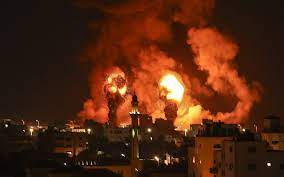
After all, the Arab street – even while repressed in their home nations – has pulsed with protests expressing ferocious rage against Israel’s wholesale massacre of Palestinians in the Gaza Strip. 

Arab leaders were forced to take some sort of action beyond suspending a few ambassadorships with Israel, and called for a special Organization of Islamic Cooperation (OIC) summit to discuss the ongoing Israeli War Against Palestinian Children. 

Representatives of 57 Muslim states convened in Riyadh on 11 November to deliver a serious, practical blow against genocidal practitioners and enablers. But in the end, nothing was offered, not even solace.  

The OIC’s final statement will always be enshrined in the Gilded Palace of Cowardice. Highlights of the tawdry rhetorical show: we oppose Israel’s “self-defense;” we condemn the attack on Gaza; we ask (who?) not to sell weapons to Israel; we request the kangaroo ICC to “investigate” war crimes; we request a UN resolution condemning Israel.  

For the record, that’s the best 57 Muslim-majority countries could drum up in response to this 21st-century genocide.  

History, even if written by victors, tends to be unforgiving towards cowards.

The Top Four Cowards, in this instance, are Saudi Arabia, the UAE, Bahrain, and Morrocco – the latter three having normalized relations with Israel under a heavy US hand in 2020. These are the ones that consistently blocked serious measures from being adopted at the OIC summit, such as the Algerian draft proposal for an oil ban on Israel, plus banning the use of Arab airspace to deliver weapons to the occupation state.

Egypt and Jordan – longtime Arab vassals – were also non-committal, as well as Sudan, which is in the middle of a civil war. Turkiye, under Sultan Recep Tayyip Erdogan, once again showed it is all talk and no action; a neo-Ottoman parody of the Texan “all hat, no cattle.” 

BRICS or IMEC? 

The Top Four Cowards deserve some scrutiny. Bahrain is a lowly vassal hosting a key branch of the US Empire of Bases. Morocco has close relations with Tel Aviv – it sold out quickly after an Israeli promise to recognize Rabat’s claim on Western Sahara. Moreover, Morocco heavily depends on tourism, mainly from the collective west.  

Then we have the big dogs, Saudi Arabia and the UAE. Both are stacked to the rafters with American weaponry, and, like Bahrain, also host US military bases. Saudi Crown Prince Mohammad bin Salman (MbS) and his old mentor, Emirati ruler Mohammad bin Zayed (MbZ), do factor in the threat of color revolutions tearing through their regal domains if they deviate too much from the accepted imperial script.  

But in a few weeks, starting on 1 January, 2024, under a Russian presidency, both Riyadh and Abu Dhabi will expand their horizons big-time by officially becoming members of the BRICS 11

Saudi Arabia and UAE were only admitted into the expanded BRICS because of careful geopolitical and geoeconomic calculations by the Russia-China strategic partnership.

Along with Iran – which happens to have its own strategic partnership with both Russia and China – Riyadh and Abu Dhabi are supposed to reinforce the energy clout of the BRICS sphere and be key players, further on down the road, in the de-dollarization drive whose ultimate aim is to bypass the petrodollar.  

Yet, at the same time, Riyadh and Abu Dhabi also stand to benefit immensely from the not-so-secret 1963 plan to build the Ben Gurion canal, from the Gulf of Aqaba to the Eastern Mediterranean, arriving – what a coincidence – very close to now devastated northern Gaza. 

The canal would allow Israel to become a key energy transit hub, dislodging Egypt’s Suez Canal, and that happens to dovetail nicely with Israel’s role as the de facto key node in the latest chapter of the War of Economic Corridors: the US-concocted India-MidEast Corridor (IMEC).

IMEC is a quite perverse acronym, as is the whole logic behind this fantastical corridor, which is to position international law-breaking Israel as a critical trade hub and even energy provider between Europe, part of the Arab world, and India.  

That was also the logic behind Israeli Prime Minister Benjamin Netanyahu’s UN charade in September, where he flashed the whole “international community” a map of the “New Middle East” in which Palestine had been totally erased. 

All of the above assumes that IMEC and the Ben Gurion Canal will be built – which is not a given by any realistic standards.  

Back to the vote at the OIC, US minions Egypt and Jordan – two countries on Israel’s western and eastern borders, respectively – were in the toughest position of them all. The occupation state wished to push approximately 4.5 million Palestinians into their borders for good. But Cairo and Amman, also awash in US weapons and financially bankrupt as they come, would never survive US sanctions if they lean too unacceptably towards Palestine.

So, in the end, too many Muslim states choosing humiliation over righteousness were thinking in very narrow, pragmatic, national interest terms. Geopolitics is pitiless. It is all about natural resources and markets. If you don’t have one, you need the other, and if you have none, a Hegemon dictates what you’re allowed to have. 

The Arab and Muslim street – and the Global Majority – may rightfully feel dejected when they see how these “leaders” are not ready to turn the Islamic world into a real power pole within emerging multipolarity. 

It wouldn’t happen any other way. Many key Arab states are not Sovereign entities. They are all boxed in, victims of a vassal mentality. They’re not ready – yet – for their close-up facing History. And sadly, they still remain hostage to their own “century of humiliation.”

The humiliating coup de grace was dispatched by none other than the Tel Aviv genocidal maniac himself: he threatened everyone in the Arab world if they don’t shut up – which they already did.

Of course, there are very important Arab and Muslim brave-hearts in Iran, Syria, Palestine, Iraq, Lebanon, and Yemen. While not a majority by any means, these Resistance actors reflect the sentiment on the Street like no other. And with Israel’s war expanding each day, their regional and global clout is set to increase immeasurably, just as in all of the Hegemon’s other regional wars.

Strangling a new century in the cradle 

The catastrophic debacle of Project Ukraine and the revival of an intractable West Asian war are deeply intertwined. 

Beyond the fog of Washington’s “worry” about Tel Aviv’s genocidal rampage, the crucial fact is that we are right in the thick of a war against BRICS 11.      

The Empire does not do strategy; at best, it does tactical business plans on the fly. There are two immediate tactics in play: a US Armada deployed in the Eastern Mediterranean – in a failed effort to intimidate Resistance Axis behemoths Iran and Hezbollah – and a possible Milei election in Argentina tied to his avowed promise to break Brazil-Argentina relations. 

So this is a simultaneous attack on BRICS 11 on two fronts: West Asia and South America. There will be no American efforts spared to prevent BRICS 11 from getting close to OPEC+. A key aim is to instill fear in Riyadh and Abu Dhabi – as confirmed by Persian Gulf business sources.  

Even vassal leaders at the OIC show would have been aware that we are now deep into The Empire Strikes Back. That also largely explains their cowardice. 

They know that for the Hegemon, multipolarity equals “chaos,” unipolarity equals “order,” and malign actors equal   “autocrats” – such as the new Russian-Chinese-Iranian “Axis of Evil” and anyone, especially vassals, that opposes the “rules-based international order.” 

And that brings us to a tale of two ceasefires. Tens of millions across the Global Majority are asking why the Hegemon is desperate for a ceasefire in Ukraine while flatly refusing a ceasefire in Palestine. 
Freezing Project Ukraine preserves the Ghost of Hegemony just a little bit longer. Let’s assume Moscow would take the bait (it won’t). But to freeze Ukraine in Europe, the Hegemon will need an Israeli win in Gaza – perhaps at any and all costs – to maintain even a vestige of its former glory. 

But can Israel achieve victory any more than Ukraine can? Tel Aviv may have already lost the war on 7 October as it can never regain its facade of invincibility. And if this transforms into a regional war that Israel loses, the US will lose its Arab vassals overnight, who today have a Chinese and Russian option waiting in the wings. 

The Roar of the Street is getting louder – demanding that the Biden administration, now seen as complicit with Tel Aviv, halt the Israeli genocide that may lead to a World War. But Washington will not comply. Wars in Europe and West Asia may be its last chance (it will lose) to subvert the emergence of a prosperous, connected, peaceful Eurasia Century.
BRICS 11 – Strategic Tour de Force

By Pepe Escobar

Source: The Unz Review

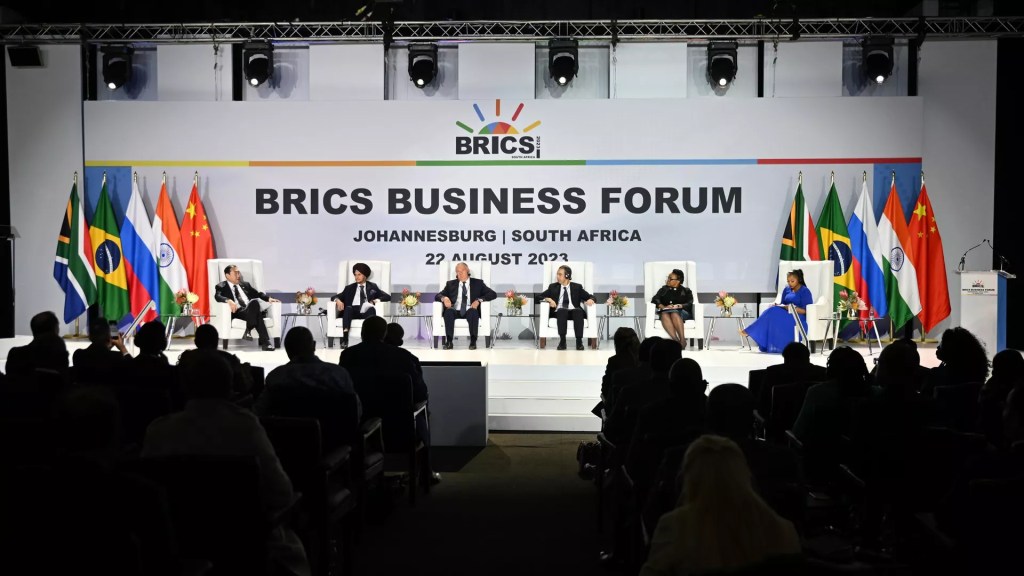
Chinese President Xi Jinping defined all the major decisions embedded in the 15th BRICS summit in South Africa as “historic”. That may be seen as an understatement.

It will take time for the Global South, or Global Majority, or “Global Globe” (copyright President Lukashenko), not to mention the stunned collective West, to fully grasp the enormity of the new strategic stakes.

President Putin, for his part, described the negotiations on BRICS expansion as quite difficult. By now a relatively accurate picture is emerging of what really went down on that table in Johannesburg.

India wanted 3 new members. China wanted as many as 10. A compromise was finally reached, with 6 members: Egypt, Iran, Saudi Arabia, United Arab Emirates (UAE), Argentina and Ethiopia.

So from now on it’s BRICS 11. And that’s just the beginning. Starting with the rotating Russian presidency of BRICS on January 1, 2024, more partners will be progressively included, and most certainly a new round of full members will be announced at the BRICS 11 summit in Kazan in October next year.

So we may soon progress to BRICS 20 – on the way to BRICS 40. The G7, for all practical purposes, is sliding towards oblivion.

Bur first things first. At that fateful table in Johannesburg, Russia supported Egypt. China went all out for Persian Gulf magic: Iran, UAE and the Saudis. Of course: Iran-China are already deep into a strategic partnership, and Riyadh is already accepting payment for energy in yuan.

Brazil and China supported Argentina, Brazil’s troubled neighbor, running the risk of having its economy fully dollarized, and also a key commodity provider to Beijing. South Africa supported Ethiopia. India, for a series of very complex reasons, was not exactly comfortable with 3 Arab/Muslim members (Saudi Arabia, UAE, Egypt). Russia assuaged New Delhi’s fears.

All of the above respects geographic principles and imprints the notion of BRICS representing the Global South. But it goes way beyond that, blending cunning strategy and no-nonsense realpolitik.

India was mollified because Russian Foreign Minister Sergey Lavrov, at the table in Johannesburg negotiating on behalf of President Putin, and highly respected by New Delhi, fully understood that a new, single BRICS currency is a long way away. What really matters, short and medium term, is expanding intra-BRICS trade in their national currencies.

That was stressed by New Development Bank (NDB) president Dilma Rousseff in her report to the South African summit hosts – even as Brazilian President Lula once again emphasized the importance of setting up a work group to discuss a BRICS currency.

Lavrov understood how New Delhi is absolutely terrified of secondary sanctions by the US, in case its BRICS role gets too ambitious. Prime Minister Modi is essentially hedging between BRICS and the completely artificial imperial obsession embedded in the terminology “Indo-Pacific” – which masks renewed containment of China. The Straussian neo-con psychos in charge of US foreign policy are already furious with India buying loads of discounted Russian oil.

New Delhi’s support for a new BRICS currency would be interpreted in Washington as all-out trade war – and sanctions dementia would follow. In contrast, Saudi Arabia’s MbS doesn’t care: he’s a top energy producer, not consumer like India, and one of his priorities is to fully court his top energy client, Beijing, and pave the way for the petroyuan.

It Takes Just a Single Strategic Move

Now let’s get into the strategic stakes. For all practical purposes, in Eurasian terms, BRICS 11 is now on the way to lord over the Arctic Sea Route; the International North South Transportation Corridor (INSTC); BRI’s East West Corridors; the Persian Gulf; the Red Sea; and the Suez Canal.

That blends several overland corridors with several nodes of the Maritime Silk Roads. Nearly total integration in the Heartland and the Rimland. All with just a single strategic move in the geopolitical/geoeconomic chessboard.

Much more than an increase of BRICS 11 collective GDP to 36% of the world’s total (already larger than the G7), with the group now encompassing 47% of the world’s population, the top geopolitical and geoeconomic breakthrough is how BRICS 11 is about to literally break the bank on the energy and commodities market fronts.

By incorporating Iran, Saudi Arabia and the UAE, BRICS 11 instantly shines on as an oil and gas powerhouse. BRICS 11 now controls 39% of global oil exports; 45.9% of proven reserves; and at least 47.6% of all oil produced globally, according to InfoTEK.

With BRICS 11 possibly including Venezuela, Algeria and Kazakhstan as new members as early as in 2024, it may control as much as 90% of all oil and gas traded globally.

Inevitable corollary: operations settled in local currencies bypassing the US dollar. And inevitable conclusion: petrodollar in a coma. The Empire of Chaos and Plunder will lose its free lunch menu: control of global oil prices and means to enforce “diplomacy” via a tsunami of unilateral sanctions.

Already in the horizon, direct BRICS 11-OPEC+ symbiosis is inevitable. OPEC+ is effectively run by Russia and Saudi Arabia.

A ground-shaking geoeconomic reorientation is at hand, involving everything from routes plied by global supply chains and new BRICS roads to the progressive interconnection of BRI, the Saudi Vision 2030 and massive port expansion in the UAE.

By choosing Ethiopia, BRICS expands its African reach on mining, minerals and metals. Ethiopia is rich in gold, platinum, tantalum, copper, niobium and offers vast potential in oil and natural gas exploration. Saudi Arabia and the UAE, incidentally, are also involved in mining.

This all spells out fast, progressive integration of North Africa and West Asia.

How Diplomacy Goes a Long Way

The BRICS 11 Shock of the New, in the energy sphere, is a sharp historical counterpoint to the 1973 oil shock, after which Riyadh started wallowing in petrodollars. Now Saudi Arabia under MbS is operating a tectonic shift, in the process of becoming strategically aligned with Russia-China-India-Iran.

Diplomatic coup does not even begin to describe it. This is the second stage of the Russian-initiated and Chinese-finalized rapprochement between Riyadh and Tehran, recently sealed in Beijing. The Russia-China strategic leadership, working patiently in synch, never lost sight of the ball.

Now compare it with collective West’s “strategies”, such as the G7-imposed oil price cap. Essentially the G7 “coalition of the willing” self-imposed a price cap on Russian crude imported by sea. The result is that they had to start buying way more oil products from Global South nations which ignored the price cap and duly increased their purchase of Russian crude.

Guess who are the top two: BRICS members China and India.

After wallowing in several stages of denial, the collective West may – or may not – realize it’s a fool’s dream to attempt to “de-couple” the West-ruled part of the global economy from China, whatever is spewed out by Washington.

BRICS 11 now shows, graphically, how the “Global South/Global Majority/”Global Globe” is more non-aligned with the West than anytime in recent history.

By the way, the president of the G77, Cuban leader Diaz-Canel, was at the BRICS summit representing the de-facto new Non-Aligned Movement (NAM): the G77 actually incorporates no less than 134 nations. Most are African. Xi Jinping in Johannesburg met in person with the leaders of most of them.

The collective West, in panic, regards all of the above as “dangerous”. So the last refuge is, predictably, rhetorical: “de-coupling”, “de-risking”, and similar idiocies.

Yet that may also get practically dangerous. As in the first ever trilateral summit in Camp David on August 18 between the Empire and two Asian vassals, Japan and South Korea. That may be interpreted as the first move towards a military-political Asian NATO even more toxic than Quad or AUKUS, obsessed to simultaneously contain China, Russia and the DPRK.

The Collective Outstripping of the Global North

The UN lists 152 nations in the world as “developing countries”. BRICS 11 is aiming at them – as they outstrip the Global North on everything from population growth to overall contribution to global GDP growth measured by PPP.

In the past 10 years since the announcement of BRI first in Astana and then in Jakarta, Chinese financial institutions have lent nearly $1 trillion for infrastructure connectivity projects across the Global South. The upcoming BRI forum in Beijing will signal a renewed drive. That’s the BRI-BRICS symbiosis.

In the G20 last year, China was the first nation to lobby for the inclusion of the 55-member African Union (AU). That may happen at the G20 summit next month in New Delhi; in that case, Global South representation will be close to parity with the Global North.

Claims that Beijing was organizing a malign conspiracy to turn BRICS into a weapon against the G7 are infantile. Realpolitik – and geoeconomic indicators – are dictating the terms, configuring the Shock of the New: the G7’s irreversible irrelevance with the rise of BRICS 11.