Three interesting facets of news over Niger appear to be doing the rounds. Firstly, that a terrorist group in Nigeria has openly appealed to the Nigerian President – who also happens to be the ECOWAS leader – to avoid at all costs a military intervention in Niger; secondly, that Joe Biden took the initiative to meet the same gentleman Bola Ahmed Tinubu in the corridors of the United Nations, hinting that huge amounts of U.S. investment could be directed towards Nigeria if Tinubu played ball; and thirdly, that just recently, the stakes were raised in Niger when its junta announced that it had invited the armies of both Mali and Burkina Faso onto its soil to help defend themselves against an “intervention” which ECOWAS has threatened was on the cards only days earlier.
But Biden’s little chat with Tinubu says a lot about the realities of what is going to happen and what can happen on the ground as clearly his administration does not want another proxy war between East and West on its hands before the re-election run up next year. The question of whether the U.S. would support ECOWAS militarily has been answered by Biden’s bribe to the Nigerian president. It’s not going to happen.
Tinubu, who is certainly the man at the centre of events, gives the impression in interviews that he is under great pressure from ECOWAS members to intervene, but he is the one cooling tempers and looking for a diplomatic solution. And yet, his comments to the press seem to have been written by the U.S. state department such is the proximity of his office and the U.S. administration – debunking the myth of how much ECOWAS is influenced by France (given that the majority of the countries are former French colonies). The Nigerian president’s role as ECOWAS chief is under the spotlight.
What does he really want? Are his objectives focussed more on Nigeria rather than the bloc?
Joe Biden’s offer of a fresh injection of investment from U.S. firms hasn’t seemed to hit the mark. It seems that Tinubu is after even faster and even easier cash.
Tinubu said that African democracies are “currently under assault by anti-democratic forces within and outside the continent”, which is really state department jargon for “the Russians are coming”.
He then called on the “American-backed development finance and multilateral institutions, which were designed to support war-torn Europe after World War II, to adopt a swift and comprehensive reform to meet the developmental requirements of young democracies in Africa”.
The translation isn’t too cryptic. Can the U.S. intervene and, also, while they’re at it, pump our central bank full of never-never-pay soft loans from IMF and World bank? Cheers!
Neither Biden nor Tinubu though seem to be bothered about the possibility of a fourth francophone African country falling into the hands of Mother Russia. Mali and Burkina Faso, who both can be assumed to be vassals of Russia have shown great solidarity with Niger which has lost no time kicking the French out and becoming a major pain in the arse for western elites who are confused about the events and want to oversimplify the nuances. “We lost Niger to the Russians” may be the well worn cliché although the facts on the ground and more complicated. There certainly seems in Niger to be an endearment towards the new junta’s government but Russia’s role so far is unclear.
About the only thing that Putin and Biden agree on is they don’t want a war in Niger.
It’s easy to forget though that Niger was a key player in ECOWAS and that many of its members placed great importance on Niger’s front line assault on Islamic groups in the region – which, if given more freedoms, could cause havoc right across West Africa but in particular in neighbouring Nigeria.
For the moment though, the so-called pressure from ECOWAS is unlikely to manifest itself beyond chest beating. ECOWAS members may have the hunger for intervention but they don’t have the guts for a war, which neither the U.S. or Russia will bankroll, so sobriety is likely to take over the narrative in the coming days. The war in Ukraine, the abysmal foreign policy blunders of Biden, the deluded arrogance of Macron and the emergence of BRICS have all contributed to the current crisis in Africa as the old relationship with the West is put to the test, with disastrous consequences. The only thing left of Obama’s “soft power” idea he conjured up in 2015 after his humiliation in Syria is a suitcase full of cash for a corrupt West African leader to share with his cabal. Pretty pathetic.
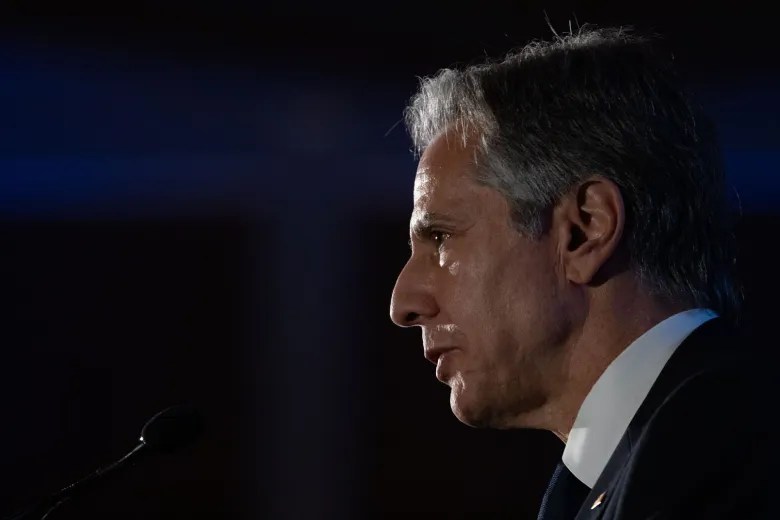
Secretary of State Antony Blinken speaks during the Mandela Washington Fellowship Summit for Young African Leaders in Washington, DC, August 2, 2023. (Official State Department photo by Chuck Kennedy)
It’s been weeks since we looked into the adventures of the Biden administration’s foreign policy cluster, led by Tony Blinken, Jake Sullivan, and Victoria Nuland. How has the trio of war hawks spent the summer?
Sullivan, the national security adviser, recently brought an American delegation to the second international peace summit earlier this month at Jeddah in Saudi Arabia. The summit was led by Crown Prince Mohammed bin Salman, known as MBS, who in June announced a merger between his state-backed golf tour and the PGA. Four years earlier MBS was accused of ordering the assassination and dismemberment of the journalist Jamal Khashoggi at the Saudi consulate in Istanbul, for perceived disloyalty to the state.
As unlikely as it sounds, there was such a peace summit and its stars did include MBS, Sullivan, and President Volodymyr Zelensky of Ukraine. What was missing was a representative of Russia, which was not invited to the summit. It included just a handful of heads of state from the fewer than fifty nations that sent delegates. The conference lasted two days, and attracted what could only be described as little international attention.
Reuters reported that Zelensky’s goal was to get international support for “the principles” that that he will consider as a basis for the settlement of the war, including “the withdrawal of all Russian troops and the return of all Ukrainian territory.” Russia’s formal response to the non-event came not from President Vladimir Putin but from Deputy Minister of Foreign Affairs Sergei Ryabkov. He called the summit “a reflection of the West’s attempt to continue futile, doomed efforts” to mobilize the Global South behind Zelensky.
India and China both sent delegations to the session, perhaps drawn to Saudi Arabia for its immense oil reserves. One Indian academic observer dismissed the event as achieving little more than “good advertising for MBS’s convening power within the Global South; the kingdom’s positioning in the same; and perhaps more narrowly, aiding American efforts to build consensus by making sure China attends the meeting with . . . Jake Sullivan in the same room.”
Meanwhile, far away on the battlefield in Ukraine, Russia continued to thwart Zelensky’s ongoing counteroffensive. I asked an American intelligence official why it was Sullivan who emerged from the Biden administration’s foreign policy circle to preside over the inconsequential conference in Saudi Arabia.
“Jeddah was Sullivan’s baby,” the official said. “He planned it to be Biden’s equivalent of [President Woodrow] Wilson’s Versailles. The grand alliance of the free world meeting in a victory celebration after the humiliating defeat of the hated foe to determine the shape of nations for the next generation. Fame and Glory. Promotion and re-election. The jewel in the crown was to be Zelensky’s achievement of Putin’s unconditional surrender after the lightning spring offensive. They were even planning a Nuremberg type trial at the world court, with Jake as our representative. Just one more fuck-up, but who is counting? Forty nations showed up, all but six looking for free food after the Odessa shutdown”—a reference to Putin’s curtailing of Ukrainian wheat shipments in response to Zelensky’s renewed attacks on the bridge linking Crimea to the Russian mainland.
Enough about Sullivan. Let us now turn to Victoria Nuland, an architect of the 2014 overthrow of the pro-Russian government in Ukraine, one of the American moves that led us to where we are, though it was Putin who initiated the horrid current war. The ultra-hawkish Nuland was promoted early this summer by Biden, over the heated objections of many in the State Department, to be the acting deputy secretary of state. She has not been formally nominated as the deputy for fear that her nomination would lead to a hellish fight in the Senate.
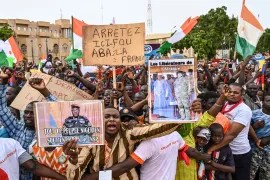
It was Nuland who was sent last week to see what could be salvaged after a coup led to the overthrow of a pro-Western government in Niger, one of a group of former French colonies in West Africa that have remained in the French sphere of influence. President Mohamed Bazoum, who was democratically elected, was tossed out of office by a junta led by the head of his presidential guard, General Abdourahmane Tchiani. The general suspended the constitution and jailed potential political opponents. Five other military officers were named to his cabinet. All of this generated enormous public support on the streets in Niamey, Niger’s capital—enough support to discourage outside Western intervention.
There were grim reports in the Western press that initially viewed the upheaval in East-West terms: some of the supporters of the coup were carrying Russian flags as they marched in the streets. The New York Times saw the coup as a blow to the main US ally in the region, Nigerian President Bola Ahmed Tinubu, who controls vast oil and gas reserves. Tinubu threatened the new government in Niger with military action unless they returned power to Bazoum. He set a deadline that passed without any outside intervention.
The revolution in Niger was not seen by those living in the region in east-west terms but as a long needed rejection of long-standing French economic and political control. It is a scenario that may be repeated again and again throughout the French-dominated Sahel nations in sub-Saharan Africa.
There are distinctions that do not bode well for the new government in Niger. The nation is blessed, or perhaps cursed, by having a significant amount of the remaining natural uranium deposits in the world. As the world warms up, a return to nuclear generated power is seen as inevitable, with obvious implications for the value of the stuff underground in Niger. The raw uranium ore, when separated, filtered and processed is known worldwide as yellowcake.
The corruption so often “talked about in Niger is not about petty bribes by government officials, but about an entire structure—developed during French colonial rule—that prevents Niger from establishing sovereignty over its raw materials and over its development,” according to a recent analysis published by Baltimore’s Real News Network. Three out of four laptops in France are powered by nuclear energy, much of which is derived from uranium mines in Niger effectively controlled by its former colonial overlord.
Niger is also the home of three American drone bases targeting Islamic radicals throughout the region. There are also undeclared Special Forces outposts in the region, whose soldiers receive double pay while on their risky combat assignments. The American official told me that “the 1,500 US troops now in Niger are exactly the number of American troops who were in South Vietnam at the time John F. Kennedy took over the presidency in 1961.”
Into this scene came Victoria Nuland, who must have drawn the short straw inside the Biden Administration. She was sent to negotiate with the new regime and to arrange a meeting with the ousted President Bazoum, whose life remains under constant threat from the governing junta. The New York Times reported that she got nowhere after talks she described as “extremely frank and at times quite difficult.” The intelligence official put her remarks to the Times in American military lingo: “Victoria set out to save the Niger uranium owners from the barbaric Russians and got a huge single-finger salute.”
Quieter in recent weeks than Sullivan and Nuland has been Secretary of State Tony Blinken. Where was he? I asked that question of the official, who said that Blinken “has figured out that the United States”—that is, our ally Ukraine—“will not win the war” against Russia. “The word was getting to him through the Agency [CIA] that the Ukrainian offense was not going to work. It was a show by Zelensky and there were some in the administration who believed his bullshit.
“Blinken wanted to broker a peace deal between Russia and Ukraine as Kissinger did in Paris to end the Vietnam war.” Instead, the official said, “it was going to be a big lose and Blinken found himself way over his skis. But he does not want to go down as the court jester.”
It was at this moment of doubt, the official said, that Bill Burns, the CIA director, “made his move to join the sinking ship.” He was referring to Burns’s speech earlier this summer at the annual Ditchley conference near London. He appeared to put aside his earlier doubts about expanding NATO to the east and affirmed his support at least five times for Biden’s program.
“Burns does not lack self-confidence and ambition,” the intelligence official said, especially when Blinken, the ardent war hawk, was suddenly having doubts. Burns served in a prior administration as deputy secretary of state and running the CIA was hardly a just reward.
Burns would not replace a disillusioned Blinken, but only get a token promotion: an appointment to Biden’s cabinet. The cabinet meets no more than once a month and, as recorded by C-SPAN, the meetings tend to be tightly scripted affairs and to begin with the president reading from a prepared text.
Tony Blinken, who publicly vowed just a few months ago that there would be no immediate ceasefire in Ukraine, is still in office and, if asked, would certainly dispute any notion of discontent with Zelensky or the administration’s murderous and failing war policy in Ukraine.
So the White House’s wishful approach to the war, when it comes to realistic talk to the American people, will continue apace. But the end is nearing, even if the assessments supplied by Biden to the public are out of a comic strip.
This piece is from Seymour Hersh’s Substack, you may subscribe to it here.

 After the Crash