
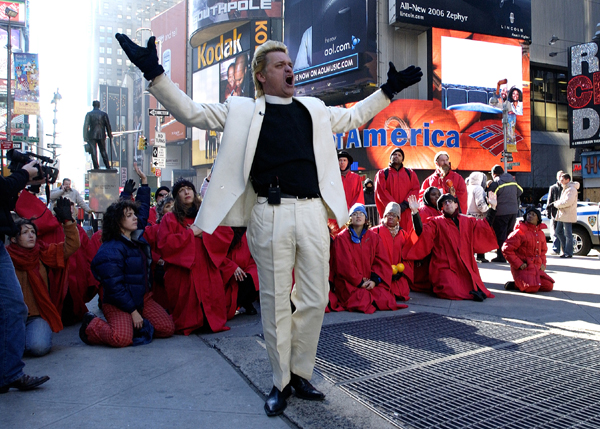
What Did You Call Me?

Reverend-Billy-3

By Reverend Billy

Source: Reality Sandwich

What did you call me? 

That is a traditional last bit of language before the shove, the fist and the bullet.

We have a circus in our benighted city New York, of name-calling, misunderstanding, and yes, murder.   This week we have Quentin Tarantino using the word “murdered” for the victims of police violence, a few hours from the funeral of a cop named Ralph Holder, who was murdered in the line of duty. Police commissioner Bill Bratton lashes out, calling the film-maker “contemptible.” (But the number of unarmed Americans shot and killed by police is approaching a thousand this year.)

This merry-go-round of words is very close to the end of language, the “What Did You Call Me?” of every B-movie western… This has gone on since before 9/11. Rudolf Giuliani took it to a new level. Then Mike Bloomberg, with his commissioner Ray Kelly – pandered to language-destroying emotions of fear every single day of the three terms of that administration.

You have to ask – how could the two sides work together? Is it possible to even begin in this canyon of clichés? The police are so defensive, they act like Scientologists. They are hair-trigger-ready to be disrespected. On the other hand, Black Lives Matter is the first successful social movement in memory, and people like me treasure this historical moment. It proves that a social movement in this age of Consumerism and Militarism is still possible. Black Lives Matter is our daylight.

We ask – how would we heal? One development this week intrigues. Al Sharpton was called to preside at the funeral by the father of the Officer Ralph Holder, and then he backed away as the pack of Irish cops Bratton and the union heads Lynch and Mullins – laid it on thick.

But the choice by the father is fascinating. It showed a moment of healing leadership coming from a not-in-the-media-circus regular citizen. It was daringly hopeful, and probably not realistic. Clearly, though, it was the kind of gesture we need. No politician could’ve done this, though our mayor Bill de Blasio may have tried – really no public figure could ever be this creative.

“Never assume that every critic is a hater, not everyone is hating on you, some people are telling you the truth.”   —Nina Simone

What Tarantino did that really gets to the police is – he claimed the word “murder.” Murder is a crime and crime is the territory of the police.

It didn’t seem to matter to them that so many called out, “Stop killing us!” But if you shout “Stop murdering us.” – the police are incensed. “Murder” is something only they understand. The police own the word “Murder.”

You could say that Tarantino is a player in a very long game of healing. Other public figures may join him in using such language. Murder is murder. More police who murder need to go on trial for murder. That word can no longer be held sacred, with the police the only priests allowed to speak it.

This is one trail of healing, but there must be others. One that I think of, as a many-times arrested and jailed New York activist, is this: How would any non-police person ever criticize the cops openly? How would that be possible? At this point in time – this is how far it’s gone – no public language can criticize cops that is not immediately damned by cops. I used the word “damned” rather than “attacked,” because the police hunt down critics in the manner of a religious cult.

“I love this country more than in any in the world, and exactly for this reason I insist on the right to criticize her perpetually.”   —James Baldwin

Don’t you find yourself grateful and amazed that the children of slaves continue to risk their lives in the act of citizenship? This is a key to possible healing. In New York City, we have a standing army of 35,000 police and they are systematically denied the education of the 1st Amendment, and they are armed. They are led by demagogues in the old style of Mussolini: And yet, African-Americans get out of bed every day and go outside into public space a willful, risky act of citizenship.

The healing that we see is so needed for this divided city will not come from Black Lives Matter backing down, changing language, acquiescing. We are in a long recovery from 9/11, which only strengthened the racism already in us.

The movement for the return to “Peace Officers” is very like the Earth Movement. Entrenched power that believes it is the owner of legalized violence must be faced down in public space. Since citizens cannot exercise their 1st Amendment rights in the privatized parks and streets now, the healing of violent law enforcement will involve some form of trespassing.

It may sound novel to suggest that healing comes from continuing the advancement of one of the antagonists. Yes – Black Lives Matter needs to advance and grow. Safety for black citizens must be normalized and formalized – and this will heal the law enforcement community. Healing in this case mostly means the education of the police.

Black Lives Matter was sparked by young blacks who refused to leave the sidewalk in front of the Ferguson police department for months.  Here in NYC, the bridges and tunnels and Macy’s and Grand Central Station were occupied. The die-ins were always called trespassing. Those die-ins must be the seeds of healing.

“I stand with the murdered.” —Quentin Tarantino

Our Hollywood buddy trespassed on police language. We hope that he continues to use such direct, honest words – and so must we.

RiseUpOctober was criticized for scheduling the “rally” at the same time as Officer Holder’s funeral, but we were going to a funeral too. Throughout the week the police and their media called the Union Square rally a political exercise, as if it were a vested interest group.

This is simply psychological bullying. They don’t think of us as experiencing sorrow. If they showed contrition for the results of their bullets, it might dawn on them that we are gathered with sorrow in our anger. Last year, the number of deaths from police use of deadly force was about 20 times the number of police deaths while on duty. And if you cannot imagine sorrow in another human being, you are more likely to hurt them. Out of this de-humanization, cops kill.

Following Black Lives Matter as our teacher, we must use all the words and all the space with our bodies. The healing is the pulling back, slowly and painfully, of these people from their fearful violence. We must pull them back to a trust of their neighbors that they haven’t enjoyed in so long.


Reverend Billy and the Stop Shopping Choir open their show “The Earth Wants YOU!” at Joes’ Pub at New York’s Public Theater on Sunday November 15. Contact Revbilly.com for show times and ticket info.
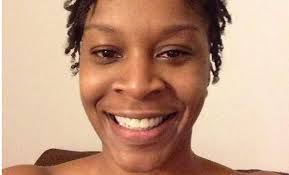
The Assassination of Sandra Bland and the Struggle against State Repression

images

The Black Lives Matter movement has another martyr, as it prepares for a national conference in Cleveland, this weekend. Sandra Bland’s murder in Texas shows, once again, that “defending one’s dignity in an encounter with the police is a crime that that can lead to a death sentence.” The emerging movement must be clear on the political nature of Bland’s death, and that only real power in the hands of the people can break the cycle of oppression.

By Ajamu Baraka

Source: Black Agenda Report

Authentic justice and liberation will only come when there is authentic de-colonization and revolutionary power in the hands of self-determinate peoples’ and oppressed classes and social groups.”

During the struggle in South Africa black activists who were captured by the state had a strange habit of jumping to their deaths from the windows of jails and courthouses whenever the authorities would turn their backs. In the U.S. the method of suicide black prisoners appear to choose is death by hanging – that is, when they are unable to pull a gun from an officer and shoot themselves in the chest while handcuffed behind their backs.

In Waller County, Texas, Sandra Bland, a young black woman from Illinois, an activist with Black Lives Matter, who was, according to friends and family, excited about her new job in Texas, is stopped for a minor traffic violation, beaten, jailed and found dead two days later in her cell. Her death is labeled a suicide by the Waller County Sheriff Glen Smith.

Because Sandra Bland was an activist who advised others about their rights and the proper way to handle a police encounter, no one is accepting the official explanation that she took her own life.

What does seem clear is that Sandra was a woman who understood her rights and was more than prepared to defend her dignity. However, for a black person in the U.S. defending one’s dignity in an encounter with the police is a crime that that can lead to a death sentence, or in the parlance of human rights, an extra-judicial execution by state agents.

While many are calling for something called justice for Sandra Bland, we would be doing Sandra and all those who have had their lives taken by the agents of repression a disservice if we didn’t place this case in its proper political and historical context.

Sandra was a woman who understood her rights and was more than prepared to defend her dignity.”

A psycho-analytic analysis of the dynamics involved with Blands’ gender and blackness could easily conclude that Bland was perceived as an existential threat to the racist male cops who pulled her out of car. Being a conscious, “defiant” black woman she probably disrupted their psychological order and meaning of themselves by her presence and willingness to defend her dignity.

However, as interesting as the individualized analysis and expressions of the psychopathology of white supremacy might be, the murder of Sandra Bland has to be contextualized politically as part of the intensifying war being waged on black communities and peoples across the country.

And because the state is waging war against us and will be targeting our organizations, as an activist, organizer and popular educator, Sandra’s murder must be seen a political murder and receive sustain focus as such.

Coming right before the Black Lives Matter Movement gathering in Cleveland, Sandra’s murder dramatically drives home the ever present dangers of not just being black in a culture of normalize anti-blackness, but the vulnerabilities associated with being a black activist and especially a black woman activist.

Historically the tyranny of white power has always had its most dehumanized expressions in relationship to black women. The unrestrained and unlimited power of white supremacist domination converged on the captive bodies of black women during slavery and has symbolically and literally continued during the post-enslavement period of capitalist/colonialist subordination of black people in the U.S.

The murder of Sandra Bland has to be contextualized politically as part of the intensifying war being waged on black communities and peoples across the country.”

However, from Harriet Tubman, Ida B. Wells, Claudia Jones, Fannie Lou Hammer through to Assata Shukur, Elaine Brown, Jaribu Hill and countless others, revolutionary black women held up the sky and provided the vision of liberation over the ages.

When the South African government began to target black women activists, the popular response was that now the racist government had “struck a rock.”

This week, under the leadership of black woman activists, much of the resistance movement to the escalating violence of the state will gather in Cleveland to engage in reflection and planning. Sandra Bland will be on the minds of those activists as well as Malissa Williams, who found herself at the receiving end of 137 bullets fired by members of the Cleveland police department that ripped apart the bodies of her and her companion Timothy Russell. And the activists will certainly highlight the case of 12 year old Tamir Rice who was shot point blank two seconds after police arrived on the scene where he had been playing with his toy gun in a park near his home.

Yet, the assassination of Sandra must be seen as a blow against the movement. That is why the BLM must struggle to develop absolute clarity related to the political, economic, social and military context that it/we face.

We understand history and our responsibilities.”

The struggle in the U.S. must be placed in an anti-colonial context or we will find ourselves begging for the colonial state to violate the logic of its existence by pretending that it will end something called police brutality and state killings. The settler-state is serious about protecting white capitalist/colonialist power while we are still trapped in the language of liberal reformism demanding “justice” and accountability. Those demands are fine as transitional demands if we understand that those demands are just that – transitional. Authentic justice and liberation will only come when there is authentic de-colonization and revolutionary power in the hands of self-determinate peoples’ and oppressed classes and social groups.

The martyrdom of Sandra Bland and all that came before her and who will follow – and there will be more – demands this level of clarity. We did not ask for this war. But we understand history and our responsibilities to our history of resistance and our radical vision that we can be more than we are today. Our enemies want us to think that they are invincible but we know their secrets and know that they can be defeated. All we have to do is to be willing to fight.

Ajamu Baraka is a human rights activist, organizer and geo-political analyst. Baraka is an Associate Fellow at the Institute for Policy Studies (IPS) in Washington, D.C. and editor and contributing columnist for the Black Agenda Report. He is a contributor to “Killing Trayvons: An Anthology of American Violence” (Counterpunch Books, 2014). He can be reached at www.AjamuBaraka.com

On the Unasked Question of Morality in Police Shootings of Black Bodies

15713475938_299bf78d0b

By Dr. Jason Michael Williams

Source: The Hampton Institute

In the past year much has happened regarding police shootings of Black bodies, and the majority of these shootings go unpunished. They go unpunished due to defensive statements such as, “I followed procedure” or “I feared for my life”. Nevertheless, these two quintessential defense statements are disproportionately applied to instances where Blacks are killed by police, yet as a society the United States does or says very little to contextualize the impact such defensive statements have on our collective consciousness and morality. However, it should be noted that this silence is deliberate, historical, and quintessentially American. Thus, morality, to many on the margins, is nonexistent at the foundation of the criminal justice system and many of the laws that govern society specifically laws that disproportionately target the poor.

There is a social-historical pathology attached to the ways in which the American public responds to the killing of Black bodies. Just as police officers claim fear today, so did white mobs during Jim Crow. Black men were hunted and killed countless times out of so-called fear due to often false allegations of rape, murder, and a myriad of other unreasonable accusations. Black women were often murdered for trivial reasons too. Nevertheless, these false and unreasonable accusations were justifiable to the American public whose barbarity knew no measures when directed at Black bodies. This pathology exists today, in the hearts and minds of many mainstreamers who dare utter “#AllLivesMatter”, as if to suppose that the murdering of Black bodies is somehow contemporary. Some mainstreamers have considered #BlackLivesMatter as a form of reverse racism. Thus arguing that the statement is somehow exclusive to other people who are killed, but this is, of course, a testament to the lack of critical thinking and historical intelligence writ large in America.

In modern society, this pathology is played out most vividly via the tumultuous relationship between Blacks and police officers. There had been countless murders of Black citizens by police, and yet many of them have been legally justified-that is, these cases have gone through the investigative processes of so-called fact-finding and rendered permissible. However, every so often, there are cases that wreck the consciousness of even the greatest conformers to the social order. For example, the case of Eric Garner, to many Americans of all colors was a prima facie case of wrongdoing, and yet the officer involved in Mr. Garner’s death faced no punishment. Another case in Cleveland where two Black bodies were shot 137 times by police officers has too failed to accomplish moral justice. Cleveland police officer, Michael Brelo cried as he heard his verdict of not-guilty. Brelo was accused of firing 49 shots of which 15 were shot while on the hood of the victims’ car. In clear opposition to an increasingly irritated public regarding police brutality, Judge John P. O’Donnell uttered, “I will not sacrifice him to a public frustrated by historical mistreatment at the hands of other officers.” If the judge were truly neutral to the concerns of the irritated public, such a reckless and defining statement would not have been made.

Nevertheless, the Judge’s rationale coexists with the feelings of many throughout the country. Whether one is scrolling through social media commentary, internet articles or watching mainstream media, the mainstream narrative is quite clear: Black lives don’t matter! And the insistence of this reality is cemented each time a Black is immorally murdered by the state. These ceremonial constants have caused many people throughout the nation to lose faith in the American justice system, including mainstreamers. Although Judge O’Donnell in the Cleveland case believed that the evidence was not solid to convict Officer Brelo, like the Garner case, many feel discontent. This discontentment is the proper manifestation of people realizing that justice in America isn’t always the moral outcome, a concept that a true justice system would strive to achieve. In fact, when “fact-finding” exist within an adversarial system easily corrupted by extralegal factors (race, gender, wealth, power, etc.), justice will undoubtedly fail those who aren’t privy to the game. Thus, American justice isn’t always about siding with moral rights, but rather it often swings on the side of barbarity and injustice as it falsely masquerades as one of the world’s most advanced and civilized systems.

The countless cases of police officers walking free from killing American citizens who happen to be Black is a testament to the limitations of American justice. Black lives don’t matter. As a result, demonstrators of late have continued to take to the streets against the immorality of American justice. They have continued to expose lady justice for the two-faced symbolism that she represents, as the global community pays witness. For these courageous individuals, the legality of justice and the majoritarian trickery invested in trying fact does not seem to fit within a moralistic frame. To these people, lives were unjustly lost, and police officers can get away with murder for simply stating what White men were able to hide behind since slavery: Fear of a Black body.

The Black lives matter movement at best should force the public to question the purpose of the criminal justice system seriously, and whether or not the processes that are currently embraced serve the interest of justice. The subjective citizenship of Black Americans should be the next topic of discussion. For instance, are Blacks to be treated as human beings, citizens, and, therefore, worthy of the right to live, breathe, and seek justice? These are key discussions that must begin to happen if justice is to be taken seriously in America. This conversation should also be raw, wide-reaching, and aided by both historical and contemporary facts. Certain acts of “justice” should be studied as violence. For example, the deliberate mass incarceration of minorities and poor people is, in fact, violence. Mass incarceration breaks up families (much like how slavery did), predisposes people to crime, destroys communities (politically, economically, and ecologically) thus pushing these spaces further beyond the margins, and render most to a life of poverty and outcast. The effects of so-called justice seem to perpetuate further inequality. In a real democracy, the state would not engage in such violence.

Furthermore, the creation of immoral laws like the war on drugs that create the contexts for Michael Browns are inhumane and violent. Such laws are neither safe for its targets (predominantly Black and Brown although now increasingly White) nor police officers. Also, the over policing of the poor is violent and extremely telling for a nation that considers itself a democracy. Over policing is violent, repressive, and undemocratic, as it mandates surveillance for the bottom and liberty for those at the top. While many people advocate for community policing in America’s ghettos, such arguments should be met with extreme caution, as community policing furthers the paternalistic mindset that the poor must be governed. Meanwhile, there are zero discussions regarding the need for community policing or surveillance programs on Wall Street or within other corporate spaces that are obviously privileged against the criminal justice system. These basic statements are more than enough for a conversation to be had on the purpose of the criminal justice system. Who does it serve? Who is most affected by it? What are the collateral consequences? Is a system of violence capable of delivering justice? Is the system morally bankrupt? Does there need to be a revolution regarding the criminal justice system?