
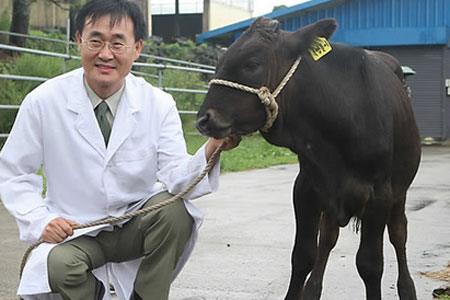
Prof. Park Se-pill of Jeju National University poses with his attacker in 2009. Photo: Korea Times
Via Slate:
In an event ripped straight of the gothic horror novel Frankenstein, a renowned embryologist was reportedly attacked by one of his cloned creations recently. The beast in this case, though, wasn’t a monster pieced together from the bodies of other animals—no, it was an 800-kilogram, black cow.
“Prof. Park Se-pill at Jeju National University had five of his ribs broken and injured his spine in the Sept. 15 attack,” reports the Korea Times. “Park was video-recording a black cow, which he cloned from species indigenous to Jeju four years ago, and all of a sudden, it charged and attacked him for 15 minutes,” a school official said. The embryologist will need eight weeks of medical treatment for his injuries.
The bovine made headlines in 2009 when Park successfully cloned it using a frozen cell taken from a deceased animal. This means the black cow is, in a sense, a “revival” of the cow that the cell was harvested from. Like a phoenix reborn after it dies—but rather than emerging from ashes, the cow originated from a test-tube.
While Park’s incident is unfortunate, it’s hard not to think of the real life allusions between the attack and Frankenstein. Perhaps if the cow could talk it would have quoted a famous line from the novel in which the monster exclaims to Dr. Frankenstein: “You are my creator, but I am your master—obey!”
Prof. Park is recovering at at Jeju National University and said he wishes to continue his study even if he has to be in a wheelchair. He reported the cow is now in a barn and no special measure will be taken despite the incident. This is some background of Park and his research from the Korea Times article that was cited:
Park has been recognized as one of the world’s leading cloning scientists since 2000 when he successfully took out human stem cell lines from embryos for the third time in history.
In particular, his team developed technologies using frozen eggs for cloning experiments _ the procedure that created the four-year-old cloned cow that gave him global recognition.
Taking advantage of his expertise, Park hoped to become the first scientist to establish stem cell batches from cloned human embryos by 2015 to help cure such degenerative diseases as diabetes and Alzheimer’s.
What Park vies to achieve is the same as what former Seoul National University Prof. Hwang Woo-suk claimed to have done in 2004 and 2005 ㅡ his feats later proved to have been falsified.
The Hwang case prompted the government to ban research with fresh human eggs in response to the ethical debate in the aftermath.
Instead, scientists have had to depend on a roundabout way of thawing frozen ova, typically leftovers after artificial insemination.
The government is unlikely to lift the restriction on the use of fresh eggs, which are deemed most suitable for therapeutic cloning research, in the near future.
Against this backdrop, Park and his team relied on their knowhow of the freeze-and-thaw process to extract stem cell lines from cloned human embryos.
 After the Crash