
War, Repression and International Gangsterism: U.S. State Policy From Benghazi to Baltimore

Baltimore-Riots.jpg_23790e32da49a4d09d45db82b7634b69

By Ajamu Baraka

Source: CounterPunch.org

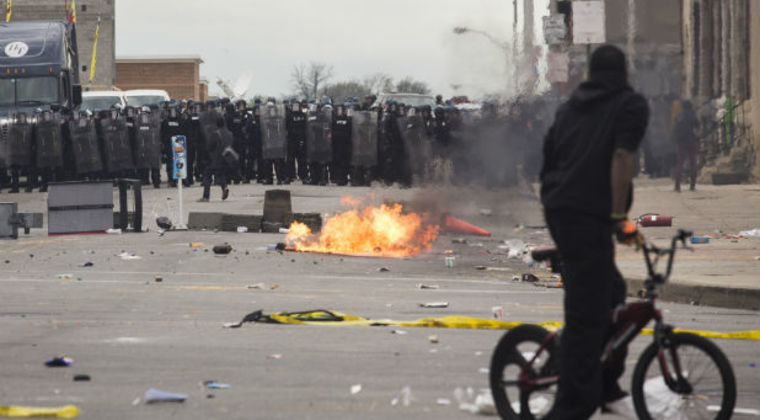
A mere two months after clashes between black youth and police in Baltimore following the murder of Freddie Gray while in police custody, President Obama’s Department of Justice (DOJ) announced the indictment of twenty-four year old Raymon Carter for his alleged involvement in the torching of a CVS pharmacy. The national government’s intervention into the case had an unmistakable message – if you engage in “unauthorized” forms of resistance – in this case, crimes against property – expect to confront the full power of the national government.

U.S. Attorney Rod J. Rosenstein made it even clearer: “Anyone in the future who participates in a ‘riot’ should know that police, prosecutors and citizens will track them down and send them to prison.”

This aggressive and speedy move on the part of the DOJ to criminalize poor, black kids in Baltimore differed sharply from the DOJ approach to high government officials, armed servants of the state at the local level and the big banks and investment firms. For the officials involved in torture under the Bush Administration, the financial gangsters who engineered the 2008 economic crisis, and the killer cops across the country who have yet to experience one indictment from Obama’s DOJ after months of “investigations,” DOJ-granted impunity has been the operative principle in practice.

But Obama’s DOJ has not been the only state institution involved in providing cover and impunity for repression and criminality in the service of the capitalist oligarchy.

Impunity for State Terrorism: the Real Story of Benghazi

What might seem oppositional and important in the game of U.S. politics is usually insignificant and diversionary. Hillary Clinton’s appearance before the House Select Committee, ostensibly established to conduct a bi-partisan investigation into the events that led to the death of Christopher Stevens and three other U.S. citizens on September 11, 2012, was a case in point.

Despite the supposed acrimony between the two ruling class parties in Congress, an ideological consensus exists around the overall strategic commitment to maintain U.S. global dominance. On that ultimate objective both corporate parties share an interest in shifting public attention away from state policies and actions that demonstrate the state’s absolute commitment to the principle of “by any means necessary” for maintaining and advancing the interests of the White supremacist, patriarchal, colonial/capitalist order.

For example, initially the Republican majority’s decision to launch another investigation into the events of 2012 was met with a considerable amount of consternation on the part of some democrats who saw the investigation as just another effort to sabotage Clinton’s run for the Presidency. However, when the republicans settled on the issue of Clinton’s emails the democrats were concerned that Clinton’s use of a private server might cause some embarrassment for her candidacy, but it was also clear that the hearings were going to be rigged and the real questions related to Benghazi would never be raised.

If the House Committee had really been committed to public accountability and surfacing the truth, there were a number of questions that could have been raised such as: 1) what was the role of the facility that was attacked? Was it a U.S. Consulate, a CIA facility or some other entity? 2) Why were those facilities set up so quickly even before a stable government was established in the aftermath of the destruction of the Libyan state? 3 ) Why were there estimated to be more than twenty CIA personnel on the ground in Benghazi just miles from the facility on the night of the attack and what was the mission of those CIA personnel? And 4) Why did the U.S. government contract with an organization to provide security for the facility that had clear ties to Jihadist groups that the U.S. considered as part of the international terrorist networks?

These kinds of questions that would have delved into U.S. involvement in Libya were not raised for two reasons: 1) The Syrian issue – Congress didn’t want the public to focus too much attention on the question of the timeline of U.S. involvement. Although many right-wing republicans were upset that the Obama administration was not more aggressive with more open and direct support for its regime change strategy, everyone in Congress knows that the narrative of reluctant and recent involvement on the part of the Obama administration in the events in Syria is pure fiction. And 2) elements in congress and the Obama administration, with the full collaboration of the corporate press, have suppressed the facts around the mission of the CIA and the role of the State Department in Libya during the period leading to the attack on the two compounds because those activities contravened both U.S. and international law.

Investigative journalist Seymore Hersh revealed that a classified annex to a report prepared by the Senate Intelligence Committee on Benghazi that was not made public, discussed a secret agreement made in early 2012 between the Obama and Erdogan administration in Turkey to run an arms supply line from Libya using arms secured with the overthrow of the Libya state to the so-called rebel forces in Syria. The operation was run by CIA director David Petraeus, and the elements that received support included jihadist groups, including the Al Nusrah Front, al-Qaeda’s official Syrian affiliate.

So even though information on the real role of the U.S. in the war in Syria is getting more coverage, the elites in Congress and the Administration were still not interested in calling too much attention to the fact that the U.S. provided material support to groups that it defined as terrorists which technically under U.S. law should have made that assistance prosecutable.

Vice President Joe Biden even stated publically that governments allied with the U.S. and their nationals were supplying arms to elements that they knew were terrorists and U.S. officials knew it:

“They poured hundreds of millions of dollars and thousands of tons of weapons into anyone who would fight against Assad. Except that the people who were being supplied were al-Nusra and al-Qaeda and the extremist elements of jihadist coming from other parts of the world. “

Yet not one of these individuals or government officials, many who travel on a regular basis to the U.S. and other Western nations have been charged or had sanctions applied to them. In fact, in a pathetic and disingenuous comment, Biden claims that even though it was pointed out to those states by U.S. officials that their support was going to extremist jihadists forces – “We could not convince our colleagues to stop supplying them.”

Obviously for the Obama Administration charging them, freezing their bank accounts, slapping sanctions on the government as was done with the governments and individuals in Iran and Russia was out of the question.

This is why for anyone whose vision is not distorted by the myopia of white supremacist, capitalist ideology, the crude class politics of the DOJ’s decision to prosecute the young resisters in Baltimore is so outrageous.

Benghazi is only a symptom of a pattern of criminal activity on the part of U.S. officials from both parties. From the illegal attacks on Iraq and Libya, subversion in Syria and Venezuela, surveillance, police state repression and mass incarceration domestically, coups in Honduras and Haiti, support for genocide in Yemen, and the continued occupation of Palestine, it is clear that what unites the elites of both parties is their unshakable commitment to maintaining the power of the U.S./EU/NATO axis of domination as the institutional expressions of concentrated white power for as long as possible.

In the meantime, Raymon Carter is facing years in prison because the state claims it has a right to hunt down and prosecute who it defines as criminals.

But the social world is not static and the balance of forces is shifting. One day using that same logic but informed by an alternative ethical framework that centers real justice, the people will be in a position to hunt down and bring to justice the international colonial gangsters who destroy our earth, torture, exploit and bring death to countless millions.

Ajamu Baraka is a human rights activist, organizer and geo-political analyst. Baraka is an Associate Fellow at the Institute for Policy Studies (IPS) in Washington, D.C. and editor and contributing columnist for the Black Agenda Report. He is a contributor to “Killing Trayvons: An Anthology of American Violence” (CounterPunch Books, 2014). He can be reached atwww.AjamuBaraka.com

Militarization of the Police: A Reflection of United States Foreign Policy

By Abayomi Azikiwe

Source: Global Research

Over the last 14 months the notion of the United States as a bastion of human rights and democracy has been further shattered.

With the police killing of 18-year-old Michael Brown in Ferguson, Missouri, it set off not only a rebellion in this St. Louis County suburb but nationwide demonstrations across the country. The rebellion in Ferguson forced the Obama administration to pay some symbolic attention to the plight of African American people who have been largely ignored as it relates to domestic policy over the last several decades.

In fact when it comes to Civil Rights and Human Rights, there has only been regressive legislation and “benign neglect” since the late 1960s. Realizing the complexity of the crisis facing the African American people, other people of color communities and working people in general, the system would rather ignore the problems rather pay any attention to them.

Nonetheless, Ferguson proved to be a turning point in U.S. history. Periodicals published in states that are aligned with Washington issued editorial questioning the domestic and foreign policy posture of the administration of President Barack Obama.

Even though the Justice Department was sent into to St. Louis County to investigate the circumstances surrounding the killing of Michael Brown, no federal charges were ever filed against Darren Wilson or anyone else within the law-enforcement, judicial and municipal systems in the area. The lack of critical response by the Obama administration compounded the discontent after the local authorities decided that there was no probable cause for charges to be brought against Wilson and others in Ferguson.

The report issued by the Justice Department Civil Rights Division did demonstrate clearly that collusion was rampant within these various departments in St. Louis County. Electronic communications were retrieved which illustrated that the African American community was being grossly exploited through traffic stops, citations, questionable arrests and prosecutions.

Many of the suburban municipalities within St. Louis County are economically unviable and consequently utilized racial profiling and targeting as a means of generating revenue. The New York Times reported several weeks after the rebellion and mass demonstrations began in Ferguson that over 12,000 outstanding warrants existed in the small city of barely over 20,000 residents. This came out to approximately two warrants per household in Ferguson.

Residents with outstanding warrants were subjected to immediate arrests and even higher fines or possible jail terms. Such legal problems hampered people’s abilities to find and retain employment as well as maintain a stable family life.

What appears to have happened in regard to the situation in Ferguson and St. Louis County is there was an apparent agreement that Wilson and other officials would resign their positions in exchange for not being pursued further by the federal government. It was also announced that some form of amnesty would be granted for residents facing high fines and jail time after being systematically targeted by the police throughout the County.

Such a compromise does not approach the resolution of the deeper problems of national oppression and racism so prevalent within law-enforcement culture. High rates of unemployment and poverty are by-products of national oppression and class exploitation which the American system is built upon.

Militarization Unveiled in Ferguson

Rather than examine the causes behind the explosion in Ferguson, the response of the political superstructure and the law-enforcement agencies was to put down the rebellion with a vengeance. Police came on the scene with armored vehicles, batons, rubber bullets, tear gas, pepper spray, long range acoustic devices (LRAD) and other forms of highly-sophisticated and deadly weaponry.

Numerous law-enforcement departments were deployed in Ferguson along with the National Guard. Missouri Governor Jay Nixon declared a “state of emergency” while law-enforcement implemented a “no-fly zone” over the region.

The youth and workers who took to the streets both violently and non-violently were immediately criminalized. Journalists seeking to cover the story were attacked and arrested.

Corporate media pundits took to the airwaves over cable television networks to put their own spin on developments surrounding the mass demonstrations and rebellions. Those who fought back against the police and destroyed private property were labeled as criminals and thugs. These characterizations provided a rationale for the use of deadly force and the denial of basic democratic rights of due process.

Governor Nixon and local authorities blamed the unrest on “outside agitators” seeking to deflect attention away from the exploitative and repressive conditions so widespread in St. Louis County. President Obama and former U.S. Attorney General Eric Holder sought to define the forms of dissent that were acceptable those that were not.

Moreover, the question becomes: where did these weapons, tanks, noxious gases and sound devices come from? These are the same weapons that have been used against the people of Afghanistan, Iraq, Libya, Syria, Palestine, Lebanon, Yemen and other geo-political regions over the last several decades.

The federal government through the Pentagon supplies these armaments through grants to local law-enforcement agencies. Are these the best tools to fight street crime? Or are these weapons supplied to fight existing unrest and more violent rebellions and revolts that are bound to come in the future?

We Can’t Breathe: Eric Garner and the Impunity of the State

In Staten Island New York the police killing of Eric Garner provided additional lessons in our understanding of the current character of state repression. Garner’s encounter with the police was caught on a cellphone video and transmitted worldwide. His last words gasping “I Can’t Breathe” became a rallying cry for those who went into the streets by the tens of thousands in New York and across the country.

Apparently recording of this crime did not matter to the grand jury that acquitted the only police officer investigated in the killing. The billions around the world who saw the video knew that there were many officers who were involved in Garner’s death by holding him down, applying pressure to his vital areas and refusing to provide any medical attention while he lay dying.

The youth who videoed the killing was himself targeted for prosecution and jailed. Once again the Justice Department did not take any action against the cops or the grand jury which allowed the police and emergency medical technicians to walk free.

In response to the grand jury decision, tens of thousands of people went out in protest in Manhattan and other areas of New York City. They blocked streets, expressways, businesses and bridges. The city had not seen such an outpouring of spontaneous demonstrations in many years.

New York City has been notorious for its “stop and frisk” and “broken windows” theory of policing. This style of law-enforcement conduct rides the waves of gentrification and forced removals of African Americans, Latinos and working class people in general throughout the municipality.

Obviously there is a concerted effort to drive millions of oppressed, working class and poor people out of the cities throughout the U.S. In New York, despite claims by officials that crime has been reduced by 80 percent, the plight of marginalized working class has worsened.

The homeless problem in New York is worse than it has ever been in the city’s history. A recent front-page article in the Sunday New York Times published on August 29 exposed the plight of those living in homeless shelters.

Those are the ones who are inside although living with bed bugs and other vermin in over-crowded buildings. Others are unfortunately sleeping on the streets in subways, storefronts, in Times Square and other areas.

Nonetheless, the liberal administration of De Blassio has no program for providing decent housing to those who need it. Wall Street with all of its propaganda about an economic recovery ignores the conditions of the most vulnerable and miserable.

Baltimore: A Flashpoint for Repression and Impoverishment

Just earlier this year in late April young Freddie Grey was killed by the Baltimore Police Department. This was by no means an isolated incident since the city has a long tradition of systematic racism in housing and police-community relations.

However, after the killing of Grey who died in police custody, the community rose up in rebellion. Immediately the Governor declared yet another “state of emergency” moving into Baltimore personally and effectively taking control of the city from its African American woman Mayor Stephanie Rawlings-Blake.

What was interesting about the rebellion in Baltimore was the more developed counter-insurgency strategy and tactics implemented. Thousands of police officers from various agencies were deployed from across the state as was the case in Ferguson, along with thousands more National Guard troops.

Nonetheless, the authorities utilized a cadre of so-called “community groups” including churches, gang members, elected officials, and other operatives to come into the unrest areas encouraging youth and workers to leave the streets and go home. They were told by these “community activists” to abide by an unjust curfew and to work with the cops and the National Guard.

Tactically they were also covered by the corporate and government-controlled media to present another face of the community to the public. After the first three days of demonstrations and unrest, the media portrayed the community as being hostile to law-enforcement and private property. Suddenly by the time the National Guard and Governor had entered the city, the people who were presented to the press were residents opposed to the unrest and working towards “restoring order”, or we should say restoring the existing order.

Hundreds of these “community activists” stood between the crowds and the police with their backs to the law-enforcement agents and their faces towards the people. This was quite a symbolic effort to turn a section of the city against those who were fed up with the repression and exploitation.

Baltimore, like Detroit, has been hit over the last decade by massive home foreclosures and neighborhood blight. Hundreds of thousands have been forced out of their neighborhoods in East and West Baltimore to make room for the “developers and investors.” The banks were at the root cause of this displacement.

Also in Baltimore, it was announced during the spring that 25,000 households would be subjected to water shut-offs as what has been happening here since the imposition of emergency management and bankruptcy in 2013-2014. Although the emergency managers are being ostensibly withdrawn in Michigan, those who are the purported “elected officials” are carrying out the same draconian program of forced removals and benign neglect of the masses.

The lessons of Baltimore, Ferguson, New York and here in Detroit is that the workers and oppressed must be organized independently of the established two-party system. There must be a link drawn between law-enforcement repression, economic deprivation, gentrification and the denial of public services. The militarization of the police is designed to reinforce the system of oppression. All of these variables must be taken into consideration in any program of resistance and fightback against the structures of exploitation and political repression.

Militarization: From the 1960s to 2015

The militarization of U.S. society is as old as the American system itself. However, for the purpose of this discussion tonight we must look to events of the 1960s when cities exploded from Watts to Detroit during the period of 1965-1968.

Detroit proved to be a turning point in the militarization of the U.S. police when thousands of National Guard and federal troops were deployed to put down the rebellion in July 1967. The National Advisory Commission on Civil Disorder found in its report that the police played an integral part in sparking urban rebellions.

Rather than heed to a program of reform, the society became more militarized and repressive. Under the presidential administration of Lyndon B. Johnson an Office of Law Enforcement Assistance was created.

According to a website entitled “What-When-How”, it says that “In 1965, the Office of Law Enforcement Assistance was created in the U.S. Department of Justice. This was the predecessor to the Law Enforcement Assistance Administration (LEAA), which was established as a result of the work of the President’s Commission on Law Enforcement and Administration of Justice.”

By 1968, as a result of a Congressional Commission on crime in the streets, the Law-Enforcement Assistance Administration (LEAA) was created continuing to the early 1980s. This same above-mentioned website notes that to ostensibly achieve the aims of reducing crime in the cities:

“To achieve this objective, the notion of criminal justice planning was introduced to the country. Heretofore, planning in criminal justice was virtually nonexistent. With the passage of the Omnibus Crime Control and Safe Streets Act (1968), LEAA was authorized to provide funds to create a ‘state planning agency’ in each state that would have as its primary function the responsibility to develop a comprehensive statewide plan for the improvement of law enforcement throughout the state. The act also authorized the states to make grants from a population-based block grant allocation to units of local government to carry out programs and projects in accordance with the planning effort to improve law enforcement.”

By the early 1980s the further criminalization of African American and other oppressed communities was well underway. We have witness the growth in the prison-industrial-complex with a rise in the incarcerated population by 500 percent over the last three decades. The “school to prison pipeline” is a reality for the majority of the African American people.

A recent article in Atlantic magazine looks at this phenomena through the experiences of former inmates and the families whose loved ones have been incarcerated. With no real jobs program on a federal level and the rising rates of poverty and marginalization, this problem will not be solved short of drastic and sweeping policy initiatives that are well beyond anything that is being advocated by the White House, Congress and the corporate community.

Therefore, the struggle for justice in the U.S. is up to the people themselves. The organized masses working in solidarity with the oppressed and working people around the globe are the remedies to seriously address these concerns.

This is the charge of the labor movement and the international solidarity struggle. We are part of both and will work with any and every one to achieve total freedom.

Abayomi Azikiwe is the editor of Pan-African News Wire.

Note: This address was delivered on October 7, 2015 before the UAW Local 140 School of the Americas Watch (SOAW) Labor Caucus mobilization and recruitment meeting held at the union hall in Warren, Michigan right outside of Detroit.

The meeting entitled “Resisting Oppression: Reflecting on Our Communities a Global and Local Perspective,” also featured Maria Luisa Rosal, Field Organizer for SOA Watch, who presented a historical review of the SOA in Latin America. Jerry and Laronda King of the Civil and Human Rights Committee co-chaired the meeting. Azikiwe began his talk with expressions of solidarity with the UAW members at Fiat Chrysler who were just hours away from a possible strike that would have shut down auto production. Another tentative deal was reached prior to the Midnight deadline at least temporarily averting a strike. This tentative deal like the first one will have to be voted on by the rank and file workers.