Tsarnaev Guilty of 30 Counts in Boston Bombing Show Trial

show tri·al

noun
noun: show trial; plural noun: show trials
  1. a judicial trial held in public with the intention of influencing or satisfying public opinion, rather than of ensuring justice.

Yesterday Dzhokhar Tsarnaev was found guilty of all 30 counts he was charged for in the Boston Marathon bombing trial. For those following the case who think critically, this came as no surprise not because of any hard evidence proving Tsarnaev’s guilt, but because on the second day of the trial Tsarnaev’s attorney Judy Clarke declared Tsarnaev was guilty in her opening statement saving the state the time and effort of having to prove its case and answer numerous glaring unanswered questions such as the ones asked by WhoWhatWhy and 21st Century Wire.

Now that this particular show trial is over, the government and corporate media will attempt to brush all uncomfortable questions under the rug and, as with JFK, WACO, Oklahoma City Bombing, Columbine, 9/11, Sandy Hook, etc., it will be left to independent researchers and journalists to search for the truth.

For more information about the Boston bombing that the government/corporate-stream media has largely ignored, read this compendium of research and analysis from the Memory Hole blog: http://memoryholeblog.com/2014/04/13/boston-marathon-bombing-a-compendium-of-research-and-analysis/

Ferguson and the Logic of Neoliberalism

Ferguson-RiotA Political Economy Premised on Exploitation and Social Repression

By Rob Urie

Source: Counterpunch.org

While the U.S. Department of Justice report on racist policing practices in Ferguson, Missouri provides direct evidence for skeptical Whites that institutional racism is fact, limiting the investigation to Ferguson implausibly delimits the scope of race based repression in the U.S. Additionally, from slavery to convict leasing to funding the Ferguson city budget with fines and penalties overwhelmingly extracted from poor and middle class Blacks, the economic basis of police repression is isolated in an improbable present. And in fact, the ‘tricks and traps’ used by the Ferguson police for economic extraction closely resembles corporate practices of using contract law, state institutions and monopoly power to take economic resources from those who lack the social power to resist.

A cognitive challenge for White Americans (and ‘conservative’ Blacks) is the distance between facts like police repression in Ferguson and the mythology of capitalist democracy that we live by. Use of the police for economic extraction in Ferguson, for funding the town budget through racial repression, ties state power to economic power within the particular circumstances of American racial and economic history. In a most basic sense this integration reframes state-market relations claimed to relate capitalism to democracy. More broadly, the TPP and TIPP ‘trade’ deals being pushed by President Obama are a variation on the racist shakedown in Ferguson. Their intent is to replace state power with corporate power while leaving Western states intact to provide state services for the benefit of corporations and the illusion of democratic control.

Discovery of a police ‘black site’ in Chicago, the prevalence of racist violence by the police across the U.S., the return of debtor’s prisons and ‘civil forfeiture’ laws that allow the police to take belongings without evidence of a crime illustrate the growing lawlessness of the police. When tied to illegal surveillance carried out by the NSA, DEA and FBI against citizens and non-citizens alike and the extra-judicial powers claimed by Mr. Obama a picture of widespread state lawlessness emerges. When considered in the context of no criminal prosecutions for war crimes against the (George W) Bush administration or against prominent bankers in the financial and economic debacle of the last decade a picture of widespread elite lawlessness emerges. Clearly the state, including local police departments, exists for purposes other than enforcing fealty to the law.

Based on supporting economic theories it is superficially ironic that the resurgence of neo-liberalism since the 1970s is coincident with this growing integration of state and ‘private’ power. Premised on clearly delineated state and market roles, neo-liberalism was / is in theory the economic realm unhindered by state restrictions. This state-market delineation facilitates the facade that capitalism is related to democracy— political freedom in the realm of the political and economic freedom in the realm of the economic. As fact and metaphor the role of the Ferguson police using asymmetrical social power to take economic wealth from vulnerable citizens demonstrates the implausibility of this theorized differentiation in the realm of the political. And new debtor’s prisons (link above) have police and the prison system acting as collection agents for Payday Lenders.

The TPP and TTIP trade deals being pushed by Mr. Obama are designed with analogous levers for extorting wealth. The investor resolution clauses in TTIP have a supranational judiciary ruling on ‘investor’ lawsuits against governments for hypothetical lost profits and taxpayers on the hook for adverse rulings. The relative absence of remaining trade restrictions and tariffs is well covered territory. What remains to be accomplished with these ‘agreements’ is the consolidation of economic power as the power to extract wealth. As with proposals for tradable carbon credits, the ‘product’ of the agreements combines the right to extort by putting forward projects never intended to be built with guarantees against adverse economic developments.

The police in Ferguson used a particular social lever, the residual of slavery, for gratuitous racial repression and for economic extraction. Slavery is a social institution, but it most particularly is an economic institution. It is a social mechanism for accruing the product of slave labor to the slave master. And slavery in the U.S. was ‘legal’ until it wasn’t. Convict leasing was explicit use of ‘the law’ and the judicial system to force poor Blacks to work for little or no pay. ‘The law’ was used as an instrument of economic exploitation and extraction. The push back from Whites and conservative Blacks that the murdered Mike Brown was a criminal because he likely stole a box of cigars takes this same law at face value. This view of the law depends on a similarly improbable separation of political and economic realms as neo-liberal theory.

As political theory might have it, if all of the citizens of Ferguson were intended to benefit from city resources while poor and middle class Blacks were disproportionately forced to pay for them that represents economic taking by some citizens for the benefit of others. The racial character of this taking places it in history. The history of Western colonialism, neo-colonialism and imperialism places it in broader internal and external context. And this history is evidence that distinct realms of the economic and the political never described existing circumstance. The practical relevance is that it places the actions of the police in Ferguson, past and pending ‘trade’ agreements and global economic relations in the space where economic and political power act in an integrated social dimension.

The effect is to reframe ‘the law’ in terms of who is committing particular acts rather than the acts being committed. The police in Ferguson can murder with impunity and shake down citizens at their discretion to fund the city budget (and their paychecks) while poor and middle class Blacks are disproportionately murdered and sent to prison for similar acts. What is legal and what isn’t is determined by who has social power, not by the acts themselves. In a racist and classist society the law is codification of class and race interests. If a black citizen of Ferguson puts a gun to someone’s head and demands their valuables they are a criminal but if the same act is committed by a cop it is within the law. Here events in Ferguson are fact and metaphor— overwhelming evidence (links above) suggests that similar social relations exist across much of the country.

This view of the law has precedence in Richard Nixon’s contention that “when the President does it that means that it is not illegal.” Earlier precedence can be found in Nazi law and in the laws of fascist Italy in the 1930s and 1940s. This isn’t to call anyone who isn’t a self-proclaimed Nazi a Nazi. The precedence lies in the view that the law is the will of a leadership class, be it the Nazi leadership in Germany or city government in Ferguson. One problem with this theory is that it makes the law capricious and ultimately impossible to follow. Race based law enforcement criminalizes race, not nominally proscribed acts. Stories of the Chicago police department’s black site (link above) have political protesters and poor Blacks accused of no crimes taken there. If people can be arrested without evidence that a crime was committed then what is the difference in outcomes between committing and not committing crimes?

A relation of neo-liberalism to fascism can be made through replacement of civil governance with corporate governance that subordinates the rights and privileges of civil society to corporate interests. The investor-state dispute mechanisms (link above) being broadened and formally codified in the TTIP trade deal will be used to demand compensation for environmental regulations that keep drinking water safe and limit greenhouse gas emissions, the metaphorical equivalent of threatening to end the planet if we don’t pay up. Civil forfeiture has the police taking valuables they might want at the point of a gun if necessary. The Ferguson police shake down poor Blacks using the law as a weapon. At the same time a ruling elite has immunity from prosecution for well documented crimes.

Much of what is written here was well understood in the 1950s, 1960s and 1970s. It hardly seems an accident that this collective memory was lost to narrow ideological dogma. Across the country property taxes are being cut with partial differences made up through regressive fees and penalties. This fits the neo-liberal preference for property over labor incomes. And neo-liberal theory has no place for history because all acts within it take place in a temporally isolated present. This dissociates racist policing in Ferguson, Chicago, New York, Detroit and Philadelphia from the roles of the legislature, judiciary, police and prisons in reconstituting the economic exploitation of slavery under the guise of free choice in capitalist democracy. Race is the particular case in America; class is the broader expression of economic power.

The tension between the DOJ report (link above) on racist policing in Ferguson and the Obama administration’s broad support for neo-liberal policies will likely produce a tight circle drawn around events in Ferguson. Already supporters of police repression are raising the argument that the words “hands up, don’t shoot” never transpired. What bearing does precise wording have on a Black child being murdered by the police? And why wouldn’t Black youth have a right to be hostile to police who, as the DOJ reports concludes, are running a racist shakedown operation to force poor and middle class Blacks to fund city government? How would White readers react to being harassed, intimidated, disproportionately jailed and forced to pay for the privilege? Ultimately the problem is larger than Ferguson and social accountability should address political economy premised in exploitation and social repression.

Rob Urie is an artist and political economist. His book Zen Economics is written and awaiting publication.


Pentagon Admits that Israel is a Nuclear Power

netanyahu_un_bomb_cartoon_2012_09_28

By Vladimir Platov

Source: Land Destroyer

In early February, the Pentagon declassified reports on Israel’s nuclear weapons program which was carried out until 1987. According to these documents, Israeli scientists were capable of producing a hydrogen bomb by that time. Although these facts were largely ignored by the Western media, some analysts have noticed that the declassification of these secret reports suspiciously coincided with the recent, rapidly deteriorating relationship between the US and Israel. As Tel Aviv started a massive campaign of criticism aimed at the Obama administration, both in the US media and worldwide, the Pentagon’s revelations were quick to follow. It is also noteworthy that only the facts on the Israeli nuclear weapons program were declassified, while information regarding similar activities of NATO allies (in particular Italy, France, and West Germany) remained locked up.

The 386 page report “Сritical technology assessment in Israel and Nato nations,” was prepared in 1987 by the Institute for Defense Analyses (IDA) and examined the capabilities Israel had already had at that time to produce nuclear weapons. In particular, the study underlines the fact that Israel’s secret laboratories, engaged in the development of an atomic bomb, were on par with the key research nuclear arsenals of the US: Los Alamos, Lawrence Livermore and Oak Ridge National Laboratory.

According to this report, by the mid-80s Israeli experts were at the same stage of research and development of various nuclear weapons the hydrogen bomb in particular, reached by American scientists between 1955-1960. IDA experts were courageous enough to recognize that in certain areas the Israelis have even surpassed their American colleagues of the time, in particular those working in the “Raphael” Israeli secret lab, who had managed to propose unconventional ways of achieving nuclear fission that would have allowed them to create their own version of the hydrogen bomb.

Under these conditions, one should revisit The Sunday Times article “Revealed: The Secrets of Israel’s Nuclear Arsenal” that was published on October 5, 1986. This article was based on the revelations of an Israeli nuclear scientist – Mordechai Vanunu – who disclosed the secrets of the Israeli nuclear program.

This 31 year-old Israeli expert on nuclear weapons had, by 1986, already been working for 10 years in a secret atomic center, Machon 2, that was built under the Negev desert and from the mid-60s had already been producing nuclear weapons. Then, facts and pictures that were presented by Mordechai to international experts caught them by surprise. They had to admit that by the mid-80s Israel became the sixth nuclear power after the United States, Soviet Union, Britain, France and China, although it did its best to conceal this information. Even by that time the Israeli nuclear potential was much higher than that of India, Pakistan and South Africa, which were also suspected of developing nuclear weapons.

According to this whistle-blowing Israeli scientist, by the mid-80s the Jewish state had secret capabilities of plutonium production for more than 20 years, which would eventually reach over the years to the level of 40 kilograms annually, which is enough to produce 10 nuclear bombs. During the 80s, Israel also came into possession of equipment necessary for the production of thermonuclear devices. In particular, a French built reactor with a capacity of 26 megawatts was upgraded by Israeli scientists to reach a capacity of 150 megawatts, which allowed Israel to engage in the production of plutonium.

Nuclear specialists, which were commenting on this article in the The Sunday Times, confirmed that by 1986 Israel could have had 100-200 nuclear bombs.

This information provides a reasonable understanding of Israel’s commitment to maintaining a nuclear monopoly in the Middle East at whatever cost by blocking their potential adversaries from acquiring nuclear weapons. In particular, Tel Aviv recklessly launched air strikes on the Osirak nuclear reactor in Iraq on June 7, 1981, and is now followed by a likewise negative approach toward the Iranian nuclear program.

In light of these publications and official US recognition of Israel as a nuclear power that has been in possession of nuclear devices for more than half a century, it is imperative for international players to begin a discussion of this issue in the UN, forcing Israel to sign the Treaty on the Non-Proliferation of Nuclear Weapons and taking the shipment of such weapons in and out Tel Aviv under rigid international control.

The Real American Exceptionalism

6834773008_e885e32526_b-700x394

From Torture to Drone Assassination, How Washington Gave Itself a Global Get-Out-of-Jail-Free Card

By Alfred W. McCoy

Source: TomDispatch.com

“The sovereign is he who decides on the exception,” said conservative thinker Carl Schmitt in 1922, meaning that a nation’s leader can defy the law to serve the greater good. Though Schmitt’s service as Nazi Germany’s chief jurist and his unwavering support for Hitler from the night of the long knives to Kristallnacht and beyond damaged his reputation for decades, today his ideas have achieved unimagined influence. They have, in fact, shaped the neo-conservative view of presidential power that has become broadly bipartisan since 9/11. Indeed, Schmitt has influenced American politics directly through his intellectual protégé Leo Strauss who, as an émigré professor at the University of Chicago, trained Bush administration architects of the Iraq war Paul Wolfowitz and Abram Shulsky.

All that should be impressive enough for a discredited, long dead authoritarian thinker. But Schmitt’s dictum also became a philosophical foundation for the exercise of American global power in the quarter century that followed the end of the Cold War. Washington, more than any other power, created the modern international community of laws and treaties, yet it now reserves the right to defy those same laws with impunity. A sovereign ruler should, said Schmitt, discard laws in times of national emergency. So the United States, as the planet’s last superpower or, in Schmitt’s terms, its global sovereign, has in these years repeatedly ignored international law, following instead its own unwritten rules of the road for the exercise of world power.

Just as Schmitt’s sovereign preferred to rule in a state of endless exception without a constitution for his Reich, so Washington is now well into the second decade of an endless War on Terror that seems the sum of its exceptions to international law: endless incarceration, extrajudicial killing, pervasive surveillance, drone strikes in defiance of national boundaries, torture on demand, and immunity for all of the above on the grounds of state secrecy. Yet these many American exceptions are just surface manifestations of the ever-expanding clandestine dimension of the American state. Created at the cost of more than a trillion dollars since 9/11, the purpose of this vast apparatus is to control a covert domain that is fast becoming the main arena for geopolitical contestation in the twenty-first century.

This should be (but seldom is considered) a jarring, disconcerting path for a country that, more than any other, nurtured the idea of, and wrote the rules for, an international community of nations governed by the rule of law. At the First Hague Peace Conference in 1899, the U.S. delegate, Andrew Dickson White, the founder of Cornell University, pushed for the creation of a Permanent Court of Arbitration and persuaded Andrew Carnegie to build the monumental Peace Palace at The Hague as its home. At the Second Hague Conference in 1907, Secretary of State Elihu Root urged that future international conflicts be resolved by a court of professional jurists, an idea realized when the Permanent Court of International Justice was established in 1920.

After World War II, the U.S. used its triumph to help create the United Nations, push for the adoption of its Universal Declaration of Human Rights, and ratify the Geneva Conventions for humanitarian treatment in war. If you throw in other American-backed initiatives like the World Health Organization, the World Trade Organization, and the World Bank, you pretty much have the entire infrastructure of what we now casually call “the international community.”

Breaking the Rules

Not only did the U.S. play a crucial role in writing the new rules for that community, but it almost immediately began breaking them. After all, despite the rise of the other superpower, the Soviet Union, Washington was by then the world sovereign and so could decide which should be the exceptions to its own rules, particularly to the foundational principle for all this global governance: sovereignty. As it struggled to dominate the hundred new nations that started appearing right after the war, each one invested with an inviolable sovereignty, Washington needed a new means of projecting power beyond conventional diplomacy or military force. As a result, CIA covert operations became its way of intervening within a new world order where you couldn’t or at least shouldn’t intervene openly.

All of the exceptions that really matter spring from America’s decision to join what former spy John Le Carré called that “squalid procession of vain fools, traitors… sadists, and drunkards,” and embrace espionage in a big way after World War II. Until the creation of the CIA in 1947, the United States had been an innocent abroad in the world of intelligence. When General John J. Pershing led two million American troops to Europe during World War I, the U.S. had the only army on either side of the battle lines without an intelligence service. Even though Washington built a substantial security apparatus during that war, it was quickly scaled back by Republican conservatives during the 1920s. For decades, the impulse to cut or constrain such secret agencies remained robustly bipartisan, as when President Harry Truman abolished the CIA’s predecessor, the Office of Strategic Services (OSS), right after World War II or when President Jimmy Carter fired 800 CIA covert operatives after the Vietnam War.

Yet by fits and starts, the covert domain inside the U.S. government has grown stealthily from the early twentieth century to this moment. It began with the formation of the FBI in 1908 and Military Intelligence in 1917. The Central Intelligence Agency followed after World War II along with most of the alphabet agencies that make up the present U.S. Intelligence Community, including the National Security Agency (NSA), the Defense Intelligence Agency (DIA), and last but hardly least, in 2004, the Office of the Director of National Intelligence. Make no mistake: there is a clear correlation between state secrecy and the rule of law — as one grows, the other surely shrinks.

World Sovereign

America’s irrevocable entry into this covert netherworld came when President Truman deployed his new CIA to contain Soviet subversion in Europe. This was a continent then thick with spies of every stripe: failed fascists, aspirant communists, and everything in between. Introduced to spycraft by its British “cousins,” the CIA soon mastered it in part by establishing sub rosa ties to networks of ex-Nazi spies, Italian fascist operatives, and dozens of continental secret services.

As the world’s new sovereign, Washington used the CIA to enforce its chosen exceptions to the international rule of law, particularly to the core principle of sovereignty. During his two terms, President Dwight Eisenhower authorized 104 covert operations on four continents, focused largely on controlling the many new nations then emerging from centuries of colonialism. Eisenhower’s exceptions included blatant transgressions of national sovereignty such as turning northern Burma into an unwilling springboard for abortive invasions of China, arming regional revolts to partition Indonesia, and overthrowing elected governments in Guatemala and Iran. By the time Eisenhower left office in 1961, covert ops had acquired such a powerful mystique in Washington that President John F. Kennedy would authorize 163 of them in the three years that preceded his assassination.

As a senior CIA official posted to the Near East in the early 1950s put it, the Agency then saw every Muslim leader who was not pro-American as “a target legally authorized by statute for CIA political action.” Applied on a global scale and not just to Muslims, this policy helped produce a distinct “reverse wave” in the global trend towards democracy from 1958 to 1975, as coups — most of them U.S.-sanctioned — allowed military men to seize power in more than three-dozen nations, representing a quarter of the world’s sovereign states.

The White House’s “exceptions” also produced a deeply contradictory U.S. attitude toward torture from the early years of the Cold War onward. Publicly, Washington’s opposition to torture was manifest in its advocacy of the U.N. Universal Declaration of Human Rights in 1948 and the Geneva Conventions in 1949. Simultaneously and secretly, however, the CIA began developing ingenious new torture techniques in contravention of those same international conventions. After a decade of mind-control research, the CIA actually codified its new method of psychological torture in a secret instructional handbook, the “KUBARK Counterintelligence Interrogation” manual, which it then disseminated within the U.S. Intelligence Community and to allied security services worldwide.

Much of the torture that became synonymous with the era of authoritarian rule in Asia and Latin America during the 1960s and 1970s seems to have originated in U.S. training programs that provided sophisticated techniques, up-to-date equipment, and moral legitimacy for the practice. From 1962 to 1974, the CIA worked through the Office of Public Safety (OPS), a division of the U.S. Agency for International Development that sent American police advisers to developing nations. Established by President Kennedy in 1962, in just six years OPS grew into a global anti-communist operation with over 400 U.S. police advisers.  By 1971, it had trained more than a million policemen in 47 nations, including 85,000 in South Vietnam and 100,000 in Brazil.

Concealed within this larger OPS effort, CIA interrogation training became synonymous with serious human rights abuses, particularly in Iran, the Philippines, South Vietnam, Brazil, and Uruguay. Amnesty International documented widespread torture, usually by local police, in 24 of the 49 nations that had hosted OPS police-training teams. In tracking torturers across the globe, Amnesty seemed to be following the trail of CIA training programs. Significantly, torture began to recede when America again turned resolutely against the practice at the end of the Cold War.

The War on Terror 

Although the CIA’s authority for assassination, covert intervention, surveillance, and torture was curtailed at the close of the Cold War, the terror attacks of September 2001 sparked an unprecedented expansion in the scale of the intelligence community and a corresponding resurgence in executive exceptions.  The War on Terror’s voracious appetite for information produced, in its first decade, what the Washington Post branded a veritable “fourth branch” of the U.S. federal government with 854,000 vetted security officials, 263 security organizations, over 3,000 private and public intelligence agencies, and 33 new security complexes — all pumping out a total of 50,000 classified intelligence reports annually by 2010.

By that time, one of the newest members of the Intelligence Community, the National Geospatial-Intelligence Agency, already had 16,000 employees, a $5 billion budget, and a massive nearly $2 billion headquarters at Fort Belvoir, Virginia — all aimed at coordinating the flood of surveillance data pouring in from drones, U-2 spy planes, Google Earth, and orbiting satellites.

According to documents whistleblower Edward Snowden leaked to the Washington Post, the U.S. spent $500 billion on its intelligence agencies in the dozen years after the 9/11 attacks, including annual appropriations in 2012 of $11 billion for the National Security Agency (NSA) and $15 billion for the CIA. If we add the $790 billion expended on the Department of Homeland Security to that $500 billion for overseas intelligence, then Washington had spent nearly $1.3 trillion to build a secret state-within-the-state of absolutely unprecedented size and power.

As this secret state swelled, the world’s sovereign decided that some extraordinary exceptions to civil liberties at home and sovereignty abroad were in order. The most glaring came with the CIA’s now-notorious renewed use of torture on suspected terrorists and its setting up of its own global network of private prisons, or “black sites,” beyond the reach of any court or legal authority. Along with piracy and slavery, the abolition of torture had long been a signature issue when it came to the international rule of law. So strong was this principle that the U.N. General Assembly voted unanimously in 1984 to adopt the Convention Against Torture. When it came to ratifying it, however, Washington dithered on the subject until the end of the Cold War when it finally resumed its advocacy of international justice, participating in the World Conference on Human Rights at Vienna in 1993 and, a year later, ratifying the U.N. Convention Against Torture.

Even then, the sovereign decided to reserve some exceptions for his country alone. Only a year after President Bill Clinton signed the U.N. Convention, CIA agents started snatching terror suspects in the Balkans, some of them Egyptian nationals, and sending them to Cairo, where a torture-friendly autocracy could do whatever it wanted to them in its prisons. Former CIA director George Tenet later testified that, in the years before 9/11, the CIA shipped some 70 individuals to foreign countries without formal extradition — a process dubbed “extraordinary rendition” that had been explicitly banned under Article 3 of the U.N. Convention.

Right after his public address to a shaken nation on September 11, 2001, President George W. Bush gave his staff wide-ranging secret orders to use torture, adding (in a vernacular version of Schmitt’s dictum),“I don’t care what the international lawyers say, we are going to kick some ass.” In this spirit, the White House authorized the CIA to develop that global matrix of secret prisons, as well as an armada of planes for spiriting kidnapped terror suspects to them, and a network of allies who could help seize those suspects from sovereign states and levitate them into a supranational gulag of eight agency black sites from Thailand to Poland or into the crown jewel of the system, Guantánamo, thus eluding laws and treaties that remained grounded in territorially based concepts of sovereignty.

Once the CIA closed the black sites in 2008-2009, its collaborators in this global gulag began to feel the force of law for their crimes against humanity. Under pressure from the Council of Europe, Poland started an ongoing criminal investigation in 2008 into its security officers who had facilitated the CIA’s secret prison in the country’s northeast. In September 2012, Italy’s supreme court confirmed the convictions of 22 CIA agents for the illegal rendition of Egyptian exile Abu Omar from Milan to Cairo, and ordered a trial for Italy’s military intelligence chief on charges that sentenced him to 10 years in prison. In 2012, Scotland Yard opened a criminal investigation into MI6 agents who rendered Libyan dissidents to Colonel Gaddafi’s prisons for torture, and two years later the Court of Appeal allowed some of those Libyans to file a civil suit against MI6 for kidnapping and torture.

But not the CIA. Even after the Senate’s 2014 Torture Report documented the Agency’s abusive tortures in painstaking detail, there was no move for either criminal or civil sanctions against those who had ordered torture or those who had carried it out. In a strong editorial on December 21, 2014, the New York Times asked “whether the nation will stand by and allow the perpetrators of torture to have perpetual immunity.” The answer, of course, was yes. Immunity for hirelings is one of the sovereign’s most important exceptions.

As President Bush finished his second term in 2008, an inquiry by the International Commission of Jurists found that the CIA’s mobilization of allied security agencies worldwide had done serious damage to the international rule of law. “The executive… should under no circumstance invoke a situation of crisis to deprive victims of human rights violations… of their… access to justice,” the Commission recommended after documenting the degradation of civil liberties in some 40 countries. “State secrecy and similar restrictions must not impede the right to an effective remedy for human rights violations.”

The Bush years also brought Washington’s most blatant repudiation of the rule of law. Once the newly established International Criminal Court (ICC) convened at The Hague in 2002, the Bush White House “un-signed” or “de-signed” the U.N. agreement creating the court and then mounted a sustained diplomatic effort to immunize U.S. military operations from its writ. This was an extraordinary abdication for the nation that had breathed the concept of an international tribunal into being.

The Sovereign’s Unbounded Domains

While Presidents Eisenhower and Bush decided on exceptions that violated national boundaries and international treaties, President Obama is exercising his exceptional prerogatives in the unbounded domains of aerospace and cyberspace.

Both are new, unregulated realms of military conflict beyond the rubric of international law and Washington believes it can use them as Archimedean levers for global dominion. Just as Britain once ruled from the seas and postwar America exercised its global reach via airpower, so Washington now sees aerospace and cyberspace as special realms for domination in the twenty-first century.

Under Obama, drones have grown from a tactical Band-Aid in Afghanistan into a strategic weapon for the exercise of global power. From 2009 to 2015, the CIA and the U.S. Air Force deployed a drone armada of over 200 Predators and Reapers, launching 413 strikes in Pakistan alone, killing as many as 3,800 people. Every Tuesday inside the White House Situation Room, as the New York Times reported in 2012, President Obama reviews a CIA drone “kill list” and stares at the faces of those who are targeted for possible assassination from the air.  He then decides, without any legal procedure, who will live and who will die, even in the case of American citizens. Unlike other world leaders, this sovereign applies the ultimate exception across the Greater Middle East, parts of Africa, and elsewhere if he chooses.

This lethal success is the cutting edge of a top-secret Pentagon project that will, by 2020, deploy a triple-canopy space “shield” from stratosphere to exosphere, patrolled by Global Hawk and X-37B drones armed with agile missiles.

As Washington seeks to police a restless globe from sky and space, the world might well ask: How high is any nation’s sovereignty? After the successive failures of the Paris flight conference of 1910, the Hague Rules of Aerial Warfare of 1923, and Geneva’s Protocol I of 1977 to establish the extent of sovereign airspace or restrain aerial warfare, some puckish Pentagon lawyer might reply: only as high as you can enforce it.

President Obama has also adopted the NSA’s vast surveillance system as a permanent weapon for the exercise of global power. At the broadest level, such surveillance complements Obama’s overall defense strategy, announced in 2012, of cutting conventional forces while preserving U.S. global power through a capacity for “a combined arms campaign across all domains: land, air, maritime, space, and cyberspace.” In addition, it should be no surprise that, having pioneered the war-making possibilities of cyberspace, the president did not hesitate to launch the first cyberwar in history against Iran.

By the end of Obama’s first term, the NSA could sweep up billions of messages worldwide through its agile surveillance architecture. This included hundreds of access points for penetration of the Worldwide Web’s fiber optic cables; ancillary intercepts through special protocols and “backdoor” software flaws; supercomputers to crack the encryption of this digital torrent; and a massive data farm in Bluffdale, Utah, built at a cost of $2 billion to store yottabytes of purloined data.

Even after angry Silicon Valley executives protested that the NSA’s “backdoor” software surveillance threatened their multi-trillion-dollar industry, Obama called the combination of Internet information and supercomputers “a powerful tool.” He insisted that, as “the world’s only superpower,” the United States “cannot unilaterally disarm our intelligence agencies.” In other words, the sovereign cannot sanction any exceptions to his panoply of exceptions.

Revelations from Edward Snowden’s cache of leaked documents in late 2013 indicate that the NSA has conducted surveillance of leaders in some 122 nations worldwide, 35 of them closely, including Brazil’s president Dilma Rousseff, former Mexican president Felipe Calderón, and German Chancellor Angela Merkel. After her forceful protest, Obama agreed to exempt Merkel’s phone from future NSA surveillance, but reserved the right, as he put it, to continue to “gather information about the intentions of governments… around the world.” The sovereign declined to say which world leaders might be exempted from his omniscient gaze.

Can there be any question that, in the decades to come, Washington will continue to violate national sovereignty through old-style covert as well as open interventions, even as it insists on rejecting any international conventions that restrain its use of aerospace or cyberspace for unchecked force projection, anywhere, anytime? Extant laws or conventions that in any way check this power will be violated when the sovereign so decides. These are now the unwritten rules of the road for our planet.  They represent the real American exceptionalism.

Alfred W. McCoy is professor of history at the University of Wisconsin-Madison. A TomDispatch regular, he is the author of Torture & Impunity: The U.S. Doctrine of Coercive Interrogation, among other works.

The Real Story Behind the Republicans’ Iran Letter

images

By Gareth Porter

Source: Middle East Eye

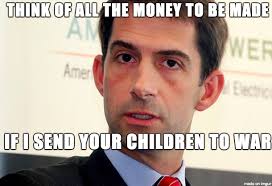
The “open letter” from Senator Tom Cotton and 46 other Republican Senators to the leadership of Iran, which even Republicans themselves admit was aimed at encouraging Iranian opponents of the nuclear negotiations to argue that the United States cannot be counted on to keep the bargain, has created a new political firestorm. It has been harshly denounced by Democratic loyalists as “stunning” and “appalling”, and critics have accused the signers of the letter of being “treasonous” for allegedly violating a law forbidding citizens from negotiating with a foreign power.

But the response to the letter has primarily distracted public attention from the real issue it raises: how the big funders of the Likud Party in Israel control Congressional actions on Iran.

The infamous letter is a ham-handed effort by Republican supporters of the Netanyahu government to blow up the nuclear negotiations between the United States and Iran. The idea was to encourage Iranians to conclude that the United States would not actually carry out its obligations under the agreement – i.e. the lifting of sanctions against Iran. Cotton and his colleagues were inviting inevitable comparison with the 1968 conspiracy by Richard Nixon, through rightwing campaign official Anna Chenault, to encourage the Vietnamese government of President Nguyen Van Thieu to boycott peace talks in Paris.

But while Nixon was plotting secretly to get Thieu to hold out for better terms under a Nixon administration, the 47 Republican Senators were making their effort to sabotage the Iran nuclear talks in full public scrutiny. And the interest served by the letter was not that of a possible future president but of the Israeli government.

The Cotton letter makes arguments that are patently false. The letter suggested that any agreement that lacked approval of Congress “is a mere executive agreement”, as though such agreements are somehow of only marginal importance in US diplomatic history. In fact, the agreements on withdrawal of US forces from both the wars in Vietnam and in Iraq were not treaties but executive agreements.

Equally fatuous is the letter’s assertion that “future Congresses could modify the terms of the agreement at any time”. Congress can nullify the agreement by passing legislation that contradicts it but can’t renegotiate it. And the claim that the next president could “revoke the agreement with the stroke of a pen”, ignores the fact that the Iran nuclear agreement, if signed, will become binding international law through a United Nations Security Council resolution, as Iranian Foreign Minister Mohammad Javad Zarif has pointed out.

The letter has provoked the charge of “treason” against the signers and a demand for charges against them for negotiating with a foreign government in violation of the Logan Act. In a little over 24 hours, more than 200,000 people had signed a petition on the White House website calling such charges to be filed.

But although that route may seem satisfying at first thought, it is problematic for both legal and political reasons. The Logan Act was passed in 1799, and has never been used successfully to convict anyone, mainly because it was written more than a century before US courts created legal standards for the protection of first amendment speech rights. And it is unclear whether the Logan Act was even meant to apply to members of Congress anyway.

AIPAC marching orders

The more serious problem with focusing on the Logan Act, however, is that what Cotton and his Republican colleagues were doing was not negotiating with a foreign government but trying to influence the outcome of negotiations in the interest of a foreign government. The premise of the Senate Republican reflected in the letter – that Iran must not be allowed to have any enrichment capacity whatever – did not appear spontaneously. The views that Cotton and the other Republicans have espoused on Iran were the product of assiduous lobbying by Israeli agents of influence using the inducement of promises of election funding and the threat of support for the members’ opponents in future elections.

Those members of Congress don’t arrive at their positions on issues related to Iran through discussion and debate among themselves. They are given their marching orders by AIPAC lobbyists, and time after time, they sign the letters and vote for legislation or resolution that they are given, as former AIPAC lobbyist MJ Rosenberg has recalled. This Israeli exercise of control over Congress on Iran and issues of concern to Israel resembles the Soviet direction of its satellite regimes and loyal Communist parties more than any democratic process, but with campaign contributions replacing the inducements that kept its bloc allies in line.

Cotton’s loyalty to Israel

Rosenberg has reasoned that AIPAC must have drafted the letter and handed it to Senator Cotton. “Nothing happens on Capitol Hill related to Israel,” he tweets, “unless and until Howard Kohr (AIPAC chief) wants it to happen. Nothing.” AIPAC apparently supported the letter, but there may be more to the story. Senator Cotton just happens to be a protégé of neoconservative political kingpin Bill Kristol, whose Emergency Committee on Israel gave him nearly a million dollars late in his 2014 Senate campaign and guaranteed that Cotton would have the support of the four biggest funders of major anti-Iran organisations.

Cotton proved his absolute fealty to Likudist policy on Iran by sponsoring an amendment to the Nuclear Iran Prevention Act of 2013 that would have punished violators of the sanctions against Iran with prison sentences of up to 20 years and extended the punishment to “a spouse and any relative, to the third degree” of the sanctions violator. In presenting the amendment in the House Foreign Affairs Committee, Cotton provided the useful clarification that it would have included “parents, children, aunts, uncles, nephews, nieces, grandparents, great grandparents, grandkids, great grandkids”.

That amendment, which he apparently believed would best reflect his adoption of the Israeli view of how to cut Iran down to size, was unsuccessful, but it established his reliability in the eyes of the Republican Likudist kingmakers. Now Kristol is grooming him to be the vice-presidential nominee in 2016.

So the real story behind the letter from Cotton and his Republican colleagues is how the enforcers of Likudist policy on Iran used an ambitious young Republican politician to try to provoke a breakdown in the Iran nuclear negotiations. The issue it raises is a far more serious issue than the Logan Act, but thus far major news organisations have steered clear of that story.

– Gareth Porter is an independent investigative journalist and winner of the 2012 Gellhorn Prize for journalism. He is the author of the newly published Manufactured Crisis: The Untold Story of the Iran Nuclear Scare.


The ISIS Truth We Hide From

Isis fighters, pictured on a militant website verified by AP.

By Bob Hennelly

Source: WhoWhatWhy

Identifying Terrorist Enemy No. 1—the Islamic State militants—is easy now, after a spate of horrific videos of beheadings and burnings.

But what’s hard for Western governments and the mainstream media is figuring out the popularity of this terror group among young western Muslims. Why do these people choose to leave the relative comforts of home and take up arms with IS militants? It’s as if these young people are from another planet.

Even after President Obama’s three-day White House Summit on Violent Extremism, few establishment “experts” and commentators seem ready to consider one possible answer: that it is the extreme militarism of the U.S. and its allies that helped spawn IS, and al Qaeda before that.

On the PBS NewsHour segment covering the White house confab, panelists were asked “why people are drawn to the kind of extremism we are seeing today?” The assembled pundits identified “local grievances” like “access to education and job opportunities” and faulted recruiting for “extreme ideology through books and social media.”

Yet there was no mention of U.S. drone strikes, prisoner rendition, torture, and the thousands of dead and wounded Muslim civilians. All of those factors have been exploited by ISIS and other violent groups to make their case that the U.S. is waging a war on Islam.

After several decades of self-proclaimed “nation building” and “exporting democracy” in the Middle East and its environs, the results are all too clear. There are shattered nations in Iraq and Afghanistan, failed states in Yemen, Libya and Syria, and more than a dozen African nations that the U.S. State Department concedes are under constant threat of attack by well-armed and organized terrorists.

Is it possible that what the U.S. has actually been doing in these hot spots is “terrorism building” and “exporting chaos”? Is this the awful truth the United States cannot bring itself to admit?

Massaging History

It would seem so, since instead of changing course, the U.S. is in the process of doubling down on its mistakes. How else to explain that the new GOP presidential hopeful, Jeb Bush, nonchalantly told the Chicago Council on Global Affairs that “mistakes were made” in Iraq. He then proceeded to lay out his own plan for becoming the new global sheriff in town.

Here’s a jaw-dropping statement from that speech:

There were mistakes made in Iraq, for sure. Using the intelligence capability that everybody embraced about weapons of mass destruction was not—turns out not to be accurate.

Watching his brother’s back, Jeb wove out of thin air a phony consensus that “everybody” signed on for the rationale for the Iraq war. That’s despite a vote in Congress in which 23 U.S. Senators and 133 House members opposed it.

You see, if “everybody” was wrong, then nobody was right. It should come as no surprise that Jeb’s team of policy wise men includes many Bush II veterans, among them the unrepentant Iraq war architect Paul Wolfowitz.

His Own Man, With an Old Plan

As much as Jeb Bush insists he is his own man, the audience in Chicago could hear echoes of his brother George’s cowboy-like approach. When Jeb was asked about how he would handle IS, he said he would develop a “global strategy” that would “tighten the noose” so he and the posse could “take them out.”

During Bush’s remarks, he took aim at the Obama administration for being too quick to disengage from the world and Iraq. He blamed Obama for creating a power vacuum that set the stage for the rise of IS and Iranian influence.

Yet an examination of President Obama’s new National Security Strategy, his proposed military budget and his request for his own War Powers re-authorization all indicate an administration that is prosecuting a global war on terror with unfettered latitude as to where and whom it targets.

Could it be that this “global war on terror,” whether it be the Bush 1.0 or Obama 2.0 version, may actually be what is proliferating the very thing it was aimed to eradicate?

One policy expert who dares to look deeper is Graham Fuller, a career CIA agent and analyst who was vice-chairman of the CIA’s National Intelligence Council. Fuller says it was the U.S. invasion of Iraq in 2003 that set the stage for IS. By creating an endemically corrupt central government in Baghdad, notes Fuller, the American occupation provided a focal point to unite disparate opposition groups. As for the high-profile effort to train a new Iraqi army, that “security” force collapsed the moment its U.S. handlers left. (In an odd twist to an already bizarre security meta-narrative, Fuller’s former son-in-law is the uncle of accused Boston Marathon Bombers Tamerlan and Dzhokhar Tsarnaev.)

***

In linking Washington’s Middle Eastern policies to the rise of terrorist groups in the region, MIT professor Noam Chomsky takes it even further back. He says the roots start with the U.S. support of Iraq in its brutal war with Iran in the 1980s, and include the draconian economic sanctions that followed Saddam Hussein’s 1990 invasion of Kuwait. In Chomsky’s view, these sanctions punished Iraqi civilians while reinforcing Saddam’s dictatorial control.

In his 2006 book Devil’s Game: How the U.S. Helped Unleash Fundamentalist Islam, longtime Nation correspondent Robert Dreyfuss documents how the U.S., as early as the 1950s, backed the Muslim Brotherhood in exchange for help fighting communism.

Peace’s Deadliest Year

One way to justify failed policies is to pretend that they have worked as advertised. Nowhere was this disconnect between rhetoric and reality more on display than in President Obama’s updating this month of his National Security Strategy.

In presenting this new security game-plan, the president exhibited excessive confidence in declaring that the United States was heading “home” and “moving beyond” ground wars in Iraq and Afghanistan. In his mini-version of Bush’s infamous ‘Mission Accomplished’ statement, he asserted that “the threat of catastrophic attacks” against the U.S. had “diminished.”

But even as the president describes a winding-down of combat operations, anything but peace is taking hold in those places.

The sectarian violence has resulted in record numbers of civilian deaths and injuries. The UN reported last month that more than 12,000 civilians were killed in Iraq in 2014, the deadliest year for noncombatants since 2008. In Afghanistan, the UN Assistance Mission counted close to 3,200 civilians killed and more than 6,400 wounded, the deadliest year since America’s longest war started.

Providing a sharp contrast to the president’s own assertion that peace is almost at hand, he has sent troops back into Iraq. And just a few days ago, his new Secretary of Defense, Ashton Carter, said the U.S. might end up sticking around in Afghanistan after all.

What the Administration and a cheerleading media refuse to acknowledge is that the two U.S. wars in Afghanistan and Iraq, aimed at ending terrorist threats in the region, have done the exact opposite. They not only caused tens of thousands of civilian casualties but hardened the resolve of yet another generation to seek revenge against their perceived Western oppressors.

Bottom Line

While details of how the president plans to use his refreshed war powers are still vague, the price tag is not.

In the name of defending the country and fighting terrorism, the president’s proposed 2016 budget calls for adding $38 billion in regular defense spending and another $58 billion for so-called “Overseas Contingency Operations.” These expanded outlays would come on top of the more than half a trillion dollars the U.S. is already spending on the military.

Even under the sequester restrictions, says one specialist, U.S. military spending was already quite robust and shamefully under-scrutinized.

“If you can’t protect the nation with $500 billion dollars,” then something is amiss, according to Veronique deRugy of George Mason University’s Mercatus Center. She notes that even under the sequester restrictions, U.S. military spending was already quite robust and shamefully under-scrutinized.

The failures are especially pronounced, says deRugy, when one takes into account that in the years since 9/11, Washington’s extra expenditures, labeled “emergency” war funding, have topped Pentagon budgets by tens of billions annually.

And so under presidents from both parties, who were supposedly ‘conservative’  and ‘liberal’,  the “emergency” continues to spread.

US War on ISIS a Trojan Horse

obama-isis-cia

In America’s coming war, don’t be surprised if everything in Syria is destroyed except ISIS.

By Ulson Gunnar

Source: Land Destroyer Report

In August of 2013, even as the words came out of US President Barack Obama’s mouth regarding an “impending” US military strike against the Syrian state, the impotence of American foreign policy loomed over him and those who wrote his speech for him like an insurmountable wall.  So absurd was America’s attempt to once again use the canard of “weapons of mass destruction” to justify yet another military intervention, that many believed America’s proxy war in Syria had finally reached its end.

The counterstroke by Russia included Syria’s immediate and unconditional surrendering of its chemical weapons arsenal, and with that, so evaporated America’s casus belli.

Few would believe if one told them then, that in 2015, that same discredited US would be routinely bombing Syrian territory and poised to justify the raising of an entire army of terrorists to wage war within Syria’s borders, yet that is precisely what is happening. President Obama has announced plans to formally increase military force in Iraq and Syria “against ISIS,” but of course includes building up huge armies of “rebels” who by all other accounts are as bad as ISIS itself (not to mention prone to joining ISIS’ ranks by the thousands).

All it took for this miraculous turn in fortune was the creation of “ISIS,” and serial provocations committed by these Hollywood-style villains seemingly engineered to reinvigorate America’s justification to militarily intervene more directly in a war it itself started in Syria beginning in 2011.

ISIS could not be a more effective part of America’s plans to overthrow the Syrian government and destroy the Syrian state if it had an office at the Pentagon.

Having failed to achieve any of its objectives in Syria, it inexplicably “invaded” Iraq, affording the US military a means of “easing into” the conflict by first confronting ISIS in Iraq, then following them back across the border into Syria. When this scheme began to lose its impact on public perception, ISIS first started executing Western hostages including several Americans. When the US needed the French on board, ISIS executed a Frenchman. When the US needed greater support in Asia, two Japanese were beheaded. And just ahead of President Obama’s recent attempt to formally authorize the use of military force against “ISIS,” a Jordanian pilot was apparently burned to death in a cage in an unprecedented act of barbarity that shocked even the most apathetic.

The theatrics of ISIS parallel those seen in a Hollywood production. This doesn’t mean ISIS didn’t really burn to death a Jordanian pilot or behead scores of hostages. But it does mean that a tremendous amount of resources and planning were put into each murder, except apparently, the effect it would have of rallying the world behind the US and its otherwise hopelessly stalled efforts to overturn the government of Syria.

Could ISIS have built a set specifically to capture dramatic shots like a flame trail passing the camera on its way to the doomed Jordanian pilot, planned crane shots, provided matching uniforms for all the extras on their diabolical movie set, but failed to consider the target audience and how they would react to their production? Could they have, just by coincidence, given exactly what the United States needed to continue its war on Syria in 2015 when it otherwise had effectively failed in 2013?

The answer is obviously no. ISIS’s theatrics were designed specifically to accomplish this. ISIS itself is a fictional creation. In reality the legions of terrorists fighting across the Arab World under the flag of “ISIS” are the same Al Qaeda militants the US, Saudi Arabia and others in an utterly unholy axis have been backing, arming and exploiting in a variety of ways for decades.

Just as the “Islamic State” in Iraq was exposed as a fictional cover for what was also essentially Al Qaeda (as reported by the NYT in their article, “Leader of Al Qaeda group in Iraq was fictional, U.S. military says“), ISIS too is just the latest and greatest re-visioning yet.

The fighters are real. Their atrocities are real. The notion that they’ve sprung out of the dunes of Syria and Iraq, picked their weapons from local date trees and have managed to wage war regionally against several collective armies is entirely fantasy. Required to maintain ISIS’ ranks would be billions in constant support. These are billions ISIS simply cannot account for from hostage ransoms and black market oil alone. The only source that could prop ISIS up for as long as it has allegedly existed and to the extent it allegedly exists, is a state or collection of states intentionally sponsoring the terrorist enterprise.

Those states are of course the chief benefactors of ISIS’ atrocities, and we can clearly see those benefactors are the US and its partners both in Europe and in the Middle East. The US would claim that the threat of ISIS necessitates them to intervene militarily in Syria (when lies about WMDs were flatly rejected by the American and international public). Of course, before the serial headline atrocities ISIS committed, the US attempted to sell this same lie but without affect. Now that sufficient blood has been split and the public sufficiently riled, the US is once again trying to move forward its agenda.

Don’t be surprised, if the US manages to succeed, that everything in Syria is left destroyed except for ISIS. A Hollywood villain this popular and effective is surely destined for a sequel in neighboring Iran or southern Russia, coincidentally where the US would like to create strife and carnage the most.

Ulson Gunnar, a New York-based geopolitical analyst and writer especially for the online magazine “New Eastern Outlook”.

ISIS 101: What’s really terrifying about this threat

ISIS-and-the-false-flag-frame-up

By John Chuckman

Source: RINF

ISIS certainly is not what a great many people think that it is, if you judge what they think by what our corporate press proclaims incessantly.

Judging by what ISIS actually does and whom its acts benefit, its clandestine associates, and the testimony of some witnesses, ISIS is a complex intelligence operation. Its complexity reflects at least in part the fact that it serves the interests of several countries and that it has more than one objective. Its complexity reflects also the large effort to reinforce a false image with disinformation and staged events such as a video of a beheading which could not have been a beheading unless they’ve discovered a bloodless method until now unknown to science.

The subject of ISIS is not without brief glimmers of humor. The image of bands of men, swathed in Arabic robes and bumping their way around the desert in Japanese pick-up trucks with Kalashnikovs raised in the air for every picture has elements of Monty Python. The idea of modern, trained and well-armed military units turning and running from them resembles a war scene in a Laurel and Hardy comedy such as the one with Hardy stuck upside down in a WWI tank turret kicking his legs the whole time Laurel drives towards the German positions managing accidentally to round-up a whole trench-full of prisoners with some wire fencing that becomes snagged on the tank.

Despite the tiresome stupidities we see and hear about it, ISIS unquestionably does kill people and destroy things, that being its purpose, and there is no humor in that.

ISIS appears to have served several tasks so far. First, it frightened Iraq’s Prime Minister, Nouri al-Maliki, out of office in Iraq, a man America and Israel grew very much to dislike owing simply to his good relations with Iran, one of the unintended consequences of America’s invasion of Iraq being expanded Iranian influence in the region. No doubt al-Maliki was terrified not so much by ISIS approaching in their pick-up trucks as he was by his own military’s tendency, as if on cue, to turn and run from ISIS, often leaving weapons behind. The message was clear: you won’t be protected.

Second, America’s highly selective “air war” against ISIS somehow manages to attack infrastructure targets inside Syria with the feeble excuse that they are facilities helping ISIS. We’ve seen what American bombing can do when it’s undertaken seriously, and somehow I have a hard time imaging the men in Japanese pick-ups lasting long when faced with what hit the Taleban in Afghanistan or Gadhafi’s forces in Libya. The air strikes are partly a show for the world – after all, how can America be seen not to be fighting such extremely well-advertised, super-violent terrorists, guys putting out videos regularly from a studio trailer they must haul around with one of their pick-up trucks?  The air strikes’ main purpose appears to be a way of hurting Assad and assisting those fighting Syria’s army without coming into conflict with Russia, as they would with a large, direct campaign. They likely also punish elements of ISIS which have exceeded their brief and serve as a reminder to the rest of what could happen to them if they stray too far from their subsidized purpose once the war comes to an end.

Three, in some of the ground fighting in Iraq where we’ve read of Iraqi units fighting ISIS, the units are often Kurdish, and sometimes the press uses expressions like “Iraqi and Kurdish troops.” But the Kurdish region is still part of Iraq legally, although it has been given a good deal of autonomy by the central government. The Kurdish region of Iraq is the country’s prime oil-producing area, and in the estimation of many observers, an area both the United States and Israel would very much like to see severed from Iraq in the way Kosovo was severed from Serbia after America’s devastating air war there. This would not only permanently assure Iraq’s weakness, it would create a rather grateful and more willing oil supplier.

Where does ISIS get its technical equipment and the know-how to produce videos and run Internet sites? These are not qualities commonly found among fanatical fundamentalists anywhere; indeed most true radical fundamentalists tend to eschew technology. A supply of advice, technical assistance, and equipment comes from somewhere. Where does ISIS get the money for food, gasoline, clothes, ammunition, and Japanese pick-up trucks? And I wonder, did one of those wild-looking jihadi types just show up one day at an Iraqi car dealership and order a fleet of Japanese pick-ups? Were they delivered out on the desert or did a gang of jihadists march in, waving their Kalashnikovs, to drive them away?

The effort to destroy the Syrian government, whether by means of ISIS or anyone else, is warmly and generously supported by Saudi Arabia and its buddy Qatar – another oil-rich, absolute monarchy where political parties are banned – both these counties’ primary interest being the defence of their immensely privileged situations against creeping threats of all progressive developments such as equal human rights or democracy or indeed against revolt led by external forces. The payments we now know the Saudi royal family long made to Osama bin Laden before 9/11 were simply bribes to keep him and his anti-establishment work out of the country. They really didn’t care a lot about what the money bought elsewhere, but since 9/11 and its many Saudi connections – 15 of the perpetrators plus the past financing plus the many members of the royal family and bin Laden family secretly flown out by American officials at the time – the Saudi authorities were genuinely fearful of how America might respond and have become far more responsive to what America wants in the Middle East and now apply their money to such projects. What America wants in the Middle East is, invariably, what Israel wants, so there is now extensive, secret cooperation where once there was complete official hostility.

We have reports from plane-spotters in the region of daily flights of mysterious planes from Israel to Qatar. We have several eye-witness reports and photographs of supply bundles dropped from unknown planes into ISIS territory. Maybe ISIS has its own air force now? We know Turkey has served both as an entry point for countless terrorists into Syria and as a place of retreat and refuge when fighting with the Syrian army becomes too hot for them, the volumes of such activity having been too great to keep secret. We have reports of Turkish supply flights. A Jordanian official recently told a reporter that ISIS members were trained in 2012 by American instructors working at a secret base in Jordan.

If ISIS is what our corporate news pretends that it is – a fanatical Muslim extremist group that sprang suddenly from the desert sands much like Jack’s bean stalk – one blindingly obvious question is, why does it not attack Israel or Israeli interest? Isn’t that what one would expect from such a cast of characters? But it has not done so, undoubtedly because Israel is an important covert benefactor and supplier.

We might equally ask why ISIS has not attacked Saudi Arabia or its interests, for although the Saudi royal family officially professes a strict and conservative form of Islam, Wahhabism, in fact many of them are very worldly people who spend a good deal of time and money at the world’s great pleasure palaces. Perhaps even more damning for a genuine fanatical fundamentalist, the Saudis now often secretly cooperate and make plans with Israel where mutual interests exist.

No, there is something highly suspicious about Islamic fundamentalist terrorists who avoid such interests while managing to brutally kill poor Syrian soldiers just doing their jobs along with the odd foreign journalist or aid worker who may just have seen something they shouldn’t have seen. Of course, we have Edward Snowden himself having described ISIS as an operation intended to protect Israel. Despite the fact that some news sources have said the interview in which this was revealed never took place, my instincts tell me it likely did. Snowden has never refuted it, and the news sources saying it did not are highly suspect on such a subject.

The way ISIS serves Israeli and American interests is by providing a focus point for extremists, attracting them from various parts of the world so that they can be recorded and kept track of. Also the tracks back to the various countries from which they come provide security services with leads to places where there might be some festering problems. In the meantime, ISIS serves the interest of helping to bring down President Assad, a goal dear to the hearts of Israelis. Please remember that black operations, even the ones about which we know, show little consideration for lives or property. Just think of Israel’s attack on an American spy ship in the Mediterranean during the Six Day War, its pilots knowingly shooting up and bombing for two hours the well-marked ship of its ally and benefactor, no explanation worth hearing ever having been offered.

Just read conservative mainline sources (pretty much a redundant pair of adjectives) about the harm Snowden has done: claims of everything from his revelations about American intelligence having served to help ISIS avoid detection (!) to his revelations having set up the United States for another 9/11! You might think intelligent people would be ashamed of making such asinine public statements, but, no, there are almost no limits to trying to discredit those revealing murderous, dark operations.

We’ve had many reports of officials in various countries, including Canada as I write, concerned about the odd individual or small group running off to join ISIS. Now why should that be a concern? A few flaky people going abroad just removes them from your country, something I should have thought was a complete gain from a security point of view. Even if they were ever to return in future, you would know exactly who they are. Where is the basis for serious concern? But the psychological advantages of noise and hype to scare people about obscure dangers and “lone wolves” and “home-grown terrorists” outweigh completely good sense and intelligence.

Finally, there are numerous reports that Abu Bakr al-Baghdadi (a nom de guerre, not his real name), the leader of ISIS, is a Western intelligence asset. What little we can learn about him makes that entirely plausible. The Supreme Leader of Iran, Ali Khamenei, has said that the man is a Mossad agent, a claim supported supposedly by documents revealed by Edward Snowden. Abu Bakr al-Baghdadi is by all accounts a secretive man who speaks directly with few people, and even his birth place, given as Samarra, Iraq, is not sure. Records of his past, as those from his period of American captivity (always a great opportunity to “turn” someone to serving two interests), are not available. He was once reported killed but is still alive. He is said to have received intensive training from Mossad and the CIA, and some sources give his real name as Simon Elliot (or, Elliot Shimon), but few details can ever be certain in such dark operations.

The truly terrifying aspect of ISIS and other forces fighting with it in Syria is that the United States and Israel have approved and supported such wanton destruction in so beautiful and formerly-peaceful a place as Syria. Millions of lives destroyed and countless historic places damaged as though they were all nothing more than a few pieces moved on a geopolitical chessboard. I think it fair to describe that as the work of psychopaths.