
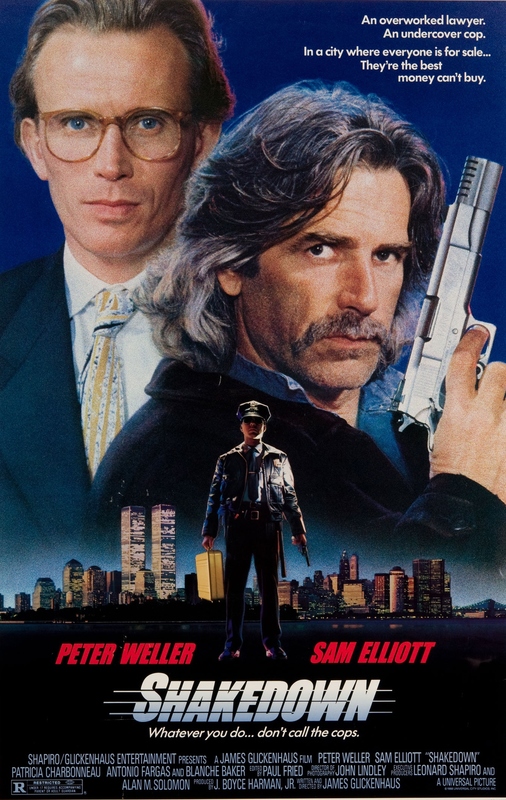
“Shakedown” (1988) is an action/crime drama written and directed by James Glickenhaus. Peter Weller and Sam Elliot star as Dalton (an idealistic lawyer) and Marks (a veteran cop) who team up to defend a low-level crack dealer who is framed to cover up a ring of crooked cops working for a drug lord. In the midst of his case, Dalton rekindles an affair with the prosecutor of the case Cantrell (Patricia Charbonneau), unbeknownst to his fiancée Gail (Blanche Baker). Shakedown is one of the more enjoyable and underrated low-budget action films of the 80s.
Film synopsis from BullfrogFilms.com:
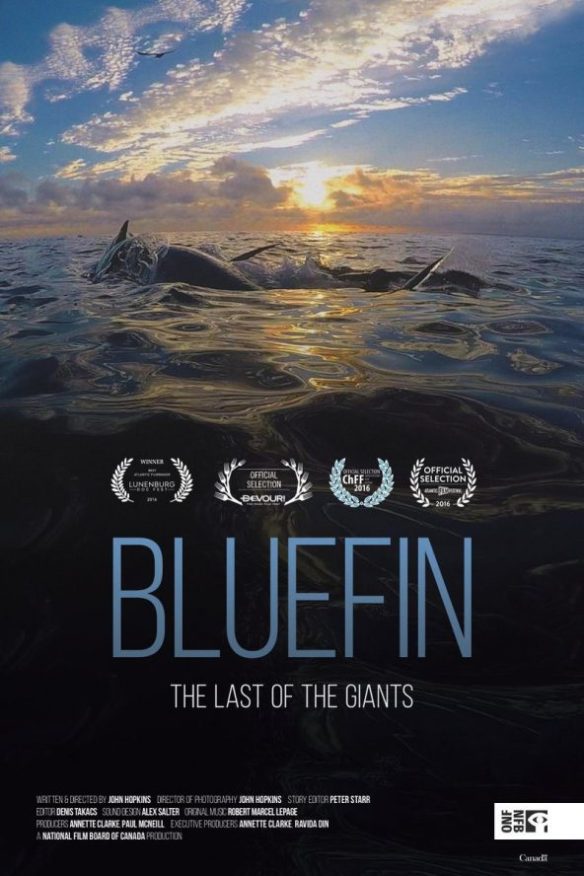
BLUEFIN is a tale of epic stakes set in “the tuna capital of the world,” North Lake, Prince Edward Island, Canada. The film explores the baffling mystery of why the normally wary bluefin tuna no longer fear humans. Local fishermen swear tuna are so starving and abundant now that they will literally eat out of people’s hands like pets. But something is not right. Have these “endangered” tuna stocks suddenly recovered as the fishermen claim? Or are we actually hunting down the last of them–like the buffalo–as scientists claim? One thing is certain: this sudden and incredible abundance of tuna off their shores flies in the face of scientific assessments claiming endangered stocks are down by 90 percent.
With stunning cinematography, director John Hopkins documents this mystery and brings the issues into sharp focus. At the heart of this documentary lies a passionate concern by all about the fate of the giant bluefin tuna. Isn’t it time we learned to appreciate the giant, and relentlessly hunted, bluefin as extraordinary “wildlife,” in the same way we love whales, dolphins and panda bears?
Watch the full film here.

“Dick” (1999) is a cult comedy co-written (with Sheryl Longin) and directed by Andrew Fleming. It’s an absurdist retelling of the events surrounding the Watergate scandal which led to the resignation of Richard “Tricky Dick” Nixon (played in the film by Dan Hedaya). Kirsten Dunst and Michelle Williams star as Betsy and Arlene, two fun-loving and ditzy best friends, who, through a random chain of events, become the legendary “Deep Throat” figure ultimately responsible for bringing down the Nixon presidency. Will Ferrell and Bruce McCulloch star as this film’s version of Woodward and Bernstein. A roster of comedic actors including Teri Garr, Dave Foley, Harry Shearer, Jim Breuer and Ryan Reynolds also make appearances.
Watch the full film here.

By Oliver Hall
Source: Dangerous Minds
Les dents du singe (The Monkey’s Teeth) is the directorial debut of René Laloux, the animator who made Fantastic Planet and Time Masters. This, his first short, came out of the experimental La Borde clinic at Cour-Cheverny. As supervisor of artistic activities at La Borde, Laloux staged therapeutic puppet shows with the resident malades mentaux during the years before he gave them their big break in the motion picture business.
According to his obit in Positif, Laloux and his patients were aided in writing the screenplay for Les dents du singe by Félix Guattari, later the co-author of a number of influential books with the philosopher Gilles Deleuze; the group’s screenwriting method was something like a combination of “automatic writing, exquisite corpse, and Jung’s tests.” In 1960, Guattari was working at La Borde as a therapist. He had been drawn to the clinic by its founder, the Lacanian psychiatrist Jean Oury.
The biography Gilles Deleuze and Félix Guattari: Intersecting Lives conveys a sense of life at La Borde:
Oury baptized his clinic as soon as it opened in April 1953, writing a constitution that he dated Year I (a tongue-in-cheek reference to the French Revolution) and that defined the three guiding principles for this collective therapeutic undertaking. The mangers were protected by democratic centralism, reflecting the Marxist-Leninist ideal that was still popular in the year of Stalin’s death. The second principle reflected the idea of a communist utopia whereby each staff member would alternate between manual labor and intellectual work, which effectively made any status temporary. Tasks were assigned on a rotating basis: everyone in the clinic switched from medical care to housekeeping, from running workshops to preparing theatrical activities. The last principle was antibureaucratic, so things were organized in a communitarian way whereby responsibilities, tasks, and salaries were all shared. Although the term “institutional psychotherapy” had not yet been coined, many of its themes were already in evidence: spatial permeability, freedom of movement, a critique of professional roles and qualifications, institutional flexibility, and the need for a patients’ therapy club.
Hollywood has not yet produced many tales about bike-riding simians meting out justice at the dentist’s office, but I expect we’ll see a “reboot” of The Monkey’s Teeth before long.
INDIAN COUNTRY NEWS
"It is the duty of every man, as far as his ability extends, to detect and expose delusion and error"..Thomas Paine
Human in Algorithms
From the Roof Top
I See This
blog of the post capitalist transition.. Read or download the novel here + latest relevant posts
अध्ययन-अनुसन्धानको सार
 After the Crash