Ghostface Killah & BADBADNOTGOOD

By Michael Grasso, K.E. Roberts, Richard McKenna
Source: We Are the Mutants
GRASSO: When our esteemed editor-in-chief recommended we look this week at the little-heralded-nor-remembered Endangered Species from 1982, I was cautiously optimistic. A B-movie starring Robert Urich, JoBeth Williams, Paul Dooley, and Hoyt Axton about cattle mutilations, shot on location in Colorado and Wyoming? I consider myself well-versed in movies about UFOs from the late ’70s and early ’80s, and the fact I’d never heard of this one was a real shock. To my further shock, the film was amazing: fascinating as both a time capsule of the early Reagan years and as a piece of weird outsider art/conspiratorial agitprop. In fact, in Mutant Chat this week I called Endangered Species “the last great 1970s political conspiracy thriller”; with a few days to mull over this assessment, I stand by it even more assertively. Endangered Species seamlessly and expertly weaves together all the threads of cattle mutilation lore as they currently stood in 1982, all while engaging the kind of B-plots that are characteristic of similar movies from this time period: a shoehorned (and slightly icky) romance between the two leads, a plucky teenage character for the teens in the audience to identify with, and a good chunk of edgy blood and gore (not just from the aforementioned mutilated cattle).
So I just have to ask before getting into the details and why I loved this trashy piece of late-night ’80s cable fare—Kelly, how in the hell did you find out about this thing?
ROBERTS: I remember this flick from the video store, but I never watched it (not that I remember, anyway) until about a year ago. Conspiracy films became a genre unto themselves after Watergate, as did UFO films after 1977’s Close Encounters. Endangered Species merges both—one of the few examples of such before The X-Files (1980’s Hangar 18, produced by exploitation experts Sunn Classic Pictures, is another). The campy elements are there, for sure, but overall I agree with you, Mike: this is a very interesting portrait of ramped-up paranoia during the high Cold War period that hits a surprising number of now well-known genre staples: “silent” black helicopters, chemical and germ warfare, keeping up with the Russians, moving vans that disguise shadowy government conspirators, references to satanism. Although the script can’t quite live up to the premise, the opening sequence that moves from a herd of cows in rural Colorado to a herd of humans rushing through the streets of NYC makes the point perfectly clear: our government makes no distinction between cows and people; we are all dumb beasts whose purpose is to be sacrificed for the preservation of the bastards in power.
MCKENNA: Jesus but it’s been a while since I last saw a mainstream film that felt as out-of-control as Endangered Species. I had a vague recollection of watching it, but apparently it was one of those false memories engendered by spending too long staring at the VHS covers down the rental shop, hence it was totally new to me. It comes on like an aggressive cross between a self-aware B-movie and an oddball independent cinema artifact, so it’s no surprise that director Alan Rudolph was a protégé of Robert Altman. Prior to Endangered Species, Rudolph had made a string of low-budget, intelligent, critically acclaimed films in a variety of genres. And Endangered Species is fucking great, despite the many odd and sometimes unpleasant things about it, which include what can’t help feeling like a bit of a cavalier attitude to animal welfare and Robert Urich’s awful yet incongruously multifaceted “hero” Ruben Castle. Castle is one of the most irritating and borderline repellent protagonists I can remember seeing posited as a good guy and romantic lead, despite which he’s given to flashes of grace and insight. Given Rudolph’s smarts, it’s intriguing to wonder if the character wasn’t a deliberate piss-take of bullheaded thuggish machismo—in fact, it’s sometimes hard to tell whether Endangered Species is actually stupid or just playing at it.
You mention Close Encounters, Kelly, and in some ways the whole film almost feels like a compelling satire-mashup of Spielbergian motifs, from the casting right down to the Sugarland Express-like motorcade of cars that provides the film with one of its most memorable images, as well as the disguised trucks containing government technology, like the ones used to ferry Francois Truffaut’s benevolent scientific staff across the US, though here ferrying something much less benign.
Rudolph’s direction is lucid and kinetic, the editing surprising, the acting pretty great, and the script off the wall enough to have its moments, but what is perhaps most surprising about it— especially given how early on it’s made clear that the UFOs are a cover for military–industrial complex shenanigans—is that Endangered Species somehow manages to remain oddly frightening (thanks in part to a deeply unsettling score by Gary Wright) and convincingly transfers the eerie atmosphere initially engendered by the non-sequitur aerial shots of rampaging livestock and rumors of heifer-lasering ETs to government conspiracies equally inhuman and incomprehensible.
GRASSO: Kelly, you’re right: this really is a sui generis artifact of ufology at the outset of the ’80s, one that really bridges two distinct eras in the field. As the 1980s progressed, tales of close encounters were rapidly leaving behind encounters of J. Allen Hynek’s third kind (where entities can be sensed or glimpsed) and becoming more and more likely to be abductions where perceptions of the experiencer’s sense of reality were changed: i.e., encounters of Jacques Vallée’s fourth kind. The suspicion that the U.S. government might be in some ways covering up or working in cahoots with the UFOs also dates from the 1980s, as the Majestic-12 hoax documents began circulating a year or two after Endangered Species was released. (One of Majestic-12’s biggest proponents, investigative reporter Linda Moulton Howe, was also one of the earliest journalists to cover the cattle mutilation phenomenon.)
But ultimately I can’t think of another film from this period that is so decidedly Valléean in its almost fractal unfolding of putative UFO phenomena. In his 1979 Messengers of Deception, Vallée spends quite a bit of time looking at cattle mutilations in the American West. At the time, the classic mutilation event was over a decade old: the case of Snippy the Horse in 1967. Vallée examines how the costly mystery of the cattle mutilation phenomenon in the latter half of the ’70s gradually turned these ranchers from initially believing that UFOs were responsible to eventually believing some kind of government conspiracy were behind the mutilations. These streams of anti-government conspiratorial thought obviously flowed together with existing suspicion of government interference in ranching and land management in the West that would feed into the militia movements of the 1990s and beyond. (It’s interesting to note that JoBeth Williams’ Sheriff Harry character deputizes the entire town at the end of the film to confront the shadowy base on the edge of town; the idea of the posse comitatus was hugely inspirational to the anti-government militias forming in the West at this time.)
But let’s concede this much to the ranchers: their cattle were dying, and they had some reason to suspect government experiments. In Endangered Species, the paramilitary forces are abducting and experimenting on cattle to test biological weapons to be used against the Soviets. (This is probably the best place to note that both Peter Coyote’s and Dan Hedaya’s black ops operatives emit real sleazy menace in every scene they’re in; they don’t get much screen time, but for me they were by far the best part of the film.) These mysterious operatives are utterly dedicated to these experiments for “patriotic” reasons. In Coyote’s confrontation with Hoyt Axton’s big-time rancher, it’s obvious that Axton’s character’s patriotism was a big reason for his collaboration with the cattle mutilators (“I’m a patriot, Steele; I’d do anything for my country”), but after the murder of town newspaper editor Paul Dooley to keep the coverup intact, the black ops boys have gone too far for his tastes. “And you’re not in Guatemala takin’ pot-shots at barefoot natives,” Axton says to Coyote, putting the black ops conspirators firmly in the sphere of the CIA. It’s no surprise that Axton eventually dies a gruesome death; after a black-bag team taints his toothbrush with a mysterious agent, his guts literally fall out of him as an out-of-control hemorrhagic illness ravages his system. Obviously, we’re meant to be reminded of the kinds of domestic ops performed by CIA programs like MKUltra here, but it’s also interesting to see a bioweapon on screen in 1982 that is very similar to the Ebola virus (discovered by scientists in 1976). Government conspiracies involving Ebola/Marburg viruses were also au courant in the 1990s, as were beliefs that the U.S. government either had deliberately engineered or released the AIDS virus into the U.S. population at the end of the 1970s.
ROBERTS: I need to mention E.T.: the Extra-Terrestrial here. Released exactly two months before Endangered Species, Spielberg’s film also featured government agents (in this case, the FBI) spying on American citizens and actively seeking to keep the truth from them, prepared to use violence if necessary. Ultimately, the agents are portrayed as benevolent, even paternalistic, their boss (played by Peter Coyote!) revealed to be much like idealistic kid-hero Elliott—as well as a potential father figure to him. Endangered Species does not cop out in such a way (as Spielberg did in 2002 when digitally replacing the FBI’s guns in the chase scene with walkie-talkies, a tragic mistake he later rectified), and is much more disturbing because of it, as you guys mention. While a number of popular ’80s films take on the military-industrial complex and conspiracy, to some degree—The Manhattan Project (1986), The Philadelphia Experiment (1984), WarGames (1983), No Way Out (1987)—only John Carpenter’s They Live (1988) and Endangered Species offer an outright rejection of Reagan’s manipulative idealism.
The film missed an opportunity with JoBeth Willams (who had just starred in 1981’s Poltergeist), whose character we expect to be a man when she’s introduced as newly elected sheriff “Harry.” The camera follows her as she walks to the podium to get sworn in, her long hair tucked up under her hat. For a while, Harry gets to show off her investigatory chops, and even challenges Urich’s claim to hero status, until the predictable “Does she ever wear a dress?” comment gets trotted out, and she takes a backseat to a stock character (the burned-out, drunk NYC cop who’s dictating his first hard-boiled novel into a mini tape recorder).
MCKENNA: It’s true, the very talented JoBeth Willams isn’t used anywhere near as well as she could have been, and the situations the script puts her in range from patronizing to offensive, but despite that she still manages to give a performance that radiates humanity and realness. Playing Urich’s daughter, Marin Kanter (who also appeared in Ladies and Gentlemen, the Fabulous Stains the same year) is great too, as are all the various minor characters who evoke a convincing milieu of dickhead provincial bureaucracy.
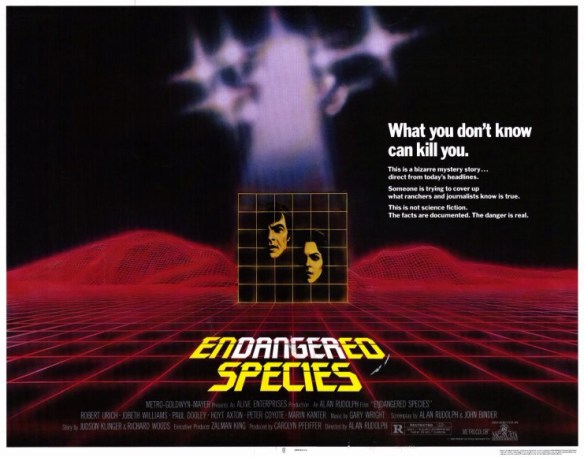
In fact, Endangered Species is such a monster that even the poster’s a rocker, bringing together the lights in the sky from the alternate posters for E.T. with a light-grid (which appears in the film as part of the black ops tech used by the baddies) reminiscent of 1981’s Looker, giving it something of the feel of a summa of the zeitgeist. The whole thing quite clearly bears the greasy fingerprints of its executive producer, Zalman King. Better known for his screenplay for 1986 wank-fest 9½ Weeks and the erotic thrillers he subsequently directed, King had given a great performance four years previous to Endangered Species as the protagonist of Jeff Lieberman’s Blue Sunshine—another sort-of-countercultural horror-conspiracy movie—and was one of those people who seemed in some strange way to have the pulse of the unwholesome side of the popular culture, for better or worse. Endangered Species is yet more proof of that odd talent.
Another thing that struck me was the language used by the villains of the piece—a realistic-sounding form of the clinically euphemistic combat talk (which, like the conversations between scientists in 1980’s Altered States, makes you aware you are listening to professionals) that has now become commonplace but that feels surprisingly ahead-of-its-time in the context of the film. It not only gives Endangered Species a sheen of accuracy but also makes you wonder just how much this compellingly detached way of speaking about death and killing—because it is compelling, unfortunately—has contributed to normalizing, to whatever small extent, the kind of thinking that lies behind it.
GRASSO: As I said at the outset, Endangered Species feels a lot more like ’70s thrillers such as The Parallax View or Three Days of the Condor than your typical 1980s VHS fare. Even the ambiguous ending pretty much assures us that greater and more momentous injustices committed by U.S. government-aligned forces will likely continue, long after the credits roll. But it does diverge from those classic 1970s conspiracy thrillers in an important way: instead of the protagonists being crusading journalists (Paul Dooley’s newspaper editor dies about halfway through), the protagonists here are a pair of cops. JoBeth William’s Sheriff Harriet character, as mentioned before, is a woman who can get things done and has the nominal trust of her fellow Coloradans (even if there is the whiff of sexism around the way she is treated at a climactic town meeting). But Robert Urich’s vacationing New York City cop is straight out of street-level 1970s films. While he’s not the same kind of maverick hero as Al Pacino’s Serpico, he’s a salt-of-the-earth schlub, reminiscent of ’70s protagonists such as Walter Matthau in The Taking of Pelham One-Two-Three. But ultimately both protagonists are cops, and I think that’s worth noting as we move from the Nixonian Seventies to the Reaganite Eighties.
To echo what Richard said above, the film certainly is visually interesting for its budget and limitations. The high plains landscapes and slowly decaying small-town streets evoke the period exceptionally well, when America’s small towns were beginning to feel the hollowing out by global capital. The implicit confluence of shadowy government forces with local and international capitalists (in form of Axton’s rancher, the sinister big rigs, and the cattle mutilators’ headquarters, a U.S. missile silo eventually sold into private hands after the first round of U.S.-Soviet arms treaties in the late ’60s) is probably one of the most interesting sub rosa themes in the film. The film’s editing, especially around the repeated ubiquitous cattle abductions by helicopter, is solid as well. And the occasional use of computer graphics eschew the frequent cheesiness inherent in most ’80s films and give us a believable look at what the advanced surveillance and medical systems that the black ops personnel use might look like. Even Gary Wright’s offbeat synth score helps convey a feeling of technological alienation (although I chuckled at the inclusion of a character singing along to “Dream Weaver” on the radio). I maybe wouldn’t go so far to say that Endangered Species is a lost classic, but it’s a fascinating document that tells us more about the state of American conspiracy theorizing in the early 1980s than a lot of bigger, better-known films from the period.
By Michael Grasso
Source: We Are the Mutants
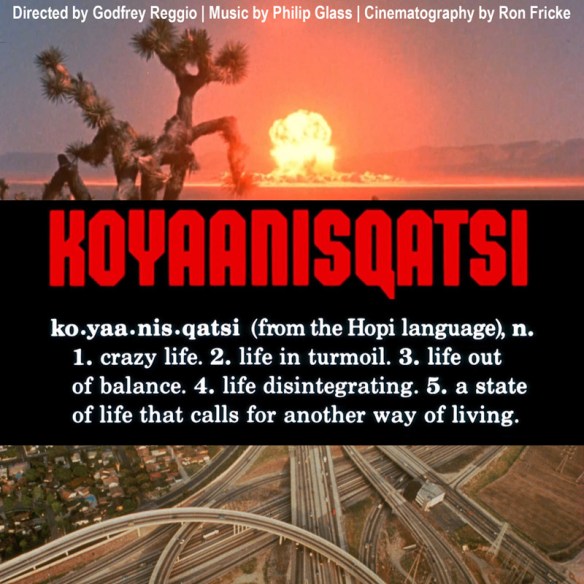
Throughout the latter half of the 1970s, ex-seminarian/political activist Godfrey Reggio and cinematographer Ron Fricke shot, assembled, and edited film footage from all over the United States—from the yawning chasms of southwestern American deserts to the teeming mechanized metropolises of New York and Los Angeles—creating a feature film that would speak to the overwhelming complexity of late 20th century life in the West. This film, Koyaanisqatsi, debuted at American film festivals in 1982 and quickly became an arthouse (and eventual home video) favorite. The frequently eerie score for the film, composed by Philip Glass, provides the only aural accompaniment for this 86-minute montage showing the collision of nature and technology, of mankind and the planet. The word koyaanisqatsi, Hopi for “corrupted life” or “life out of balance,” provided a mission statement for the film; while Reggio has been cagey about not wanting to either imply or explicitly provide any specific meaning for the film, both the title and the Hopi prophecies of doom sung over the film’s final act make Koyaanisqatsi‘s point of view more or less explicit: something is dreadfully and fundamentally wrong with the way the settler inhabitants of America and the industrialized world as a whole relate to both the planet and themselves.
Koyaanisqatsi arrived with much fanfare as part of the PBS “Great Performances” anthology series in March of 1985. Given my love of all things PBS, I was absolutely there to see it in one of its initial broadcasts or repeats in ’85 or ’86. I’d heard about it most likely due to the hype around the film’s arrival on broadcast television for the first time. I do remember watching it at night, alone, possibly while my parents were out or in bed. When I found Koyaanisqatsi on a streaming service this year, I realized that I hadn’t watched it in its entirety since I was 10 years old. As I watched, I found myself thinking about how 10-year-old Mike responded to these overwhelming images. The process of meaning-making for a 10-year-old kid watching a film containing a sophisticated symbolic critique of modern life fascinated me. I decided to watch Koyaanisqatsi in 2019 with a close eye towards the images and sounds that had stuck with me subconsciously in the intervening third of a century, the sequences that offered today’s me a direct connection to my younger self. In childhood I was surrounded by films, cartoons, and other educational programming that transmitted the profundity and complexity of human existence and the universe directly into my growing brain. What did Koyaanisqatsi‘s sensory bombardment, its sometimes overwhelming contrasting of nature and technology mean to me then? And how did that meaning change for me as an adult, now fully conscious of and conversant with the issues Reggio raises?
It’s absolutely the first 15 minutes of the film that I remember most vividly from childhood. It begins with the juxtaposition of ancient petroglyphs at Horseshoe Canyon in Utah against slow-motion, almost abstract closeups of the Apollo 11 launch in 1969. This kind of meaning-through-montage connected with me on an intimate level at the age of 10; this was precisely the kind of respect for the pageant of human “progress” that electronic media teachers such as Carl Sagan had inculcated in me in my early years. Sagan did not necessarily privilege the Western, “scientific” worldview in his works; understanding that the ancient astronomers of the American West were precisely as clever as their European and Asian counterparts was an important part of Sagan’s pedagogy. And in this sweeping montage of the natural environment of the American West, Reggio offers a simultaneously calming and stunning view of the untouched majesty of nature. This is the same “blank screen” of desert that would thrill Baudrillard during his sojourn in North America at about exactly the same time. Even on a relatively tiny 1980s television screen, these aerial shots were breathtaking; it wouldn’t be until I first saw an IMAX projection in 1987 when the Omni Theater opened at Boston’s Museum of Science that I felt something similarly awe-inspiring.
These images of nature and the elements—earth and clouds and crashing waves—soothe the viewer; Glass’s musical accompaniments for these sections are tellingly titled “Organic” and “Cloudscape.” But just as we are lulled into a sense of security and a naturally human sense of awe at the landscape, Reggio (and Glass) throw us violently out of our idyll, showing us what man has done to these landscapes. We see engineering on a massive scale: strip mining, power plants with huge cooling lakes, massive dam projects. Glass’s hectic, pulsing aria, titled “Resource,” says it all. Natural rhythms and flows are subsumed under black clouds of pollution from earth-moving equipment; natural landscapes carved by millions of years of river and wind are carved into regularly-repeating, Cartesian geometry. “Resource” is horrifying, punishing: every trumpet blast announces the coming of something horrible. Again I am reminded of Cosmos: Sagan opines in Episode 5, “Blues for a Red Planet,” where Sagan imagines how an alien species will be able to determine that an intelligent species inhabits Earth—by how we change and adjust our natural environment. To Sagan, this is a largely joyful sign of our ingenuity and a necessary contrast with the natural “canals” of Mars. To Reggio, these marks are a constant, painful scarring, and his depiction of them on-screen has an immediate and negative emotional impact on the viewer, even a young one. Pollution was, of course, something I’d been made aware of from an early age: not just from the constant bombardment of PSAs on television, but from the plumes rising from the smokestacks every time I’d cross the Tobin Bridge in the family station wagon to go into Boston.
For much of “Resource” we are denied the opportunity to see sky: despite the grandeur of the landscapes, the camera angles and editing completely remove the context of said landscape with its cycles with nature and climate. The only blue we are offered is the reflection of the sky in the slightly sinister pools of the power plants’ cooling waters. And it’s here that we start to see humans for the first time as well, first dwarfed by the enormity of the dams and power plants around them, then briefly a few individuals populating the background of a sequence in a metal foundry. These figures are the reason behind all the scarring and carving of industry. Here is mankind. The glowing metal of the foundry reminds us of the original technological myth: fire tamed by Promethean man.
And there Reggio brings forth the myth’s ultimate expression: nukes. Stock footage of nuclear explosions would not be a symbol that needed much in the way of interpreting for a 10-year-old still scared bone-deep of the prospect of nuclear war. In this section we begin to see how all of these technological “advances” impact humanity. We see beachgoers enjoying a hot sunny beach—but with a huge looming power plant behind them. We see the mighty Boeing 747 taxiing on a runway, another testament to human ingenuity—sheathed and shimmering in an uncanny petroleum haze. Highways and cloverleaf overpasses are shown, overflowing with traffic; new cars are lined up in a holding yard, soon juxtaposed with Soviet tanks, American fighter jets, ICBMs, and more Apollo footage. Production and consumption, the war machine, and the nuclear arms race: all part of the same insane global system. The film footage of cluster bomb blasts, de rigueur as a signifier of the American war machine since the days of Vietnam and thus intimately familiar to 1985 me from various expressions on television and in pop culture, have a new and shocking impact when shown as part of the unnatural system that digs resources from the ground and turns them into immediate, instant death.
For many, the segment near the center-point of the film where the viewer is treated to an aerial survey of the abandoned Pruitt-Igoe housing projects in St. Louis is the film’s most brutal and emotional. Bookended in Koyaanisqatsi by other images of the failure of social housing in the South Bronx, and very much of a piece with the worldwide midcentury penchant for Brutalist “urban renewal”, the tale of Pruitt-Igoe would be resolutely familiar to an adult in the early 1980s. For me at 10, a sheltered white kid who’d grown up entirely in the suburbs, the sequence’s eerie ruined majesty held complete mystery. What were these huge repeating buildings shaped like boxes? Why were they in such disrepair? And why were they being totally and completely annihilated with explosives in such a dramatic fashion? I was insulated through much of my youth (by express design of the white power structure, as it turns out) from the living and educational conditions of Black Americans in both my own home city of Boston and around the country. The wages of centuries of American apartheid were nothing but a vague unease at the periphery of my consciousness. The power demonstrated in both choosing to build and choosing to destroy these buildings, over a period of a mere three decades—little more than one human generation—was accurately and shockingly conveyed by the film, but its ultimate meaning was lost to me. As an adult, with all the context and knowledge present upon my re-viewing of the film, “Pruitt-Igoe” stands as a testament to midcentury liberalism’s best intentions, naturally sabotaged by the white violence inherent in American capitalism. This is the one sequence of Koyaanisqatsi that I look back on today and wish I’d had an adult—a wise, sensitive adult—to guide me through.
At the film’s halfway point, we really begin to see mass man. At first in slow motion, urban crowd “B-roll” shots of a type I would have been intimately familiar with from television in 1985, shot in slow-motion, cut with close-ups of individual human beings in front of vivid backgrounds: the whooshing of an urban subway, a military officer in front of a jet engine, a group of casino workers with the lights of Las Vegas flashing behind them. In a concerted way, these “portraits” arrest us as viewers after the sensory assault of the first 40 minutes of the film, getting us to begin seeing the individuals behind the mass movements and incomprehensible destruction we’ve seen so far. As an adult I find them almost unbearably poignant; I found myself wondering what happened to all these folks after Reggio and Fricke finished filming them. As a kid, their slightly outdated fashions (from the mid-to-late-’70s, by the looks of it) consigned them to the more recent past of the only context I could understand: sitcom reruns in syndication, that forever-lagging-behind-the-present that ensured I was in some ineffable way a nostalgic even at the age of 10.
“The Grid” is the section of Koyaanisqatsi where Reggio and Fricke first use time-lapse photography for, I would argue, its greatest achievement in film history. As much as we’ve been given a key to understanding the impact of technology and so-called progress on the natural world, this section, full of glittering cityscapes and the pulsating grid of traffic in Los Angeles at night, are heartbreakingly beautiful. The flow of traffic through midtown Manhattan, so expertly regulated by traffic lights, is yet somehow unnatural; these highway and street scenes, sped up, remind us (and certainly would have reminded the young me who’d grown up with educational programming) of microphotography of blood cells in arteries and capillaries, but somehow off: constantly halting and resolutely inorganic. In contrast, one of the film’s trademark shots (featured on the home video box and posters) of the moon’s movement through the sky as it is eclipsed by an office block is so sure in the lens of Fricke’s innovative time-lapse cameras, so machine-precise, far outstripping in elegance and power the stuttering processes of automobile and pedestrian traffic regulated by human-created technology.
Possibly the most homely, familiar, and comforting section of the film involves the juxtaposition of manufacturing, industry, and food processing with the crazy-quilt of consumption that completes industrial capitalism’s cycle. Hot dogs and Twinkies, blue jeans and televisions and automobiles roll off of assembly lines; as an adult in 2019 all I could think was “look at all those human workers!” There were so few robots in sight in each of these sequences, and the factory workers themselves looked so humble yet so proud. I also thought back to me at age 10, and how Mister Rogers’ Neighborhood would have primed me to look at these time-lapse sequences of production as something wondrous, something to be proud of. The flip side of all this production is seen in Koyaanisqatsi‘s views of Americans enjoying their leisure time: playing video games (I spotted Ms. Pac-Man, Q*bert, and Defender among many other video cabinets in the arcade sequence), bowling, going to the movies, visiting the mall food court, and especially watching television. The time-lapse photography zips through banks of televisions airing the prime-time advertisements and network news breaks of the kind I’m obsessed with and hunt down on YouTube in 2019. As a kid, this would have been the segment of the film that would’ve been the most immediate and identifiable to me. The people in these sections looked like me: they were suburban, not urban, dressed in casual clothes, not hats and suits and trenchcoats. They were young! There were younger kids sipping on milkshakes and having burgers with their families at the mall. These people were me. Did I understand how my consumption made me an accomplice to the black billowing smoke and scarred landscapes seen earlier in the film? At that age, I’m sure not.
Reggio always returns to people, not only to give the viewer (whether 10 years old or 43 years old) that sense of identification, a sense of their stakes in the modern “life out of balance,” but to return to the dignity of the individual human being. Reggio’s intellectual origins both in post-Vatican II Catholic conceptions of social justice and human dignity as well as Christian eco-anarchism demands this kind of attention to the individual humans behind these teeming visual landscapes. The final sequence is titled “Prophecies.” Glass’s musical accompaniment for this final sequence features a chorus singing three Hopi prophecies, interpreted by academic consultants Michael Lowatewama and Ekkehart Malotki, and translated on-screen at the end of the film. These prophecies are ones that would be familiar to anyone raised in the Western Christian tradition: tales of the death of the world thanks to mysterious poisons falling from the sky. As the choir chants these predictions of chaos and confusion, we see people wandering the streets, crushed by their surroundings: a homeless man gazing down at the change in his hand, a sick man put onto a litter by EMTs, someone in a hospital with a bloody wound resulting from an intravenous injection of fluids. The combination of Hopi prophecy on the soundtrack with the kind of lost people that Christ tried to minister to is devastatingly effective; even as a child, this section evoked pity and empathy in me rather than the disgust from seeing out of control pollution or technology. Bookending this is a lengthy sequence in slow-motion of an Atlas-Centaur rocket disaster, one of its thrusters tumbling back to earth slowly. The name of the star might have been Wormwood, but a year after this PBS airing, both a Challenger disaster and a nuclear disaster at another Wormwood half a world away would offer yet another Promethean lesson to both the U.S. and the Soviet Union.
I can’t remember exactly what I felt like immediately after viewing Koyaanisqatsi all those years ago, but its indelible images and sounds remained firmly in my subconscious all through my adolescence and adulthood. Now I’m middle-aged, the same age as all those scurrying New York City businessmen who seemed so weirdly uniform and alien to me as a kid. As I watch now, I of course am able to see that we are all lost in the life out of balance now. I wouldn’t call Reggio prophetic because anyone with eyes to see and ears to hear knew what was happening to us in the years since the end of the Second World War. And while art can absolutely point out injustice, fraud, exploitation, and abuse, it can very easily be used to recuperate these ideas into a more comfortable idea of the inevitability of “progress.” I don’t feel like any later misuse of Reggio’s praxis is his fault per se; whether or not he expressly provides meaning for us, his words and actions in the years following Koyaanisqatsi‘s release are clear and obvious.
I’ve never bothered to watch the two “Qatsi” sequels released in the years following the original. Their dual focuses were on life in the developing world and “life as war,” focusing on the modern world’s war with itself over technology. I’m not sure if they could achieve the mythic status and impact which Koyaanisqatsi had on my developing brain as a kid. Was 10 years old too young to consider these kinds of issues of modern life? I’m not sure. All I know is that I’m grateful I was given the opportunity to internalize these images and thoughts, to consider my place on a planet, both blessed and cursed by my surroundings, to ponder my role both as an individual and as part of a societal collective. While the televisual instruction of my childhood idols Sagan and Rogers may have in some small part normalized the mindset that brought us to this point (all while being steadfast advocates of social justice and peace, of course), Reggio’s camera, untouched by words, conveys the meaning of this life out of balance directly, resolutely, fearlesssly. A prophet Reggio himself may not be, but his filmic prophecy, and through it the prophecy of the Hopi, lives on.
Watch the full film on Kanopy here: https://www.kanopy.com/product/koyaanisqatsi
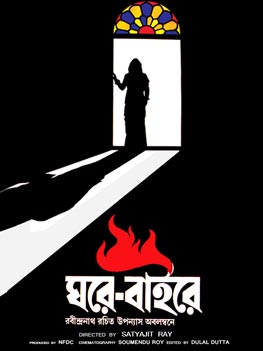
“Ghare Baire” (“The Home and the World” ) is a 1984 Bengali film directed by Satyajit Ray and based on the novel of the same name by Rabindranath Tagore. Ray began the script for it in the 1940s, long before his first film Pather Panchali. It’s a period piece set in 1907 yet deals with still-timely issues such as the tensions between the personal and political, freedom and security, tradition and change, internationalism and imperialism, nationalism and xenophobia, and populism and demagoguery.
Watch the full film on Kanopy here: https://www.kanopy.com/wayf/product/home-and-world
INDIAN COUNTRY NEWS
"It is the duty of every man, as far as his ability extends, to detect and expose delusion and error"..Thomas Paine
Human in Algorithms
From the Roof Top
I See This
blog of the post capitalist transition.. Read or download the novel here + latest relevant posts
अध्ययन-अनुसन्धानको सार
 After the Crash