Even readers not particularly well versed in science fiction know Philip K. Dick as the author of the stories that would become such cinematic visions of a troubled future as Blade Runner, Total Recall, Minority Report, and A Scanner Darkly. Dick’s fans know him better through his 44 novels, 121 short stories, and other writings not quite categorizable as one thing or the other. All came as the products of a creatively hyperactive mind, and one subject to more than its fair share of disturbances from amphetamines, hallucinogens, unconventional beliefs, and what those who write about Dick’s work tend to call paranoia (either justified or unjustified, depending on whom you ask). But Dick, who passed in 1982, channeled this constant churn of visions, theories, convictions, and fears into books like The Man in the High Castle, Do Androids Dream of Electric Sheep?, Ubik, and VALIS, some of the most unusual works of literature ever to carry the label of science fiction — works that, indeed, transcend the whole genre.
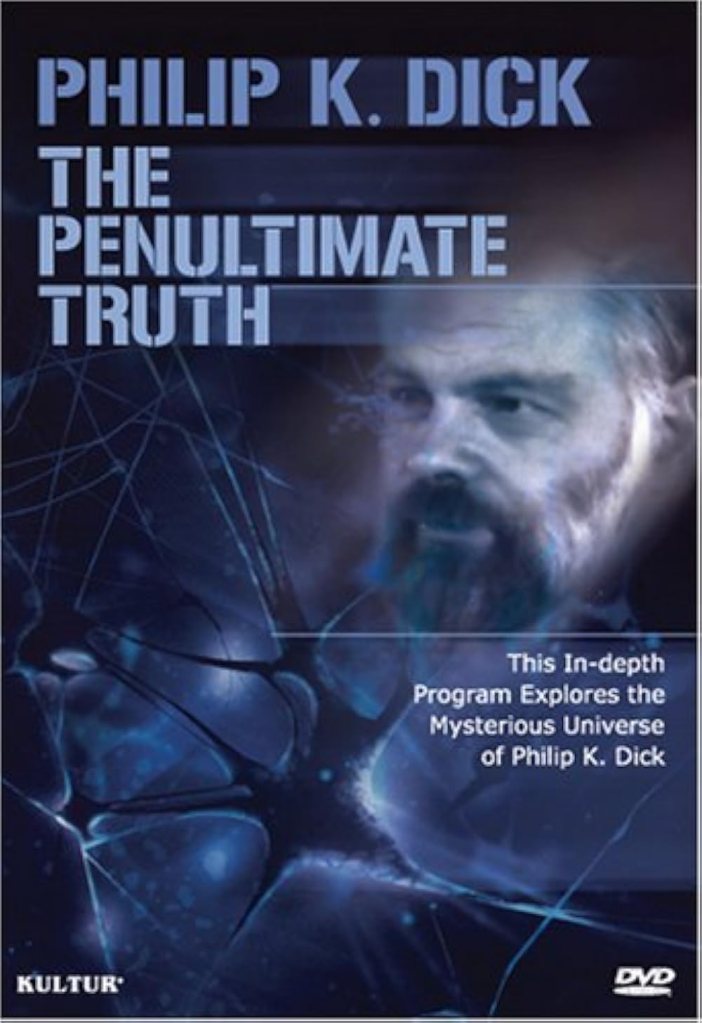
But what must it have felt like to live with the guy? The Penultimate Truth About Philip K. Dick (named after his 1964 novel of humanity tricked into living in underground warrens) seeks out the writer’s friends, colleagues, collaborators, stepdaughter, therapist, and wives (three of them, anyway), assembling a portrait of the man who could create so many textual worlds at once so off-kilter and so tapped into our real worries and obsessions. Each of these interviewees regards differently Dick’s dedication to the pursuits of both literary achievement and psychonautical adventure, his complicated conception of the true nature of reality, his at times unpredictable behavior, and his penchant for encounters with the divine. Director Emeliano Larre and writer Patricio Vega’s 2007 documentary reveals one of the most fascinating personalities in late 20th-century letters, though, as any professor of literature will tell you, we ultimately have to return to the work itself. Fortunately, Dick’s personality ensured that we have a great deal of it, all of it unsettling but greatly entertaining. Readers taken note. You can Download 14 Great Sci-Fi Stories by Philip K. Dick as Free Audio Books and Free eBooks.
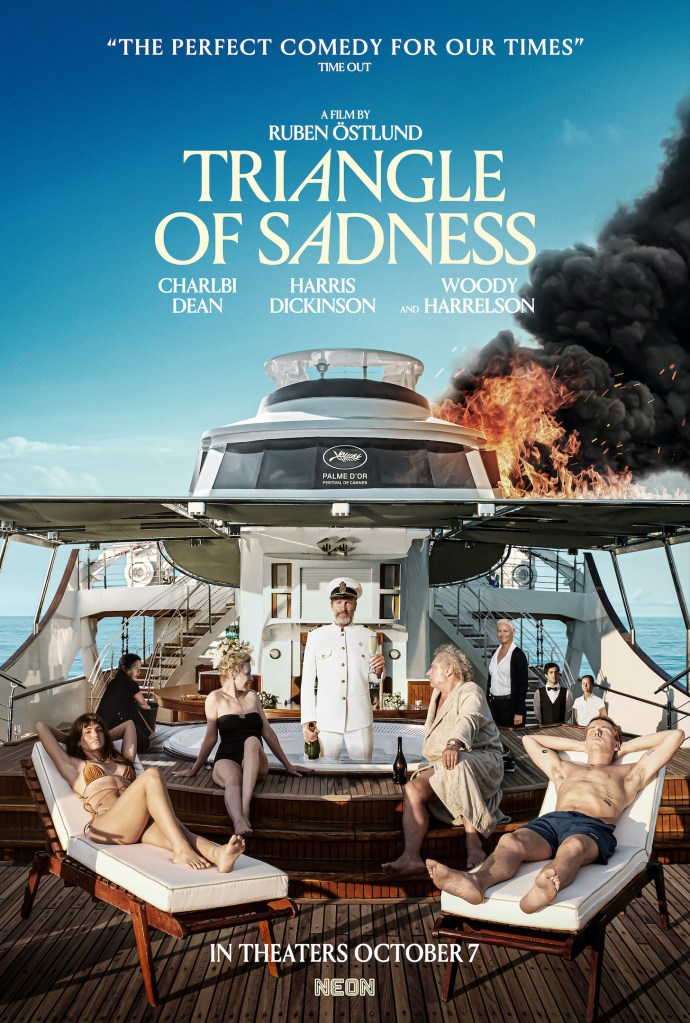
Östlund’s The Square was a favourite of mine the year it came out, and like that film his new one won the big award, the Palme d’Or, at the Cannes Film Festival. I don’t think Triangle of Sadness is quite as good — it would be hard to match the skewering of modern masculinity in both The Square and Force Majeure — but the film works as a wilder kind of a movie, an uproarious class comedy, this time setting a lacerating eye at the One Percent.
It starts like it’s going to take its shots at the fashion world, which Robert Altman’s Pret A Porter proved isn’t always easy to do well — though maybe Zoolander had a little more luck — but as we follow the bickering couple at its centre (the recently and sadly passed away, Charlbi Dean and Denis Shapovalov-alike Harris Dickinson) onto a yacht cruise for the super-rich, the film really sets sail.
The upper deck/lower deck divide is where the tension (and humour) lies, between the clueless toffs and the hard working crew who do everything they can to make the cruise comfortable because, you know, money.
The satire is blunt, but the laughs come thick and fast, and the picture has no trouble mixing low-brow, physical humour — it’s been a long time since I’ve seen a movie so in love with body fluids that didn’t also qualify as gore — with more political concerns.
There’s something particularly Scandinavian about it. Östlund is pointing and laughing at his characters in a way that reminds me a little of Thomas Vinterberg and Anders Thomas Jensen‘s recent work. It doesn’t give the audience a pass, but recognizes the hypocrisies of the world we live in. I’ve read a few takes that see the film as insipid and insulting because its targets are so obvious — as if that’s any reason not to take a whack at them. If Triangle of Sadness makes you angry, maybe check your privilege.
A supporting appearance from Woody Harrelson as the perpetually soused captain is fun, but things get really interesting in the final act.
The film seems to suggest the thirst for power and status is universal, no matter what your station in life. I’m not sure I’d be so cynical about it, but I’m willing to hear it as a point of argument. That mid-movie farce might be most satisfying as a metaphor for the desperation of late capitalism in the face of climate change and the inevitable end of our globalized system.
Either way, see it with a crowd and your favourite cinepanions and make time for a conversation after the lights go up. This is a movie with quite a lot on its mind.
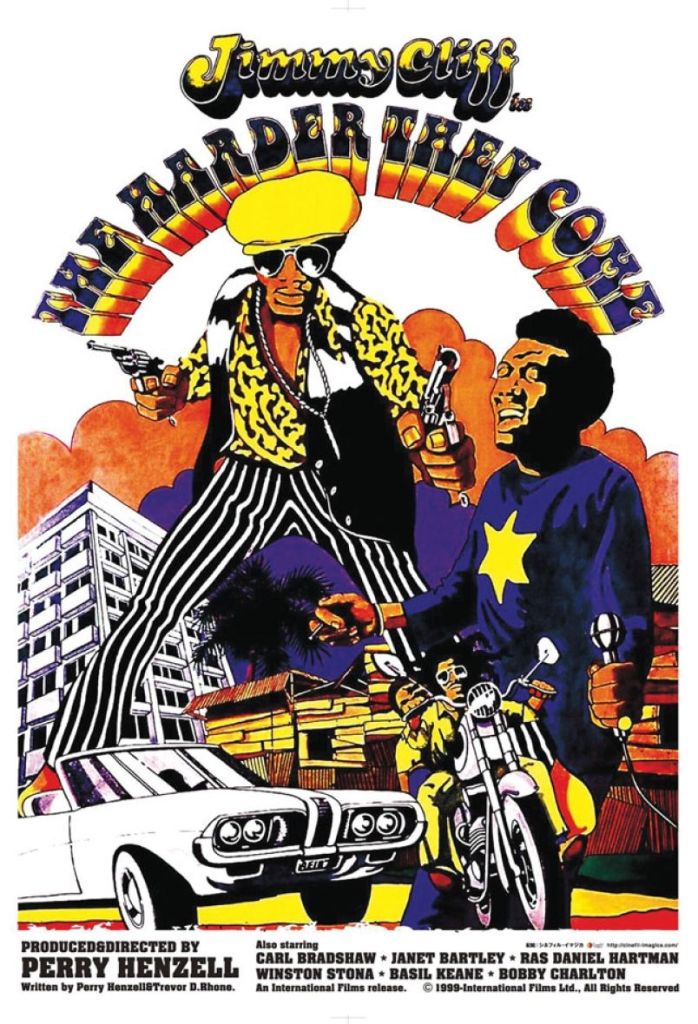
Title: The Harder They Come Release Date: 5 June 1972 Director: Perry Henzell Production Company: International Films Inc. Summary/Review:
The groundbreaking soundtrack from The Harder They Come has long been one of my favorite albums, but I’d never seen the movie until a 50th anniversary screening at The Brattle Theatre this week. Reggae legend Jimmy Cliff stars as Ivanhoe “Ivan” Martin, a young man who arrives in Kingston, Jamaica and tries to make ends meet while trying to break into the music business. His repeated attempts at honest work fail and he eventually becomes a marijuana runner for a local gangster. When he kills a police officer in a panic he goes on the lam and finally achieves the fame he desires as an outlaw.
The story is familiar and predictable but nevertheless well-told. The story and style seems to have drawn influence from French New Wave movies like Breathlessand it shares similarities with Senegal’s Touki Bouki, released the next year. I particularly like the first half of the film which captures the feel and rhythms of early 1970s Kingston with a neorealist touch. The latter part of the movie feels more like a hasty pastiche of Bonnie and Clyde. Ivan’s gleeful embrace of his outlaw status feels almost psychotic and he swiftly becomes a character hard to sympathize with. Nevertheless it’s a fascinating period piece and a groundbreaking movie for Jamaican cinema.
[Note: This article, which is both a film review and critical analysis, contains spoilers. If you haven’t seen Miracle Mile, we encourage you to do so, then come back and read this afterward.]
For the longest time, I thought I was the only one who loved the 1988 film Miracle Mile. Turns out it has become a cult film. For good reason.
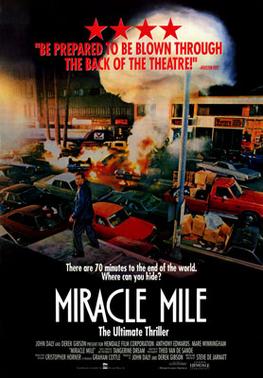
This taut, suspenseful, low-budget movie received little promotion, and was barely seen in theaters. I only discovered it years after its release on VHS/DVD rental racks, lured by an exciting-looking cover image where a man stands atop a car in the midst of a chaotic traffic jam.
Miracle Mile is an example of a film that you could watch the first 15 minutes of and have no idea where it’s going. It starts when Harry (Anthony Edwards) spends an afternoon exchanging distant, flirting glances with Julie (Mare Winningham) while they separately browse a paleontology museum.
They’re both shy, but they have a “meet cute” outside the La Brea Tar Pits and Museum, agreeing to a date while looking over the bubbling oily pitch that preserves animals from thousands of years ago in what is now central Los Angeles.
The La Brea Tar Pits are part of the Miracle Mile district, an arts and shopping hub near where Wilshire Boulevard intersects Fairfax Avenue. Nearly all of the movie’s action takes place in and around Miracle Mile, starting when Harry oversleeps and accidentally stands Julie up for their third date, during which they intended to, uh, consummate their attraction.
Instead, Harry takes a call at a phone booth outside a late-night diner, becoming the first person in the city to find out nuclear war is imminent — or might be.
Bombed because of bombs
Miracle Mile should be a classic, as it works on multiple levels: It’s a fast-paced suspense story with a romantic heart and the guts to steer toward devastation. The film shows the best and worst of society under stress, earning big effects out of a small but varied cast. Along the way it’s a visual feast, carefully plotted and storyboarded, with inspired details loaded into nearly every frame. Few films are as ambitious.
I’m going to double up on a Spoiler Alert and repeat: If you haven’t seen the film, track it down and watch it without knowing much upfront.
That out of the way, it’s obvious why Miracle Mile didn’t get the accolades it deserved: It’s utterly downbeat. The movie starts as a dream and ends as a nightmare.
Written and directed by Steve De Jarnatt, the script had been circulating since 1983, with buzz about its high quality, but no studios would make it because of the ending. The hook is that Harry (Edwards) may have inadvertently started a chain-reaction of panic based on a hoax. He could be a modern-day Chicken Little. The movie gives you hope, then pulls it all away.
Though the main characters are sweet, and a few people demonstrate nobility in the midst of chaos, we also see humans at their worst. Road-raging maniacs with nothing to lose are scarier and more menacing than zombies. Roger Ebert concluded his review with: “What the movie confirmed for me is something I’ve always suspected: that if there’s ever an hour’s warning that the nuclear missiles are on the way, thanks all the same, but I’d just as soon not know about it.”
How do you promote a movie with such a massive tonal shift? You can’t call it a horror movie without ruining its surprise, and you can’t market it as a romance without a mass audience backlash. The movie cost $4 million to make and barely earned $1 million.
De Jarnatt, who had previously made the visually inventive sci-fi movie Cherry 2000, could have or should have become a major auteur director. Instead, the failure of Miracle Mile sidelined his career, despite it being a tour-de-force of creativity.
A little out of time
In early voice-over narration, Harry describes his new love Julie as being “a little out of time.” He means she’s timeless, but his word choice becomes ironic. It’s also an apt term for the movie: It was a couple years short of the indie-film explosion of the 1990s, when pictures like Slacker and Reservoir Dogs invigorated the market for adventurous, hard-to-categorize, formula-shattering stories.
Miracle Mile was also “out of time” on its subject matter: It proved to be the last hurrah in that era’s focus on Cold War fears. When Miracle Mile‘s script was written, in 1983, nuclear annihilation was a viable topic for successful movies like WarGames (1983) and Red Dawn (1984). By 1989, when Miracle Mile had its full U.S. release, the U.S.S.R.’s glasnost reforms under Mikhail Gorbachev were taking root, leading to the fall of the Berlin Wall in 1989 and 1990. The public mood had waning interest in a movie about everything blowing up.
Alas, with global tensions on the rise in the 2020s, Miracle Mile is relevant again.
The movie also feels out of time stylistically. The Tangerine Dream soundtrack, among their best, also feels lodged in the 1983 spirit of Risky Business and its “Love on a Real Train” digital sensuality. Several of Miracle Mile‘s bit players look like they stepped out of the early ’80s new-wave era instead of the matured hip-hop fashions and proto-grunge styles on the cusp in 1989. At one point, a woman shows up wearing blue eye shadow while sporting a slicker and a fedora, like she just discovered the Eurythmics in the age of Nirvana.
Getting big results out of a small cast
Now that Miracle Mile is a resurgent cult film, the cast’s anachronistic vibe has given way to timelessness. Anthony Edwards had honed his “ordinary guy turned leading man” charm, and Mare Winningham was winning (and not hammy) in a bomber jacket and a choppy haircut that gave her a punkish-chipmunk appeal. In numerous scenes, such as when she tries to walk in spite of a leg that’s still asleep, Winningham seems like a nice person you’d want to know. For his part, Edwards has to establish the basis of the story via a difficult acting task: Incredulity turning to dread during a confusing and alarming phone call, then an overlapping recitation of that call to a diner full of skeptical strangers. All while seeming like a smart, sympathetic, ordinary guy. He nails it completely.
The diner scene introduces nearly a dozen bit players who bring the night-owl city to life. Sitting at the counter, a transvestite (Danny De La Paz) and a plain-looking man (Earl Boen, best known as the snide psychiatrist in the first twoTerminator movies) use noodles to map out L.A. streets ala people in the Saturday Night Live skit “The Californians.” A mouthy waitress (O-Lan Jones) and gruff cook (Robert DoQui, who was also terrific as police chief in RoboCop) also feed two streetsweepers (Claude Earl Jones and Alan Rosenberg), a wannabe flight attendant (Diane Delano) acting out an air emergency, and a mysteriously Mensa-smart stock broker (Denise Crosby) who multitasks by speed-reading CliffsNotes for Thomas Pynchon’s impenetrable novel Gravity’s Rainbow.
Even brief scenes boast distinct performances, as when Harry and a stereo-hoarding burglar (Mykelti Williamson) get into a standoff with a shotgun-wielding watchman (Edward Bunker, a gritty actor later seen in Reservoir Dogs) at a taxicab gas station. Later, as Harry roams a fitness center trying to find a helicopter pilot, he encounters the spandex-clad Brian Thompson, who volunteers but insists on bringing a gay companion, also in full spandex, asking, “Got a problem?” From wandering homeless ramblers to a bitter, ranting man on a skysraper, Miracle Mile paints a big picture with just a few distinct strokes.
Location becomes a character
One of my favorite things about Miracle Mile is the way it proudly highlights a section of Los Angeles, using buildings and landmarks as points of reference to each other, as well as thematically.
The La Brea Tar Pits aren’t just interesting to look at, they set the stage for a tale about evolution and destruction. The human characters are framed in front of the extinct mammoths as foreshadowing, and then people die in the same pits where the mammoths were trapped. (For good measure, figurines of tusked, mammoth-like elephants are seen at the base of the bedside lamp in Harry’s hotel room.)
The Pan-Pacific Park, with its Art Deco backdrops, evokes the Pacific Theater of World War II, where atomic bombs were dropped and hydrogen bombs tested. In an early scene, Harry plays trombone there alongside a jazz band, doing Count Basie numbers from the war era. Numerous shots frame palm trees, some carefully lit from below, building to a final image of a palm tree on fire like a mushroom cloud.
The area’s geographical focal point is the 5900 Wilshire building, a 30-story totem with a vertical design that’s all the spookier for its resemblance to the World Trade Center towers destroyed on 9/11/2001. Scenes constantly frame the building in the background, looming over the movie like the rising stalk of a future atomic blast. The building’s name, emblazoned at its crest, is Mutual Benefit Life — a phrase evoking an opposite term, Mutual Assured Destruction.
Interestingly, the 5900 Wilshire building now features at its base a section of the Berlin Wall, covered in mural art, from the same time period when Miracle Mile made the building its focus. (Coincidentally, soundtrack artists Tangerine Dream originated in Berlin.)
Miracle Mile gets additional mileage from Park La Brea, the residence of Julie (Winningham) and her stubbornly separated parents, in their own Cold War from an argument nobody remembers the reason for. Also frequently seen is the Los Angeles Museum of Contemporary Art, or LACMA, as a backdrop for characters running to or fro, or even being pushed in shopping carts.
Shopping carts are a frequent sight throughout the movie, sometimes showing up in the edge of a frame for no clear reason, perhaps as symbols of America’s consumerism outpacing its political consciousness. The movie makes no attempt to explore why nuclear war is happening, and it seems few characters have any insight into the tensions that led up to it, even though a newspaper headline mentions failed arms talks. (The recent, also-catastrophic film Civil War has a similar emphasis on effect rather than cause.)
Consumerism is the pivot point for a final scene, in a department store. Characters die there in confusion, trying to go up the down escalator, then hiding out in a room full of clocks as time is running out. The store where that scene was filmed has since been torn down and replaced with the curvacously modern Petersen Automotive Museum.
Johnie’s Coffee Shop
The Miracle Mile location that stands out most of all is Johnie’s Cafe (also known as Johnie’s Coffee Shop), the movie’s hub of exposition and microcosm. Johnie’s, on the northwest corner of Fairfax and Wilshire, has been featured in numerous movies, including Reservoir Dogs, The Big Lebowski, American History X, and Gone in 60 Seconds.
Johnie’s was given the full makeover treatment for Miracle Mile: Production designer Christopher Horner filled both exterior and exterior with visual references to nuclear war and destruction. Early on, Harry and Julie kiss in slow-motion in front of Johnie’s shimmering yellow lights in a way evoking a bomb exploding behind their heads.
The outer statue, resembling a Bob’s Big Boy chain restaurant logo, is named Fat Boy, and holds aloft two rotund, rotating cheeseburgers. The name “Fat Boy,” along with the two bomb-shaped burgers, references Fat Man and Little Boy, the bombs dropped on Hiroshima and Nagasaki in Japan. (A movie with the title Fat Man and Little Boy would be released the following year, in 1989.)
Inside Johnie’s, a mural depicts an erupting volcano and an ancient city, hinting at the no-warning destruction Mount Vesuvius wreaked upon Pompeii in 79 AD — an event with a level of thermal energy often compared to hydrogen bombs. (An earlier scene references the 1932 movie Bird of Paradise, which also depicted a society-destroying volcano.)
Nearby are several missile-shaped vending machines, which tie in very briefly to an entry-area booth that is only seen once in the movie, where a woman is slumped over. The woman (Lucille Bliss) appears passed out, or possibly even dead, and she has Tarot cards strewn out in front of her, as if she saw the future and died of shock. The presence of Tarot is interesting because of its link to the book Gravity’s Rainbow, also seen in the diner (as CliffsNotes being read). That novel, which uses Tarot as a theme, is also about Nazi-era V-2 rockets, and ends with an atomic blast in Los Angeles. (The gag prop CliffsNotes also serve a visual purpose: Their yellow and black design is similar to the signs indicating radiation fallout shelters.)
Story symmetry
One of my favorite things about Miracle Mile is how much thought went into every aspect of its production. The plot is clever, the scenes are exciting, and the cast brings the city to life in its nocturnal form. But writer-director Steve De Jarnatt wasn’t satisfied with that alone: He constructed the movie with the intricacy of clock gears, putting small touches and ideas everywhere possible. Movies are collaborative, and production designer Christopher Horner, conceptual designer David L. Snyder, art director Richard Hoover, and many others likely deserve a portion of credit for these details.
Miracle Mile is loaded with thematic mirror images and parallels. For one, the story is bookended by blasts: It shows the Big Bang and evolution at the start (using imagery from Carl Sagan’s Cosmos program), and ends with a destructive “big bang.”
At the museum Harry purchases a prism, holding it in his hand to make rainbows (another link to Gravity’s Rainbow), and at the end he imagines himself and Julie being transformed into diamonds, a kind of prism. During an early date, Harry and Julie are framed through the water of a lobster tank, with the camera rising to reveal them. At the end, inside the submerging helicopter, the camera lowers to view them again through water.
The young lovers, at the beginning of their romantic journey, are mirrored by the old couple (John Agar and Lou Hancock), on the tail end of theirs. Characters are seen twice in elevators under different circumstances, twice on stairs (in one, briskly ascending, in another getting nowhere), and police are seen twice in a state of falling, as law and order fall apart.
Early on, Harry stands in front of a TV that is signing off, and it shows fighter jets leaving streaks through the air, including an image of three jets streaking apart in three directions. At the end, as nukes are about to destroy the city, we see three fanning missiles in the same formation.
When the plot’s chain reaction starts, from a flicked cigarette, a pigeon carries the lit cigarette to its nest and sets its own eggs on fire. Later, we see Harry eating scrambled eggs, soon tainted by drops from his bleeding nose. The idea of destroyed eggs, ruined from outside events, is certainly a metaphor for what happens to Harry and Julie’s embryonic love story.
Mushroom clouds are everywhere
Let’s talk about Miracle Mile‘s richest visual motif: Its ongoing mushroom-cloud imagery.
For a low-budget movie that can’t afford a lot of special effects (besides a few basic green-screened and matte-painting images), Miracle Mile does the next best thing: It sneaks some sort of smaller-scale mushroom cloud into every scene possible. Sometimes it shows an actual explosion in an atomic-bomb shape, and sometimes it’s a subtle visual composition, but there’s no doubt Steve De Jarnatt and the cinematographer, Theo van de Sande, put extraordinary effort into this element.
Mushroom cloud images include the following:
Mare Winningham framed by tusks
The La Brea Tar Pit’s gas bubbles
Cumulus clouds behind the 5900 Wilshire building
Colored balloons at Park LaBrea
The burning birdnest
The hotel’s electrical explosion
The moonrise
Smoke emanating behind Harry’s head as he sleeps
The top half of the spinning globe at Julie’s apartment (resting at Africa, where the opening scenes of evolution occurred)
Johnie’s rotating cheeseburgers
Harry pouring creamer into a full coffee pot in the diner
The gas station explosion(s)
The traffic-jam explosion
The burning palm tree
A deer in the headlights
One final mention: The first time I saw Miracle Mile, the moment I realized it was an enjoyably higher grade of filmmaking was when Harry was lying on the freeway on-ramp, and the headlights of an apparent automobile were racing toward him. He braces as if expecting to be run over, and in the next shot it’s revealed that the two headlights are from two motorcycles, which pass on either side of him.
As it turns out, that scene’s concept is from the 1921 Buster Keaton film, Hard Luck. Numerous other films have used the sight gag, including: Are We There Yet? (2005) and Mr. Nobody (2009), but Miracle Mile uses it with especially playful, one-thing-leads-to-another momentum. This is one of the many fine details that make Miracle Mile well worth cult-film, watch-and-rewatch status.

 After the Crash