
WHITE GOD (2014): DOGS FIGHT BACK
By Dawn Keetley
Source: Horror Homeroom
Summary of White God: Thirteen-year old Lili (Zsófia Psotta) moves in with her father who proves unwilling to pay the fees incumbent on the owners of mongrel dogs. He thus forces Lili to abandon her beloved Hagen on the streets of Budapest. The film follows the dual paths of Lili and Hagen as they, finally, find their way back to each other.
I loved White God (I’ll get that out up front), which premiered at the 2014 Cannes Film Festival and recently become widely available in the US. White God is a particularly interesting intervention in the horror genre in that it is the only film I can think of in which the animal (Hagen) becomes the protagonist rather than the antagonist. In all the other natural horror films I’ve seen recently, animals (wolves, sharks, crocodiles, bears) threaten more-or-less sympathetic humans. White God stands alone in showing how profoundly humans threaten animals.
White God is about two-hours long and I’ll warn you up front that it doesn’t become a horror film until about 30 minutes from the end. Only then does the beautifully shape-shifting form of the film end up as a revenge narrative (I couldn’t help comparing it to I Spit on Your Grave [1978]). And while both its human protagonist, Lili, and its dog protagonist, Hagen, are both, in their different ways, abandoned, it’s Hagen who suffers most and who ends up getting his justified revenge.
Up to that point, though, the director brilliantly weaves together resonances of childhood stories like Anna Sewall’s Black Beauty (1877), Sheila Burnford’s The Incredible Journey (1961), filmed in 1963 and again, as Homeward Bound, in 1993, and William H. Armstrong’s Sounder (1969), along with direct references to Jack London’s fiction, notably White Fang (1906).
In fact, White God‘s title is undoubtedly taken from White Fang, as Hagen’s adventures among the uniformly despicable humans that populate Budapest resemble almost exactly a portion of White Fang’s life with a man London pointedly calls the “mad god.” White Fang’s first encounters with humans are with Native Americans—and while they are certainly not positive, their barbarity pales in comparison to the brutality of his first encounters with white men, whom White Fang calls “white gods.” As London writes: “White Fang did not reason it out, did not in his mind make the sharp generalization that the white gods were more powerful.”[i] But so they are—and most of them do not use their power well. The mad “white god” that serves as the clear progenitor to a character Hagen has the misfortune to meet in White God takes White Fang and subjects him to an abusive training program designed to make him a vicious fighter. The training works well, and White Fang goes on to defeat every dog in the Yukon, as well as sundry wolves and a lynx.
Unlike White Fang, Hagen defies his training at a crucial moment, though. At first he goes along with it, acceding to his master’s desire. But then, at the end of his first fight, Hagen looks at his dead rival and has a realization that White Fang does not. Dogs aren’t the enemy.[ii]
From that moment, looking at the bloodied body of the dog he fleetingly thought was his rival, Hagen knows exactly who the enemy really is. He then rounds up all the stray dogs in Budapest, urging them into revolt.
While White God works as a powerful parable of the uprising of animals against their domination and brutalization by humans, it can also be read as an allegory for human oppression. The title, White God, along with the racial hierarchies (of Native Americans and whites) that it imports from White Fang, suggest that the dogs are also stand-ins for those humans who are cast aside because they are not “white,” because they are “mutts” and “half-breeds.” The current crisis in Europe over immigrants, mostly from Syria, and Hungary’s contentious role in that crisis, only intensifies this allegory, as the film has already begun to accrue meanings beyond its moment of inception.
As the dogs stream through Budapest’s streets, exhilarated by their collective power, the film unequivocally becomes a horror film, and the dogs invoke the zombies that streamed through London and Paris in 28 Days Later (Danny Boyle, 2002) and 28 Weeks Later (Juan Carlos Fresnadillo, 2007).
While it is indeed exhilarating to see them, the dogs’ resemblance to zombies infuses these scenes with sadness and dread. Does this resemblance foreshadow their eventual doom? What can dogs do, in the end, in the face of determined human opposition? Do they really have any choice but to submit to their role of our “best friends” as their best means of survival? Despite how bad so many of us are at being their “friend.”
The ending of White God, after Hagen’s glorious and bloody revenge, is ambiguous. Hagen meets Lili again but she’s changed: we’ve seen her shift much more of her allegiance toward humans during the course of her journey (which I found much less gripping than Hagen’s). There’s a scene, which we see right at the opening of the film and then near the end, in which dogs run furiously as Lili pedals her bike. Are they chasing Lili? Is she leading them? Are they both on separate journeys, the dogs indifferent to her? The answer becomes only a bit clearer in the second reiteration of the scene.
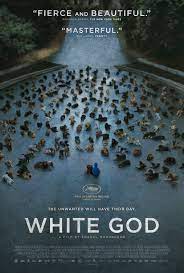
The ending presents us with an image that is on all the posters for the film—and its meaning is ambiguous too.
Clearly Lili figures as some kind of “god” figure here, for Hagen and the other dogs: she has become the “white god” of the title. But will she use her power to save the dogs? Or will she merely appease them until others come to destroy them. You can make up your own mind. Me? I’m not hopeful.
R | 121 mins. | Kornél Mundruczó | Hungary | 2014
Grade: A
____________________
Watch White God on Kanopy here: https://www.kanopy.com/en/product/2332130


 After the Crash