Two for Tuesday
Reply

By Dawn Keetley
Source: Horror Homeroom
Summary of White God: Thirteen-year old Lili (Zsófia Psotta) moves in with her father who proves unwilling to pay the fees incumbent on the owners of mongrel dogs. He thus forces Lili to abandon her beloved Hagen on the streets of Budapest. The film follows the dual paths of Lili and Hagen as they, finally, find their way back to each other.
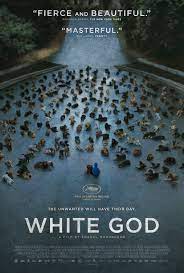
I loved White God (I’ll get that out up front), which premiered at the 2014 Cannes Film Festival and recently become widely available in the US. White God is a particularly interesting intervention in the horror genre in that it is the only film I can think of in which the animal (Hagen) becomes the protagonist rather than the antagonist. In all the other natural horror films I’ve seen recently, animals (wolves, sharks, crocodiles, bears) threaten more-or-less sympathetic humans. White God stands alone in showing how profoundly humans threaten animals.
White God is about two-hours long and I’ll warn you up front that it doesn’t become a horror film until about 30 minutes from the end. Only then does the beautifully shape-shifting form of the film end up as a revenge narrative (I couldn’t help comparing it to I Spit on Your Grave [1978]). And while both its human protagonist, Lili, and its dog protagonist, Hagen, are both, in their different ways, abandoned, it’s Hagen who suffers most and who ends up getting his justified revenge.
Up to that point, though, the director brilliantly weaves together resonances of childhood stories like Anna Sewall’s Black Beauty (1877), Sheila Burnford’s The Incredible Journey (1961), filmed in 1963 and again, as Homeward Bound, in 1993, and William H. Armstrong’s Sounder (1969), along with direct references to Jack London’s fiction, notably White Fang (1906).
In fact, White God‘s title is undoubtedly taken from White Fang, as Hagen’s adventures among the uniformly despicable humans that populate Budapest resemble almost exactly a portion of White Fang’s life with a man London pointedly calls the “mad god.” White Fang’s first encounters with humans are with Native Americans—and while they are certainly not positive, their barbarity pales in comparison to the brutality of his first encounters with white men, whom White Fang calls “white gods.” As London writes: “White Fang did not reason it out, did not in his mind make the sharp generalization that the white gods were more powerful.”[i] But so they are—and most of them do not use their power well. The mad “white god” that serves as the clear progenitor to a character Hagen has the misfortune to meet in White God takes White Fang and subjects him to an abusive training program designed to make him a vicious fighter. The training works well, and White Fang goes on to defeat every dog in the Yukon, as well as sundry wolves and a lynx.
Unlike White Fang, Hagen defies his training at a crucial moment, though. At first he goes along with it, acceding to his master’s desire. But then, at the end of his first fight, Hagen looks at his dead rival and has a realization that White Fang does not. Dogs aren’t the enemy.[ii]
From that moment, looking at the bloodied body of the dog he fleetingly thought was his rival, Hagen knows exactly who the enemy really is. He then rounds up all the stray dogs in Budapest, urging them into revolt.
While White God works as a powerful parable of the uprising of animals against their domination and brutalization by humans, it can also be read as an allegory for human oppression. The title, White God, along with the racial hierarchies (of Native Americans and whites) that it imports from White Fang, suggest that the dogs are also stand-ins for those humans who are cast aside because they are not “white,” because they are “mutts” and “half-breeds.” The current crisis in Europe over immigrants, mostly from Syria, and Hungary’s contentious role in that crisis, only intensifies this allegory, as the film has already begun to accrue meanings beyond its moment of inception.
As the dogs stream through Budapest’s streets, exhilarated by their collective power, the film unequivocally becomes a horror film, and the dogs invoke the zombies that streamed through London and Paris in 28 Days Later (Danny Boyle, 2002) and 28 Weeks Later (Juan Carlos Fresnadillo, 2007).
While it is indeed exhilarating to see them, the dogs’ resemblance to zombies infuses these scenes with sadness and dread. Does this resemblance foreshadow their eventual doom? What can dogs do, in the end, in the face of determined human opposition? Do they really have any choice but to submit to their role of our “best friends” as their best means of survival? Despite how bad so many of us are at being their “friend.”
The ending of White God, after Hagen’s glorious and bloody revenge, is ambiguous. Hagen meets Lili again but she’s changed: we’ve seen her shift much more of her allegiance toward humans during the course of her journey (which I found much less gripping than Hagen’s). There’s a scene, which we see right at the opening of the film and then near the end, in which dogs run furiously as Lili pedals her bike. Are they chasing Lili? Is she leading them? Are they both on separate journeys, the dogs indifferent to her? The answer becomes only a bit clearer in the second reiteration of the scene.
The ending presents us with an image that is on all the posters for the film—and its meaning is ambiguous too.
Clearly Lili figures as some kind of “god” figure here, for Hagen and the other dogs: she has become the “white god” of the title. But will she use her power to save the dogs? Or will she merely appease them until others come to destroy them. You can make up your own mind. Me? I’m not hopeful.
R | 121 mins. | Kornél Mundruczó | Hungary | 2014
Grade: A
____________________
Watch White God on Kanopy here: https://www.kanopy.com/en/product/2332130

By Keith Garlington
Source: Keith and the Movies
It’s hard to believe that it has been twelve years since French filmmaker Michel Hazanavicius won his Best Director Academy Award for the Best Picture winning “The Artist”. While it has become somewhat fashionable in some circles to dismiss that brilliant 2011 film as unworthy, I still hold it in incredibly high regard as a delightful ode to a bygone cinematic era.
Hazanavicius’ latest film couldn’t be more different. “Final Cut” is a meta zombie comedy that is an open-armed tribute to cinema, a love letter to genre filmmaking, a celebration of creative collaboration, and just an all-around wacky piece of work. It’s a faithful remake of Shin’ichirô Ueda’s 2017 cult hit “One Cut of the Dead” but with its own French twist. It’s a consistently clever and routinely funny concoction that sees Hazanavicius and his all-in cast having the time of their lives.
Describing “Final Cut” to those who haven’t seen “One Cut of the Dead” is a bit of a challenge because the less you know going in the better. The film’s unorthodox structure plays a big part in making it such a fun experience. It’s a case of a filmmaker showing you one thing and then adding an entirely different perspective later on. I know that’s vague, but suffice it to say Hazanavicius has a field day playing with his audience’s expectations.
The spoiler-free gist of the story goes something like this. Romain Duris plays Rémi Bouillon, a frustrated filmmaker who signs on to direct a low-budget zombie short film for an upstart streaming platform that specializes in B-movies. But there’s a catch. The 30-minute single-take film is to be shot and streamed LIVE! It’s an unheard of undertaking but one the platform’s ownership has already pulled off in their home country of Japan. Now they want to do it in France.
Rémi is hesitant to take the job at first, seeing it as a doomed-to-fail project. But with the encouragement of his wife Nadia (Bérénice Bejo) and with hopes it will rekindle his relationship with his aspiring filmmaker daughter Romy (Simone Hazanavicius) he agrees.
Soon he’s on location dealing with a smug high-maintenance lead actor (Finnegan Oldfield), his inexperienced lead actress Ava (Matilda Lutz), a supporting actor who can’t stay off the bottle (Grégory Gadebois), and the demands of domineering producers who don’t prescribe to the notion of a director’s creative freedom.
As “Final Cut” shifts to the show’s production phase things get crazy and we gain an entirely new perspective on everything we’ve seen up to that point. Hazanavicius drenches his audience in blood, gore, and countless zombie horror tropes which is a big part of the fun. That said, it’s never the slightest bit tense or scary but neither does it try to be. It’s much more of a comedy, full of running gags, fun characters, an infectious B-movie charm, and a surprising level of warmth that I never expected.
Watch Final Cut on Kanopy here: https://www.kanopy.com/en/product/13547325

By Simon Abrams
Source: RogerEbert.com
Japanese filmmaker Nobuhiko Obayashi was diagnosed with lung cancer in 2016, about three years before he completed “Labyrinth of Cinema,” a trippy anti-war drama about Japanese war movies, of which Obayashi re-creates, parodies, and criticizes in one long movie within his movie. Or really, it’s one long movie marathon within Obayashi’s movie since “Labyrinth of Cinema” takes place at an evening-long war film festival hosted by Setouchi Kinema, a small Hiroshima movie theater that’s putting on one last show before permanently closing.
The plot is simple enough to be irrelevant: three bright young things— teeth-picking film historian Hosuke (Takahito Hosoyamada), enthusiastic film buff Mario (Takuro Atsuki), and aspiring gangster Shigeru (Yoshihiko Hosoda)—chase after chaste 13-year-old Noriko (Rei Yoshida) after she tumbles into the Setouchi Kinema’s movie screen, and becomes part of Obayashi’s unstable meta-narrative. By the way: Obayashi died of lung cancer a year and a half ago. You can tell that his death weighed on him just by watching “Labyrinth of Cinema,” his last movie, a three-hour living will, and a dazzling curtain call.
The movie’s Hiroshima setting gives away its personal nature since Onomichi, Hiroshima is director/co-writer/co-editor Obayashi’s hometown and also the main location for some of his movies, including the 1983 bubblegum-psych fantasy “The Girl Who Leapt Through Time.” Obayashi is best known to American cinephiles as the director of the 1977 day-glo nightmare “House,” a fizzy horror-fantasy that only became an international cause célèbre in 2009 after it screened at the New York Asian Film Festival and a few other noteworthy events. In “Labyrinth of Cinema,” Obayashi (along with co-writers Kazuya Konaka and Tadashi Naito) tries to sum up what he’s learned and tried to convey through filmmaking in a volatile auto-critique of movies as both seductive propaganda and palliative empathy machines.
Obayashi uses green-screen technology and cheap (but effective) computer graphics to dramatize folksy anecdotes about filmmakers like John Ford and Yasujiro Ozu, which he sandwiches between brutal and/or sentimental episodes about local war crimes and counter-cultural resistance. Sometimes Obayashi quotes poetry, particularly by Chuya “Japan’s Rimbaud” Nakahara. Sometimes, a cartoon character or samurai folk hero (Musashi Miyamoto?!) steals a scene or two. A few characters, like the time-traveling authorial stand-in Fanta G (drummer Yukihiro Takahashi), talk about movies as a beautiful, essential lie that’s first used as a balm and a distraction, and then also considered as a runway to a brighter and still unimaginable future. You give Obayashi three hours of your time, and he’ll give you a brilliant headache.
You might watch “Labyrinth of Cinema” and wonder where the hell this all came from. Like Obayashi’s recent war trilogy (2011-2017), and many of his earlier features—and short movies and TV commercials—“Labyrinth of Cinema” constantly reminds you that it’s “A Movie.” Before Obayashi’s movies begin, the words “A Movie” are usually presented on-screen in a frame within the image’s frame. So in “Labyrinth of Cinema,” Obayashi’s characters are often re-framed by small circular frames within the camera’s frame. Sometimes these images flip around on-screen, so that a character who was on the left side of the screen is now upside, or on the right, as if they were in conversation with themselves, the viewer, and anyone else who’s watching. There are also a surprising number of fart jokes and some callbacks to older Japanese movies like “I Am a Cat,” “The Rickshaw Man,” and “Wife! Be Like a Rose.” “Labyrinth of Cinema” is a lot of movie.
Obayashi’s various projects are instantly recognizable, given his usual combination of mistrust and fascination with movies as an expression of wish fulfillment and nostalgia. So it’s not surprising that his view of the past—and the cinematic image—is never really seductive in “Labyrinth of Cinema.” Cheerfully naïve characters get lost in their companions’ comforting, half-remembered memories, and never stop to wonder why one thing inevitably leads to another, and another, and another. They float around on-screen, unmoved by the laws of gravity or physics and unable to hide in whatever photo-booth-quality backdrop surrounds them. Obayashi’s characters all half-know and half-hope that they’ll live to see the next scene, so they take their time learning how to ride the ever-breaking tidal wave of Japanese history according to Nobuhiko Obayashi.
“Labyrinth of Cinema” is tremendously affecting, frequently beguiling, usually exhausting, and on, and on, and on. An indulgent ramble from an innovative surrealist who was always sensitive and even suspicious of his own work’s impact—as a tool for advertising, political whitewashing, and pure sentimental indoctrination. On his out way the door, Nobuhiko Obayashi left us wondering how he got all the way from “House” to here without losing faith in humanity and his art; I don’t know, but “Labyrinth of Cinema” is still there anyway.
By Brian Tallerico
Source: RogerEbert.com
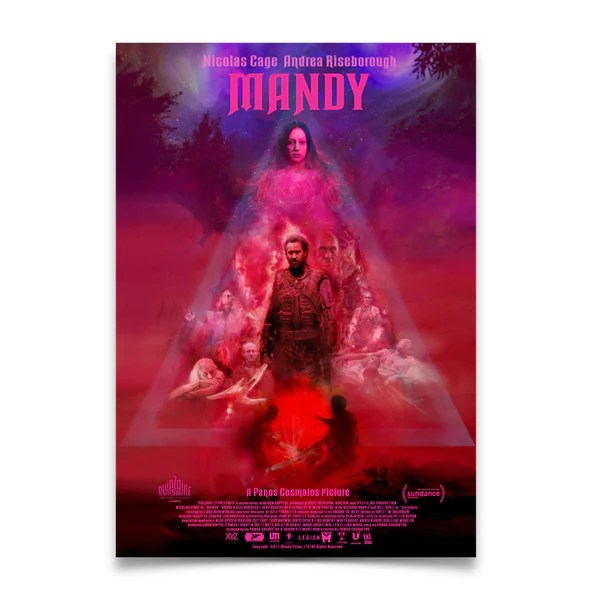
More than most movies, it’s hard to know where to begin with an appreciation or critique of Panos Cosmatos’ “Mandy.” It’s a really difficult film to capture tonally and even narratively in a review, largely because it is such a stylish, visceral experience that it demands you give yourself over to it actively instead of passively analyzing it. On the one hand, it’s a thriller, of sorts, a vengeance piece about a man killing those who destroyed his life. But, man, does that not really capture the experience of this movie. Some have compared it to an ‘80s heavy metal album cover sprung to life, but that’s only part of “Mandy,” and doesn’t convey the emotional depth that saturates every frame. And then there’s the fact that “Mandy” is kind of two movies in one, a slow-burn journey into hell in the first hour and a blood-soaked climb out of it in the second. Did I mention the chainsaw fight yet?
Nicolas Cage stars in “Mandy” as Red Miller, a lumberjack who lives a quiet life in the woods with his girlfriend Mandy, played by Andrea Riseborough. One day, Mandy catches the eye of a cult leader named Jeremiah Sand (Linus Roache), who proceeds to conjure motorcycle-riding demons to steal the girl and make her one of their own. In the process, Red is tortured and nearly killed. The first half of “Mandy” is filled with long, color-saturated takes of impending doom. Even casual behavior like quiet scenes between Mandy and Red have a foreboding nature, and then the film peaks in the middle with a waking nightmare as Red sees something no one should ever see happen to the love of his life. Deeply traumatized, Red is destroyed, and there’s a sequence in which Cage drinks an entire bottle of booze (well he ingests the stuff that isn’t poured on his wounds) while in his underwear, howling like an injured animal. It’s going to be GIF-ed and mocked, but it’s actually a great bit of acting, conveying a man not just mourning or in grief but literally destroyed.
Like a character in a Queensrÿche concept album, Red emerges from this destruction with his plans for vengeance. With a title card that divides the film in half, “Mandy” then becomes the movie that most people will remember in that it’s about Red working his way through both the demons that Jeremiah conjured and, inevitably, the gang itself. The heavy metal comparison is apt not just because the genre often included figures like the nightmarish creations that Jeremiah brought to life but in the very structure of “Mandy,” which unfolds in a very untraditional manner in both halves. Scenes play out like songs on an album, episodically cast in extreme color palettes that amplify the trippy, surreal natures of the entire experience. “Mandy” is a fascinating genre exercise in that it is as untraditional a horror movie as you’ll see this year but also relies on so many classics of the form. It is, at its core, a downright biblical tale of evil and vengeance.
It’s also pretty bad-ass when it comes to stand-out moments, particularly an already-acclaimed fight with two men wielding chainsaws like they’re swords. It’s a perfect blend of the old and new in “Mandy” and a distillation of what the film does well in how it takes a familiar good vs. evil sequence and twists it to fit Cosmatos’ vision.
Having said that, there are times when I felt the length of said vision. “Mandy” runs over two hours, and a little of its style goes a long way. I think there’s a masterful version of this movie that runs notably shorter, but that doesn’t mean there’s not an unforgettable one the way it is right now.
One more thing before you go on this journey with Nicolas Cage: the incredible Johann Johannsson (“Sicario,” “Arrival“) does the best of his career in this, his final film composition. The score here is another character, a series of screeching, violent noises that add to the tone of the film in ways that can’t be overstated. The film simply doesn’t work without it. And, as much as I like other parts of the movie, Johannson’s work alone justifies a viewing. It reminds us how much we lost by his early passing.
Watch Mandy on Hoopla here: https://www.hoopladigital.com/title/12253438
INDIAN COUNTRY NEWS
"It is the duty of every man, as far as his ability extends, to detect and expose delusion and error"..Thomas Paine
Human in Algorithms
From the Roof Top
I See This
blog of the post capitalist transition.. Read or download the novel here + latest relevant posts
अध्ययन-अनुसन्धानको सार
 After the Crash