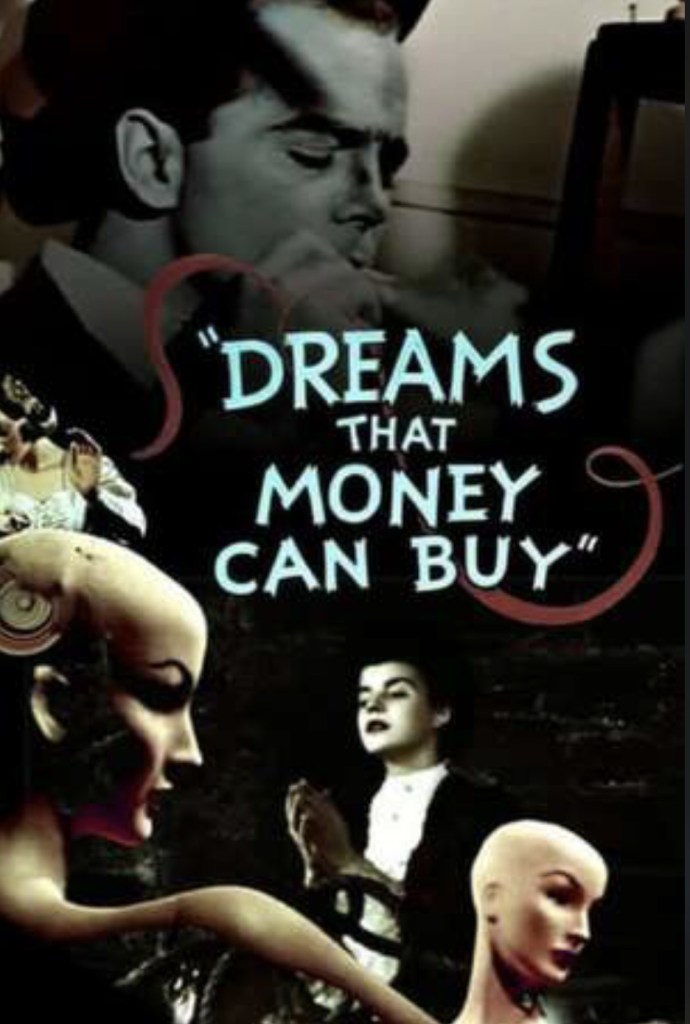
“Everybody dreams. Everybody travels, sometimes into countries where strange beauty, wisdom, adventure, love expects him.” These words, a tad floaty and dreamlike themselves, open 1947’s Dreams That Money Can Buy. “This is a story of dreams mixed with reality,” the narrator intones. He can say that again. Directed by Hans Richter, painter, graphic artist, avant-gardist, “film-experimenter,” and energetic member of the Dada movement, the picture takes a storyline that seems mundanely realistic — impecunious poet finds apartment, then must figure out how to pay the rent — and bends it into all manner of surreal shapes. And I do, literally, mean surreal, since several of the scenes come from the minds of noted avant-garde and surrealist artists, including, besides Richter himself, painter and photographer Man Ray, conceptualist Marcel Duchamp, sculptor Alexander Calder, and painter-sculptor-filmmaker Fernand Léger.
Joe, the film’s protagonist, finds he has a sort of superpower: by looking into the eyes of another, he can see the contents of their mind. He promptly sets up a sort of consultation business where he examines the unconscious thoughts of a client: say, an unambitious banker whose wife lives “like a double-entry column: no virtues, no vices.” He then uses the abstract materials of their thoughts to come up with a self-contained, somewhat less abstract dream for them to dream: in the banker’s case, a dream called “Desire,” which takes the form of a short film by Dadaist painter-sculptor-graphic artist-poet Max Ernst. For Joe’s other, differently neurotic customers, Richter, Man Ray, Duchamp, Calder, and Léger come up with suitable formally and aesthetically distinct dreams. While all these artists imbue Dreams That Money Can Buy with their own inimitable sensibilities (or nonsense abilities, as the case may be), I feel as though certain modern filmmakers would have the time of their lives remaking it. Michel Gondry comes to mind.
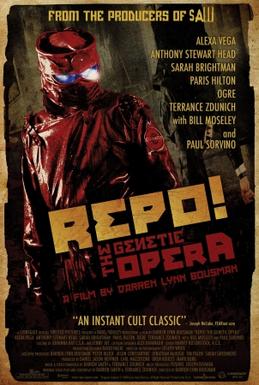
I love a good, bad movie. Especially ones that aren’t trying to be bad. There’s something deeply enjoyable about a movie taking itself utterly seriously and being incredibly genuine with its material – especially when the results are probably not as objectively “good” as its creators might have intended. This is where Repo! The Genetic Opera enters. Repo! The Genetic Opera is a movie musical in the same vein as The Rocky Horror Picture Show – it’s a sci-fi musical made on a low budget that, in the years after its release, has found a cult following. And, like The Rocky Horror Picture Show, Repo! The Genetic Opera is just one of those films that have to be seen to be believed. It is all at once confusing, entertaining, delightful, baffling, and grotesque. It’s an experience to behold and it’s a film that I adore. (4 out of 5 wands.)
(NOTE: There are spoilers ahead.)
Repo! The Genetic Opera (written by Darren Smith and Terrance Zdunich, directed by Darren Lynn Bousman) In the mid-21st century, an epidemic of organ failures leads to the rise of GeneCo., a company providing transplants at a great price. Those who miss their payments become targets of GeneCo. mercenaries, who repossess the organs. In a world of drug addiction and legalized murder, a sheltered youth (Alexa Vega) seeks a cure for her rare disease as well as information about her family’s mysterious history. Her questions are answered at “The Genetic Opera.”
Directed by Darren Lynn Bousman (of Saw II-IV fame), Repo! The Genetic Opera is the story of Shilo (Alexa Vega), a young girl with a blood disease who finds herself at the center of a feud between Nathan (Anthony Stewart Head), her father and a secret Repo Man for GeneCo, and Rotti Largo (Paul Sorvino), the CEO of GeneCo (a company that specializes in organ replacements). It is a story about a young girl striving for freedom and seeking to find her place in the world. It is a story about corporate greed, feuding families, spoiled children, and drug-and-surgery addicts. And, most of all, it is an opera – but instead of traditional opera music, the score is comprised entirely of mid-2000’s-style rock music. And boy, do all of these elements make for a confused film.
The plot of Repo! is a royal mess. Rumor has it that about an hour of the film was cut from the original script, for one reason or another, and it shows. The plot, itself, is fairly simple but like any soap opera, the twists and turns in the personal relationships come quick and fast and it all becomes a bit hard to follow unless you’re paying extremely close attention. And, for the average moviegoer, Repo! is not the kind of film that will demand their rapt attention. You’re never entirely sure just what the film is trying to focus on – is it a story about Shilo’s quest for independence? Is it a story about Nathan’s failures as a father? Is it a familial drama between the Largo family? Essentially, the film is about all of those things and also none of them. The film’s first act simultaneously rushes through exposition while feeling like an endless pit of background information. There’s absolutely no sense of the passage of time throughout the film. The second act is so short that by the time the third act begins, you have no idea how the film is gonna manage to wrap up all of these plot threads by the end of its titular opera sequence. The film is the very definition of style over substance, prioritizing spectacle and shock value over any semblance of a coherent narrative. And that’s largely a reason why the film was panned upon its release.
However, Repo! the Genetic Opera is a delightful movie in spite of all of that. It’s a baffling film to sit through, but that’s part of its charm. Plus, nobody who is watching Repo! these days is watching it for its plot. People enjoy this film because of its solid score, its bizarre atmosphere, and its wickedly enjoyable performances. Terrance Zdunich and Darren Smith’s score is this strange blend of rock, opera, traditional musical theatre, and alternative music. It’s something that shouldn’t work – and yet, it does. It feels a bit like Rocky Horror Picture Show in its sheer audaciousness; the film was literally marketed as “not your grandparents’ opera.” Like an opera, the entirety of the film’s narrative is told through its music. Unlike an opera, many of Repo!’s songs stand on their own as memorable, well-written and performed songs. Sure, some of them are a bit too over-the-top and cringey and there’s a definite lack of stylistic cohesion, but many of the songs are absolute earworms that will be stuck in your head for days. “Zydrate Anatomy”, “Chase the Morning”, “Legal Assassin”, “Infected”, and “At the Opera Tonight” are great examples of the variety of musical styles found in the film. None of those songs sound alike, but all of them are great.
Equally eclectic is the array of talent gathered for Repo!’s cast. I have no idea how Bousman managed to convince some of these actors to do this movie but thank God he did. I mean, how many films can say they have the girl from Spy Kids, Giles from Buffy, Paris Hilton, and Sarah Brightman in their cast? Remarkably, everyone in this film does a great job – including Paris Hilton. Everyone is fully committed to their characters and the film’s silliness and it shows. It’s impressive how well relatively new actors like Terrance Zdunich, Paris Hilton, and Ogre do when sharing the screen with the likes of Sarah Brightman, Anthony Stewart Head, and Paul Sorvino. Everyone in the film is perfectly cast and they are all bringing their A-games. Obvious standouts include Zdunich, Paul Sorvino, Anthony Head, Sarah Brightman, and Alexa Vega, but there is truly not a weak member of this cast. Half of the fun of Repo! is its music, and the way the narrative is told through it, and half of the fun is found in the film’s eclectic cast.
At the end of the day, Repo! The Genetic Opera is simply one of those films you have to experience. The plot makes no sense, but the visuals are seeped in this gothic-yet-futuristic atmosphere that draws you into the world in spite of the baffling plot. It looks and feels cheap, but that never stops any part of the film from reaching for the stars. The songs are catchy, memorable, and serve the narrative as well as you could hope for given the constraints of the film. The performances are strong and, fitting with the film’s overall tone of insanity, absolutely bonkers. The fact that this film manages to work at all is a testament to all who worked on it. So many elements of this movie just shouldn’t work – and, to be fair, many of them don’t. But much of the film does work, and it’s held together by this glue of passion and genuine respect for what’s trying to be accomplished. Repo! The Genetic Opera is a memorable experience not because it’s a terrible film but because it’s a seriously good one if you’re willing to meet it where it is.
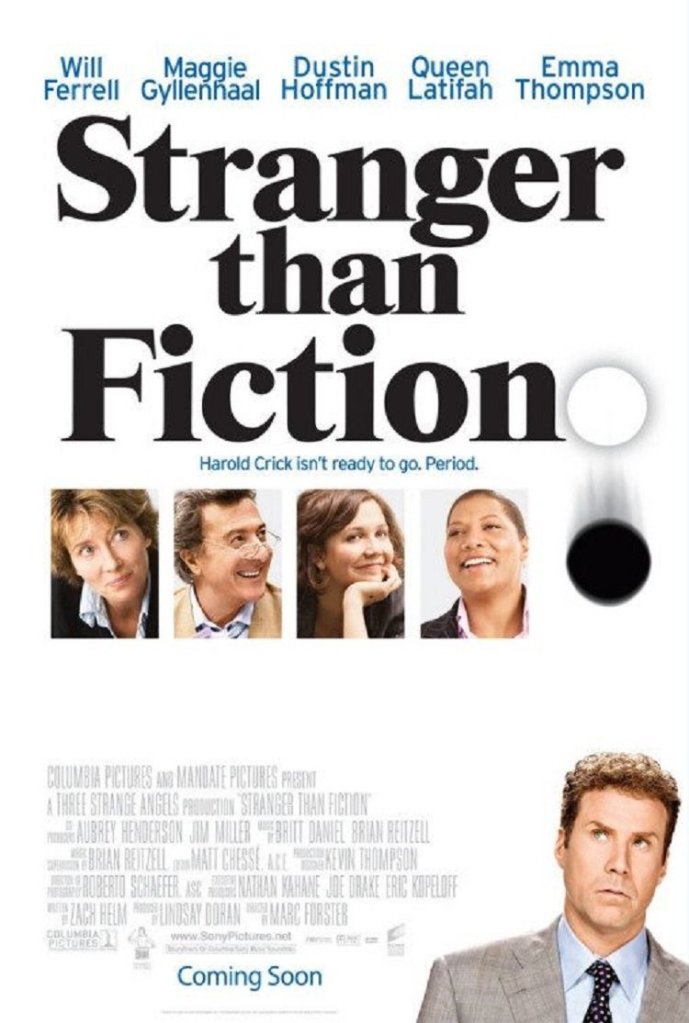
What a thoughtful film this is, and how thought-stirring. Marc Forster‘s “Stranger Than Fiction” comes advertised as a romance, a comedy, a fantasy, and it is a little of all three, but it’s really a fable, a “moral tale” like Eric Rohmer tells.
Will Ferrell stars, in another role showing that like Steve Martin and Robin Williams he has dramatic gifts to equal his comedic talent. He plays IRS agent Harold Crick, who for years has led a sedate and ordered life. He lives in an apartment that looks like it was furnished on a 15-minute visit to Crate and Barrel. His wristwatch eventually tires of this existence and mystically decides to shake things up.
Harold begins to hear a voice in his head, one that is describing his own life — not in advance, but as a narrative that has just happened. He seeks counsel from a shrink (Linda Hunt) and convinced he is hearing his own life narrative, seeks counsel from Jules Hilbert, a literature professor (Dustin Hoffman). Hilbert methodically checks off genres and archetypes and comes up with a list of living authors who could plausibly be writing the “narration.” He misses, however, Kay Eiffel (Emma Thompson), because he decides Harold’s story is a comedy, and all of her novels end in death. However, Eiffel is indeed writing the story of Harold’s life. What Hilbert failed to foresee is that it ends in Harold’s death. And that is the engine for the moral tale.
Meanwhile, an astonishing thing happens. Harold goes to audit the tax return of Ana Pascal, a sprightly, tattooed bakery shop owner (Maggie Gyllenhaal) and begins to think about her. Can’t stop thinking. Love has never earlier played a role in his life. Nor does she much approve of IRS accountants. How rare, to find a pensive film about the responsibilities we have to art. If Kay Eiffel’s novel would be a masterpiece with Harold’s death, does he have a right to live? On the other hand, does she have the right to kill him for her work? “You have to die. It’s a masterpiece.” But life was just getting interesting for Harold. The shy, tentative way his relationship with Ana develops is quirky and sideways and well-suited to Gyllenhaal’s delicate way of kidding a role. He doesn’t want to die. On the other hand, after years of dutifully following authority, he is uncertain of his duty — and he is so meekly nice, he hates to disappoint Eíffel. Harold himself has never done anything so grand as write a masterpiece. Although the obvious cross-reference here is a self-referential Charlie Kaufman screenplay like “Adaptation,” I was reminded of another possible parallel, Melville’s famous short story “Bartleby the Scrivener,” made into the 2001 movie with Crispin Glover and David Paymer. Bartleby is an office drudge who one day simply turns down a request from his boss, saying, “I would prefer not to.” Harold Crick, like Bartleby, labors in a vast office shuffling papers that mean nothing to him, and one day he begins a series of gentle but implacable decisions. Harold would prefer not to audit any more tax returns. And he would prefer not to die. But he is such a gentle and good soul that this second decision requires a lot of soul-searching, and it’s fascinating to watch how Hilbert and Ana participate indirectly in it, not least through some very good cookies. And what is Eiffel’s preference when she finds what power she has? Her publisher has assigned her an “assistant” (Queen Latifah) to force her through her writer’s block, so there is pressure there, too. She chain-smokes and considers suicide.
The director, Marc Forster, whose work includes the somber (“Monster’s Ball“) and the fantastical (“Finding Neverland“), here splits the difference. He shoots in a never-identified Chicago, often choosing spare and cold Mies van der Rohe buildings, and he adds quirky little graphics that show how Harold compulsively counts and sees spatial relationships. His work with the actors seeks a low-key earnestness, and Ferrell becomes a puzzled but hopeful seeker after the right thing. Gyllenhaal and Hoffman never push him too hard. And I like the dry detachment with which both Hoffman and Thompson consider literature, which is conceived in such passion and received with such academic reserve. Alas, Forster never finds the right note for Latifah’s character, who may not be necessary.
“Stranger Than Fiction” is a meditation on life, art and romance, and on the kinds of responsibility we have. Such an uncommonly intelligent film does not often get made. It could have pumped up its emotion to blockbuster level, but that would be false to the premise, which requires us to enter the lives of these specific quiet, sweet, worthy people. The ending is a compromise — but it isn’t the movie’s compromise, it belongs entirely to the characters and is their decision. And that made me smile.
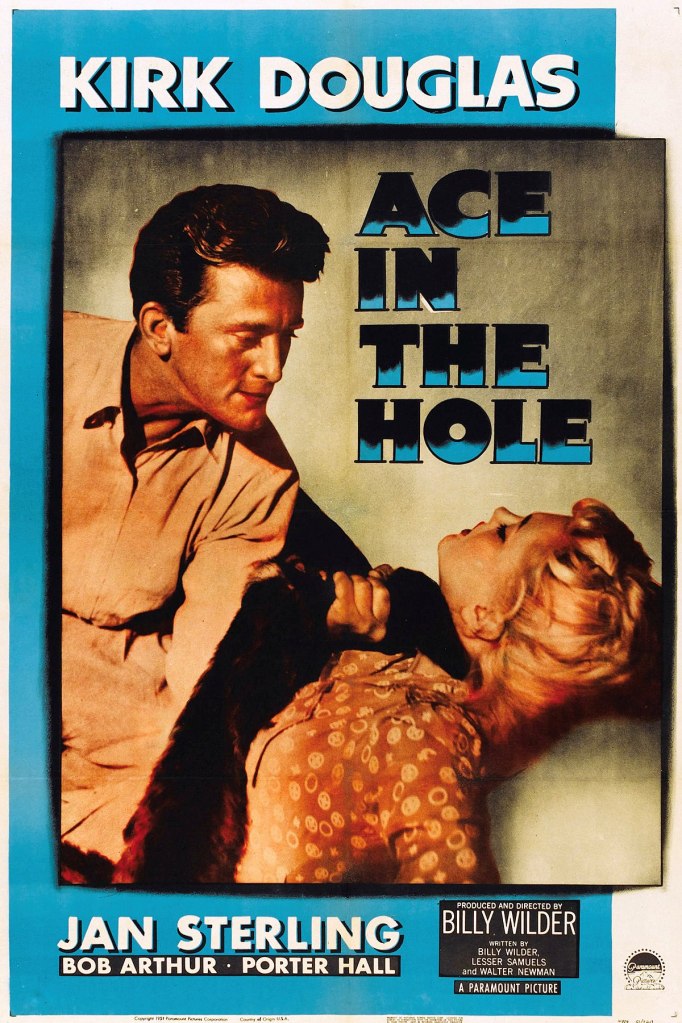
An embroidered sign on the wall of the Albuquerque Sun-Bulletin reads, “Tell the Truth.” The paper’s managing editor, the moral and idealistic journalist Jacob Boot, hung it there “as a sign of his and the newspaper’s guiding ethic.” But ethics are something reporter Chuck Tatum has done without, which, along with his drinking (“Not a lot, just frequently”), earned him the sack from several daily papers on the east coast. Now relegated to hungrily petitioning for a job at a small New Mexico paper, Tatum tells Boot, “I can handle big news and little news. And if there’s no news, I go out and bite a dog to create some.” To be sure, the Sun-Bulletin’s guiding ethic is something of a joke to Tatum, and to filmmaker Billy Wilder, who layered Ace in the Hole with caustic pessimism toward the insincerity of American culture and the media’s failed capacity for truth. It would be one of Wilder’s most personal films, having written, produced, and directed the film with less studio meddling than he had ever experienced. But in 1951, Wilder’s picture debuted and vanished without a trace in one swift motion, disregarded by critics and audiences as the director’s most sneering demonstration of his worldly cynicism. Today, Ace in the Hole represents an artistic zenith in Wilder’s career, where his skill as a filmmaker and thorough condemnation of the human race converge into biting social commentary that stands apart from his more commonly known hits.
Along with many other directors of his day, Wilder (Jewish, and of Austrian-Hungarian descent) fled Adolf Hitler’s looming rein over Europe in the late 1930s. Wilder left Paris for the United States and, given his experience in the European motion picture industry, landed work as a Hollywood screenwriter. For the better part of his early career, he collaborated with his writing partner Charles Brackett on a number of popular films. Their early hits include Ernst Lubitsch’s Ninotchka (1939) and the Howard Hawks screwball comedy Ball of Fire (1941). He soon petitioned Paramount Pictures to allow him to write and direct his own film exclusively and, based on the impressive successes of Hollywood’s first comedic writer-director Preston Sturges (The Lady Eve, Sullivan’s Travels), Wilder was given his chance. While German filmmakers were best known for their blatant expressionism, Wilder surprised Paramount studio heads in 1942 when his blithe and commercial debut The Major and the Minor turned out to be a box-office triumph. It was completely devoid of any unmarketable German-ness so well known in Hollywood from directors like Fritz Lang, as Wilder intentionally set out to make a commercial crowd-pleaser—if only to prove to studio heads that his films could earn a profit and connect with audiences so that later he could branch out.
Established as a bankable success, Wilder would go on to helm several benchmark pictures, many of them blending unconventional material with commercial appeal. Double Indemnity (1944), about a femme fatale who convinces her insurance agent to kill her husband, became an archetypal noir story; The Long Weekend (1945) was about an alcoholic on a serious bender and won the Oscar for Best Picture and Wilder a statue for Best Director; and Sunset Boulevard (1950) reflected Hollywood in a morbid, dark light, but also earned several Oscars and an immovable place in film history. In fact, many of Wilder’s films earned such a place. Though, Wilder remained best known for later comedies and romances like Sabrina (1954), The Seven Year Itch (1955), Love in the Afternoon (1957), Some Like it Hot (1959), The Apartment (1960), and Irma La Douce (1963). Each winks to the audience by testing the boundaries of orthodoxy. A Foreign Affair (1948), for example, is somehow a romantic comedy, despite its setting in the otherwise humorless postwar Berlin. His movies were best known for their irony and unconventional settings, for their light lampooning and harsh criticism of established norms. Wilder was an incredible dramatist, a superb romantic, but foremost a satirist. Among them all, Ace in the Hole’s rebellious and unrelenting pessimism prove alarming when compared to the filmmaker’s more popularized string of successes.
Development on Ace in the Hole began just after Wilder finished work on Sunset Boulevard and separated from his longtime writing partner Charles Brackett. In his search for a replacement writing partner, he found Walter Newman, a 23-year-old writer of radio plays. Newman suggested they adapt a real-life event: On January 30, 1925, cave explorer W. Floyd Collins was trapped in Sand Cave in Kentucky when a landslide pinned him down. Learning of this, William Burke Miller, a reporter for the Louisville Courier-Journal, crawled through a narrow opening to interview Collins. Miller’s story made national headlines. Local crowds and tourists gathered to watch the rescue efforts; businesses came to provide the crowds with distractions during their considerable downtime. Vendors sold hot dogs and a record huckster even wrote a song for country singer Vernon Dalhart. It later sold 3 million copies. Before long, the sheer number of people and vendors equated to a county fair or carnival, all of them forgetting that there was a man trapped and dying nearby. Collins was trapped for eighteen days before he died. Miller won a Pulitzer Prize in 1926 for his reporting. For Wilder, the story was not surprising. He worked for a scandal sheet in the 1920s while in Berlin. “I was doing the dirty work of crime reporting… Some of this I remembered for Ace in the Hole.” In one of Wilder’s anecdotes about his time as a reporter, he recalled being assigned to interview the parents of a murder victim and parents of a murderer. He admitted to making up the answers to the questions for the murderer’s parents; he couldn’t bring himself to face them. Wilder knew other journalists went to similarly subjective lengths.
A scarring indictment of journalism and, by extension, American culture, was just the sort of project he wanted to make as his first effort away from Brackett. Along with Newman, Wilder also invited the contracted Paramount writer Lesser Samuels, a former newspaper man, to join in telling a story that bore similarities to Collins’ fate. Their then-titled treatment “The Human Interest Story” was greenlit by Paramount with a budget of $1.5 million, $250,000 of which went to Wilder. Nonetheless, many in Hollywood doubted the project and held misgivings about what Wilder would produce without Brackett. Many felt that Brackett helped rationalize and tone down Wilder’s otherwise virulent cynicism. Aware of how he was seen throughout the industry, Wilder nonetheless continued to explore the most cynical film of his career. To protect himself and his next film, Wilder kept its subject matter under tight wraps. He handwrote a note on the first draft saying, “Do not give out under any circumstances—to anyone!” Had even the basic story leaked, not only would his detractors have ammunition with which to accuse him of rampant cynicism, but the press would certainly not be in favor of a film that sets out to lambaste the media. Meanwhile, Wilder signed Kirk Douglas to play the film’s resident William Burke Miller, here named Chuck Tatum—a deceitful reporter who creates the news with his own braggadocio and slick maneuvering. To prepare for Douglas for the role, Wilder sent him to work at the Herald Examiner as a novice reporter for a week.
Principal photography began on July 10, 1950, and wrapped on September 11, with the screenplay having been completed just four days earlier. Censor Joseph Breen had a few complaints about the lack of “a proper voice for morality,” citing the generally disparaging tone of the piece; however, because the protagonist’s utter lack of scruples result in him paying for his nihilism with his life, Breen had few demands for changes. Breen insisted on a single change in which the corrupt sheriff, Gus Kretzer (Ray Teal), whose role in the film’s central scandal goes unpunished, receives some manner of comeuppance. Wilder conceded and, in the end, he resolved to add a line about the newspaper’s editor Jacob Boot (Porter Hall) writing an exposé on the sheriff’s wrongdoings. For the visual presentation, Wilder and cinematographer Charles Lang wanted an authentic look far removed from many of then-current directors of photography. Wilder admired cinematographers who weren’t “working for the goddamned Academy Award”—who didn’t use “fancy camerawork, with the camera hanging off the chandelier.” Lang’s work is gritty and real, with brief touches of high-contrast shadows and noirish influence. Critic Manny Farber described Lang’s work on Ace in the Hole as having “a chilling documentary exactness.” On the periphery, Victor Desney, an actor who had approached Wilder about adapting Collins’ story two years earlier, learned about the production at Paramount and filed a lawsuit. Though Wilder and his writers changed the names and locations for the script and initially won their case, an appeal filed in the California Supreme Court ruled in favor of Desney. Wilder and his lawyers settled privately for a hearty sum.
Journalist William Burke Miller’s moral bankruptcy was surely exaggerated by the film, as Tatum’s Machiavellian cunning and self-centered portrayal is given intense bravado by Douglas. Tatum is a charismatic, ambitious, megalomaniac personality, yet filled with self-contempt. The story begins with Tatum, a hard-luck newspaper writer who talks loud, thinks fast, and belongs somewhere in a city scouring slums and politicians’ bedrooms for a story. Nevertheless, no city will have him. He’s been fired from eleven newspapers around the country for reasons ranging from drinking on the job to sleeping with the editor’s wife. His former salaries were more than anyone in the “sun-baked Siberia” of Albuquerque, where he finds himself when the film begins, has ever come close to earning. Casing the offices of the local paper, Tatum speaks with as much modesty as you will see from him—he tells the owner that taking him on will make the paper $200 a week, as he is a $250 writer willing to take the job for $50. Once hired, even a year later, Tatum still lights matches off typewriter recoils, scoffs at the paper’s embroidered “Tell the Truth” motto, and talks of his New York City glory days as if there were still a chance for him. All the while, he waits for a Big Fish to come along, onto which he hopes to snag his hook and pull himself out of his dinky Albuquerque boat, into the river and down all the way to New York City once again.
Beginning to feel that biding his time in New Mexico’s empty pasture of newspaper journalism might be his last mistake, Tatum sees a way back into The Big Time when driving to a rattlesnake festival (“Even for Albuquerque this is pretty Albuquerque,” Tatum remarks). By chance, Tatum and his gopher photographer stop at a wayside trading post and restaurant; they learn the store’s owner is trapped inside a centuries-old Native American cave system while digging for artifacts to sell. Remembering a journalist who years ago won a Pulitzer for dragging out such a story to its full dramatic scope (likely an in-film reference to Miller), Tatum sees the predicament of Leo Minosa (Richard Benedict), the pleasant store owner and war vet who remains trapped in a tiny opening, as the perfect opportunity. Tatum explains, “Bad news sells best. ‘Cause good news is no news.” As with other Wilder protagonists, Tatum takes the low road to raise himself up, selling himself for the concept of personal accomplishment, not yet realizing the consequences until he ends up dead—a reoccurring theme in Wilder’s films since Double Indemnity. Tatum takes control of the rescue operation, out-talking even the local police; he bribes Sheriff Kretzer with the idea of reelection and fame from newspaper coverage. A contractor familiar with cave rescues wants to fasten the unstable walls with bearings, which should allow Minosa’s rescue in half a day. Too dangerous, Tatum explains. He suggests using a drill and going in through the top of the mountain—a decision that will extend Tatum’s newspaper treatment by days, allowing him to gain the attention of New York City’s high-brow journalists.
Tatum’s coverage attracts local attention. Tourists stop by just to get a look at the cave where “hero” Leo Minosa remains trapped. And then there’s Minosa’s wife, Lorraine, played by the appropriately desperate and tired-looking Jan Sterling. She seems none-too-broken up about her husband’s predicament—she uses Leo’s absence to try and leave him, until Tatum convinces her to stay for the event’s profits. After all, the crowds at the spectacle buy burgers at the Minosa trading post, giving Lorraine more business than they’ve had in, well, ever. (“We sell a case of soda pop a week, and once in a while a Navajo rug,” she admits.) Eventually, Lorraine comes on to Tatum, hoping that he can whisk her away from her isolation, off to The Big City. Through a few subtle glances, we realize Lorraine knows just what Tatum is up to. “That’s the first grand I’ve ever had,” she says to him after a good day of business, smiling with sexual conviction. “Thanks. Thanks a lot.” Tatum instructs her to get that smile off her face, that she has the part of a distraught wife to play. “Why don’t you make me?” she says. Tatum slaps her hard across each cheek and her smile is replaced with angry confusion. “Don’t wipe those tears,” he says. “That’s the way you’re supposed to look.” It is a vicious, scary moment in the film, one where we realize how cruel and manipulative Tatum truly is, and how breathtaking an actor Douglas could be.
Compare Douglas’ Tatum to his character Jim McLeod in William Wyler’s Detective Story, released the same year as Ace in the Hole. Both characters are driven, self-aware, and conscious of their own moral downfalls. McLeod resorts to criminality to put criminals away; Tatum creates his own stories for journalistic purposes. Douglas excels in these roles, both powerful, flawed men. Their brash sensibilities are subdued only by Douglas’ natural, charming confidence. And while each character may be anti-heroic, to the point where we know they must die in the end to amend their misdeeds, we root for them, as they are uniquely sympathetic and convincing in their passions. By the time the drill is set up on top of the mountain, Lorraine is selling tickets to her husband’s imprisonment in the cave, even letting the circus erect tents, sell concessions, and sing songs about rescuing Leo—giving a very literal meaning to “media circus”. Wilder commissioned Paramount’s songwriting team of Jay Livingson and Ray Evans to write “We’re Coming, Leo”, a song to commemorate the cave-in, instructing them to write “the worst song you can, with bad rhymes and everything else bad.” A woman in a cowgirl getup sells copies of the song to spectators. Parents buy Indian headdresses for their children. Servers carry orders of food through the crowd. The throng’s blithe and entertained. A billboard claims the “proceeds go to the Leo Minosa Rescue Fund,” but undoubtedly, no one but the vendors will see a dollar. Wilder’s critique of postwar America is unremitting.
Flourishing under such conditions, Tatum juggles prearranging a job contract with a New York newspaper, keeping quiet those who know his secrets, communicating with Leo and instilling in him hope, and maintaining order in the newly constructed “community” just outside the cave. Wilder captures the cynical nature of the truth and media by exploring the reporter, his victims, and those who allow his plan to progress. His ending leaves both Leo and Tatum dead. “I’m a thousand-dollar-a-day newspaperman,” Tatum tells his idealistic Albuquerque editor. “You can have me for nothing.” Tatum falls to the ground, lifeless from a stab wound incurred by the rejected Lorraine. The final shot is Wilder’s only bravado shot in the picture, with Douglas dropped to within an inch of the camera’s lens. After all his efforts, Tatum could not assure than Minosa would live the week needed to once again boost his name. And yet, in the end, Tatum is not just a remorseless journalist; he’s riddled with guilt, but not enough to end his coldhearted behavior. Leo dies needlessly in the cave off-screen, believing Tatum is his friend to the last moment. Lorraine is left pathetically clinging to her profits. When the circus finds out Leo is dead, collective heads drop in sadness; within moments the makeshift parking lot is abandoned and only scattered garbage remains. Tatum failed to secure a much needed happy ending to his human interest story; had Leo survived, perhaps Tatum would have lived in the end. But that would be another film entirely.
As with so much modern media, Tatum decides what his readers know and where the story goes. He reports on and develops his yarn in the manner to which he desires. Television and newspaper journalists choose what they report, and more often than not it’s the type of news their audience wants to hear. This is a subjective, sensationalist process, guided by money and ratings as opposed the ideal objectivity professional journalists have forever yearned for but rarely achieve. Tatum takes subjectivity to the next level: interaction. While Ace in the Hole may seem satirical with Tatum pulling the locals’ strings like a puppeteer, reconsider the film’s basis in fact, that such events actually occurred to an extent. In some instances, they still occur today. In 1998, Steven Glass was famously fired from The New Republic magazine for fabricating entire stories. Names, places, events—all made-up. This is, of course, the next extension beyond what Tatum does in the film. And luckily, no one died from Glass’ actions; moreover, since there is no law against bad journalism, Glass was never punished. Fortunately, cinema can provide a cathartic, poetic justice. Like any great film noir, the criminal hero, Tatum in this case, is punished in the end for his wrongdoings, a narrative archetype that Wilder all but established with Double Indemnity. Though Ace in the Hole is not, for the most part, shot in the visually expressionist noir style, its plot conforms to traditional noirish devices—complete with an equally corrupt blonde bombshell to parallel the anti-hero. Only in the final scene, as Tatum collapses to the ground do we see Wilder’s noir intent. Douglas’ visage is barely lit but for a highlighted cheekbone and lower eyelid, so near we cannot help but confront the reality of Tatum’s death.
Perhaps this film’s cynicism explains its abortive performance in America, where critics found Wilder’s pessimistic attitude toward the unlikely chances of credible journalism offensive, and audiences altogether ignored it. Furthermore, the film illustrates general human corruption, since most of the film’s characters, save for Leo and Booth, are bought by Tatum’s charm. Curious that Paramount allowed such a powerfully overcast film to be made, or even believed audiences in 1951 were willing to endure such material. Even today, Ace in the Hole shocks for its blatant display of corruption otherwise commonplace amorality. The comparatively raw audiences of 1951 were not used to seeing such barefaced gloom and hopelessness depicted onscreen, unless film noir was their genre. While earning accolades in Europe, the picture was all but forgotten shortly thereafter. Poor receipts in North America panicked Paramount executives, who changed the title to “The Big Parade” briefly—a change that did little to increase attention to this sour-flavored picture. In Europe, which at the time was blossoming with some of the best in filmic auteurism, and which had no qualms about a film scorning American journalism and culture, Ace in the Hole was widely regarded as a masterpiece. When asked if Ace in the Hole was a cynical film, I. A. L. Diamond, Wilder’s co-writer on Some Like it Hot, said, “Sure they called it cynical. And then you see thousands and thousands of people turning up at Idlewald airport in New York to watch a plane coming down with bad landing gear. People clog the runway waiting for it to crash—and you ask yourself how cynical Ace in the Hole really was.”
In the wake of the film’s failure, Wilder’s break with Brackett was also blamed. Wilder resolved never to work with either Newman or Samuels again, not that the studio would back another collaboration between them after Ace in the Hole‘s failure. And because Paramount’s next Wilder movie, Stalag 17 (1953), was a huge success both commercially and artistically, Wilder’s salary for that film was purportedly withheld by Paramount to make up for the studio’s massive losses. “Fuck them all,” Wilder said of Ace of the Hole‘s critics. “It is the best picture I ever made!” Not long after the film’s release and its scathing reviews, Wilder witnessed a car accident in which a man was run over right in front of him. As Wilder got out of his car to check on the victim, a newspaper cameraman took a picture of the scene. Wilder told the cameraman to call an ambulance, but he replied, “I’ve got to get to the Los Angeles Times. I’ve got a picture that I’ve got to deliver.” Wilder said, “You put that in a movie, the critics think you’re exaggerating.” While Ace in the Hole was described as being from the “rattlesnake’s view of the world” by critics, today the ethical injustices committed by contemporary journalists far exceed those of Chuck Tatum. Years later, the film was almost universally forgotten, seen only occasionally on television. In 2002, the AFI declared it an overlooked masterpiece and held a special screening hosted by Neil LaBute. Five years later, New York’s Film Forum showcased the film with a newly restored print. Film historians around the world have since praised it with a newfound adoration and appreciation for the director’s purest voice.
Sayings like “ahead of its time” or “forward-thinking” do Ace in the Hole little justice. The film captured the lowest depths of 1950s journalistic misconduct, but also reflected the wasteland that Wilder believed American culture to be with supreme viciousness. Sensationalism and subjective reporting—amid contemporary saturation via social media, television, radio, newspapers, magazines, and even cinema—have become more commonplace and monstrously unrestrained today than perhaps even Wilder could have imagined them becoming. Then again, the mutation of the media and our ever-increasing obsession with spectatorship would have disgusted Wilder, but they wouldn’t have surprised him. Lost to time and further eclipsed by the director’s landmark productivity after its release, Ace in the Hole’s cutting-edge criticism of journalistic integrity, or lack thereof, presents one of the most scathing samples from Wilder’s career of hard-biting satires and comic romances. Wilder saw Tatum’s unfeeling opportunism as a small sampling of what’s wrong with our culture. His censure of the media extends further to a vicious condemnation of American culture, specifically those who remain drawn to sensationalism regardless of who is harmed for their entertainment.
Bibliography:
Hopp, Glen. Billy Wilder: The Complete Films, The Cinema of Wit. Taschen, 2003.
Horton, Robert (editor). Billy Wilder: Interviews. Univ. Press of Mississippi, 2001.
McNally, Karen (editor). Billy Wilder, Movie-Maker: Critical Essays on the Films. McFarland, 2010.
Phillips, Gene D. Some Like It Wilder: The Life and Controversial Films of Billy Wilder. University Press of Kentucky, 2009.
Sikov, Ed. On Sunset Boulevard: The Life and Times of Billy Wilder. New York: Hyperion, 1998.
I initially felt a fool for not having seen The Third Man earlier. However, in retrospect, having now read most of Graham Greene’s major works, and having received some keen insight into the back-story of producer Alexander Korda through Kati Marton’s book The Great Escape, I feel I was able to enjoy The Third Man even more for the staggering masterpiece that it is.
As a European/American co-production bankrolled by two legendary hands-on producers, David O. Selznick and Alexander Korda, The Third Man was masterfully crafted by director Carol Reed from a screenplay by British novelist Graham Greene. The film served as a pinnacle of the film noir movement and is a prime example of master filmmakers working with an iconic writer and utilizing an amazing cast and crew to create a masterwork representing professionals across the field operating at the top of their game.
Fans of Greene’s novels need not be disappointed as the screenplay crackles with all that signature cynicism and sharp witted dialogue. Carol Reed’s crooked camera angles, moody use of shadowing and external locations (Vienna, partially bombed out, wet and Gothic, never looked more looming and haunting) and crisp editing are the perfect visual realizations of Greene’s provocative wordplay and often saturnine view of the world. Reed’s brief opening montage and voice-over introducing us to the black market in Vienna is also shockingly modern, as it is that energetic quick-cut editing that has influenced directors like Scorsese to film entire motion pictures in just such a style. Also making the film decidedly timeless is the zither music score of Anton Karas, a bizarre accompaniment to the dark story that serves as a brilliant contradiction to what is being seen on screen.
The story of The Third Man slides along like smooth gin down the back of one’s throat as characters, plot and mood meander and brood along cobblestone streets and slither down dark alleys in an intoxicated state. Heavy drinking hack writer Holly Martins (Joseph Cotten, doing an excellent Americanized riff on Graham Greene himself) arrives in post WWII occupied Vienna to meet up with his old pal Harry Lime (Orson Welles) only to find that Lime is reportedly dead, the police (headed by a perfectly cold Trevor Howard) don’t seem to care, and Lime’s charming broken-hearted mistress (Alida Valli, perfect as another Greene archetype) has been left behind. Of course, Martins can’t leave well enough alone as conspiracy, murder, unrequited romance, and political intrigue ensue. Welles benefits greatly from being talked about for most of the film and appearing mostly in shadows spare for two scenes: the famous ferris wheel speech, and a climatic chase beneath the streets of Vienna through Gothic sewers. His top hap, dark suit, and crooked smile are the stuff of film legend.
The side characters, however, are what make The Third Man such a rich, rewarding experience. We’re treated to small glimpses into the mindsets of varying people ranging from a British officer obsessed with American Western dime-store novels (of which Martins claims his fame) to an Austrian landlady eternally wrapped in a quilt going on and on in her foreign tongue as international police constantly raid her building and harass her tenants. The brilliance is that one needs no subtitles to understand her frustration. These added layers of character and thoughtful detail, hallmarks of Greene, set The Third Man in a class above the rest of film noir from the late 1940’s era.
Make no mistake, The Third Man is arguably one of the most finely crafted films ever made. One’s preference towards noir and Greene’s world-view will shape how much one actually enjoys the film. For the sheer fact it has held up so well over the decades and has clearly influenced so many great films that came after it, its repeated rankings as one of the greatest motion pictures ever made can not be denied. With a good stiff drink in hand, and Graham Greene’s collection dog-eared on my bookshelf, The Third Man is undoubtedly now one of my favorite films. Reed’s closing shot of a tree-lined street along a cemetery and Joseph Cotten leaning against a car smoking a cigarette while Alida Valli walks right past him with that zither music score playing is one that has left an indelible mark on my memory and enriched my love of film as art.
The futureworld of The Zero Theorem is so chaotic, gaudy, aggressively high-tech, and lonely—and not much of a stretch from where we’re heading—that it’s no wonder Qohen Leth (Christoph Waltz) wants to stay indoors permanently. The Gollum-like Qohen (that’s Co-hen)—all neuroses and no hair, and even prone to referring to himself as “we”—is a corporate number cruncher so skilled that he is granted permission to work from home, a cavernous former church he shares with pigeons, rats, and many layers of dust, tasked with solving the unsolvable title equation, pertaining to the meaning of life.
But, as it turns out, there’s not much peace to be had in Qohen’s hideaway either. This empty, socially inept man’s world—both real and virtual—is regularly disrupted by a collection of amusing weirdos, including, most notably, his weaselly superior (David Thewlis) and the big boss’s obnoxious yet ultra-likeable genius teenage son (Lucas Hedges) who’s sent in to assist Qohen. (The considerable screen chemistry between Waltz and Hedges makes for some of the film’s best scenes.) The women, however, don’t fare quite so well: Mélanie Thierry as the “love interest” is relegated to looking like a human sex doll, while Tilda Swinton, playing “odd” yet again, is cringe-worthy as Qohen’s invasive digital psychiatrist.
The Zero Theorem is very much a Terry Gilliam film: fantastical, kooky, occasionally sloppy, but with a big brain and a beating heart. And like most of his work, it won’t appeal to all, but its unmistakable passion makes it well worth the while.
It’s taken me exactly a year to go from Dark Star to Starman in my survey of John Carpenter’s career. At this rate, I’ll be at Escape From L.A.by this time in 2018. The timing works out on this one, however. There’s no “winter holiday” Carpenter movie — no, The Thing doesn’t count, that’s a “winter” movie — but Starman is as cheerful and uplifting a science-fiction tale as Carpenter has ever turned out, so it feels right for December.
Starman has quite the long history behind it. The script was in development at Columbia back in 1980 and went through a round-robin of writers. Columbia had the opportunity to do the Spielberg project that would eventually turn into E.T., but turned it down in favor of Starman — a decision the studio would come to regret when E.T. became the highest-grossing movie in history during the Summer of 1982 (when it squashed a certain other alien visitor movie).
The mega success of E.T. caused director John Badham to abandon Starman because he thought it was too similar to Spielberg’s movie. (Badham went on to direct WarGames, so that worked out.) Many other directors were on the film at one time or another — Adrian Lynne, Mark Rydell, Tony Scott, Peter Hyams — but John Carpenter had the pitch that stood out: film it as a love story/road movie in the classic Hollywood vein. Like It Happened One Night, but with an alien. Carpenter wanted to show he had the directing chops to tackle a different type of material. He was also still wounded over the poor reception of The Thing and wanted to deliver a hit for a big studio.
And thus we have a John Carpenter film for the whole family! Which is odd enough on its own.
The Story
Advanced extraterrestrials discover space probe Voyager II and choose to answer humanity’s invitation to “come and see us sometime,” as inscribed on the probe’s audio-visual disc. An alien observation ship heads to Earth, but the U.S. Air Force knocks it from its planned course so it crashes in rural Wisconsin. The disembodied alien aboard takes on the human shape of Scott Hayden (Jeff Bridges), the recently deceased husband of lonely Jenny Hayden (Karen Allen), by using DNA from a lock of Scott’s hair.
Jenny’s reaction to the physical resurrection of her husband with an extraterrestrial’s mind is… complex. She agrees to drive Starman-Scott to Arizona for a rendezvous with a ship from his homeworld. At first she acts out of fear, but later because she’s genuinely falling in love with the being in Scott’s shape — and she knows his body will die unless he makes the rendezvous. Their cross-country trip must stay ahead of pursuit by the police, a curious SETI scientist (Charles Martin Smith), and an aggressive National Security Agency director (Richard Jaeckel) who isn’t interested in giving the alien the “friendly reception” promised on Voyager 2’s golden disc.
The Positives
Starman is a sweet, lyrical movie that has aged beautifully. It’s Carpenter’s most humanist film, the opposite of the invasion paranoia and frigid horror of The Thing. But Starman isn’t Carpenter attempting to do a karaoke E.T. or imitate Spielberg, even considering the background of the project. No one else could’ve made Starman the way Carpenter did. E.T. is a science-fiction fable about childhood. Starman is a science-fiction fable about adulthood, realized as a road movie. It’s also a beautiful and complex romance about love rediscovered and hope overcoming morbidity and the human tendency to cynicism. Yes, overcoming cynicism in a John Carpenter film!
In short, this is probably the only John Carpenter film you can show to your Great Aunt Betty. Or to any other relatives who just don’t get out to movies that often. It’s a four-quadrant film — the only one in the director’s career.
It’s astonishing/aggravating how the 1980s shrugged off the brilliance of Jeff Bridges. It wasn’t until the late 1990s that the entertainment world stopped taking him for granted as merely a handsome actor who had an almost proverbial trouble landing roles in hit movies. Starman is a perfect case of this: although he was nominated for an Academy Award for Best Actor that year, Bridges not only didn’t win, he didn’t experience a major career boost from the nomination. Starman was only a moderate success in 1984, which didn’t help, and people seem to have forgotten Bridges was even nominated for the movie.
Bridges’s Best Actor nomination is the only time any Carpenter film got an Oscar nod. (“What, The Thing wasn’t nominated for special effects?” you’re shouting. Nope, it wasn’t. Don’t shoot the messenger.) Bridges lost to F. Murray Abraham for Amadeus. I can’t complain much about this because Jeff Bridges eventually won an Oscar for Crazy Heart in 2009, Abraham was superb in Amadeus, and Bridges has never been anything but thankful for the career he’s had. (“I couldn’t of dreamed it being any cooler than it is,” he said in a 2009 interview.) But given all that, if I were an Academy voter in 1984, I’d definitely cast my vote for Jeff Bridges. Because he’s just amazing in Starman.
Bridges as Starman-Scott is immediately impressive for the unusual physicality the actor invests in the part. Viewers are continually reminded through even the smallest gestures (oh, that nutty smile!) that this is an alien creature trying to figure out the most basic workings of the human body and human communication. Just watching Starman attempt to navigate eating Dutch apple pie feels like a full acting course. There’s also tons of great humor from the character quirks, with gags that Terminator 2: Judgment Day would later recycle as Starman-Scott fumbles with colloquialisms and gestures like “Take it easy,” and “Up yours.” My favorite of these comedy bits is when Starman-Scott nearly gets him and Jenny killed on a railroad track because he learned the wrong lesson about driving from watching her: “Red light stop, green light go, yellow light go very fast.”
But what Bridges achieves with the role is bigger than odd tics and a physical sense of the alien. He shows Starman-Scott evolve over a few days from an entity that terrifies Jenny into a person she loves deeply, and not only because he resembles her deceased husband. Starman is an alien moving toward human — but also toward something better than human and better than his species, as he indicates his and Jenny’s son will be. His wordless resurrection of Jenny inside the trailer is a powerhouse moment for Bridges where he shows the key point of alien and human merging. (He never tells Jenny that he brought her back from death, a subtle but wonderful addition to the character.)
It takes two to make a romance story work, of course. Thankfully, Karen Allen delivers her career-best performance as Jenny Hayden. (Sorry, Raiders of the Lost Ark.) Starman-Scott may be the flashiest part, but Jenny is the main character who goes through the change from a woman burnt-out early in life by the loss of a loved one to a woman reborn with hope for the future. The role is an incredibly challenging one, putting the strain of a constant tug-of-war of emotions on Allen as she reacts to the bizarre actions and potential danger from an alien wearing the form of the recently deceased love of her life. That’s plenty for an actor to unpack in each scene, and Allen goes on an incredible emotional road trip along with the physical one. Trying to explain the meaning of love to Starman-Scott in the diner, right as she’s making another plan to escape from him, is one of the tear-jerking highlights. But it’s the scene aboard the train, where Starman-Scott tells her she will have his baby, that contains Allen’s finest moments. It’s also the best scene in the film, lovingly crafted in a way I’d wager most people in Hollywood would never have expected from John Carpenter.
Although still missing photographer Dean Cundey (Donald M. Morgan repeats from Christine), Carpenter lenses some amazing outdoor sequences using the open spaces of Middle America as a canvas. It’s the most visually wide-open film he ever shot. I’m used to complimenting Carpenter and his cinematographers for doing impressive work with the widescreen format in enclosed and dark spaces. Here’s the opposite: Carpenter having the opportunity to shoot a movie like a John Ford epic Western. He even gets to use Monument Valley!
Starman is my pick for the best score to a John Carpenter film not composed or co-composed by John Carpenter. Producer Michael Douglas convinced Carpenter to let Jack Nitzsche score the film, based on Douglas’s previous work with Nitzsche on One Flew Over the Cuckoo’s Nest. Nitzsche’s all-electronic score has some striking similarities to Carpenter’s own work (I think he paid close attention to the director’s musical style) but it develops enough of a separate identity. The main theme, a soaring love piece, is an exemplar of how mid-1980s composers were discovering ways to create vast electronic soundscapes. (See also: Vangelis.)
The only Carpenter Acting Company regular to pop up is Buck Flower, who plays a short-order cook who gives Starman-Scott a ride after the alien feels he’s putting Jenny in too much danger. It’s one of the funniest scenes, as the cook finds its surprisingly easy to chat with Starman-Scott’s odd handling of conversations:
Cook: What’s your line?
Starman-Scott: Line?
Cook: Work. Whaddya do when you’re not hitching rides?
Starman-Scott: Oh, I make maps.
Cook: Make any money?
Starman-Scott: [pause] I make maps.
Cook: Well, you don’t get rich cookin’ either!
At one hour and fifty-five minutes, Starman is John Carpenter’s longest movie. Think about that: nineteen movies on his resumé and none even reached the two-hour mark. That’s incredible, and it says plenty about what an efficient filmmaker and tight storyteller Carpenter is.
The Negatives
I don’t have much to say against Starman. As a gentle science-fiction romance, it’s nearly perfect. Yet … it’s never my first choice when I’m looking to rewatch a John Carpenter film. There’s so much to love about it, but it doesn’t engage me on the same level that even some ostensibly lesser entries in the Carpenter filmography do.
As I talked about above, this isn’t a sell-out movie or Carpenter trying to imitate a recent hit. This is no work-for-hire paycheck gig like Memoirs of an Invisible Man. But it feels like something Carpenter needed to do at least once so he could get back to the suspense, cynicism, and violent weirdness that are his specialty; the films of his that are endlessly rewatchable. Starman is an interesting detour for Carpenter, as well as a good film to share with non-fans and family members who don’t want to watch gang members murder a little girl, an “action adventure comedy Kung-Fu ghost story monster movie,” or a satirical/political allegory about alien invaders that also contains a prolonged wrestling scene. Just writing those descriptions explains a lot about why I love John Carpenter’s movies — and why I feel a touch removed from Starman.
One actual criticism I have is that the government/science sections of the story with scientist Mark Shermin and military blowhard George Fox are less developed than the road trip romance sections. The seamless split between these similar halves of the narrative that Spielberg achieved in Close Encounters of the Third Kind with Roy Neary’s collapsing family on one side and Lacombe’s quest on the other doesn’t occur here. The movie loses a bit of its momentum whenever it shifts away from its central couple.
Charles Martin Smith gives Mark Shermin personality, but there’s not much to the character on the page and his impact on events is minimal. The trimming down of the military, political, and SF aspects of the story to center more on the romance only really inflict damage to the movie in this case: it seems as if Shermin should have a larger role and much more to say about who and what the alien visitor is. His only encounter with Starman-Scott is a short one; I would’ve enjoyed a few additional minutes of exchange between them to learn more about Starman’s view of humanity and what drives Shermin.
The Pessimistic Carpenter Ending
Not applicable! This is as optimistic as Carpenter films come, leaving Jenny Hayden on Earth with her life renewed and the gift of a child from both her husband and the Starman — a child who shall become a teacher. You won’t find as optimistic a quote in the Carpenter canon as Starman’s observation on humanity: “Shall I tell you what I find beautiful about you? You are at your very best when things are worst.”
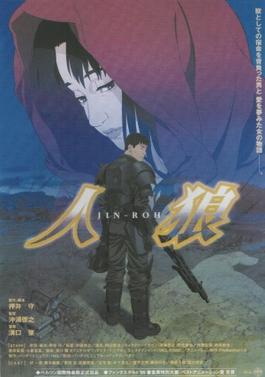
Like every young anime fan, you relied on Reddit, Tumblr, or YouTube as your source of information when looking for new anime to watch; in particular, I was a fan of the ultraviolent Wicked City-type films. No one in my sphere of influence watched anime like that, but as a person who was raised young on 80s ultraviolent action flicks and cheesy slasher flicks. Most anime I watched did not scratch that itch I had. One day, while browsing YouTube, I saw a recommendation from my favorite anime reviewer. He just made a review on a little film named Jin Roh: The Wolf Brigade, a hidden late 90s gem that almost nobody talked about.
Jin Roh: The Wolf Brigade was released in Japan on June 3rd, 2000, and did not hit America until it was licensed by Bandai Entertainment and Viz Media for an English release, hitting theaters on May 25th, 2001. The Film chronologically is the third film in Mamoru Oshiis Kerberos Saga beginning in 1987. The Kerberos Saga ranges through various installments, such as live-action films, radio dramas, an original manga run, and a feature-animated film.
When I first experienced the film for myself, I was upset that something this beautiful felt hidden and almost forgotten by mainstream anime fans nowadays. However, my opinion changed when I showed my friends the film; rewatching it with new viewers fresh for the experience made me realize why Jin Roh is such an underrated gem in the first place.
Based on Mamoru Oshii’s original manga Kerberos Panzer Cop. Jin Roh takes place in an alternate timeline. Set in an alternate 1950s Japan, where after World War 2, Germany won the war, occupied Japan, and eventually denazified, leaving the country in economic and political ruin. The film follows Kazuki Fuse. A member of the Capital Police menacing paramilitary unit nicknamed Kerberos equipped with MG-42 machine guns and specialized nightmare-inducing Protect Gear that looks straight from a sci-fi movie.
We follow Fuse as he is embroiled in a web of political intrigue and personal turbulence after failing to stop a member of the terrorist group known as The Sect from detonating satchel charges that cause a blackout. The incident damages Kerberos’ reputation. Fuse, deeply haunted by guilt, is reprimanded for failing to stop the bomber and sent back to basic training for re-evaluation. Fuse, still remorseful, visits the courier’s grave, meets Kei Amemiya, a woman who claims to be the courier’s older sister, and develops a friendship. However, Kei is eventually revealed not to be the suicide bomber’s sister but a former member of the Sect who is being used as a pawn by the Capital Police to discredit Kerberos and disband the unit once and for all.
Jin Roh is unlike other anime like Akira or Ghost in the Shell, but it is as influential as the two. However, the film does not bombard the senses with a visual feast for the viewer. Even though many animators, including the director, worked on anime such as Paranoia Agent, Evangelion, Patlabor 2, and so on, the real magic comes in its sound design and soundtrack.
It is something you’ll quickly come to appreciate. The film’s attention to realism and subtlety in its sound design helps create a realistic environment; it’s purposeful and not distracting. Things sound squishy when they should; Fuze reassembling his MG-42 sounds real and so damn crisp to the ear; even the sound of a Molotov hitting the ground shows the care and level of detail that went into making every sound heard realistic.
I’m not discrediting the visuals because what you see visually is also curated and adds to the experience. Characters are distinct, and the world is visually stunning; on my second viewing, I realized I never noticed most of the weapons, uniforms, and vehicles seen are German or German-influenced. The Mauser C96 is the Kerberos standard sidearm. Capitol Police are seen carrying MP40s, and when Fuse is sent back to basic for training, we see members of the unit training with Sturmgewehr 44 rifles. It is what makes this film so distinct. There’s noticeable love and attention to detail carefully considered when developing the movie. I never understood why it was so underrated until I rewatched it with my friends. Watching the emotional roller coaster, my friends went on made me realize something. Jin Roh is meant to be a rainy-day film.
It should be a hidden gem. It’s a cozy watch, especially with the soundtrack composed by Hajime Mizoguchi in collaboration with Yoko Kanno. Even though the soundtrack is used sparsely compared to other films, it hits. There’s not a punch pulled when it comes to composing the soundtrack. It is orgasmic. It is why even though the film may not be as acclaimed as Akira, it’s memorable. And that’s what the legacy of this movie is supposed to be. Jin Roh is a memorable viewing experience.
While scenes can feel like they drag, they serve a purpose. The movie doesn’t care about your expectations as a viewer; hell, within the opening scene and throughout the film, it makes it a matter of fact. Surprisingly going as far as spoiling how the film will end with visual clues and off-screen exposition. It’s something sprinkled throughout with imagery of wolves or that Fuse figuratively and almost literally being a wolf.
The scene in the sewers with the wolf brigade still gives me chills. It is revealed the wolf brigade has been fully aware of the Public Security plan and used it as an opportunity to flush out those trying to eliminate the unit. Fuse himself is a deep-cover operative. Well aware of what’s going on. A wolf in sheep’s clothing. It is even more heartbreaking in the end. Just like the tale of Little Red Riding Hood, the wolf devoured Little Red Riding Hood. Fuse, distraught, realizes he has no other choice and kills Kei, cleaning up all loose ends.
Jin Roh on the surface, may be boring to some, or the use of the wolf and little red riding hood may be pretentious to others. Except, it is safe to say that is purely personal bias. Jin Roh is a stunning film. I encourage any anime fan who has not graced their screens with the movie, should. It should be watched and celebrated with other great pieces of animation. As the sea of new anime rises. Gems like Jin Roh are bound to be forgotten or passed over. The next time you are looking for a visually stunning; masterfully made; and well-curated film, watch Jin Roh: The Wolf Brigade. You won’t regret it.



 After the Crash