Kushner-Linked Firm and Gig Economy Set to Reap Huge Profits as Mass Evictions Begin

By Raul Diego

Source: Mint Press News

In 2014, former Blackstone and Goldman Sachs investment banker Ryan Williams got together with his “college buddy,” Joshua Kushner – Jared’s brother – to form a real estate investment platform they called Cadre. Cadre sought to disrupt the real estate industry in the wake of the 2008 subprime mortgage crisis by tinderizing property deals through a tech platform that brought investors and sellers together. According to Williams, whose other investors include George Soros and Peter Theil, Cadre’s mission is “to level the playing field in an industry that is often tilted toward the biggest players” by taking an “offline” industry online and making it “transparent.”

A pre-Covid initiative to capitalize on its platform came in the form of the so-called “opportunity zones,” that Jared Kushner directly lobbied for inclusion in Trump’s 2017 Tax Cut and Jobs Act, billed as a funding mechanism to help poor and distressed communities, which turned into a multi-billion-dollar land heist by the wealthiest Americans, like the Kushner family. The pandemic lockdown protocols forced Cadre to downsize, laying off 25 percent of its workforce in March.

But now, the company is restarting its predatory engines as the home eviction wave forming on the horizon signals potential windfalls for companies like Cadre, that are in a position to profit. It is doing so by launching a pop-up banking operation called “Cadre Cash,” which will try to lure deposits from “investors” by offering a three percent annualized “reward” to finance a new round of land-grabs as millions of Americans teeter on the edge of homelessness and landlords look to unload un-rentable properties.

Another company, Civvl, is tackling a different side of the burgeoning housing crisis in America with its on-demand service model for eviction crews. Just like Uber, the Civvl app lets “frustrated property owners and banks secure foreclosed residential properties” by connecting haulers and the rentier class.

Civvl’s parent company, OnQall, specializes in mobile app platforms that monetize side-hustles like moving, cleaning and lawn care services. The eviction crew app has, predictably, drawn a storm of criticism since Motherboard‘s article on Civvl this past Monday.

“It’s fucked up that there will be struggling working-class people who will be drawn to gigs like furniture-hauling or process-serving,” exclaimed housing activist Helena Duncan, who also pointed out the clear dystopian contours evident in a scenario where working class people are paid to wage economic warfare on fellow working class people. Civvl puts up a disingenuous defense against the earned invectives, comparing itself to Monster.com. “They’re not evicting anyone,” a Civvl spokesperson told Motherboard, “they’re just the help.”

Both Cadre and Civvl are poised to make a killing as eviction moratoriums abate across the country and millions find themselves on one side or another of evictions – tenants forced onto the streets by small landlords who will have little choice but to sell in a depressed market. Only the CDC’s national eviction moratorium, issued three weeks ago, stands in the way of the avalanche of displacement and dispossession at our doorstep. But, even the risks of fines and jail time doesn’t seem to be discouraging companies like OnQall or landlords, in general.


Ridiculous loopholes

Cadre, in particular, is at the head of the pack of “disruptive” real estate tech platforms mostly due to the favor it enjoys in the halls of the Trump administration. “Jared was one of the key people early on. And his contributions were critical,” says Cadre CEO Ryan Williams of Jared Kushner, whose stake is worth over $50 Million, according to 2018 SEC filings.

Despite claims that Kushner sold a “substantial portion” of his shares in the company and that the president’s son-in-law has no role in the business endeavor, recent history surrounding the so-called “opportunity zones” of Trump’s Tax bill revealed Cadre’s and Kushner’s central role in a multi-billion dollar land heist by the wealthiest Americans, like the Kushner family.

Paying lip service to the same “diversity” principles Cadre’s African American founder asserts underlie his company’s vision, the more than 200 federally-designated “opportunity zones” for disadvantaged communities that resulted from the legislation, Cadre’s machine-learning and processed census data was simply serving to make a “ridiculous loophole” available to wealthy investors to buy up land at a serious discount.

The bulk of the opportunity zone funding, some of which was set up by William’s former employer and Cadre investor, Goldman Sachs, went to high-end real estate development projects in affluent areas, retail developments and luxury hotels, such as Richard Branson’s 225-room hotel in William’s home state of Louisiana, less than two miles away from one of the poorest parts of New Orleans. The project had been announced by Branson a year before the tax-cut legislation was signed into law, but nevertheless qualified to participate in the opportunity zone program.


Picking up the bodies

The housing catastrophe in the United States is barley gathering steam, and while many landlords and property owners still face legal challenges in cases where eviction moratoriums remain in place, the loose patchwork of laws governing property rights across the nation – not to mention foundational ideology – gives companies like Civvl and Cadre the chance to circumvent these and rely on naked power to drive people away from their homes or convince them to sell it to massive real estate concerns, like CBRE or Kushner’s rich buddies.

Civvl is confident that they can take advantage of people’s lack of knowledge about their rights to make money as the eviction middle man. Indeed, the company is betting that municipal and federal authorities will see things their way. “This is something that has to be done,” says a company spokesman. “Listen,” he continued, “if someone is killed on the street, someone needs to go pick their body up.”


Related Video:

Sacrifice for Thee But None For Me

By Charles Hugh Smith

Source: Of Two Minds

The banquet of consequences for the Fed, the elites and their armies of parasitic flunkies and factotums is being laid out, and there won’t be much choice in the seating.

Words can be debased just like currencies. Take the word sacrifice. The value of the original has been debased by trite, weepy overuse to the point of cliche. Like other manifestations of derealization and denormalization, this debasement is invisible, profound and ultimately devastating.

Consider the overworked slogan of implied shared sacrifice: we’re all in this together. Pardon my cynicism, but doesn’t this sound like what the first class passengers in the lifeboats shouted to the doomed steerage passengers on the sinking Titanic?

Here is the ice-cold reality of America in 2020: Sacrifice for Thee But None For Me. This isn’t a new trend, of course. Any measurable sacrifices shared by all the socio-economic classes ended with World War II in 1945, and since then it’s been one long slide to Sacrifice for Thee But None For Me.

We’ve seen this slide to decay and collapse many times in history. The elites who once gained social status and political power by making real sacrifices on behalf of the nation / empire become entirely self-serving, accumulating ever greater wealth and power by transferring all the sacrifices and risks onto the lower classes.

Peter Turchin, author of War and Peace and War: The Rise and Fall of Empires, describes how civic virtue is gradually replaced by personal greed and self-interest.

This excerpt perfectly captures the current zeitgeist:

“Virtus included the ability to distinguish between good and evil and to act in ways that promoted good, and especially the common good. Unlike Greeks, Romans did not stress individual prowess, as exhibited by Homeric heroes or Olympic champions. The ideal of hero was one whose courage, wisdom, and self-sacrifice saved his country in time of peril.

Unlike the selfish elites of the later periods, the aristocracy of the early Republic did not spare its blood or treasure in the service of the common interest. When 50,000 Romans, a staggering one fifth of Rome’s total manpower, perished in the battle of Cannae, as mentioned previously, the senate lost almost one third of its membership. This suggests that the senatorial aristocracy was more likely to be killed in wars than the average citizen….

The wealthy classes were also the first to volunteer extra taxes when they were needed… A graduated scale was used in which the senators paid the most, followed by the knights, and then other citizens. In addition, officers and centurions (but not common soldiers!) served without pay, saving the state 20 percent of the legion’s payroll….

The richest 1 percent of the Romans during the early Republic was only 10 to 20 times as wealthy as an average Roman citizen.”

Now compare that to the situation in Late Antiquity when

“An average Roman noble of senatorial class had property valued in the neighborhood of 20,000 Roman pounds of gold. There was no ‘middle class’ comparable to the small landholders of the third century B.C.; the huge majority of the population was made up of landless peasants working land that belonged to nobles. These peasants had hardly any property at all, but if we estimate it (very generously) at one tenth of a pound of gold, the wealth differential would be 200,000! Inequality grew both as a result of the rich getting richer (late imperial senators were 100 times wealthier than their Republican predecessors) and those of the middling wealth becoming poor.”

Compare this to the America of World War II and the America of today. Wealthy, politically influential families such as the Kennedys could only retain their influence if their sons served in positions of combat leadership, and Joe Kennedy was killed in the European theater after volunteering for a highly risky air mission. John F. Kennedy very nearly lost his life in the South Pacific.

And how do our era’s crop of presidents and presidential contenders fare by comparison? The idea that flesh and blood should ever be at risk in defense of the nation /empire–perish the thought.

As Turchin sagely observed, it’s not just the limitless greed and avoidance of sacrifice of the elite that generates destabilizing inequality–it’s the eradication of the middle class as all the risks and sacrifices were shifted from the self-serving top to the middle and lower classes.

As I’ve often noted, risk cannot be made to disappear, it can only be transferred to others. In the grand scheme of things, the inherent risks of globalization and financialization have all been transferred to the middle and working classes (however you define them). The elite class enjoys the near-infinite support of the Federal Reserve and it’s ability to print near-infinite sums of currency to bail out the greediest, most self-serving scum of parasites and speculators.

Meanwhile, all the sacrifices required to support this unfair, corrupt, predatory system have been transferred to the middle and working classes via sleight of hand. The sacrifices weren’t transparent and up front; they were cloaked in the decline of job security, in ever-higher costs, in the decline of social mobility and the erosion of the purchasing power of wages.

The elites’ economist flunkies and factotums claimed that bailing out the freeloaders, parasites and speculators would benefit “the little people” because the grand trade-off delivered by the Federal Reserve (as correspondent R.J. pointed out to me) was: no more financial panics, which caused much misery in the working class due to business failures causing layoffs and unemployment.

But globalization, financialization and the rise of cartel-state monopolies have eviscerated the middle and working classes far more effectively and permanently than any brief financial panic, while greatly enriching the elite class–a rise in wealth that is backstopped by the Federal Reserve: profits are the elites to keep while their losses are socialized, i.e. transferred to the lower classes.

Job security, the purchasing power of wages and social mobility–nothing vital to the middle or working classes is backstopped by the Fed; the Fed’s one and only job is backstopping the wealth of our parasitic, predatory elite.

Sacrifice for Thee But None For Me. The banquet of consequences for the Fed, the elites and their armies of parasitic flunkies and factotums is being laid out, and there won’t be much choice in the seating.

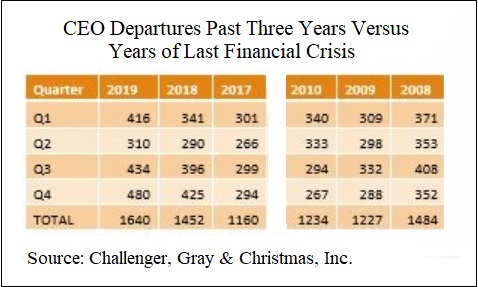
An Unprecedented 1,640 CEOs Departed in 2019; Now Execs Are Dumping Stock at Highest Pace Since 2006

By Pam Martens and Russ Martens

Source: Wall Street on Parade

A rather fascinating picture is emerging that suggests that things were not as rosy in the U.S. economic landscape prior to the pandemic as President Donald Trump and his Director of the National Economic Council, Larry Kudlow, would have the public believe.

Challenger, Gray & Christmas, Inc. has been tracking CEO departures for the past 12 years. Its Vice President, Andrew Challenger, called the numbers for 2019 “staggering.” It was the highest number since their surveys began in 2002. A total of 1,640 CEOs headed for the exits last year. That was 156 more CEOs than those who left their post in 2008 – the year that Wall Street blazed a scorched earth trail through the U.S. economy.

The number of CEOs that did not leave on their own accord last year was 101 out of the 1,640. According to the study, 15 CEOs left over allegations of professional misconduct; 20 left amid a scandal, “typically under investigations for financial wrongdoing or other legal issues”; 24 saw their positions terminated; 39 left due to a merger or acquisition; 3 left due to bankruptcy.

CEOs of old, established companies have the clearest view of what is happening in the overall economy. They can compare sales growth to prior years and prior decades. They can spot negative or positive trends in the economy far ahead of the economic reports that the federal government releases to the public.

When an outsized number of CEOs decide to cash out their stock options, grab their golden parachutes, and flee their corner offices – something smells.

On top of that fishy smell comes a report from TrimTabs Investment Research that corporate insiders have reaped more than $50 billion in stock sales since May, putting insider selling on a pace not seen since 2006 – two years before the stock market and economic crash of 2008.

The above two reports on corporate executive behavior are compatible with Wall Street On Parade’s reports that show that the current financial crisis began in the fall of 2019 – months before the first case of COVID-19 had emerged anywhere in the world. What triggered the financial crisis? The same kind of liquidity crisis on Wall Street that ushered in the crisis of 2008. (See Wall Street’s Financial Crisis Preceded COVID-19: Chart and Timeline and our archive of more than 100 articles on the financial crisis of 2019/2020 here.)

Why does it matter when the financial crisis began? It’s critically important for the following reasons.

First, the U.S. national debt has exploded to $26.69 trillion. To wrap your mind around this explosion of the national debt, you need some historical perspective. At the beginning of the Bill Clinton Presidency in January 1993, the U.S. national debt stood at $4 trillion. At that point, the United States was more than 200 years old. During that 200 years, the U.S. had financed the Revolutionary War, the Civil War, World Wars I and II and the Vietnam War. The country had also been through the greatest economic collapse in its history, the Great Depression, which required a multitude of fiscal spending programs.

It took more than two centuries for the U.S. national debt to reach $4 trillion but in just the past 27 years the national debt has grown by more than $22 trillion – more than a five-fold increase in less than three decades.

This staggering amount of debt puts the nation at risk of a future credit downgrade and cripples its ability to adequately deal with the financial struggles of its citizens during the worst health and financial crisis in a century.

One of the key reasons for this mushrooming debt was the Wall Street financial crisis of 2008 which required massive fiscal spending to keep the economy from sinking into a depression.

But no serious steps were taken by Congress to reform Wall Street. Derivatives remain largely unregulatedDark Pools are still trading in darkness. Wall Street continues to pay credit rating agencies to rate their toxic debt piles. Off balance sheet casinos run rampant at the largest Wall Street banks. Obscene pay for performance via stock options continues to incentive CEOs and CFOs to massage earnings.

The biggest unaddressed problem is the critical need to restore the Glass-Steagall Act. All of the dangers cited above can, and do, bring down an entire financial institution as we learned in 2008. But with the restoration of the Glass-Steagall Act, the giant, federally-insured, deposit-taking banks would be completely separated from the Wall Street casino investment banks.

This handful of mega banks that hold the majority of deposits in this country are too critical to keeping credit flowing to businesses and consumers to be run by the Wall Street bet-the-ranch mentality. These banks are simply too big to be bailed out again.

When Citigroup was disintegrating from all of the evils mentioned above from 2007 to 2010, this is what it took to resuscitate its sinking hull: $45 billion in capital infusions from the U.S. Treasury; over $300 billion in asset guarantees from the federal government; the Federal Deposit Insurance Corporation (FDIC) guaranteed $5.75 billion of its senior unsecured debt and $26 billion of its commercial paper and interbank deposits; and the Federal Reserve secretly, with no authorization or even awareness of Congress, made a cumulative $2.5 trillion in below-market rate loans to Citigroup from 2007 through at least the middle of 2010, according to an audit by the Government Accountability Office (GAO).

And, finally, acknowledging that this latest financial crisis began prior to the pandemic shines a bright light on the incompetency of the Federal Reserve to manage these Wall Street behemoth banks. It’s simply an insane regulatory model to have a bank regulator with the ability to create money out of thin air that can secretly create and spend $29 trillion bailing out the banks to cover up its own incompetency. That’s what happened from 2007 to 2010 and is in the process of happening again. (See The Fed Has Pumped $9 Trillion into Wall Street Over the Past Six Months, But Mnuchin Says “This Isn’t Like the Financial Crisis”.)


The Pandemic Is Accelerating Trends That Are Disrupting the Foundations of the Economy

By Charles Hugh Smith

Source: Of Two Minds

The problem is the economy that’s left has no means of creating tens of millions of jobs to replace those lost as the 1959 economic model collapses.

Fundamentally, the economy of 2019 was not very different from the economy of 1959: people went shopping at retail stores, were educated at sprawling college campuses, went to work downtown, drove to the doctor’s office or hospital, caught a flight at the airport, and so on.

The daily routine of the vast majority of the workforce was no different from 1959. In 2019, the commutes were longer, white-collar workers stared at screens rather than typewriters, factory workers tended robots and so on, but the fundamentals of everyday life and the nature of work were pretty much the same.

Beneath the surface, the fundamental change in the economy was financialization, the commodification of everything into a financial asset or income stream that could then be leveraged, bundled and sold globally at an immense profit by Wall Street financiers.

This layer of speculative asset-income mining had no relation to the actual work being done; it existed in its own derealized realm.

For decades, these two realmsthe structure of everyday life (to borrow Braudel’s apt term) and the abstract, derealized but oh so profitable realm of financialization–co-existed in an uneasy state of loosely bound systems.

If you squinted hard enough and repeated the mantras often enough, you could persuade yourself there was still some connection between the everyday-life economy and the realm of financialization.

The two realms have now disconnected, and the real-world economy has been ripped from its moorings, as patterns of work and every-day life that stretch back 70 years to the emergence of the postwar era unravel and dissolve.

The trends that are currently fatally disrupting retail, education, office work and healthcare have been in place for years. When I wrote my 2013 book about the digitized future of higher education in a low-cost union of high-touch and low-touch learning, The Nearly Free University, all these trends were already clearly visible to those willing to look beyond the models embedded in the economy for decades or even centuries.

Visionaries like Peter Drucker foresaw the complete disruption of the education and healthcare sectors as far back as 1994. Post-Capitalist Society.

The problem with this disruption is it eliminates tens of millions of jobs–not just the low-paying jobs in retail and dining-out, but high-paying jobs in university administration, healthcare, and other core service sectors.

The last real-world connection between everyday life and financialization was the over-supply of everything that could be financialized: the way to reap the big profits was expand whatever could be leveraged and sold. So retail and commercial space ballooned, colleges proliferated, cafes sprang up on every corner, etc.

Meanwhile, financialization’s unquenchable thirst for higher profits stripped everything of the redundancy and buffers required to stabilize the system in times of crisis. So hospitals no longer kept inventory because by the logic of financialization, all that mattered was maximizing the return on capital–nothing else could possibly matter in the derealized realm of speculative profiteering.

Now healthcare finds itself trapped between the pincers of financialization’s stripmining and the collapse of retail in-person demand–the financial foundation of the entire system. Under the relentless pressure of financialization’s stripmining and profteering, healthcare only survives if it can bill somebody somewhere a staggering amount for everything from office visits to procedures to hospital stays to medications.

Once that avalanche of billing dries up, the entire sector implodes: a sector that accounts for almost 20% of the U.S. economy.

Higher education is also imploding, and for the same reason: its output no longer justified its enormous cost structure. The same can be said of overbuilt retail and commercial space: the financial justification for sky-high rents have imploded and will never come back. The over-supply is so monumental and the collapse of demand so permanent, the gigantic pyramid of debt and speculative excess piled on all these excesses is collapsing.

A bailout by the Federal Reserve won’t change the fundamentals of the collapse of financialization; all the Fed can do is reserve scarce lifeboat seats for its billionaire banker-financier pals. (Warren, you know Bill, have you met Jamie, Jeff, Tim and the rest of the Zillionaire Rat-Pack?)

Despite the record highs in the stock market–the ultimate expression of financialization disconnected from the real-world economy–financialization is also imploding. Financialization still claimed a connection to the real world of income streams and the value of the collateral underlying all the speculative profiteering: the high rents paid by the restaurants on the ground floor and the businesses for office space above justified the high value of the collateral, the commercial building.

Foundational swaths of the real-world economy have been swept away, and so the collateral is largely worthless. Lots of people want their employer to start paying for business-class airline seats again so they can jet around the country on somebody else’s dime, staying in pricey hotels and attending conferences, but these activities no longer have any financial justification.

The economy of 1959 is finally expiring. The enormous time and money sinks of transporting humans hither and yon no longer have any financial justification.

The problem is the economy that’s left has no means of creating tens of millions of jobs to replace those lost as the 1959 economic model collapses. We all know that automation is replacing human labor, but the real change is the collapse of the financial justification for the enormously costly systems we now depend on to generate jobs: healthcare, retail, tourism, dining out, education, working downtown, and all the professions dependent on managing all this complexity.

While the elimination of low-skill jobs–a longstanding trend–is attracting attention, the implosion of the 1959 economic model and financialization will soon sweep away millions of high-paying professional jobs that no longer have any financial justification.

As the 1959 economy implodes, so does the tax system based on payroll taxes and property taxes. This article sketches out the perverse incentives for employers to invest in automation rather than hire workers: Covid-19 Is Dividing the American Worker (WSJ.com)

There are alternatives, but they require accepting the implosion of both the 1959 economic model and its evil offspring, financialization.

I sketched out an alternative way of organizing work, everyday life and finance in my book A Radically Beneficial World. There are alternative ways of organizing civilization other than the insanely wasteful and exploitive system we now inhabit.

If the “Market” Never Goes Down, The System Is Doomed

By Charles Hugh Smith

Source: Of Two Minds

The reliance on “good news” narratives dooms our financial system and economy to a death spiral once reality breaks through the induced euphoria.

“Markets” that never go down aren’t markets, they’re signaling mechanisms of the Powers That Be. Markets are fundamentally clearing houses of information on price, demand, sentiment, expectations and so on–factual data on supply and demand, shipping costs, cost of credit, etc.–and reflections of trader and consumer emotions and psychology.

If markets are never allowed to go down, the information clearing house has been effectively shut down. Whatever information leaks out has been edited to fit the prevailing narrative, which in this moment is “central banks will never let markets go down ever again, so jump in and ride the guaranteed Bull to easy gains.”

The past 12 years offer ample evidence for this narrative: every dip draws a near-instantaneous monetary-policy response that reverse the dip and gooses markets higher.

That permanent monetary intervention distorts markets doesn’t matter to participants. Who cares if markets have become “markets,” simulacra of real markets that are now nothing but signaling mechanisms that all is well so buy, buy, buy? If gains are essentially guaranteed, who cares that markets are not longer information clearing houses?

Indeed. There’s no reason to care until the fatal spiral downward surprises us all. Here’s an analogy of what happens when real information gets edited to fit a convenient narrative.

Unfortunately, the patient has cancer which is starting to metastasize, i.e. spread to other organs in the body. But unbeknownst to the patient, this accurate information is considered “bad news,” so the test results and other information is carefully edited to show the cancer is actually shrinking–the exact opposite of what the actual facts reflect.

The patient is naturally delighted with this false data because it appears he’s on the mend and doesn’t need any surgery or other drastic treatments.

If participants don’t have information that reflects actual conditions, they cannot help but make disastrous decisions. Falsified or heavily edited information is misleading, and so all decisions made on the assumption this information is accurate will be fatally skewed.

Symptoms of the fatal spread of the disease are masked by stimulants that not only mask the spread but give the patient a sense of euphoric power and supreme confidence.

Imagine the patient’s terrible dismay when symptoms break through the euphoria and he learns his cancer is now terminal. Increasing the tragedy is his awareness that had the authorities in charge of his care given him the real-world data instead of the carefully edited “happy story” version, treatments could have been undertaken that might have extended his life. Now those options have been lost forever.

That’s the situation in our economy and financial system. The information cleared in markets has been suppressed, distorted and edited for 12 long years of permanent and ever-increasing monetary interventions, as the “doses” of intervention required to maintain the cocaine-like euphoria and supreme confidence in central bank manipulation of “markets” so they always signal the “good news” of guaranteed gains ratchets higher on every intrusion of reality.

The reliance on “good news” narratives dooms our financial system and economy to a death spiral once reality breaks through the induced euphoria. Our last chances to clear the financial cancers eating away at our economy are slipping away forever, masked by the “market’s” cocaine-like euphoria and supreme confidence in central-bank guaranteed gains.

If the stock market is never allowed to go down, this is the equivalent of telling the cancer-riddled patient that their cancer has disappeared, even as the disease is leading inexorably to the patient’s needless demise.

Stories Of Economic Despair From America’s Worst Economic Downturn Since The Great Depression Of The 1930s

By Michael Snyder

Source: End of the American Dream

The economic pain that we are witnessing right now is far greater than anything that we witnessed during the last recession.  U.S. GDP declined by 32.9 percent on an annualized basis last quarter, more than 100,000 businesses have permanently shut down since the COVID-19 pandemic first hit the United States, and more than 54 million Americans have filed new claims for unemployment benefits over the last 19 weeks.  Up until just recently, a $600 weekly unemployment “supplement” and a federal moratorium that prevented many evictions had helped to ease the suffering for millions of American families, but both of those measures have now expired.  As a result, a tremendous amount of economic pain which had previously been deferred will now come rushing back with a vengeance.  Millions of American families are no longer going to be able to pay their bills, and experts are warning that we could soon see an “eviction crisis” that is absolutely unprecedented in American history.

48-year-old Thomas Darnell of West Point, Mississippi never thought that he would be in this position.  He had been a factory worker for over 20 years until he lost his job in May, and since then he hasn’t been able to find another.  And then on top of everything else, everyone in his house caught COVID-19…

First, he was furloughed for three weeks in April and then laid off in May. Then things got worse: His entire household of seven, including himself, his wife, three kids and daughter-in-law, along with his baby grandson, contracted coronavirus after they saw their immediate family over the Independence Day weekend.

“I’m tired and shaky. Even after a few weeks, I’m still trying to recover,” Darnell says, who has since been cleared of the virus but still has lingering symptoms.

He is concerned that employers will be scared away by his recent illness, and he is becoming desperate because he is running out of money.

With no health insurance and no paychecks coming in, Darnell and his wife have gotten to the point where they have to make a choice between buying insulin or buying groceries

He can’t afford health insurance, which has added to his anxiety because he and his wife are both diabetic, he says. Like Bolei, Darnell and his wife have been forced to make a grueling decision between either paying for their medications or keeping food on the table.

“Do we buy insulin or groceries? It’s a hard juggle,” Darnell says. “I’m willing to make less money and start working again to get health insurance, but no one is hiring.”

The weekly $600 unemployment supplements from the federal government had helped to keep them going for a while, but now those payments have ended, and the immediate future is looking quite bleak.

In Richmond, Virginia, a mother of eight named Shamika Rollins wasn’t sure how she was going to make it when her hours as a home health aid were reduced.  Unpaid bills started piling up, and then she got an eviction notice a few weeks ago.  The following comes from CBS News

Shamika Rollins’ eight children share two bedrooms in Richmond, Virginia. But she’s worried about losing their home after she says she received an eviction notice in June.

“First thing, I panic, and then next thing, I look, and I’m like, I got my kids. And it’s like, okay, now you gotta figure this out,” she told CBS News correspondent Adriana Diaz.

If a miracle does not happen, Rollins and her eight children will soon be out in the street, and this is causing her to have “a lot of sleepless nights”

“I have a lot of sleepless nights,” Rollins said. “My mind is constantly racing, you know, what’s your next move?”

Sadly, there are millions of other Americans in the exact same position.

In fact, experts are projecting that up to 40 million Americans could be evicted from their homes during this pandemic.

Many small business owners are also facing heartbreaking choices during this downturn.  A restaurant owner in Delaware named Alex Heidenberger “hasn’t paid the mortgage on his home the past four months” as he desperately tries to keep his once profitable restaurants alive…

Heidenberger, who typically draws about $20,000 a month in profit from the restaurant, now receives nothing. He says he hasn’t paid the mortgage on his home the past four months. He served lifeguard duty for a couple of weeks, mostly to help a beach crew depleted by COVID-19 quarantines but also to make some cash.

“I’m working harder than I have ever worked in my life,” he says, adding that he puts in about 80 hours a week at the two restaurants. Yet, “I have no money… This is all I think about. I don’t sleep.”

The COVID-19 pandemic has hit the restaurant industry particularly hard.  Americans are not eating out as regularly as they once did because of the virus, and it is probably going to remain that way for the foreseeable future.

In Massachusetts, a restaurant owner named John Pepper once had eight thriving locations, but at this point only two of them remain open

John Pepper used a PPP loan to pay employees and reopen four of his eight Boloco restaurants when Massachusetts lifted its shutdown order in early May. But with the money spent and business at the restaurants down as much as 70%, Pepper had to again close two locations. The staff of 125 he had before the virus outbreak is down to 50.

“A lot of this is out of our hands at this point,” Pepper says. “At this moment, I don’t see getting my full payroll back.”

Overall, we are facing a “restaurant apocalypse” in the U.S. that is unprecedented in size and scope.

According to one estimate, we could lose more than a third of all of our restaurants by the end of this calendar year

As many as 231,000 of the nation’s roughly 660,000 eateries will likely shut down this year, according to an estimate from restaurant consultancy Aaron Allen & Associates provided to Bloomberg News. This will bring the industry’s steady growth to a halt and mark the first time in two decades that U.S. restaurant counts don’t climb. Restaurants have already shed millions of jobs this year, economic data show.

What we are watching is truly horrifying.  So many hopes and dreams went into each one of those restaurants that are shutting down, and countless restaurant owners are going to be completely financially ruined by all of this.

For other Americans, this economic downturn has put their very lives at risk.  In Colorado, 70-year-old Catherine Azar was already dealing with heart problems and diabetes, and now she is in danger of being thrown out into the street

“It’s hard for me to conceive of someone being willing to put another person out in the street in the middle of a deadly pandemic, and I’m high risk. I’m 70. I have heart issues and I’m diabetic,” Azar said.

Rollins and Azar are just two of the 43 million Americans at risk of eviction in the coming months. For context, about 1 million Americans were evicted in 2010, the year after the Great Recession.

How long do you think that a 70-year-old woman with heart problems and diabetes would last on the street or in a shelter?

And as millions upon millions of Americans get evicted during the months ahead, the shelters are all going to fill up really fast.

America simply was not prepared for an economic downturn of this nature, and the truth is that much bigger challenges are still ahead.

So please do not look down on anyone that needs help right now, because soon you may find yourself in the exact same position.

Why Does It Feel Like We’re in “Life During Wartime”?

By Charles Hugh Smith

Source: Of Two Minds

The laughably hopeless hope is that by propping up the corpses, the populace will discern some faint flicker of life in the decaying carcasses and return to their free-spending ways.

Call it cultural synchronicity, but it increasingly feels like we’re living in the 1979 Talking Heads song Life During Wartime, which was anchored by the lyric “This Ain’t No Party, This Ain’t No Disco, This Ain’t No Foolin’ Around.” Indeed.

It also feels like Life During Wartime because the propaganda is so blatant and intense: we’re winning the war on Covid-19, and our wars on everything else, too, of course, as war is the favored metaphor and favored policy at the end of the Empire.

The ceaseless propaganda is that “a vaccine is right around the corner.” The inconvenient reality is that Corporate Insiders Pocket $1 Billion in Rush for Coronavirus VaccineWell-timed stock bets have generated big profits for senior executives and board members at companies developing vaccines and treatments.

In other words, wartime profiteering isn’t just allowed, it’s encouraged–yet another sign that we’re in the final decay/collapse phase of Imperial Pretensions.

It’s easy to mix up the propaganda and the counter-propaganda, because they’re both so extreme. There is no middle ground, only pre-packaged positions which dictate which “data” is cherry-picked to support the political partisanship that’s being defended.

Is Data Our New False Religion? (June 23, 2020)

In a world of thousands of unread papers published in hundreds of scientific journals no one even reads and a corrupt culture of “science for sale,” there’s a veritable orchard to cherry-pick.

“Robert Horton, editor in chief of The Lancet, one of the most respected professional peer reviewed publications in the world dealing with biomedical research had this to say in an editorial published by The Lancet in April of 2015:”

“The case against science is straightforward: much of the scientific literature, perhaps half, may simply be untrue. Afflicted by studies with small sample sizes, tiny effects, invalid exploratory analyses, and flagrant conflicts of interest, together with an obsession for pursuing fashionable trends of dubious importance, science has taken a turn towards darkness.”

source: What is medicine’s 5 sigma?

“And this, published in 2009, by Dr. Marcia Angell, former editor of The New England Journal of Medicine, another world leading publication in medical research:”

“It is simply no longer possible to believe much of the clinical research that is published, or to rely on the judgment of trusted physicians or authoritative medical guidelines. I take no pleasure in this conclusion, which I reached slowly and reluctantly over my two decades as an editor of The New England Journal of Medicine.”

Skeptical of medical science reports? (ncbi.nlm.nih.gov)

Metaphorically speaking, the civilian populace believes “we’re winning” until the bombs start dropping on their homes. For some reason, this doesn’t feel like “winning.”

The V-shaped recovery is the propaganda war the status quo must win, for this is the narrative battle for the hearts and minds of the populace. The fear here is that should the populace lose confidence in The V-shaped recovery, they might reduce their borrowing and spending and increase their saving, dooming an economy that depends entirely on marginal spending funded by debt to keep from imploding.

As the chart of the rising wedge model of breakdown below illustrates, when big-ticket costs ratchet higher like clockwork–rent, property taxes, childcare, higher education, debt, healthcare, etc.– while income stagnates for the bottom 90%, any drop in spending, no matter how modest, breaks the system because any reduction in spending reduces tax revenues, corporate profits and debt payments below the critical threshold.

This is why the Federal Reserve is so keen on bailing out bankrupt-in-all-but-name corporations and banks: The laughably hopeless hope is that by propping up the corpses, the populace will discern some faint flicker of life in the decaying carcasses and return to their free-spending ways.

This is also why “stimulus” is being scattered from helicopters: the hope is that by substituting borrowed trillions for earned trillions, people will substitute magical thinking for clear-eyed recognition that the era of “growth” has transitioned into the era of DeGrowth, a state of affairs that signals the demise of all the bloated, sclerotic institutions operated to benefit insiders and Corporate America’s cartels and monopolies: the most protected bastions of the era, colleges and hospitals, are going broke and closing.

As Marx noted, “everything solid melts into air” when it’s no longer financially viable. Helicopter “stimulus” just creates a temporary illusion of solidity.

And then there’s the immense profitability of Big Tech pushing propaganda, partisanship, anger and indignation: If you’re not terrified about Facebook, you haven’t been paying attention.

The foundations are collapsing, but by all means, please keep your eye on the decaying corpses: didn’t an eyelid flicker in that one? I could swear that one moved its foot…

This is “life in wartime,” where the battles are waged in narratives, confidence and magical thinking.

Forget the V, W or L Recovery: Focus on N-P-B (June 29, 2020)

The Fed’s Casino Is In Flames, But Please Continue Gambling (June 18, 2020)

Our Wile E. Coyote Economy: Nothing But Financial Engineering (June 12, 2020)

Unstoppable: The Greatest Depression and the Reverse Wealth Effect (June 10, 2020)

A Bigger Picture

Baluchitherium. Gone but not forgotten.

By James Howard Kunstler

Source: Kunstler.com

The Covid-19 virus itself didn’t run the United States into a ditch but it exposed the weakness and rot in the nation’s drive-train, and now all of us passengers on that disabled bus must decide whether to stay helplessly inside the smoldering wreckage arguing over who’s to blame, or begin a long, uncertain march down the road on our own two feet to a place of new arrangements.

In 1918, the country was lashed by a far deadlier pandemic disease at the same time it was fighting a world war, and daily life barely missed a step. The economy then was emphatically one of production, not the mere consumption of things made elsewhere in the world (exchanged for US IOUs), nor of tanning parlors, nail salons, streaming services, and Pilates studios. The economy was a mix of large, medium, and small enterprises, not just floundering giants, especially in the retail commerce of goods. We lived distributed in towns, cities not-yet-overgrown, and a distinctly rural landscape devoted to rural activities — not the vast demolition derby of entropic suburbia that has no future as a human habitat. Banking was only five percent of the economy, not the bloated matrix of rackets now swollen to more than forty percent of so-called GDP. Government at the federal and state levels was miniscule compared to the suffocating, parasitic leviathan it is now.

What happened? Like Hemingway’s old quip about a man going broke slowly and then all-at-once, we allowed everything in American life to creep into hapless giantism too cumbersome to adapt to new conditions, and suddenly conditions have changed. And now it’s all coming apart: the dying chain stores, the giant zombie companies that can only exist by borrowing money to buy back their own stocks, the auto-makers who have run out of lending schemes for non-creditworthy customers, the shale oil fracking companies that could never make a red cent, the agri-biz farmers grown morbidly obese on a diet of credit and government subsidies (just like their end-customers grew obese on engineered snack-foods), the Wall Street lords of financialization hypothecating fortunes by leveraging the stripped assets of everything not nailed down from sea to shining sea, the swelling underclass conditioned to helplessness, addiction, and vice, the inescapable ambient tyranny of media hype, propaganda, and disinformation, and, of course, the catastrophe that government has become.

Get this: none of these things now wobbling and staggering will be resurrected. They’re all going extinct, like the Baluchitherium of the Oligocene. To keep propping them up — as the Federal Reserve sedulously props up financial markets — will only promote the illusion that we don’t have to move on and conduct daily human life differently. A worldwide contraction was already underway before Covid-19 stepped onstage. The contraction was sending a very loud and clear message: gigantism went as far as it could go and now it’s up to the smaller and nimbler to carry on. Beware the promises of the sclerotic authorities asking you to remain in thrall to them — and dependent on them.

Expect these authorities to screw up even the next big exercise in their own franchise: the 2020 election. It will be the climax to a season of political hysteria and will complete the chapter of our history that left us on that smoldering big bus in the ditch. The scramble away from that disaster scene will be frightful and desperate. No matter who ends up in control of the government — or pretends to be — the same forces of contraction and decomplexifying will actually rule and you will have to act accordingly.

Many people will seek to escape the places they live now to find new homes and livelihoods elsewhere. These demographic movements are already underway. New York City is hemorrhaging much of its tax base as the wealthy flee, Chicago too, and the whole state of California. These places will be overwhelmed by functional bankruptcy, even if legal legerdemain allows them to avoid declaring it. Other states, counties and municipalities — including many suburban blobs — will also founder, meaning all the usual support systems and safety nets vanish. Many supply chains will break. Money may either be scarce or worthless, which are two ways of going broke.

Right now, start planning where you might go and what you can do. The turmoil will be filled with opportunity to find ways to be useful to other people, to devise work-arounds for ruptured systems and relationships, in getting food to people, making things they need, distributing them, fixing things that are broken where possible, and moving people and stuff from point A to point B. There will be plenty of work for people who are willing to do it. Keep in mind that it’s entirely up to you to make good choices.

Don’t despair, and if you find yourself veering toward it, get over yourself. It’s just part of becoming stronger than you thought you could be,  and the times will require it of you anyway. The offices that gave out brownie points for avouched victimhood will also be shutting down. Won’t that be a relief? Welcome to the joyful illumination that life is difficult for everybody. Who is ready for this epic journey?