Saturday Matinee: Wrong is Right

(An updated repost from June 29, 2019)

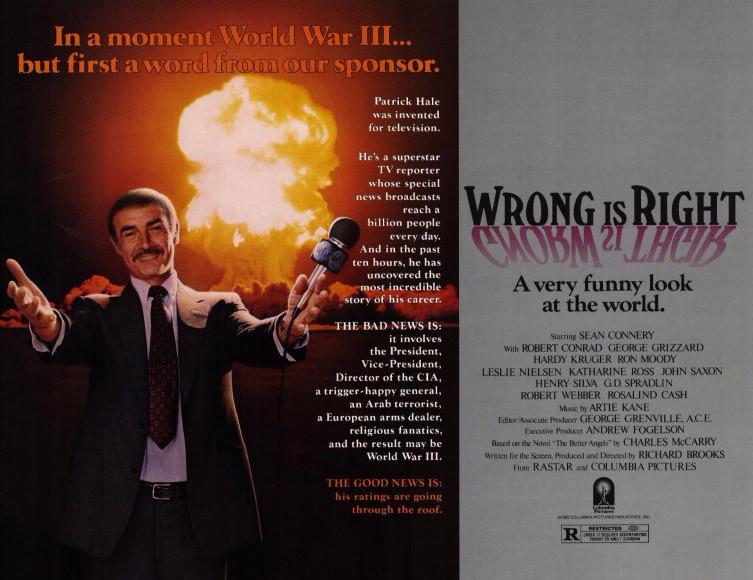
“Wrong is Right” (1982) is an alarmingly prescient political satire directed by Richard Brooks and based on the novel ”The Better Angels” by Charles McCarry. Sean Connery stars as Patrick Hale, a popular television journalist who becomes entangled in a conspiracy after an assignment in the Middle East to interview a patriarch of a royal family. Powerful factions involved include the American president (George Grizzard), a high-powered arms dealer, the CIA, a rising right-wing populist presidential contender, a terrorist group and various military/corporate interests who collectively ignite a geopolitical powder keg.

Key to enjoying this Strangelovian comedy is to look past the obvious budgetary constraints or view them as metacommentary on the often flimsy narratives manufactured by the figures and institutions which happen to be the main targets of the film’s satire. Despite the inconsistent acting from the large and varied cast, Wrong is Right is notable for Sean Connery’s greatest underrated performance and a brief but chilling cameo by a young Jennifer Jason Leigh four minutes into the film. Also noteworthy is the acerbic rapidfire dialogue and labyrinthine plot which plays like a mash-up of the decades since the film’s release to our current moment processed through a fever dream.

Watch Wrong is Right on Tubi here: https://tubitv.com/movies/690775/wrong-is-right

Saturday Matinee: Final Cut

REVIEW: “Final Cut” (2022)

By Keith Garlington

Source: Keith and the Movies

It’s hard to believe that it has been twelve years since French filmmaker Michel Hazanavicius won his Best Director Academy Award for the Best Picture winning “The Artist”. While it has become somewhat fashionable in some circles to dismiss that brilliant 2011 film as unworthy, I still hold it in incredibly high regard as a delightful ode to a bygone cinematic era.

Hazanavicius’ latest film couldn’t be more different. “Final Cut” is a meta zombie comedy that is an open-armed tribute to cinema, a love letter to genre filmmaking, a celebration of creative collaboration, and just an all-around wacky piece of work. It’s a faithful remake of Shin’ichirô Ueda’s 2017 cult hit “One Cut of the Dead” but with its own French twist. It’s a consistently clever and routinely funny concoction that sees Hazanavicius and his all-in cast having the time of their lives.

Describing “Final Cut” to those who haven’t seen “One Cut of the Dead” is a bit of a challenge because the less you know going in the better. The film’s unorthodox structure plays a big part in making it such a fun experience. It’s a case of a filmmaker showing you one thing and then adding an entirely different perspective later on. I know that’s vague, but suffice it to say Hazanavicius has a field day playing with his audience’s expectations.

The spoiler-free gist of the story goes something like this. Romain Duris plays Rémi Bouillon, a frustrated filmmaker who signs on to direct a low-budget zombie short film for an upstart streaming platform that specializes in B-movies. But there’s a catch. The 30-minute single-take film is to be shot and streamed LIVE! It’s an unheard of undertaking but one the platform’s ownership has already pulled off in their home country of Japan. Now they want to do it in France.

Rémi is hesitant to take the job at first, seeing it as a doomed-to-fail project. But with the encouragement of his wife Nadia (Bérénice Bejo) and with hopes it will rekindle his relationship with his aspiring filmmaker daughter Romy (Simone Hazanavicius) he agrees.

Soon he’s on location dealing with a smug high-maintenance lead actor (Finnegan Oldfield), his inexperienced lead actress Ava (Matilda Lutz), a supporting actor who can’t stay off the bottle (Grégory Gadebois), and the demands of domineering producers who don’t prescribe to the notion of a director’s creative freedom.

As “Final Cut” shifts to the show’s production phase things get crazy and we gain an entirely new perspective on everything we’ve seen up to that point. Hazanavicius drenches his audience in blood, gore, and countless zombie horror tropes which is a big part of the fun. That said, it’s never the slightest bit tense or scary but neither does it try to be. It’s much more of a comedy, full of running gags, fun characters, an infectious B-movie charm, and a surprising level of warmth that I never expected.

Watch Final Cut on Kanopy here: https://www.kanopy.com/en/product/13547325

Saturday Matinee: The Square

By Freda Cooper

Source: Flickering Myth

SYNOPSIS:

A museum curator is preparing to launch a major art exhibition.  He sees himself as having a social conscience, but when his wallet and phone are stolen, the other side of his character emerges and he badly mis-handles the situation – and does the same thing when it comes to promoting his new show.

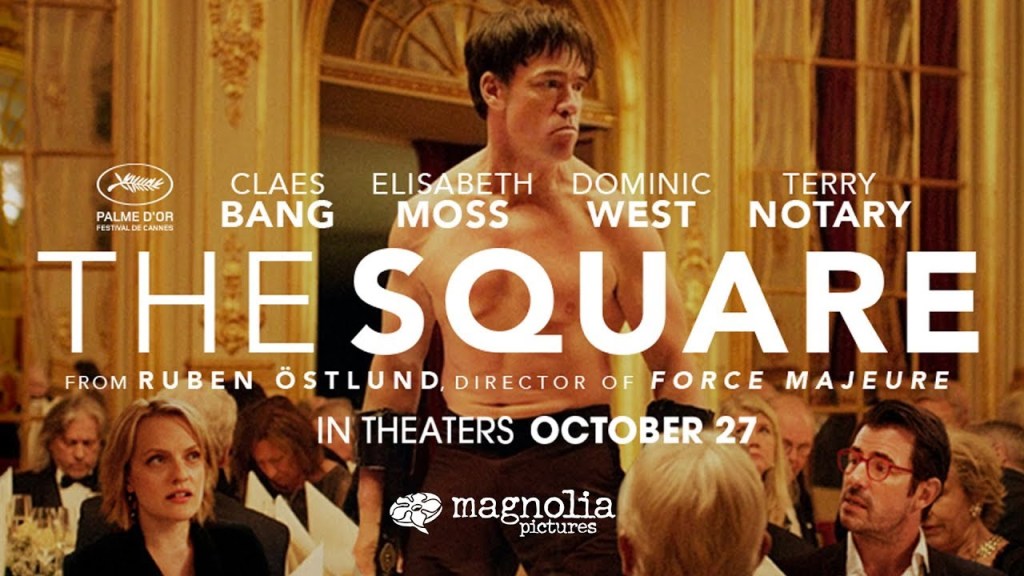
A film from Ruben Ostlund isn’t going to be cozy.  Compelling and fascinating, yes, but never easy and sometimes impenetrable.  His previous offering, Force Majeure, was well received and won the Un Certain Regard prize at Cannes in 2014.  His latest, The Square, went one step further and scooped the Palme D’Or last year.

Force Majeure centred on a spontaneously cowardly act by a father.  This has another act from another father at its centre, but this time one that’s thought out.  Badly.  And it’s followed by a second one, which is equally ill-considered.   The Square of the title is an art installation, the centrepiece of an exhibition supervised by museum curator Christian (Claes Bang).  He’s a man under pressure, both professionally and domestically, but still believes he has a social conscience – until his wallet and phone are stolen.  His reaction is extreme, a more accurate reflection of the real man, and he’s responsible for something equally rash when it comes to launching his beloved exhibition.

That’s putting it simply.  Ostlund has a number of targets for what is, at times, a savage satire.  At the heart of it is how those with money treat others – the homeless, the poor or those who are just not as wealthy.  Society encourages tolerance and kindness, but it’s easier to ignore them.  “Would you take a moment to save a life?” asks a charity worker and everybody who walks past her says no.  Are they just saying no to her or to her actual question?  Or both?

The art establishment, in the form of The Square installation, comes in for attack as well.  It’s meant to represent a space where everybody is safe and responsible for each other – but that can apply to any space, from a circle to a pentagon. It’s nonsense.  As are some of the other exhibits, especially one made up of conical piles of gravel.  It’s no surprise that some are accidently vacuumed up by the cleaner.  The exhibition’s marketing team is equally ridiculous, but also irresponsible in its creation of a promotional video of a little, impoverished girl.  It goes viral and causes an outcry – all because Christian doesn’t take the time to think it through properly.

Much of this creates uncomfortable laughter, but lurking in the background in the museum is another installation featuring an ape like man, brought to life by a performance artist.  His actual appearance at the exhibition launch is breath-stoppingly unsettling, as he lumbers around the room, aggressively whooping and pawing at the guests.  The end of the scene is even more deeply disturbing.  Yet again, the idea is mis-judged, with the guests initially alarmed and scared and then turning on the man in the most vicious of ways.

That scene marks a change in tone, but it’s also where the film starts to unravel.  Christian delivers a speech, videoed on his phone, which essentially explains the plot.  Except that, by that stage, the point is already clear, so it’s hardly necessary.   His explanation of the marketing video to a packed press conference is equally superfluous and more than a little disingenuous.  But Claes Bang holds both halves of the film together with the arrogant, flawed but not wholly unlikeable Christian, although talents like Dominic West and Elizabeth  Moss are under-used and have only a handful of scenes apiece.  Terry Notary, in that exhibition launch sequence delivers the piece of acting that sticks in your mind and, disturbing as  it is, it’s powerfully excellent.

The Square doesn’t have the clarity of Force Majeure, but it does have the ability to grab the audience firmly by the shoulders for the duration.  Given the complexity and occasional obscurity of the story, the film needs it.  It isn’t always satisfying, but it is never less than compelling.

____________________

Watch The Square on Tubi here: https://tubitv.com/movies/590338/the-square?start=true

Saturday Matinee: Let the Bullets Fly

By Josh Larsen

Source: Larsen on Film

Little visual gags fly as fast as the bullets in this 2010 Chinese action comedy, starring co-writer and director Jiang Wen as Pocky Zhang, a bandit leader who poses as governor of a southern outpost. One of the first things we see is a bandit leaning down to listen for an approaching train on railroad tracks—but first he ostentatiously sticks his finger in his ear to clear it out.

Mistaken identity is at the core of much of the movie’s comedy. Let the Bullets Fly opens with Zhang and his band hijacking that train, which is carrying the actual governor (Ge You) to his post in Goose Town. During his interrogation of the governor (captured in a shot-reverse-shot sequence that’s edited at light speed), Zhang decides that pretending to be the governor might be more lucrative than simply robbing him. But upon arriving in Goose Town (with the real governor in tow, disguised as Zhang’s counselor), Zhang finds that things are actually run by the local crime boss, Master Huang (Chow Yun-Fat). This leads to a series of strategic chess moves between the two men, culminating in a comic set piece where Zhang’s crew and Huang’s henchmen square off while wearing the same bandit masks with red circles on them, unable to tell who is who. It’s a face-off as farce.

With its manic comic sensibility, Let the Bullets Fly recalls the work of Hong Kong’s Stephen Chow (Shaolin SoccerKung Fu HustleCJ7), whose own films seem inspired by Looney Tunes cartoons (the opening train sequence here could easily be a Wile E. Coyote short). Physics takes a back seat to fun, so that much of the film seems to be occurring in fast motion. As director, Jiang looks for every opportunity to be showy; at one point an alarm clock is thrown in the air and shot to pieces, causing a metal circle to sail over the camera like a collar.

As an actor, Jiang seems to understand that his face has a comic appeal—those big ears—that allows him to underplay the gags by keeping a straight face. He’s a delight. The legendary Chow (The KillerCrouching Tiger, Hidden Dragon) gets a double role as the villainous Master Huang and Huang’s dim-witted body double. He’s quite a bit broader than Jiang, but equally amusing.

The disparate tones Jiang juggles can make for some uncomfortable moments. There are sudden bits of graphic violence, for instance, and a rape scene that isn’t given nearly the serious consideration it deserves. (Like much of the movie, it’s a setup for a later gag.) But as a political satire, Let the Bullets Fly is pointed and precise. “I want to make money standing tall,” Zhang says at one point, trying to explain why he’s left forest robbery behind. “Impossible,” the real governor replies, knowing bureaucratic corruption all too well. The best joke in Let the Bullets Fly might be that a bandit is the movie’s moral center.

____________________

Watch Let the Bullets Fly on Hoopla here: https://www.hoopladigital.com/title/10088666

Saturday Matinee: OSS 117: Cairo, Nest of Spies

By Marc Savlov

Source: Austin Chronicle

As Hollywood increasingly relies on ever less entertaining parodies of whole cinematic genres to sate an apparently insatiable public appetite for seriously dumb humor, the comparatively sophisticated yuks of Airplane! and The Naked Gun have devolved into the lowest-common-denominator yucks of the Scary Movie franchise and the viciously unfunny gurgles of Not Another Teen Movie, et al. Truly great parody relies in equal measure on both finely calibrated nuance and audience familiarity with the object of comic ridicule and not on how many fart jokes you can jam into an already bloated 90-minute running time. Austin Powers, for example, succeeded as much on the merits of its hyper-detailed production and art design as it did on Mike Myers’ groovy, hirsute mugging. Its swinging, Bond-esque London looked, or at least felt, as real as its modern-day counterpart, and its subject of parody, the 007 films, was universally known. Leave it to the French to beat us at our own bizarrely self-reflexive comic shenanigans. OSS 117: Cairo, Nest of Spies is a model of smart, often very silly, but never, ever stupid comic perfection. Set in 1955, back when Cairo was bristling with anti-English antipathy over a looming Suez canal crisis and radical Islam was just getting warmed up, the French Office of Strategic Services sends its best man, Hubert Bonisseur de la Bath, aka OSS 117 (Dujardin), to Egypt to discover the whereabouts of vanished agent Jack Jefferson (Lefebvre). OSS 117 is, of course, a fatuous, self-involved, debonair jerk who attracts the leggiest ladies and trouble of every sort. But Cairo, Nest of Spies, is far more than a Clouseau-on-holiday knockoff. Simple, period touches like the frequent use of obvious rear-projection (a nod to Hitchcock and a wonderfully evocative gag in and of itself), an ongoing bit about OSS 117’s nicotine independency, and an unexpectedly hilarious undercurrent of homoeroticism among spies of all nations conspire to make this a consistently entertaining parody that never once makes you feel like an idiot for laughing out loud at its idiocy.

___________________

Watch OSS 117: Cairo, Nest of Spies on Crackle here: https://www.crackle.com/details/cde3fda4-76e8-4b82-b612-ba0ae52fa27c/oss-117:-cairo-nest-of-spies

Saturday Matinee: Catch-22

Classic Film Review: So was “Catch-22” the failure we remember it to be?

By Roger Moore

Source: Movie Nation

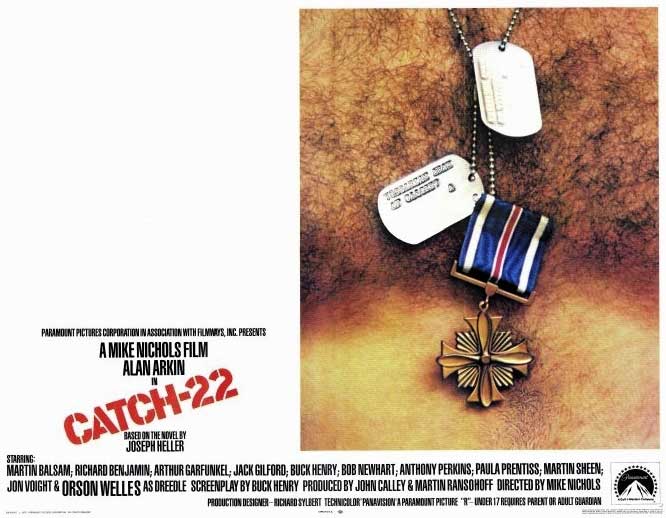
Perhaps it took a humorless, career-crippling George Clooney TV version of Joseph Heller’s novel to make us better appreciate Mike Nichols’ daring, infamously-expensive version of “Catch-22.”

Released at the height of the Vietnam War, suffering in comparison to Robert Altman’s equally anti-war dramedy “M*A*S*H,” seemingly more on a par with with equally cynical action comedy “Kelly’s Heroes,” which has had the benefit of a lot more TV exposure, “Catch” still plays the way it did way back in 1970 — as a pricey, “difficult” satire with a “difficult” shoot as baggage.

But wipe away the “Catch-22 lore,”the people cast and cast-aside, the fact that Nichols wanted the more age-appropriate Al Pacino as Yossarian, the young bombardier/anti-hero, and grapple with the film’s disordered narrative, the nightmarish focus of the story — an active-duty combat airman flying through and ranting through what we now call Post Traumatic Stress Syndrome, coupled with a tinge of guilt.

It’s amazing to see now. And considering how our war movies, from “300” to “Midway,” “Greyhound” to “Flyboys” and even at times, “Dunkirk,” are made now — with digital planes and ships and sometimes tanks — they really don’t make’em like this any more.

Nichols made the most of his coastal Mexican location, showing off all 17 WWII vintage B-25s taking off and landing every chance he got. You couldn’t do that today.

And that cast. Alan Arkin makes a fine, perplexed and outraged Yossarian, a sane man trapped in the insanity of war, an actor who never hits a punchline too hard, never takes the character’s exasperation into parody.

“Let me see if I’ve got this straight. In order to be grounded, I’ve got to be crazy. And I must be crazy to keep flying. But if I ask to be grounded, that means I’m not crazy anymore, and I have to keep flying.”

“You got it,” Doc Daneeka (Jack Gilford) tells him. “That’s Catch-22.

“Whoo… That’s some catch, that Catch-22.”

Orson Welles as a grumpy general, Tony Perkins as a put-upon chaplain, Martin Balsam as the murderously vain Col. Cathcart, Buck Henry as his venal sidekick, Col. Corn (screenwriter Henry was never better, as an actor), baby-faced Bob Balaban as the always-crashing, always-tinkering, even-tempered Orr, it’s a dazzling corps.

Bob Newhart half-stammering through Major Major Major, a very young Martin Sheen raging as the pilot Dobbs, Art Garfunkel as the innocent co-pilot Nately who falls for an Italian hooker, Charles Grodin as an upper-class twit navigator, a smarmy, befuddlingly upbeat Richard Benjamin (cast, with his wife Paula Prentiss as a nurse Yossarian chases), the famous French star who fled to Hollywood Marcel Dalio is the wizened old Italian who figures Italy has already won the war, since it has surrendered and Americans are still fighting and dying. And there’s a sea of actors we’d come to recognize on TV (“The Bob Newhart Show” is over-represented) in the years that followed.

Jon Voight stands out, just enough, as the grinning opportunist Milo Minderbender, a stand-in for every war profiteer you’ve ever read about, working the angles, an impersonal unpatriotic multinational corporation who wins no matter who loses.

Like its two contemporaries, “M*A*S*H” and “Kelly’s Heroes,” it’s a guy’s movie with a dated leering quality about the opposite sex. It’s heavy-handed, here and there, betraying Nichols — feeling his oats after “The Graduate” — indulging in some serious “blank check” filmmaking.

And reading, over the years, of all the people Nichols wanted to cast, or cast and then replaced, you kind of wish he’d moved on from Gilford, a future Oscar nominee who doesn’t bring enough cowardly sniveling to the good doc.

“Catch-22” was popular enough that they did a pilot for a sitcom based on it, as was the case with “M*A*S*H.” Richard Dreyfuss had the lead in that.

Over the years, I’ve interviewed half a dozen actors from that all-star cast, and often, without prompting, they’d bring it up. It took half a year of their lives, most of them, and burned itself into their memories, even if it wasn’t the blockbuster Paramount expected it to be.

Watching it again, outside of the academic settings where it turned up in “film as satire” classes and the like, it feels more cinematic than the scruffy, Altmanesque “M*A*S*H,” a movie marred by that stupid screen-time-chewing football game. It’s less fun than the more-watchable “Patton” and even “Kelly’s Heroes” (which is FAR longer).

But as a darker-than-dark comedy about the futility and insanity of war, it towers above its contemporaries in ways that should have scared-off George Clooney. It’s the best film of a seemingly-unfilmmable classic novel we’re ever going to get.

MPAA Rating: R, graphic violence, blood, nudity, profanity

Cast: Alan Arkin, Martin Balsam, Buck Henry, Tony Perkins, Bob Newhart, Paula Prentiss, Richard Benjamin, Marcel Dalio, Bob Balaban, Art Garfunkel, Martin Sheen, Jack Gilford, Peter Bonerz, Norman Fell, Austin Pendleton, Jon Voight and Orson Welles.

Credits: Directed by Mike Nichols, script by Buck Henry, based on the Joseph Heller novel. A Paramount release.

Running time: 2:02

____________________

Watch Catch-22 on Kanopy here: https://www.kanopy.com/en/product/3216674

Saturday Matinee: Sadness and Joy in the Life of Giraffes

By Teresa Viera

Source: Cineuropa

Sadness and Joy in the Life of Giraffes [+], Tiago Guedes’ fourth feature, premiered in Portuguese cinemas on 21 November. A cinematic adaptation of Tiago Rodrigues’ play of the same name, it portrays the transition from childhood to adulthood.

Giraffe (Maria Abreu) is at the centre of this story: a quirky 12-year-old girl who is addicted to dictionaries, she seems to be much older (and more mature) than she actually is, and her endearing nickname was given to her by her mother, who passed away. Giraffe lives with “the man who is her father” (Miguel Borges), an unemployed forty-something actor who has no future prospects but still tries not to give up hope for his daughter. Her father is not the only man in her life, though, as she has an imaginary friend named Judy Garland. A big, fat teddy bear who curses all the time – not in a Tourette’s kind of way, but that doesn’t stop him from being plain rude and inappropriate – he is a reflection of Giraffe’s emotional anguish at a moment when she is trying to push her grief aside, as well as a symbol of her actual age, and he will be her companion on a journey that will change her entire life. As “the man who is her father” couldn’t pay the bill for her to watch the Discovery Channel, in order for her to complete a school paper about giraffes, her mind is made up: she will run away to gather enough money not only to pay for that month’s bill, but those for the rest of her life.

Wandering through the city, with the sounds composed by Manel Cruz (creating a compelling, bittersweet 2000s indie vibe) accompanying her, she has several encounters with different characters (including Chekhov). These are, in fact, moments of duality and contrast (a child and an angry old man, an innocent girl and a punk, and so on) that enable the character to continuously gather insights for her journey and, most importantly, to gain knowledge about life itself. This narrative style is also reflected in the film’s visual approach, which is based on a continuous line combined with illustrations, as well as short glimpses of Giraffe’s perspective (through videos shot with her mobile phone). These visual and narrative contrasts are what create the film’s tragicomic tone: a tone most of us can relate to, as that’s just how life is. As light, beautiful, cheerful and safe as this film can sometimes feel or seem, it is also – in a beautiful but subtle way – highly charged, as it is, in fact, about one of the most important (and dramatic) chapters in one’s life. Growing up isn’t easy, our innocence is lost somewhere along the way, and something inside of us slowly perishes. And this film shows us exactly that: using fiction and a child’s imaginary world (and the destruction of that same world), it demonstrates how sad and joyful life really is – or can be.

Sadness and Joy in the Life of Giraffes was produced by Portugal’s Take It Easy and is distributed by NOS AudiovisuaisPortugal Film is overseeing its international sales.

____________________

Watch Sadness and Joy in the Life of Giraffes on Hoopla here: https://www.hoopladigital.com/title/15667286

The 100 Year-Old Man Who Climbed Out the Window and Disappeared

By Josh Kupecki

Source: Austin Chronicle

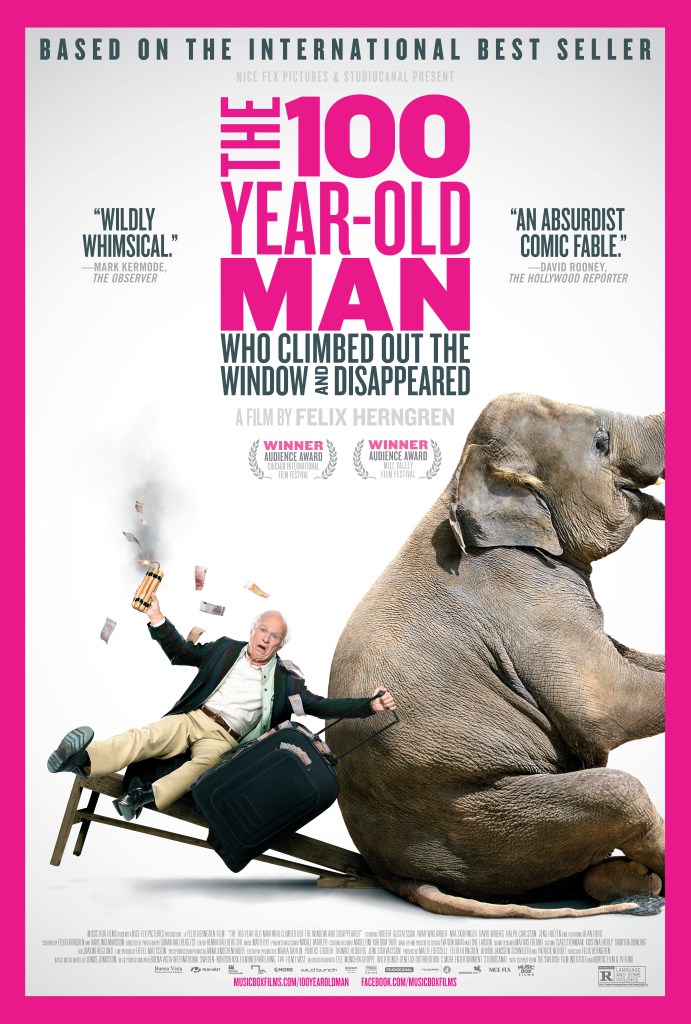
A whimsical comedy based on the bestselling Swedish novel (and book-club fodder) by Jonas Jonasson, The 100-Year-Old Man Who Climbed out the Window and Disappeared begins with exactly that, as Allan Karlsson (Gustafsson) escapes his retirement home on the day of his inauguration into the centenarian club with a “fuck this” attitude and little more than the slippers that bear his first name in Magic Marker. He shuffles off to the bus station where he buys a ticket to the next bus leaving town and inadvertently steals a suitcase with 50 million krona from some local thugs. He hooks up with a retired train attendant, Julius (Wiklander), and together they hit the road, picking up stray characters to add to their entourage while (often unknowingly) skirting the tattooed gangsters after that jackpot. One character owns an elephant. Another can’t decide on a career path, so has almost completed a half-dozen degrees. It is all very fanciful and droll, a mildly subversive and ramshackle Scandinavian version of the Grumpy Old Men on-the-road formula.

But that’s only half the story. Through flashbacks that seem to come whenever the present-day action hits a lull, we see Allan’s life unfold, and what a life that was. From his humble beginnings as the son of a revolutionary, young Allan develops a passion for blowing things up that parlays him into becoming a demolitions expert. There follows a stumbling and drunken shuffle through the history of the major conflicts of the 20th century (the film will be endlessly compared to Forrest Gump), as Allan travels to Franco’s Spain for the Spanish Civil War, helps Robert Oppenheimer develop the atomic bomb, pisses off Josef Stalin to the point where he gets sent to a gulag, becomes a double agent for the CIA during the Cold War, confers with Ronald Reagan, etc. Throughout it all, Allan is oblivious to the impact he has on world events, holding true to the theory espoused by his mother that “life is what it is and does what it does.”

These two narrative threads are constantly jockeying for dominance in a story that has a refreshing nonchalance, but is hindered by the lack of any tension whatsoever. Obviously better served as a novel, The 100-Year-Old Man… still entertains for the majority of its running time, but it feels like two separate movies, a dual shaggy dog story stitched together like Frankenstein’s monster, never breaking free of its quirky literary origins.

Watch The 100-Year-Old Man… on Kanopy here: https://www.kanopy.com/en/product/1053322