Saturday Matinee: The Last of Sheila

REVISITING THE LAST OF SHEILA (1973)

By Craig Leask

Source: Foote & Friends on Film

The Last of Sheila is a brilliantly clever thriller which tries (and succeeds) beautifully in combining the best of a bitchy Hollywood self-satire, mixed with a traditional whodunit. Ultimately the film is tongue in cheek homage to both the murder mystery genre and the cutthroat world of movie making. It’s about playing a game, both as a diversion as well as means of controlling, manipulating, and undermining desperate people, their self-esteem, and their careers. The film is very well structured and as such, it is not a movie for those who like their plots to be obvious – the writing requires the viewer to pay close attention to each clue, plot twist, nuance, and strategically placed red herring – and trust me, there are many. Virtually every line of dialogue and visual reference, including the most blatant which is revealed later into the film, is designed to assist the viewer in playing detective.

The screenplay came from the unexpected collaboration of actor Anthony Perkins (Psycho) and composer Stephen Sondheim (of Broadway fame), who had based the film on their penchant for elaborate scavenger hunt parties the pair hosted for their show business friends in New York City in the 1960’s and 70’s. A guest to one of their parties was producer and director Herbert Ross (The Goodbye GirlCalifornia Suite) who encouraged them to write a script based on the party and its roster of famous guests. Ultimately this conversation led to the development of the The Last of Sheila. Although there is a very clear Agatha Christie vibe to the premise, the writers wanted to differentiate their murder mystery with any others: they wanted no detective. The participants were to be isolated, and they alone were to solve the crime. This was the only film script written by either Anthony Perkins or Stephen Sondheim.  Herbert Ross stepped in to direct.

The plot centers around movie producer and game-aficionado Clinton Greene (James Coburn) who invites a diverse group of business contacts and associates for a one-week cruise aboard his yacht off the southern coast of France on the one-year anniversary of the death of his wife, gossip columnist Sheila Greene (Yvonne Romain in her final acting role). Once the ship is under way, Clinton announces to the passengers that they will all partake in “The Sheila Greene Memorial Gossip Game” in which each of the six guests will be assigned “a pretend piece of gossip” on an index card, to be kept hidden from the other passengers. The object of the game is simple: discover everyone else’s “gossip” through a series of carefully planned events and clues, while protecting one’s own secret. Each night a planned event on shore will reveal the holder of one of the secrets. Following the conclusion of the first night’s activity, cumulating with revealing of the first card, “You are a SHOPLIFTER”, realization begins within the group that each guest’s card may not be a “pretend” piece of gossip as initially stated, but instead an actual, embarrassing secret about each participant.

To further tease and flaunt his dominance over the Hollywood B-List invitees, Clinton announces he is about to begin a new film project and is offering each guest the opportunity to participate in the project – with the better billing awarded to those who score higher in his game. It is no secret that being involved in a Clinton film project is precisely the lure each of the guests need to repair their damaged careers and restore their tattered reputations.

As the game progresses, the evenings begin to evolve into a macabre game of clue, with guests each sparring over who owns each dirty little secret as they compete for top billing in the elusive film project. In the midst of a particularly eerie session of the game, set in an abandoned monastery, someone protecting their own damaging secret rewrites the rules resulting in the death of one of the participants, leaving the surviving guests to play murderous musical chairs in a proverbial floating drawing room.

It is interesting to note that this really is a game to each of the guests; collectively they do not waste time grieving over another’s death, they merely clean up the blood and write off one more loser against their desperate yearning for a win.

The cast of guests / suspects and their players have been carefully and well selected for the film, including: attention starved secretary-cum-talent agent Christine (Dyan Cannon in a role based closely upon talent agent Sue Mengers); starlet Alice Wood (Raquel Welch) and her talent-manager husband Tony (Ian McShane) who holds leafy aspirations of becoming an associate producer; pessimistic “has-been” film director Philip Dexter (James Mason); Tom Parkman (Richard Benjamin), a screenwriter frustrated with only doing rewrites of others’ work and Lee, Tom’s wife, who is basically just bored and rich. These characters have been developed to represent a cross section of Hollywood personalities: people who are proud and narcissistic, who maintain their status and dominance through developing and spreading rumors about the faults of their competition. They each portray a surface air of stability and contentment, while diligently working on their social status, desperately seeking to connive their way back on top in the eyes of the Hollywood power establishment. This is what actually differentiates this film from your basic “bring a group of people together, isolate them and make one a murderer” plot, is the writers are concerned as much with who the characters are and how they interact as they are with murder itself.

Although the character conflicts and the backstory to whom-does-what-to-whom doesn’t always seem justified, the performances as demonstrated in the ever-competitive personality game, are clever, sharp-edged, quick and very entertaining. I did however find Rachael Welch as the starlet “Alice” to be quite unremarkable.  She added little to nothing to the plot and in my opinion her and her character didn’t need to be in the film at all. James Mason did, howeve,r famously refer to working with her on the film, stating she was “the most selfish, ill-mannered, inconsiderate actress that I have ever had the displeasure of working with.”

Ironically, the film ends to Bette Midler’s song “Friends,” playing over its closing credits.

In 2012 New Line Cinema, division of Warner Brothers Pictures, announced a remake of The Last of Sheila was in the works, helmed by producer Beau Flynn. The project appears to have fizzled out shortly after this announcement as no further mention of the remake has been made.

Saturday Matinee: Alligator

By Mike Brooks

Source: Mana Pop

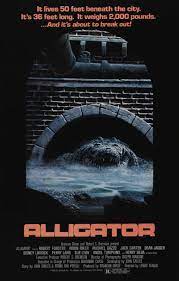
The urban legends surrounding the idea of alligators living in the sewer date back to the late 1920s and early 1930s, which makes it rather surprising that it took until 1980 for such an ideal subject matter to make its way into a horror movie. We got giant ants in the sewers back in 1954 for Christ’s sake why not alligators? It took screenwriter John Sayles to finally pen such an urban epic, but his gator wouldn’t simply be large it would be super-sized!

After the success of Jaws, the rip-offs of Spielberg’s summer blockbuster almost become a genre unto themselves, sadly, most of them were terrible and without any artistic merit but with Lewis Teague’s Alligator we got a truly excellent “man against nature” monster movie, one that turned out better than it had any right to be. While there are plot and character elements similar to what appears in the Spielberg shark film, with the main protagonist being a police officer who is helped by an animal expert, and there is a professional hunter who dies similar to that of Quint in Jaws, but he’s more villainous antagonist rather than part of the camaraderie trio in that film, but what John Sayles brought to the story was an environmental slant with the creatures immense size being due to the dumping of the bodies of dead animals that had been subjected to an experimental growth formula and then being eaten by the sewer-dwelling alligator, thus the cause of its increased size.

The basic plot of Alligator follows the actions of a PTSD-suffering homicide detective named David Madison (Robert Forster), who lost his previous partner under less-than-ideal circumstances, and it’s his investigations of body parts showing up in the local sewer that brings him into contact with a pet shop owner (Sidney Lassick) who has been stealing dogs and selling them to a Slade Pharmaceuticals for growth experiments. And just how evil is this company? Well, not only does scientist Arthur Helms (James Ingersol) cut the larynxes of his subjects to keep them quiet he demands that the pet shop owner only bring him puppies. It’s safe to say this guy will not be around when the end credits roll, in fact, the film’s big smorgasbord of action takes place at Arthur’s wedding, where he is to be married to his boss’s daughter.  It is at the wedding where he and his boss (Dean Jagger), as well as the crooked Mayor (Jack Carter), all meet their untimely ends, which begs the question “Did the alligator get a copy of the script, so it knew where the villains were and who it had to eat?”

Filling in the role of consulting oceanographer Matt Hooper from Jaws we have herpetologist Marisa Kendall (Robin Riker), who doesn’t believe that Madison’s latest deceased partner (Perry Lang) could have been eaten by a sewer-dwelling alligator, stating that a creature that size would have starved in a week and that the toxic gasses found in a sewer are not conducive to a healthy life. Even his boss Chief Clark (Michael Gazzo) doesn’t believe him and wants David to take a much-needed vacation, but lucky for Madison, a yellow journalist (Bart Braverman), who is one of the reporters that have suggested that Madison may have been responsible for the death of his first partner, is killed by the alligator and was kind enough to leave photographic evidence of the creature’s existence. This results in a failed sewer dragnet that causes the Mayor to sideline Madison and bring in big game hunter, Colonel Brock (Henry Silva), to track and kill the beast, this would be the film’s Quint analog, unfortunately, Henry Silva is never given a cool monologue about being aboard the U.S.S. Indianapolis and is just eaten in a dark alleyway.

Stray Observations:

• The alligator’s first victim is a sewer worker named Edward Norton which is an obvious nod to the character played by Art Carney on The Honeymooners.
• That the alligator in question was flushed into the sewers by Marisa’s father, twelve years ago when she was a child and I’m surprised that her dad didn’t get an ironic death in this film.
• The idea of a victim’s camera taking snapshots of the monster during the attack was also used in Jaws 2 (1978).
• Madison gets fired because of his investigation of Slade Pharmaceuticals, whose owner is friends with the mayor, but no actual grounds are given for his dismissal and any Policeman’s Union would be down on this situation like a ton of bricks.
• Henry Silva’s big game hunter hiring three black youths to be his “native bearers” is as brilliant as it is racist and makes his death even more appealing.
• The two men working the gate at the wedding don’t seem to notice that people are being eaten by a giant alligator a few feet away, then again, this is Chicago so maybe that’s normal.

This may have started off as a simple Jaws rip-off but with Lewis Teague’s deft hand at the helm, and the wonderfully tongue-in-cheek script by John Sayles, they were able to produce a film of admirable quality and a lot of this has to do with such a great cast of character actors, a group that is more than aptly lead by the great Robert Forster, who really nails the whole world-weary cop who is “Too old for this shit” to perfection. It should also be noted that Teague did run into the same problem that Spielberg had concerning his mechanical shark, as the mechanical Alligator did not function all that well or often, but the use of a baby alligator on a miniature set worked surprisingly well.

Lewis Teague’s Alligator is easily one of the better examples of the genre, one that has brought the world such “classics” as Grizzly and Orca, but John Sayles elevated things by weaving in some nice social commentary – the creature did seem to eat its way up the social-economic food chain – and the movie even had the balls to have the alligator brutally eat a small child. If this “Man against Nature” film has somehow escaped your notice do yourself a favour and track this one down, you won’t be disappointed.

____________________

Watch Alligator on tubi here: https://tubitv.com/movies/100006257/alligator

Saturday Matinee: Pump Up the Volume

Looking back at Pump Up The Volume

By Simon Brew

Source: Den of Geek

“Do you ever the feeling that everything in America is completely fucked up?”

When writer/director Allan Moyle’s work is celebrated, it’s generally Empire Records that gets the acclaim (and with some justification). Furthermore, if the conversation then moves on to cult movies starring Christian Slater, then it’s almost sacrilege to not start with Heathers.

Me? In both cases, I go for Pump Up The Volume every time, a thoughtful film masquerading behind a name that doesn’t necessarily do it a lot of justice. It’s certainly not the first story about a shy-by-day high school kid who assumes an anonymous identity out of hours – although this is a film in pre-Internet days, remember – but it’s comfortably one of the best.

“I didn’t talk to one person today, not counting teachers”

The film centres on Christian Slater’s Mark, a meek, lonely teenager, moved into a strange area by his parents, and attending a high school where he knows nobody. Actually, scratch that, he knows the youngest school commissioner in the history of Arizona – that’d be his father – but other than that, he’s very much alone.

He’s also nervous and shy: early in the film, his writing is read out to the class by an impressed teacher, and his discomfort at his talent being aired in such a way is evident. Mark prefers flying under the radar.

That’s until 10pm every night, when he takes his one piece of company in life, his radio broadcasting equipment (given to him by his parents so he can keep in touch with his old friends), finds an available frequency, and broadcasts for as long as he wants as pirate DJ Happy Harry Hard-On. His collection of music is quite brilliant, and the film’s soundtrack is most definitely worth checking out (although it lacks the version of Leonard Cohen’s Everybody Knows that’s heard more prominently in the film), but it’s what Harry has to say that grabs the attention.

Because in Harry, Mark has an outlet to say what he actually thinks. And say it he does. His views aren’t, in the scheme of things, massively radical. His parents have sold out (his father used to fight the system, we’re told, and now he “is the system”), the school system is warped, and everyone conforms. There’s nobody to look up to, nothing to do. Oh, and he simulates masturbation. A lot.

As if to reinforce the two sides of his life, after one of his early broadcasts, Mark attempts to talk to a girl at school, and she blanks him.

That notwithstanding, though, he inadvertedly becomes the lone voice of protest in the midst of a messed up system. The film centres around the fictional school of Hubert Humphrey High, whose principal, Loretta Cresswell, firmly knows how to get the academic results that her own superiors judge her school on (her eventual demise in the film, arguably, doesn’t solve that much). Root out the problem students, with the below average scores, then find a reason to expel them, and just keep those who get decent grades on the register.

Interestingly, the story does have its roots in a real life situation. Appreciating Hubert Humphrey High doesn’t exist, what does exist is a school that it’s based on, and where Moyle’s sister, according to the Toronto Star, taught.

“This dancing is a privilege, and it’ll be taken away if it’s abused”

Back to Harry, then. His listeners are everywhere, and his audience unites the people who simply don’t talk to each other when they’re together at school. The nerdy overweight kid, the jocks, the prim and proper swot girl: Moyle draws together the usually clichéd characters of the high school movie, and pretty much gathers them around the radio. Some of them have very swish radios, too.

This wins him a gradually building word-of-mouth audience, which is where Mark’s problems begin. Kids start ringing each other up, to help pass the broadcast on. Tapes do the rounds. More people start to notice. Moyle demonstrates this by gradually congregating more and more people at the physical spot where the reception for Harry’s show is at its best.

Consequently, much to the growing consternation of his father and the principal, more and more people take seriously what Harry has to say. A calm school population starts to take on a rebellious flavour, and a small system that works on complicity starts to unravel.

It doesn’t help, of course, that Mark/Harry has access to documents and information that don’t show Hubert Humphrey High in the best of lights. And when he particularly highlights the case of one student who has been expelled for her problems, although really for her grades, then suddenly, Harry is on lots of people’s radar.

The turning point for the movie, though, comes surprisingly early: it’s the suicide of one of Harry’s listeners. As his army of followers know, if you include a number in your letter to Harry (he’s a pirate radio DJ with a  PO box), you get a call back. In this case, it’s all a little too late. One on-air conversation with Harry later, said caller commits suicide, and the system has its scapegoat. Moyle’s film makes no bones about the way the system looks for the obvious, public fix rather than examining what really drove a youngster to kill himself, and it’s in moments like these when it’s at its best.

There’s also a foil of sorts to Mark/Harry, and that’s with Samantha Mathis’ Nora. The film was made in 1990, and it shows just what my predictive powers are like that I was fairly convinced at the time she’d go on to be a bigger star than she became. Her choices of films didn’t massively help – the Super Mario Bros movie is a stain on most people’s CV – but there’s real potential in her performance here.

For Nora is a far more popular person than Mark by day, yet she too feels the need to express herself anonymously. In her case, it’s her letters to his show, signed from the Eat Me Beat Me lady. It’s Nora who fairly quickly works out Mark’s true identity, and the irony of their relationship is that by them both talking to nobody, they both find somebody.

“Like everything else, you have to read the fine print”

It’s around then, though, that the film starts to run out of steam. It lands lots of punches in its first hour, in pretty quick succession, yet its momentum falters a little, and it goes just a little more conventional (the romance, certainly, is well done, but less interesting). Thus, the final act of the film is more concerned with those in authority tracking down Harry, and shutting down his show. And it all comes together via Harry’s last broadcast, which ends up taking place from the back of a 4×4.

It’s worth acknowledging too, that some points jar just a little. Some of the reaction moments to people listening to Harry’s broadcasts feel a little out of place. Furthermore, while Moyle takes time to briefly explore why the parents, staff and authorities act the way they do, he doesn’t invest too much in it.

Why do they come up with daft schemes such as BIONIC (‘Believe It Or Not I Care’)? Why do Mark’s parents not see beyond the tick box obvious? There are moments with Mark’s dad in particular, to be fair, where you get a glimpse of what he was, and contrast that with what he’s become (check out the moment where he catches Mark and Nora in the basement). But Moyle is, understandably, a little harder on their side of the story.

Still, for its few foibles, and appreciating that the film tailors off a little, at no point in its 102 minute running time does it feel like it’s outstaying its welcome. There’s sometimes a rawness to it, and there’s also a bunch of strong performances from the predominantly young cast.

I should focus on Christian Slater in particular, though. He’s electric here, in the midst of Harry’s raging monologues, but it shouldn’t be overlooked how well he conveys Mark’s innate shyness. It’s one of the more trickier characters he’s tackled, and the issues he has to talk about – sexual abuse, suicide, sexuality, loneliness – mean he has to balance the tone just right. I’d suggest he very much does. Moyle’s writing, too, is at times exquisite. The monologue he pens for Slater to deliver on the simplicity of suicide is dark, gripping material for a supposed teen movie

“I am not perfect. I have just been going through the motions of being perfect”

I find it odd that Pump Up The Volume, a film with a misjudged title and a not wonderful promotional campaign behind it, seems to have been lost a little. Appreciating that at most we’ve had a basic DVD release of the film, and it’s never likely to be ripe for Blu-ray, it’s still comfortably one of the best teen movies of the 90s (and the 90s were hardly short of strong teen movies), and also, a qualityaddition to the unnaturally strong genre of radio DJ movies (seriously: how many bad ones can you name?)

Even if you take just the romance element in isolation (arguably the weakest ingredient) between Mark and Nora, the scene where Harry takes to the airwaves to tell her his feelings, unable to look her in the eye and voice them face to face, is really well done. It’s the kind of stuff that romcoms stumble over all the time. Here’s a teen movie that handles it with class.

When the film is quiet in particular, and when good actors are being trusted with long passages of dialogue, Pump Up The Volume is brilliant. And it still is. Moyle has fashioned here an intelligent, well made and strongly written film, with something to say, that – in an age of Internet anonymity – might even be more resonant over two decades later.

And if it isn’t? Well, to take the works of Harry himself, “so be it”…

Saturday Matinee: The Square

By Freda Cooper

Source: Flickering Myth

SYNOPSIS:

A museum curator is preparing to launch a major art exhibition.  He sees himself as having a social conscience, but when his wallet and phone are stolen, the other side of his character emerges and he badly mis-handles the situation – and does the same thing when it comes to promoting his new show.

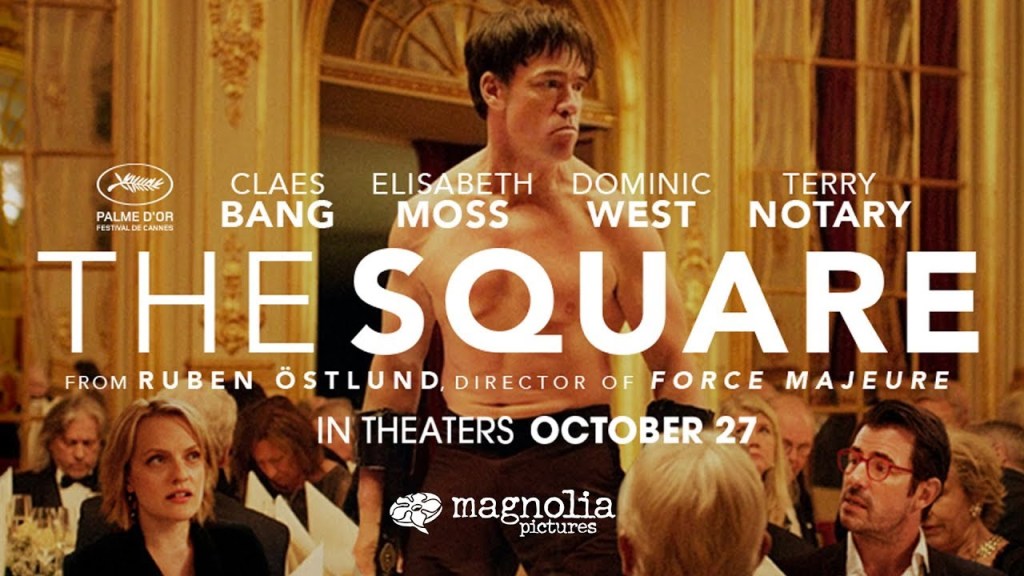
A film from Ruben Ostlund isn’t going to be cozy.  Compelling and fascinating, yes, but never easy and sometimes impenetrable.  His previous offering, Force Majeure, was well received and won the Un Certain Regard prize at Cannes in 2014.  His latest, The Square, went one step further and scooped the Palme D’Or last year.

Force Majeure centred on a spontaneously cowardly act by a father.  This has another act from another father at its centre, but this time one that’s thought out.  Badly.  And it’s followed by a second one, which is equally ill-considered.   The Square of the title is an art installation, the centrepiece of an exhibition supervised by museum curator Christian (Claes Bang).  He’s a man under pressure, both professionally and domestically, but still believes he has a social conscience – until his wallet and phone are stolen.  His reaction is extreme, a more accurate reflection of the real man, and he’s responsible for something equally rash when it comes to launching his beloved exhibition.

That’s putting it simply.  Ostlund has a number of targets for what is, at times, a savage satire.  At the heart of it is how those with money treat others – the homeless, the poor or those who are just not as wealthy.  Society encourages tolerance and kindness, but it’s easier to ignore them.  “Would you take a moment to save a life?” asks a charity worker and everybody who walks past her says no.  Are they just saying no to her or to her actual question?  Or both?

The art establishment, in the form of The Square installation, comes in for attack as well.  It’s meant to represent a space where everybody is safe and responsible for each other – but that can apply to any space, from a circle to a pentagon. It’s nonsense.  As are some of the other exhibits, especially one made up of conical piles of gravel.  It’s no surprise that some are accidently vacuumed up by the cleaner.  The exhibition’s marketing team is equally ridiculous, but also irresponsible in its creation of a promotional video of a little, impoverished girl.  It goes viral and causes an outcry – all because Christian doesn’t take the time to think it through properly.

Much of this creates uncomfortable laughter, but lurking in the background in the museum is another installation featuring an ape like man, brought to life by a performance artist.  His actual appearance at the exhibition launch is breath-stoppingly unsettling, as he lumbers around the room, aggressively whooping and pawing at the guests.  The end of the scene is even more deeply disturbing.  Yet again, the idea is mis-judged, with the guests initially alarmed and scared and then turning on the man in the most vicious of ways.

That scene marks a change in tone, but it’s also where the film starts to unravel.  Christian delivers a speech, videoed on his phone, which essentially explains the plot.  Except that, by that stage, the point is already clear, so it’s hardly necessary.   His explanation of the marketing video to a packed press conference is equally superfluous and more than a little disingenuous.  But Claes Bang holds both halves of the film together with the arrogant, flawed but not wholly unlikeable Christian, although talents like Dominic West and Elizabeth  Moss are under-used and have only a handful of scenes apiece.  Terry Notary, in that exhibition launch sequence delivers the piece of acting that sticks in your mind and, disturbing as  it is, it’s powerfully excellent.

The Square doesn’t have the clarity of Force Majeure, but it does have the ability to grab the audience firmly by the shoulders for the duration.  Given the complexity and occasional obscurity of the story, the film needs it.  It isn’t always satisfying, but it is never less than compelling.

____________________

Watch The Square on Tubi here: https://tubitv.com/movies/590338/the-square?start=true

Saturday Matinee: Let the Bullets Fly

By Josh Larsen

Source: Larsen on Film

Little visual gags fly as fast as the bullets in this 2010 Chinese action comedy, starring co-writer and director Jiang Wen as Pocky Zhang, a bandit leader who poses as governor of a southern outpost. One of the first things we see is a bandit leaning down to listen for an approaching train on railroad tracks—but first he ostentatiously sticks his finger in his ear to clear it out.

Mistaken identity is at the core of much of the movie’s comedy. Let the Bullets Fly opens with Zhang and his band hijacking that train, which is carrying the actual governor (Ge You) to his post in Goose Town. During his interrogation of the governor (captured in a shot-reverse-shot sequence that’s edited at light speed), Zhang decides that pretending to be the governor might be more lucrative than simply robbing him. But upon arriving in Goose Town (with the real governor in tow, disguised as Zhang’s counselor), Zhang finds that things are actually run by the local crime boss, Master Huang (Chow Yun-Fat). This leads to a series of strategic chess moves between the two men, culminating in a comic set piece where Zhang’s crew and Huang’s henchmen square off while wearing the same bandit masks with red circles on them, unable to tell who is who. It’s a face-off as farce.

With its manic comic sensibility, Let the Bullets Fly recalls the work of Hong Kong’s Stephen Chow (Shaolin SoccerKung Fu HustleCJ7), whose own films seem inspired by Looney Tunes cartoons (the opening train sequence here could easily be a Wile E. Coyote short). Physics takes a back seat to fun, so that much of the film seems to be occurring in fast motion. As director, Jiang looks for every opportunity to be showy; at one point an alarm clock is thrown in the air and shot to pieces, causing a metal circle to sail over the camera like a collar.

As an actor, Jiang seems to understand that his face has a comic appeal—those big ears—that allows him to underplay the gags by keeping a straight face. He’s a delight. The legendary Chow (The KillerCrouching Tiger, Hidden Dragon) gets a double role as the villainous Master Huang and Huang’s dim-witted body double. He’s quite a bit broader than Jiang, but equally amusing.

The disparate tones Jiang juggles can make for some uncomfortable moments. There are sudden bits of graphic violence, for instance, and a rape scene that isn’t given nearly the serious consideration it deserves. (Like much of the movie, it’s a setup for a later gag.) But as a political satire, Let the Bullets Fly is pointed and precise. “I want to make money standing tall,” Zhang says at one point, trying to explain why he’s left forest robbery behind. “Impossible,” the real governor replies, knowing bureaucratic corruption all too well. The best joke in Let the Bullets Fly might be that a bandit is the movie’s moral center.

____________________

Watch Let the Bullets Fly on Hoopla here: https://www.hoopladigital.com/title/10088666

Saturday Matinee: OSS 117: Cairo, Nest of Spies

By Marc Savlov

Source: Austin Chronicle

As Hollywood increasingly relies on ever less entertaining parodies of whole cinematic genres to sate an apparently insatiable public appetite for seriously dumb humor, the comparatively sophisticated yuks of Airplane! and The Naked Gun have devolved into the lowest-common-denominator yucks of the Scary Movie franchise and the viciously unfunny gurgles of Not Another Teen Movie, et al. Truly great parody relies in equal measure on both finely calibrated nuance and audience familiarity with the object of comic ridicule and not on how many fart jokes you can jam into an already bloated 90-minute running time. Austin Powers, for example, succeeded as much on the merits of its hyper-detailed production and art design as it did on Mike Myers’ groovy, hirsute mugging. Its swinging, Bond-esque London looked, or at least felt, as real as its modern-day counterpart, and its subject of parody, the 007 films, was universally known. Leave it to the French to beat us at our own bizarrely self-reflexive comic shenanigans. OSS 117: Cairo, Nest of Spies is a model of smart, often very silly, but never, ever stupid comic perfection. Set in 1955, back when Cairo was bristling with anti-English antipathy over a looming Suez canal crisis and radical Islam was just getting warmed up, the French Office of Strategic Services sends its best man, Hubert Bonisseur de la Bath, aka OSS 117 (Dujardin), to Egypt to discover the whereabouts of vanished agent Jack Jefferson (Lefebvre). OSS 117 is, of course, a fatuous, self-involved, debonair jerk who attracts the leggiest ladies and trouble of every sort. But Cairo, Nest of Spies, is far more than a Clouseau-on-holiday knockoff. Simple, period touches like the frequent use of obvious rear-projection (a nod to Hitchcock and a wonderfully evocative gag in and of itself), an ongoing bit about OSS 117’s nicotine independency, and an unexpectedly hilarious undercurrent of homoeroticism among spies of all nations conspire to make this a consistently entertaining parody that never once makes you feel like an idiot for laughing out loud at its idiocy.

___________________

Watch OSS 117: Cairo, Nest of Spies on Crackle here: https://www.crackle.com/details/cde3fda4-76e8-4b82-b612-ba0ae52fa27c/oss-117:-cairo-nest-of-spies

Saturday Matinee: Strange Brew

‘Strange Brew’: The Cult Comedy Classic that Married Canadiana with ‘Hamlet’

Beer. Hockey. Shakespeare. Beauty, eh?

By Lloyd Farley

Source: Collider

It’s August, 1983 at the local movie theatre.The lights go down, the curtains part. A trailer or two roll, maybe A Christmas Story, or the hilarious Yentl. The iconic MGM lion then comes on screen, and you wait breathlessly for his mighty roar to begin the film. And then…BURP.

No, this movie can’t possibly begin with such comedic absence of reverence, can it? The camera pans around to capture two parka and toque clad men, one of which is turning the lion’s tail like a crank to get it to roar. Absence of reverence, confirmed. The two men see the camera is running, so they run to the set, riddled with cases of beer and a backdrop with a large map on it, the words Great White North spread across, and so wide it includes England, Russia and Hawaii. The hilarious, absurd, Shakespearian, James Bond villainous, rife with all manner of Canadian stereotype film Strange Brew has begun.

The two men are brothers Bob and Doug McKenzie, played by Rick Moranis and Dave Thomas. The duo came to life on SCTV as The Great White North, an improvised bit by Moranis and Thomas for more Canadian content. They used every stereotype — toques, parkas, back bacon, beer, the iconic “coo-roo-coo-coo” loon call, “hosers” — and simply talked. They would add “eh?” to the end of every sentence, a tic as Canadian as “oh yea, no, for sure”. The McKenzie’s took off with syndication in the US. Capitalizing on their popularity, they released the comedy album The Great White North, which included the song “Take Off” with collaborator Geddy Lee (his highest charting single, including his work with Rush). The success of the album begat the movie, which Thomas pitched as having creative ties with Hamlet.

The beginning of the film is a movie within the movie: Mutants of 2051 A.D., a home-made sci-fi classic, like the works of The Goldbergs‘ Adam (Sean Giambrone). When the film breaks, the brothers, watching the film in the theatre, flee from angered moviegoers, and lose their dad’s (Mel Blanc) beer money. Forced to get beer for their dad the next morning, they place a mouse in an empty bottle of Elsinore beer, hoping to leverage it for free beer. They are told to go to the brewery, where the new owner, Pam Elsinore (Lynne Griffin), gives them jobs watching for mice in beer bottles (and cases of free beer). They wander around the brewery and into Brewmeister Smith’s (Max von Sydow) operations room, where they can see patients from the nearby Royal Canadian Mental Health Facility playing hockey.

Wait, back up. Esteemed Swedish actor Max von Sydow, of Bergman‘s The Seventh Seal? Yep. His son was a huge fan of SCTV, and encouraged his father to take the role. The character has been working on a plan to take over the world by adding a mind control drug to Elsinore beer, testing on the patients from the nearby facility. Through certain musical tones, those under the drug can be made aggressive (shown in an amusing bit where Doug plays the iconic loon theme on the keyboard), with those results tested through games of hockey. Because, you know, Canada.

Tranquilized by Smith and his accomplice, Pam’s Uncle Claude (Paul Dooley), the brothers wake up and make a delivery in their van, not knowing that the brakes are cut and that the beer kegs in the back have Pam and her father’s friend Henry (Douglas Campbell) inside. They careen down the hill into the lake, and then…Intermission.

Police divers find the boys in the van, alive and drinking beer. Charged with attempted murder, they are found insane by the judge. The brothers are sent to the asylum and placed in Smith’s care, where they are straitjacketed, prompting a game of steamroller, and take turns using electric shocks on one another. Freed by Rosie, they return to the brewery to stop Smith.

Pam and Bob are captured by Smith and placed in a brewery tank, which begins filling with beer. Rosie and Doug find them, discovering that Bob drank the entire contents of the tank and is now cartoonishly bloated, and needing to ‘take a leak’, which he does by, um, expelling and putting out a fire at the asylum. Knowing Smith has shipped tainted beer to Oktoberfest, Bob and Doug stop at home to get the help of Hosehead (Buddy), who flies off — you read that right — to stop the party and indulge in beer and sausages. The brothers take the remaining beer away, and presumably home. The film ends…

… no, it doesn’t. Bob and Doug reappear on the set of The Great White North and talk throughout the credits, sending off those that stayed behind – not the hosers that took off after the movie was done — with a beer whistle and a “happy trails”. Right now you’re thinking, “Geez, we got hosed! What about Hamlet, you knob?”

Strange Brew‘s retelling of Hamlet ranges from the painfully obvious to a much subtler degree. An intellectual ribbon throughout the lunacy. The name Elsinore is the easiest reference, a clear nod to the Danish royal castle Elsinore from the play. Pam is the Hamlet, the heiress of the brewery/kingdom after the death of her father, who is still reeling from her mother Gertrude (Jill FrappierQueen Gertrude) marrying her uncle Claude (Claudius) within days of the loss. Pam is shown by the ghost of her father, John (Eric House), how Claude and Smith murdered him. The ghost recounting the details of his death is taken directly from Hamlet, but the fact that he appears via a Galactic Border Patrol videogame in the movie is a clever reference to a feared invasion of Denmark by neighboring Norway. The presence of the Mental Health Facility would suggest a reference to the role of madness in Hamlet, from Hamlet’s acting as such to Ophelia’s descent into true madness, while the tinged beer a bow to the poisoned glasses of wine in the play’s final act. The McKenzie brothers themselves have a link to the play as a modern-day Rosencrantz and Guildenstern.

Strange Brew is as much an experience as a comedy, and, with the Canadian penchant for self-deprecation and a highbrow Shakespearian tint, its lighthearted jabs at the Canadian identity should be mandatory (well, at least suggested) viewing every July 1st on Canada Day. Happy trails indeed, eh?

Saturday Matinee: Catch-22

Classic Film Review: So was “Catch-22” the failure we remember it to be?

By Roger Moore

Source: Movie Nation

Perhaps it took a humorless, career-crippling George Clooney TV version of Joseph Heller’s novel to make us better appreciate Mike Nichols’ daring, infamously-expensive version of “Catch-22.”

Released at the height of the Vietnam War, suffering in comparison to Robert Altman’s equally anti-war dramedy “M*A*S*H,” seemingly more on a par with with equally cynical action comedy “Kelly’s Heroes,” which has had the benefit of a lot more TV exposure, “Catch” still plays the way it did way back in 1970 — as a pricey, “difficult” satire with a “difficult” shoot as baggage.

But wipe away the “Catch-22 lore,”the people cast and cast-aside, the fact that Nichols wanted the more age-appropriate Al Pacino as Yossarian, the young bombardier/anti-hero, and grapple with the film’s disordered narrative, the nightmarish focus of the story — an active-duty combat airman flying through and ranting through what we now call Post Traumatic Stress Syndrome, coupled with a tinge of guilt.

It’s amazing to see now. And considering how our war movies, from “300” to “Midway,” “Greyhound” to “Flyboys” and even at times, “Dunkirk,” are made now — with digital planes and ships and sometimes tanks — they really don’t make’em like this any more.

Nichols made the most of his coastal Mexican location, showing off all 17 WWII vintage B-25s taking off and landing every chance he got. You couldn’t do that today.

And that cast. Alan Arkin makes a fine, perplexed and outraged Yossarian, a sane man trapped in the insanity of war, an actor who never hits a punchline too hard, never takes the character’s exasperation into parody.

“Let me see if I’ve got this straight. In order to be grounded, I’ve got to be crazy. And I must be crazy to keep flying. But if I ask to be grounded, that means I’m not crazy anymore, and I have to keep flying.”

“You got it,” Doc Daneeka (Jack Gilford) tells him. “That’s Catch-22.

“Whoo… That’s some catch, that Catch-22.”

Orson Welles as a grumpy general, Tony Perkins as a put-upon chaplain, Martin Balsam as the murderously vain Col. Cathcart, Buck Henry as his venal sidekick, Col. Corn (screenwriter Henry was never better, as an actor), baby-faced Bob Balaban as the always-crashing, always-tinkering, even-tempered Orr, it’s a dazzling corps.

Bob Newhart half-stammering through Major Major Major, a very young Martin Sheen raging as the pilot Dobbs, Art Garfunkel as the innocent co-pilot Nately who falls for an Italian hooker, Charles Grodin as an upper-class twit navigator, a smarmy, befuddlingly upbeat Richard Benjamin (cast, with his wife Paula Prentiss as a nurse Yossarian chases), the famous French star who fled to Hollywood Marcel Dalio is the wizened old Italian who figures Italy has already won the war, since it has surrendered and Americans are still fighting and dying. And there’s a sea of actors we’d come to recognize on TV (“The Bob Newhart Show” is over-represented) in the years that followed.

Jon Voight stands out, just enough, as the grinning opportunist Milo Minderbender, a stand-in for every war profiteer you’ve ever read about, working the angles, an impersonal unpatriotic multinational corporation who wins no matter who loses.

Like its two contemporaries, “M*A*S*H” and “Kelly’s Heroes,” it’s a guy’s movie with a dated leering quality about the opposite sex. It’s heavy-handed, here and there, betraying Nichols — feeling his oats after “The Graduate” — indulging in some serious “blank check” filmmaking.

And reading, over the years, of all the people Nichols wanted to cast, or cast and then replaced, you kind of wish he’d moved on from Gilford, a future Oscar nominee who doesn’t bring enough cowardly sniveling to the good doc.

“Catch-22” was popular enough that they did a pilot for a sitcom based on it, as was the case with “M*A*S*H.” Richard Dreyfuss had the lead in that.

Over the years, I’ve interviewed half a dozen actors from that all-star cast, and often, without prompting, they’d bring it up. It took half a year of their lives, most of them, and burned itself into their memories, even if it wasn’t the blockbuster Paramount expected it to be.

Watching it again, outside of the academic settings where it turned up in “film as satire” classes and the like, it feels more cinematic than the scruffy, Altmanesque “M*A*S*H,” a movie marred by that stupid screen-time-chewing football game. It’s less fun than the more-watchable “Patton” and even “Kelly’s Heroes” (which is FAR longer).

But as a darker-than-dark comedy about the futility and insanity of war, it towers above its contemporaries in ways that should have scared-off George Clooney. It’s the best film of a seemingly-unfilmmable classic novel we’re ever going to get.

MPAA Rating: R, graphic violence, blood, nudity, profanity

Cast: Alan Arkin, Martin Balsam, Buck Henry, Tony Perkins, Bob Newhart, Paula Prentiss, Richard Benjamin, Marcel Dalio, Bob Balaban, Art Garfunkel, Martin Sheen, Jack Gilford, Peter Bonerz, Norman Fell, Austin Pendleton, Jon Voight and Orson Welles.

Credits: Directed by Mike Nichols, script by Buck Henry, based on the Joseph Heller novel. A Paramount release.

Running time: 2:02

____________________

Watch Catch-22 on Kanopy here: https://www.kanopy.com/en/product/3216674