Two for Tuesday
Reply

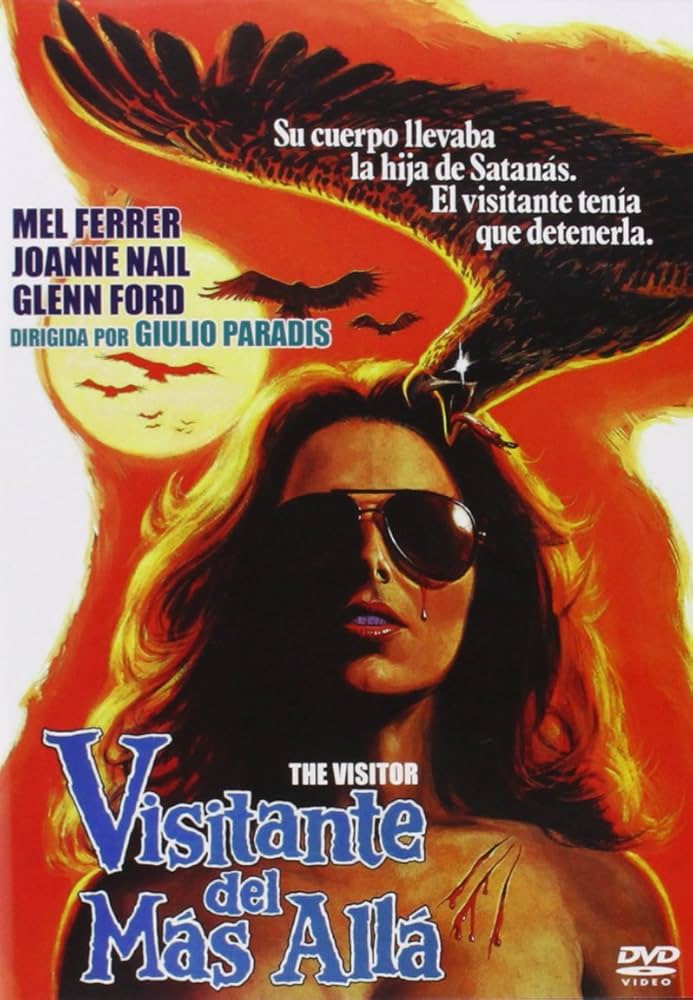
Witney Seibold Reviews ‘The Visitor’ (1979)
By Witney Seibold
Source: Critically Acclaimed
I first encountered Michael J. Paradise’s “The Visitor” at an after-hours, by-invite-only screening curated by my local video store.
You see: The managers of said video store would, on a weekly basis, acquire whatever 35mm prints they could get a hold of for cheap and/or free. These prints consisted of obscure German comedies, weird sex films, lost genre oddities, sci-fi epics with missing reels, and, in one baffling bout of programming, “My Giant.” Then, in conjunction with a helpful projectionist at the movie theater next door (where I worked at the time), the store managers would invite over employees and friends of employees to view said films, eager to talk aloud in the theater and openly discuss the insanity on screen. These were magical nights of baffling cinematic exploration, and I’m glad to have been invited on several occasions.
It was in this milieu that I was introduced to Michael J. Paradise’s 1979 sci-fi epic “The Visitor,” perhaps one of the most baffling films ever produced. It was such a moving experience that I rushed to my (now long-neglected) criticism blog to review it. That was in 2007. The time has now come to re-visit “The Visitor” and see what new lessons can be learned. Luckily, the film is just as brain-melting as it always was.
Michael J. Paradise is the nom de cinéma of director Giulio Paradisi, an Italian character actor and assistant director who only made four features in his career (one of which was a crime comedy called “Spaghetti House”). “The Visitor” was his second feature, and, from the looks of it, the most ambitious. Tapping into many of the “2001”-inspired sci-fi trends of the time, Paradisi made a film that sought to tie together the cosmos with spirituality, Jesus with space aliens, and apocalyptic genre tropes with an all-star cast.
“The Visitor” sets its sights on the entire universe, the nature of good and evil, and how humanity is the plaything of warring ancient space deities. The “big questions,” however, are mixed into a psychedelic bouillabaisse of confounding imagery, bad plotting, and weird-ass performances, at least one of which was done entirely under the influence of alcohol. “The Visitor” is insane.
The plot of the film centers on a young girl named Katy (Paige Connor) who is poised to be the next Christ or the next Antichrist, depending on which timeless deity can influence her fastest. On the light side is John Huston and Franco Nero, who oversee an ultra-futuristic space lounge populated by bald children. Nero dispenses Christ-like wisdom while Huston does the legwork; Huston sets up shop on modern-day Earth atop a Los Angeles skyscraper with a cadre of performing space cultists. Many of Huston’s scenes involve his direction of their performance art and his manipulating the stars with his very mind. He wants Katy to become a vessel for – who else? – Yahweh.
On the dark side, we have Lance Henricksen, owner of the Atlanta basketball team, who regularly attends creepy board meetings in a modern high-rise to discuss apocalyptic details with a shadowy cabal of high-powered executives. Henricksen is urged by this cabal (headed by Mel Ferrer) to magically influence young Katy into becoming a vessel for Zatteen, a.k.a. Satan. Katy, meanwhile, has already displayed a propensity for evil: Not only does she have telekinetic powers, but at her birthday party, Katy received a gun as a present (!) and shoots her aunt.
Shelley Winters also appears as a recently-hired nanny for Katy, but I was unsure if she was in the employ of the Huston cult or the Henricksen cult. At the film’s conclusion, she does give a tearful farewell to the Huston character, but that adds no rhyme nor reason. To add a much-needed human element to “The Visitor,” much of the film is seen through the eyes of Katy’s mother Barbara (Joanne Nail), who serves as our protagonist. She will eventually be felled by a gunshot and will spend much of “The Visitor” in a wheelchair.
The above synopsis only emerged in my mind after several viewings of “The Visitor.” While in the midst of actually viewing this Frankensteinian monstrosity, however, one may find themselves totally lost. “The Visitor” takes very long intermissions wherein portentous music pounds at the soundtrack but not much of ultimate consequence happens. The star-manipulating scene mentioned above is neat, I suppose, but it has no influence on the characters or the story as far as I can tell. There is another sequence wherein Katy is particularly at risk at an ice-skating rink, and the film’s poor sense of spatial continuity might have one believing that John Huston is scurrying down 3000 flights of stairs to stop it. At the end of that fateful descent, nothing notable happens.
The most mind-blowing celebrity cameo is provided by Sam Peckinpah who, in 1979, was in dire straits. In 1978, he directed “Convoy,” often seen as the least of his films, and it’s been posited that he accepted make “Convoy” only due to his addictions to booze and cocaine. He appears in one scene of “The Visitor” as Barbara’s ex-husband and Katy’s biological father. Peckinpah’s dialogue appears to have been dubbed, and, as we posited at that midnight screening so many years ago, it may have been because he was too drunk to remember his lines. He certainly seems tipsy and unhappy in his scenes.
In 2007, I was happy to let “The Visitor” melt my brain without much in the way of analysis. It was instantly classified by the midnight audience as a “Holy Fucking Shit” movie, and it still, to this day, enjoys a coveted spot on the “Holy Fucking Shit” shelf at CineFile Video.
In 2018, having now seen more bonkers, psychedelic 1970s sci-fi epics, I have a better context for it. Thanks to “2001: A Space Odyssey,” audiences enjoyed nearly a decade of incredibly ambitious sci-fi movies that sought to unlock the deepest philosophical questions about eternity, humankind’s place in the cosmos, and how our consciousnesses may be a vital piece to a vast, astral puzzle. If one is swallowing tabs of acid while watching Carl Sagan interviews, one could easily conceive of something like “The Visitor.”
I can’t say that the bulk of 1970s psychedelia was necessarily successful – they were big on histrionics but short on actual logic, character, historical theology, filmmaking acumen, or even basic entertainment value – but one can at least admire them for being willing to tip into the surreal to reach something higher. The movies often suck, but I can see why someone might have written something like, say, “God Told Me To” or “Zardoz.” I just couldn’t say how they did.
“The Visitor” will ever remain an oddity, but wow, what a rush! This is one of the crown jewels in baffling psychedelic 1970s freakout cinema and should be shared immediately. Drafhouse Films put out a handsome Blu-ray of it a few years back, and I encourage the purchase of it, sight unseen. I have my copy.
Watch The Visitor on Kanopy here: https://www.kanopy.com/en/kcls/video/13448350
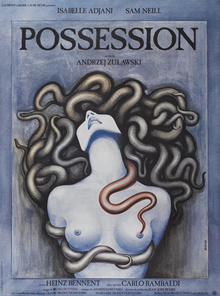
By Abby Brenker
Source: Lunatics Project
This article will certainly contain spoilers. You have been warned.
There is so much to say about Possession (1981). It was written and directed by Polish filmmaker Andrzej Zulawski. First of all, this film is difficult (but not impossible) to find. It’s worth the effort though. It’s currently showing at Metrograph theaters, and may be available on their streaming platform. I have not seen it on a big screen but I think that would be the ideal way to see it, if you aren’t susceptible to panic attacks.
Possession doesn’t fit cleanly into any specific genre. It’s equal parts drama, thriller and horror…maybe with a sprinkle of sci-fi. If you haven’t seen this movie, it starts out with a husband and wife who are dealing with infidelity and separation. But it devolves into something nightmarish, feverish and horrifying.
Right off the bat, we have to discuss Isabelle Adjani’s performance. It’s intense and exhausting and a performance that will stick with me for a while. Adjani has many memorable scenes, but one that comes to mind is when her character, Anna, enters a subway. Her continuous panting and heavy breathing (reminiscent of Midsommer), slowly erupt into screaming, laughter and blood and…so much more. The physical toll that this roll must have taken on Adjani is immense. There is no reprieve for the actors.
Everything about Possession is exaggerated, which makes some of the scenes hard to watch. But at its core, the allegory is quite clear. The monster which we are introduced to about halfway through the film represents the resentment and growing agony of divoce. Zulawski turns this common experience into grotesque body horror and upsetting desire. Though, I am sure you could watch this film over and over again and find new meanings and layers.
The film also stars Sam Neill in the role of the husband. Adjani plays her own doppelganger, as does Neill. The doppelganger element creates a circular, never ending pattern. A fairly unfavorable take on romantic relationships. Essentially, as one attraction wanes, another waxes. Side note: Zulawski did go through a divorce before he made Possession. Not very surprising.
It’s a film that’s meant to invoke a very specific emotional reaction from the audience. In a lot of ways it reminded me of how I felt watching Aronofsky’s Mother!. Both Mother! and Possession are films that I like and respect, but do not necessarily enjoy watching. But these films aren’t meant to be entertaining, they’re meant to take you on a very specific, guided emotional journey.
Beyond the plot and acting, the filmmaking is stunning. The cinematography is dizzying, in a good way. Often the camera moves freely around the actors, bringing additional elements to the drama that’s unfolding, One of the final scenes is filmed in dramatic vignette. Other shots are stark and clinical, until they are blood soaked. The filmmakers use sound here in a unique way. The actors breathing or moans or over the top noises add another layer to the soundtrack and rhythm of Possession.
In one of the final moments of the film, the husband and wife’s bloody pre-death kiss, was one of the hardest to watch for me. Not to mention the way Anna bends her arms backwards to try to end them both. A tragically horrifying yet somehow fitting end.
From a filmmaking perspective, Possession (1981) should be on everyone’s must-watch list. But it will soon also be on your what-the-fuck-did-I-just-watch list. Possession is like being in a bad dream. From the start, the way the actors move is slightly off. They always seem to be wearing the same outfits day to day, or very similar colors. The way the plot unfolds is familiar but surprising. It lures us in under the false-pretense of a drama and whacks us over the head with body horror and tentacle fueled sex scenes. Only to leave us with a cynical feeling about love and modern relationships.
Possession was nominated for the Palme d’Or at Cannes in 1981. Though it didn’t win, Isabelle Adjani won best actress that year at Cannes for her role. Andrzej Zulawski has said that he makes films about “what is torturing” him. I think Possession is an excellent example of a highly successful exploration of one’s person torture. So be warned, what you’re feeling at the time you watch this film will undoubtedly impact how you perceive it.
Possession begs us to ask the question, who really is the bad guy?
Watch Possession on Kanopy here: https://www.kanopy.com/en/kcls/video/14014934
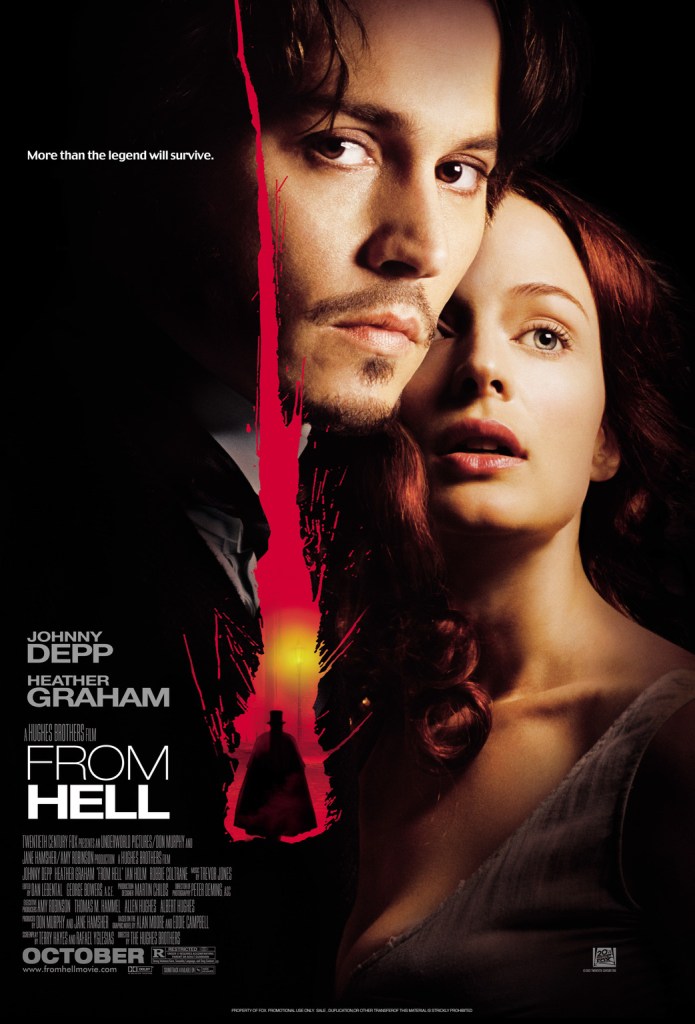
By Roger Ebert
Source: RogerEbert.com
One day men will say I gave birth to the 20th century. — Dialogue by Jack the Ripper I’ d like to think Darwin has a better case, but I see what he means. The century was indeed a stage for the dark impulses of the soul, and recently I’ve begun to wonder if Jack didn’t give birth to the 21st century, too. Twins. During 10 weeks in autumn 1888, a serial killer murdered five prostitutes in the Whitechapel area of London. The murders were linked because the Ripper left a trademark, surgically assaulting the corpses in a particularly gruesome way. “I look for someone with a thorough knowledge of human anatomy,” says Inspector Abberline of Scotland Yard. An elementary knowledge would have been sufficient.
The story of Jack the Ripper has been fodder for countless movies and books, and even periodic reports that the mystery has been “solved” have failed to end our curiosity. Now comes “From Hell,” a rich, atmospheric film by the Hughes Brothers (“Menace II Society“), who call it a “ghetto film,” although knowledge of film, not the ghetto, is what qualifies them.
Johnny Depp stars as Inspector Frederick Abberline, an opium addict whose smoke-fueled dreams produce psychic insights into crime. The echo of Sherlock Holmes, another devotee of the pipe, is unmistakable, and “From Hell” supplies its hero with a Watsonoid sidekick in Peter Godley (Robbie Coltrane), a policeman assigned to haul Abberline out of the dens, gently remind him of his duty, protect him from harm, and marvel at his insights. Depp plays his role as very, very subtle comedy–so droll he hopes we think he’s serious.
The movie feels dark, clammy and exhilarating–it’s like belonging to a secret club where you can have a lot of fun but might get into trouble. There’s one extraordinary shot that begins with the London skyline, pans down past towers and steam trains, and plunges into a subterranean crypt where a Masonic lodge is sitting in judgment on one of its members. You get the notion of the robust physical progress of Victoria’s metropolis, and the secret workings of the Establishment. At a time when public morality was strict and unbending, private misbehavior was a boom industry. Many, perhaps most, rich and pious men engaged in private debauchery.
The Hughes Brothers plunge into this world, so far from their native Detroit, with the joy of tourists who have been reading up for years. Their source is a 500-page graphic novel (i.e., transcendent comic book) by Alan Moore and Eddie Campbell, and some of their compositions look influenced by comic art, with its sharp obliques and exaggerated perspectives. The movie was shot on location with the medieval streets of Prague doubling for London, and production designer Martin Childs goes for lurid settings, saturated colors, deep shadows, a city of secret places protected by power and corruption.
We meet some of the prostitutes, particularly Mary Kelly (Heather Graham), who is trying to help her sisters escape from the dominance of the pimps. We see Abberline and Kelly begin a romance that probably would have been a lot more direct and uncomplicated at that time than it is in this movie. We see members of Victoria’s immediate family implicated in whoring and venereal mishaps, and we meet the Queen’s Surgeon, a precise and, by his own admission, brilliant man named Sir William Gull (Ian Holm). The investigation is interrupted from time to time by more murders, graphically indicated, and by forms of official murder, like lobotomy. Sir William is an especially enthusiastic advocate of that procedure, reinforcing my notion that every surgeon of any intelligence who practiced lobotomy did so with certain doubts about its wisdom, and certain stirrings of curious satisfaction.
Watching the film, I was surprised how consistently it surprised me. It’s a movie “catering to no clear demographic,” Variety reports in its review, as if catering to a demographic would be a good thing for a movie to do. Despite its gothic look, “From Hell” is not in the Hammer horror genre. Despite its Sherlockian hero, it’s not a Holmes and Watson story. Despite its murders, it’s not a slasher film. What it is, I think, is a Guignol about a cross-section of a thoroughly rotten society, corrupted from the top down. The Ripper murders cut through layers of social class designed to insulate the sinners from the results of their sins.
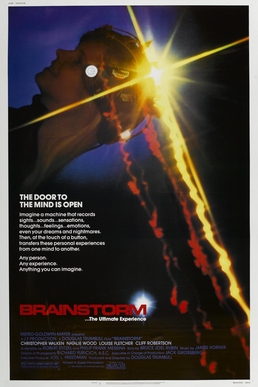
By Moe
Source: Cup of Moe
The 1983 sci-fi thriller “Brainstorm” stars Christopher Walken and Natalie Wood. This forward-thinking science fiction romp presents virtual reality (VR) in its early stages and evolution. Although the Douglas Trumbull-directed film isn’t perfect, it’s a neat look at VR with superb acting, a magnificent score, and excellent effects.
A scientific group led by Michael Brace (Walken) and his estranged wife Karen (Natalie Wood), along with Michael’s colleague Lillian (Louise Fletcher) invents the computer and brain interfacing device. Their creation not only allows for virtual reality experiences but allows feelings and sensations to be recorded on tape. In this way, others may experience those as well.

After their initial success, CEO Alex Terson (Cliff Robertson) instructs Brace et al to offer a demo of their device with the intent to secure financial backing. It’s during this exhibition that the group realizes the true power of their device: its ability to record human emotions. Michael uses the device to record memories with emotions, and thereby influence the real world. But whereas Michael employs this as the utility to reconnect with his estranged wife, previous colleague Landan Marks (Donald Hotton) aspires to use it for military applications.
When Lillian suffers a heart attack, she puts on the headset and records her death. Michael later discovers her recorded memories. Eventually, Michael realizes the insidious intent to use his creation for warfare when he uncovers “Project Brainstorm.” As such, Michael and Karen team up to thwart efforts to use their technology to perpetuate the military industrial complex.
“Brainstorm” offers an intriguing and groundbreaking look at VR. There’s an exploration of not only virtual reality experiences but the effects on the user. This manifests in the ability to record emotions as well as memories. I like the way “Brainstorm” touches on humanity’s influence of tech, and the means through which tech shapes humanity. Moreover, “Brainstorm” presents an accurate portrayal of tech advancement. Early in the film, Terson instructs his team to make a smaller version of their helmet. Similarly, a trend in real-world technology is constant innovation in creating smaller devices.
I quite enjoy the helmet design and the effects are top-notch. The 1983 movie has aged pretty well with its fish-eye lens shots and well-crafted animation sequences.Trumbull worked on effects for films such as “2001: A Space Odyssey,” “Silent Running,” and “Blade Runner.” It’s evident that Trumbull understood the genre and he infuses mesmerizing special effects, particularly at the end.
Cinematography is fantastic. The film is set in North Carolina and uses several NC scenes as prominent backdrops. Notably, the Wright Brothers National Memorial plays an important role. Plus, there’s a neat shot of Duke Chapel. Locations even appear futuristic. The Burroughs Wellcome building offers its then high-tech looks as the main office for Michael, Karen, and Lillian. A gorgeous Chapel Hill, NC home with its parallelogram angles and solar panels was used as well.
Acting is phenomenal. Walken lends an inspired performance, and Natalie Wood is captivating in her final cinematic appearance. But it’s Louise Fletcher as Lillian who completely steals the show with a tour de force acting job.
It would be remiss to discuss “Brainstorm” without touching on its superb score. Renowned composer James Horner provides the musical backing which is replete with the timpani Horner became best known for. Horner’s “Brainstorm” soundtrack features elements from his “Wolfen” score. Later, in the 1986 sci-fi hit “Aliens,” Horner continued this trend. But it’s a formula that works.
Unfortunately, “Brainstorm” doesn’t quite end as well as it starts. The finale is admittedly a muddled moment which will leave you wondering “what?” as the credits roll. Michael plays back Lillian’s tape and watches the afterlife playing out, even glimpsing hell for a moment. Departed souls in the form of bioluminescent butterflies flow peacefully into heaven. Though the effects hold up fine, this sequence falls flat in lacking the poetry of similar scenes like the end of “2001: A Space Odyssey.”
Still, it’s tough to hold the abrupt and admittedly cheesy, ending against the movie. Wood’s tragic and mysterious death led production to halt. Eventually, Trumbull rewrote the script and used Wood’s younger sister as a stand-in for her remaining shots.
I especially enjoy how “Brainstorm” probes the relationship between tech and humanity, presenting complex concepts like computer-brain transference. “Brainstorm” may not carry the legacy of sci-fi flicks like “Blade Runner,” “Alien,” and “The Matrix.” However, its stellar cinematography, acting, score, and effects plus forward-thinking portrayal of tech make this 1983 movie a smart, lasting thriller.
INDIAN COUNTRY NEWS
"It is the duty of every man, as far as his ability extends, to detect and expose delusion and error"..Thomas Paine
Human in Algorithms
From the Roof Top
I See This
blog of the post capitalist transition.. Read or download the novel here + latest relevant posts
अध्ययन-अनुसन्धानको सार
 After the Crash