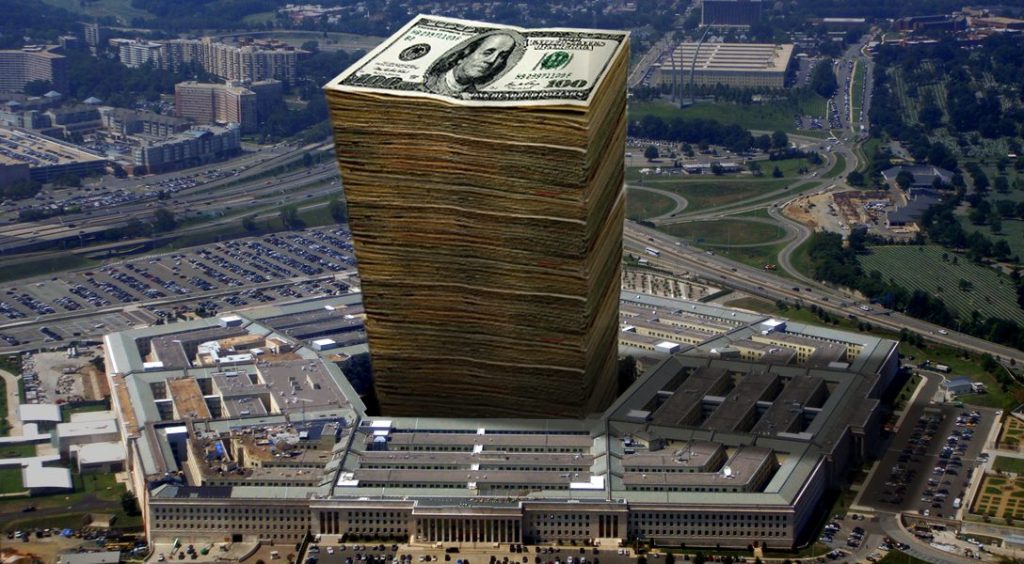
Our Real National Security Budget

$2 Trillion, Here We Come.
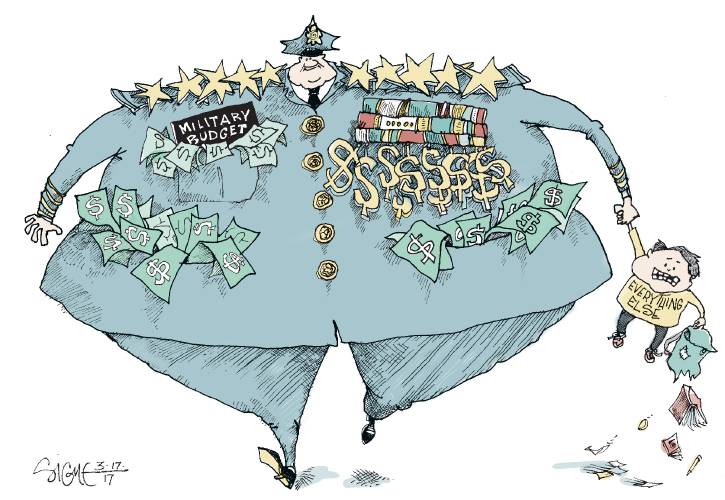
Signe’s second toon du jour SIGN17e Military

By Andrew Cockburn

Source: Spoils of War

The Biden Administration has just published its proposed budget, generating copious commentary, much of it displaying a commensurate degree of misunderstanding, especially regarding our gargantuan national security spending. To get at the truth of the matter, I consulted my friend Winslow Wheeler, who has been observing the insalubrious intricacies of the budget process over the past fifty years as a senior aide to Senators from both parties as well as a senior analyst for the General Accounting Office and directing the Center for Defense Information.

The defense budget has just been posted by the administration is being described as approaching a trillion dollars. Is that accurate?  :

No. It’s actually a lot more than that. In fact it’s beginning to inch up on $2 trillion. 

How so?

The problem is that when most people look at the defense budget, they don’t count everything that we spend even for the Pentagon. But in addition to that, there are hundreds of billions of dollars outside of the Pentagon’s budget that we spend for national security. Things like the nuclear weapons activities in the Department of Energy; that’s $37 billion$26 billion for retired military pensions and healthcare and $12 billion for the Selective Service, the National Defense Stockpile, and a strange and suspicious looking category for the international activities of the FBI in something called “Defense Related Activities.”

Do we have any idea what that last one is for?

It has always been classified. In the 50 years I’ve been watching the defense budget, it’s never been explained other than some occasional hints. One year they admitted to a lot of money being spent by the FBI in, wait for it, Taiwan, and so it’s very unclear exactly what this is, but it’s always counted as part of so-called defense related activities.  

The expenses that I have just been describing come to $970 billion, but that leaves out a lot.. Add in about $800 billion for the Department of Veterans Affairs, the State Department and its associated agencies, the Department of Homeland Security. And we know now from our Republican friends that border protection is a dire national security issue. Add all that together. Then you can calculate the share for the interest on the debt that we pay each year. All those activities I’ve just described come to 21% of all federal spending. Calculating in that percentage as a the amount it contributes to the debt burden gives you $254 billion.. And so you add all of that up together and you get $1.767 trillion.

Jesus Christ.  What about CIA and other intelligence spending?

All the intelligence agencies are in the Pentagon budget except for the intelligence agencies for the State Department, Coast Guard and  the Department of Homeland Security. Those are the few other things that are not in the Pentagon budget that are distributed in the other agencies that I’ve described.  When they last published the total amount for the intel budget it was over $120 billion, but it’s all embedded in these various agencies.

Since the budget was published, there’s been some wailing and lamentation that because of irksome spending restraints, this budget  actually represents a cut or at least restraint on defense spending. What’s your view on that?

Well, last yea the budget deal that then-Speaker Kevin McCarthy negotiated with the Democrats for the Pentagon allowed only a 1% increase in defense spending. But because of the screwy way that we actually calculate things, if you put together everything we spent just for the Pentagon without all those other items I mentioned, last year, it looks like we will have spent $968 billion, while for 2025, Biden’s requesting $921 billion. So yes, that’s a cut. But that doesn’t include the supplementals that Biden will request later this year for the Pentagon, for Ukraine, Israel, God knows what, that will get us back into competition with 2024. The reason why 2024 is higher than the Biden request is because it had 60 billion worth of emergency supplementals that Congress is about to approve and that money is counted in my total. But because of the broken accounting rules that we use for the budget, that money’s not counted when you calculate the deal that McCarthy made with the Democrats, and that’s emergency money that doesn’t count on budget cap.

For years we had the Overseas Contingency Operations defense spending, the so called war budget, which was the extra money the military got for actually fighting wars in Afghanistan and elsewhere. Are we getting back to that?

Yes.  The politically-derived budget caps don’t apply to that money.  And it’s a lot more than just for the wars; lots of billions for goodies for everybody added each year thereIt’s all part of the hocus pocus ways that Congress allows itself to appropriate money so it can pretend that it’s using restraint, but actually is exploiting all kinds of loopholes to increase whatever cap or restraint they pretend that they’ve added to the defense budget.

What’s the next budgetary legislative stage that we’re going to endure?

:We haven’t finished with 2024 yet, because Congress  has gotten into this habit of never passing budgets on time. And it also helps the Speaker of the House and the Majority Leader of the Senate discipline members so they don’t get out of the line on things. We do these things called continuing resolutions that keep the money flowing but only at the level approved in the previous year. And we’re in that situation for the Defense Department for 2024. Next week or the week after, they’re going to resolve that and pick a final total for 2024, which will include most, but probably not all of the emergency supplemental that Biden requested for Ukraine, Israel, Taiwan, and defense industrial base spending. So that number will become final in two or three weeks. We have barely begun on the 2025 consideration in Congress that will take the next three, four months and we’ll have another continuing resolution because they won’t pass things in time for the beginning of the fiscal year on October 1st, and we’ll go through this charade once again. And because this is an election year, it’ll be all that more sloppy, painful, and unappealing to observe.

Then when they do it, Chuck Schumer and whoever is the Speaker of the House will pat themselves on the back and say, ‘well, we’ve done a great job. Who says we can’t do anything. We just got the budget finally passed.’ But that will be months late yet again.

Are there items tacked onto the defense bills that have nothing to do with defense? 

Yes. There’s two bills. One is the National Defense Authorization Act, which is the bill that goes to the House and Senate Armed Services Committees. That’s a policy bill. It doesn’t make money actually available to be spent, but it pretends it does. It has lots of numbers in it; it’s a tar baby for all kinds of crazy stuff or politically driven stuff because the legislative process is so broken.  Members don’t have an opportunity to do stuff on the floor of the House and Senate and especially in the Senate because the Majority Leader exploits the rules to make amendments impossible. The National Defense Authorization Act is one of those bills where they actually get a chance to do amendments and they do all kinds of crazy stuff, lots of stuff that has absolutely nothing to do with national defense.  Last year they had 600 amendments for that bill.

Whew.

But they don’t really get debated. This is yet another way that the Majority Leader, Chuck Schumer, controls things. If you’re a Senator, you have to supplicate Schumer to get him to accept your amendment. That will then will get into a package that he’s blessed and it’ll be adopted wholesale by the Senate with perfunctory debate and members giving staff-written speeches about ‘this is a wonderful bill. It includes my important amendment to increase ice block cutting in Minnesota’ and all kinds of other crazy stuff. Every one of these will have been approved by Schumer or his agents as politically acceptable. If you are a dissenter and have a problem with how things are done in the Pentagon or anywhere else, you will not get Schumer’s blessing and your amendment will not be added to his package to be dumped into the National Defense Authorization Act, and you’ll be out in the cold. We go through essentially the same process with the appropriations bill, which is the one that actually makes the money available to all these agencies. Yet again, Schumer controls the process where if he likes the smell of your amendments and it’s okay with the prevailing political dogma that week or that month or for the last decade, it’ll get included. And if you have something that that Chuck Schumer doesn’t like, your amendment will be out in the cold.

Was it always like this?

When the Senate described itself as the world’s greatest deliberative body back in the 1970s and eighties, it would have a process where a bill would come up on the floor in the Senate, and the Senate took great pride in the fact that it had unlimited amendments, and you could offer an amendment on anything you wanted to all of these bills, whether it’s the National Defense Authorization Act or the FAA Authorization Act, and there would be a proper debate, and then the Senate would vote and the majority of those senators present in voting would prevail.

Today it’s a fundamentally broken process because of the automatic filibuster, which allows the party leaders to totally control things. Unless a Senator can somehow put together sixty votes to override a filibuster, Schumer and McConnell can simply prevent your amendment from even coming to the floor, let alone get debated. It’s also a corrupt process because if you legislate in ways that Chuck Schumer, or whoever is the leader, doesn’t like or your idea is a pain in the ass for the Democratic, or Republican, caucus, you will be on the outs.  Furthermore, Schumer, and McConnell control a large portion of the money that you need for your reelection campaign. And if you don’t behave yourself, you’ll be on the outs, not just on getting your amendment adopted, but you’ll be on the outs so far as getting any of his money is concerned. And for the money that he doesn’t directly control, he’ll be sending the message to the big political donors, ‘don’t give anything to Senator So and So. He’s not one of us; he’s not a good boy.’  That’s the way we do business these days.

Getting back to the defense bill, I saw an item this morning that the Navy is saying they all have to cut back Virginia class submarine production from two to one next year because of their terrible financially straitened circumstances. How do we read that?

There’s two things going on there. One is that the Navy has requested a gigantic ship-building budget, something like $45 billion. The problem is that navy ships are so expensive these days that you can’t fit much dirt into that bag. Those submarines are about $3 billion apiece. Aircraft carriers, and we’re paying for two more, are about $13 billion apiece. They have a brand new ‘low cost’ frigate that’s getting into production this year. Those come in at $1 billion apiece. When you have ships that cost these amounts, even with a gigantic budget, like $45 billion, you can’t buy many of them. The second thing that’s going on is the Navy is tickling the system. They’re saying, ‘Oh dear, we can only afford one sub this year because we’re so stretched running. And isn’t that just terrible?’ So they’re tickling Congress where it feels good, and they’re saying, ‘okay, when you add money, add money for another submarine.’

So does that mean the budget will grow beyond what the President has asked for?

The Biden request is a floor, not a ceiling.

And the other game that goes on is they are actually limited in a relative sense in the billions of dollars that they can add on each year. So the staff on the appropriations committee and the two armed services committees, they go looking for things to cut in the accounts in the Pentagon budget where nobody’s paying much attention. So they can then plow that money back into the stuff that the Navy wants for these submarines, or that Senator X, Y, or Z wants for a research and development program that just happens to be performed in his, or her, state and just happens to be from that company that gave him a healthy political contribution last year.  One of the things the staffs love to cut is training money for the Air Force and others,  because they’ll declare the request to have been excessive. They’ll add that few hundred million dollars to the pot for goodies that members of Congress want. An added problem, of course, is that the Air Force is already way, way behind on trending hours for pilots, and that account needs more money, not less money. There are all kinds of other games that the staff at these committees play to pretend they’re taking out unuseful money, and paying for the oh, so wonderful ideas that members of Congress want for their special requests.

Thank you. At least we’ve been warned.

The Global Deep State: A Fascist World Order Funded by the American Taxpayer

By John & Nisha Whitehead

Source: The Rutherford Institute

“The madmen are in power.”— Philip K. Dick, The Man in the High Castle

The debate over U.S. foreign aid is a distraction.

That’s not to say that the amount of taxpayer money flowing to foreign countries in the form of military and economic assistance is insignificant. Even at less than 1% of the federal budget, the United States still spends more on foreign aid than any other nation.

The latest foreign aid spending bill includes $95 billion for Ukraine, Israel and Taiwan.

Since World War II, the U.S. has given more foreign aid to Israel than any other country ($318 billion), with the bulk of those funds designated for Israel’s military efforts.

Even so, more than 150 countries around the world receive U.S. taxpayer-funded assistance.

As Forbes reports, “U.S. foreign aid dwarfs the federal funds spent by 48 out of 50 state governments annually. Only the state governments of California and New York spent more federal funds than what the U.S. sent abroad each year to foreign countries.”

Whether or not that some of that foreign aid is used for legitimate purposes, the global welfare system itself is riddled with corruption and waste. As Adam Andrzejewski rightly asks, “Do taxpayers instinctively know that they are funding choir directors in Turkmenistan, filmmakers in Peru, aid for poultry farmers Tanzania, and sex education workshops for prostitutes in Ethiopia?”

The problem is not so much that taxpayers are unaware of how their hard-earned dollars are being spent. Rather, “we the people” continue to be told that we have no say in the matter.

We have no real say in how the government runs, or how our taxpayer funds are used, but that doesn’t prevent the government from fleecing us at every turn and forcing us to pay for endless wars that do more to fund the military industrial complex than protect us, pork barrel projects that produce little to nothing, and a police state that serves only to imprison us within its walls.

This financial tyranny persists whether it’s a Democrat or Republican at the helm.

At a time when the government is spending money it doesn’t have on programs it can’t afford, the national debt continues to grow, our infrastructure continues to deteriorate, and our borders continue to be breached.

What is going on?

The “government of the people, by the people, for the people” has been overtaken by a shadow government—a corporatized, militarized, entrenched global bureaucracy—that is fully operational and running the country.

This powerful international cabal made up of international government agencies and corporations—let’s call it the Global Deep State—is just as real as the corporatized, militarized, industrialized American Deep State, and it poses just as great a threat to our rights as individuals under the U.S. Constitution, if not greater.

Clearly, we have entered into a new world order: fascism on a global scale.

It remains unclear whether the American Deep State (“a national-security apparatus that holds sway even over the elected leaders notionally in charge of it”) answers to the Global Deep State, or whether the Global Deep State merely empowers the American Deep State. However, there is no denying the extent to which they are intricately and symbiotically enmeshed and interlocked.

Consider the extent to which our lives and liberties are impacted by this international convergence of governmental and profit-driven corporate interests in the surveillance state, the military industrial complex, the private prison industry, the intelligence sector, the security sector, the technology sector, the telecommunications sector, the transportation sector, and in recent years, the pharmaceutical-health sector.

All of these sectors are dominated by mega-corporations operating on a global scale and working through government channels to increase their profit margins. The profit-driven policies of these global corporate giants influence everything from legislative policies to economics to environmental issues to medical care.

Global Disease

The COVID-19 pandemic propelled us into a whole new global frontier in which those hoping to navigate this interconnected and highly technological world of contact tracing, vaccine passports and digital passes find themselves grappling with issues that touch on deep-seated moral, political, religious and personal questions for which there may be no clear-cut answers.

Our ability to access, engage and move about in the world has now become dependent on which camp we fall into: those who have been vaccinated against whatever the powers-that-be deem to be the latest Disease X versus those who have not.

This is what M.I.T. professor Ramesh Raskar refers to as the new “currency for health,” an apt moniker given the potentially lucrative role that Big Business (Big Pharma and Big Tech, especially) will play in establishing this pay-to-play marketplace. The airline industry has been working on a Travel Pass. IBM is developing a Digital Health Pass. And the U.S. government has been all-too-happy to allow the corporate sector to take the lead.

“It is the latest status symbol. Flash it at the people, and you can get access to concerts, sports arenas or long-forbidden restaurant tables. Some day, it may even help you cross a border without having to quarantine,” writes Heather Murphy for the New York Times. “The new platinum card of the Covid age is the vaccine certificate.”

Global Surveillance

Spearheaded by the National Security Agency, which has shown itself to care little for constitutional limits or privacy, the surveillance state has come to dominate our government and our lives.

Yet the government does not operate alone. It cannot. It requires an accomplice. Thus, the increasingly complex security needs of our massive federal government, especially in the areas of defense, surveillance and data management, have been met within the corporate sector, which has shown itself to be a powerful ally that both depends on and feeds the growth of governmental bureaucracy.

Take AT&T, for instance. Through its vast telecommunications network that crisscrosses the globe, AT&T provides the U.S. government with the complex infrastructure it needs for its mass surveillance programs. According to The Intercept:

“The NSA considers AT&T to be one of its most trusted partners and has lauded the company’s ‘extreme willingness to help.’ It is a collaboration that dates back decades. Little known, however, is that its scope is not restricted to AT&T’s customers. According to the NSA’s documents, it values AT&T not only because it ‘has access to information that transits the nation,’ but also because it maintains unique relationships with other phone and internet providers. The NSA exploits these relationships for surveillance purposes, commandeering AT&T’s massive infrastructure and using it as a platform to covertly tap into communications processed by other companies.”

Now magnify what the U.S. government is doing through AT&T on a global scale, and you have the “14 Eyes Program,” also referred to as the “SIGINT Seniors.” This global spy agency is made up of members from around the world (United States, United Kingdom, Australia, Canada, New Zealand, Denmark, France, Netherlands, Norway, Germany, Belgium, Italy, Sweden, Spain, Israel, Singapore, South Korea, Japan, India and all British Overseas Territories).

Surveillance is just the tip of the iceberg when it comes to these global alliances, however.

Global War Profiteering

War has become a huge money-making venture, and America, with its vast military empire and its incestuous relationship with a host of international defense contractors, is one of its biggest buyers and sellers.

The American military-industrial complex has erected an empire unsurpassed in history in its breadth and scope, one dedicated to conducting perpetual warfare throughout the earth. For example, while erecting a security surveillance state in the U.S., the military-industrial complex has perpetuated a worldwide military empire with American troops stationed in 177 countries (over 70% of the countries worldwide).

Although the federal government obscures so much about its defense spending that accurate figures are difficult to procure, we do know that since 2001, the U.S. government has spent more than $1.8 trillion in the wars in Afghanistan and Iraq (that’s $8.3 million per hour). That doesn’t include wars and military exercises waged around the globe, which are expected to push the total bill upwards of $12 trillion by 2053.

The illicit merger of the global armaments industry and the Pentagon that President Dwight D. Eisenhower warned us against more than 50 years ago has come to represent perhaps the greatest threat to the nation’s fragile infrastructure today. America’s expanding military empire is bleeding the country dry at a rate of more than $15 billion a month (or $20 million an hour)—and that’s just what the government spends on foreign wars. That does not include the cost of maintaining and staffing the 1000-plus U.S. military bases spread around the globe.

Incredibly, although the U.S. constitutes only 5% of the world’s population, America boasts almost 50% of the world’s total military expenditure,  spending more on the military than the next 19 biggest spending nations combined. In fact, the Pentagon spends more on war than all 50 states combined spend on health, education, welfare, and safety. There’s a good reason why “bloated,” “corrupt” and “inefficient” are among the words most commonly applied to the government, especially the Department of Defense and its contractors. Price gouging has become an accepted form of corruption within the American military empire.

It’s not just the American economy that is being gouged, unfortunately.

Driven by a greedy defense sector, the American homeland has been transformed into a battlefield with militarized police and weapons better suited to a war zone. President Biden, marching in lockstep with his predecessors, has continued to expand America’s military empire abroad and domestically in a clear bid to pander to the powerful money interests (military, corporate and security) that run the Deep State and hold the government in its clutches.

Global Policing

Glance at pictures of international police forces and you will have a hard time distinguishing between American police and those belonging to other nations. There’s a reason they all look alike, garbed in the militarized, weaponized uniform of a standing army.

There’s a reason why they act alike, too, and speak a common language of force: they belong to a global police force.

For example, Israel—one of America’s closest international allies and one of the primary yearly recipients of more than $3 billion in U.S. foreign military aid—has been at the forefront of a little-publicized exchange program aimed at training American police to act as occupying forces in their communities. As The Intercept sums it up, American police are “essentially taking lessons from agencies that enforce military rule rather than civil law.”

This idea of global policing is reinforced by the Strong Cities Network program, which trains local police agencies across America in how to identify, fight and prevent extremism, as well as address intolerance within their communities, using all of the resources at their disposal. The cities included in the global network include New York City, Atlanta, Denver, Minneapolis, Paris, London, Montreal, Beirut and Oslo.

The objective is to prevent violent extremism by targeting its source: racism, bigotry, hatred, intolerance, etc. In other words, police—acting as extensions of the United Nations—will identify, monitor and deter individuals who exhibit, express or engage in anything that could be construed as extremist.

Of course, the concern with the government’s anti-extremism program is that it will, in many cases, be utilized to render otherwise lawful, nonviolent activities as potentially extremist.

Keep in mind that the government agencies involved in ferreting out American “extremists” will carry out their objectives—to identify and deter potential extremists—in concert with fusion centers (of which there are 78 nationwide, with partners in the private sector and globally), data collection agencies, behavioral scientists, corporations, social media, and community organizers and by relying on cutting-edge technology for surveillance, facial recognition, predictive policing, biometrics, and behavioral epigenetics (in which life experiences alter one’s genetic makeup).

This is pre-crime on an ideological scale and it’s been a long time coming.

Are you starting to get the picture now?

The government and its global partners have struck a deal that puts the American people on the losing end of the bargain.

On almost every front, whether it’s the war on drugs, or the sale of weapons, or regulating immigration, or establishing prisons, or advancing technology, or fighting a pandemic, if there is a profit to be made and power to be amassed, our freedoms are being eroded while the Global Deep State becomes more entrenched.

We’ve been losing our freedoms so incrementally for so long—sold to us in the name of national security and global peace, maintained by way of martial law disguised as law and order, and enforced by a standing army of militarized police and a political elite determined to maintain their powers at all costs—that it’s hard to pinpoint exactly when it all started going downhill, but we’re certainly on that downward slope now, and things are moving fast.

Given the dramatic expansion, globalization and merger of governmental and corporate powers, we’re not going to recognize this country 20 years from now.

As I make clear in my book Battlefield America: The War on the American People and in its fictional counterpart The Erik Blair Diaries, the U.S. government will not save us from the chains of the Global Deep State. It’s too busy selling us to the highest bidder.

House Passes $886 Billion National Defense Authorization Act

The bill extends Section 702 of FISA, which allows mass warrantless surveillance of Americans

By Dave DeCamp

Source: Antiwar.com

On Thursday, the House passed the $886 billion 2024 National Defense Authorization Act (NDAA), which funds the Pentagon and some military spending for other government agencies. The NDAA has already been passed by the Senate and now heads to President Biden’s desk.

The NDAA includes a provision to extend Section 702 of the Foreign Intelligence, which allows mass warrantless surveillance of Americans. US government agencies portray the law as designed to target foreigners outside of the US, but it allows the collection of any communications they have with Americans, including emails and text messages.

Section 702 was due to expire at the end of this year, but the NDAA extends it to April 19, 2024. According to Rep. Thomas Massie (R-KY), the House only needed 143 votes to strip the extension out of the NDAA, but only 118 House members voted “nay,” including 73 Republicans and 45 Democrats.

“Here are the 118 Representatives who voted to protect your right to privacy. (Nay to FISA warrantless surveillance as part of NDAA),” Massie wrote on X with a picture of the roll call. “We lost but it was close. We needed 143 votes (1/3) to stop FISA since they suspended the rules to bring it to the floor.”

The mammoth $886 billion NDAA is $28 billion more than what was approved last year. President Biden is seeking another $111 billion to fund military aid for Ukraine, Israel, and Taiwan on top of regular military spending, but Republicans are holding out until Democrats agree to a deal on significant changes to border policies.

The new NDAA includes several amendments to fund the US and allied military buildup in the Indo-Pacific that’s aimed at China. One amendment allows the Pentagon to transfer three nuclear-powered Virginia-class submarines to Australia as part of the AUKUS military pact the US, Britain, and Australia signed in 2021 to prepare for a future war with China.

As Maui Burns, Biden Demands Another $24 Billion…For Ukraine

By Ron Paul

Source: Eurasia Review

I am not a big fan of Federal Government disaster relief. Too much of the time the money never gets to those who need it most, and too often Washington’s armies of disaster “experts” are more interested in pushing people around than helping them.

Nevertheless, it’s hard to look at recent footage of the devastation in Maui and then hear President Biden tell Congress that he needs another $24 billion for Ukraine. How can this Administration continue to justify tens of billions of dollars for this losing war that is not in our interest while the rest of the United States disintegrates?

Biden’s new $24 billion request comes on top of well over $120 billion already spent to fight the US proxy war on Russia in Ukraine. Heritage Foundation budget expert Richard Stern has done the math and determined that Biden’s spending on the Ukraine war thus far will cost each and every American household $900. How many Americans would rather have those $900 dollars back in their pocket rather than in the pockets of Lockheed-Martin, Raytheon, and Ukraine’s oligarchs?

Recent surveys have shown that a majority of Americans could not afford to cover a sudden $1,000 emergency. Will Americans connect the dots and realize that the reason they can’t find that $1,000 for an emergency is because the neocons have already sent it to Ukraine?

Ukraine has long been known as among the most corrupt countries on earth and not long ago investigative journalist Seymore Hersh wrote that Ukrainian president Vladimir Zelensky has embezzled at least $400 million in aid from the American people. Corruption scandals continue to break in Ukraine. Just last week Zelensky fired the heads of all local draft boards for corruption. Some press reports suggest that sales of luxury cars in Ukraine have broken all previous records. I wonder why.

No wonder the tide of US public opinion is turning against further involvement in the war. Recently CNN found that among all Americans, more than 55 percent are opposed to continued aid to Ukraine. Among Republicans the number opposing more aid to Ukraine rises to three-out-of-four. That is why we are finally starting to see more Republican Members raising concerns. I’d like to think they have seen the light that an aggressive and interventionist foreign policy is not in America’s interest, but most likely they are worried about losing elections. Whatever their motivation, this turning tide should be welcomed.

Yet the Biden Administration persists in backing Ukraine even as the US mainstream media is increasingly pointing out the obvious: Ukraine is not winning and cannot win, and continuing to pour money into a losing cause will just result in bankruptcy at home and more dead Ukrainians overseas.

Last week Newsweek published an article asking, “Does Ukraine Have Kompromat on Joe Biden?” In the article, Northeastern University Professor Max Abrahms wonders out loud whether Biden’s continued support for Ukraine might be related to compromising information held in Kiev about the many Biden family shady business ventures in Ukraine and the region. It is certainly worth considering.

Meanwhile, the residents of Maui that survived the recent horrific fire will take little comfort knowing that the Biden Administration is more interested in sending their money to Ukraine than in helping them recover.

The Ukraine Mess is Animal Farm in Reverse: Starring Blackrock and Other Pigs

By Phil Butler

Source: New Eastern Outlook

Recently, the head of the European Commission, Ursula von der Leyen, said that the European Union should double its assistance to Ukraine. She went on to say the EU should create a support fund of 50 billion euros by the end of the year and that everything should be done to ensure victory on the battlefield for the Ukrainians.

The European Union has created a “support package” for Ukraine for 2023 of up to €18 billion. This money, however, is not in the form of gifts, grants, or to create an emergency war chest. These billions are a loan under an EU macro-financial assistance program dubbed the MFA+ Instrument. In the fine print, EU member states are guaranteeing these loans as well as paying the interest for the Ukrainians. The move is extraordinary given that Ukraine is not an EU member and that, even before the current conflict, was one of the most corrupt governments on Earth. This begs the question, “Why?”

The EU is issuing special bonds to be sold to investors for this purpose at a time when many people in the European Union go without proper healthcare, services, and even employment. The European Union, EU Member States, and European financial institutions have already dispersed some €49 billion to President Zelensky’s regime. This figure, added to the $76.8 billion already funneled to Ukraine, dwarfs any assistance given to any other country in the world. This very conservative report from the Council of Foreign Relations shows the U.S. alone has shoveled more into Zelensky’s coffers than Afghanistan, Israel, Jordan, Ethiopia, and Iraq combined in 2020.

In all, some 47 countries have given money and arms to Ukraine. As of now, EU Institutions (?) handed Zelensky over €30 billion. The UK has forked over about €10 billion as their pensioners worry about what’s for dinner next. Germany has given somewhere around €8 billion, and Japan almost €7 billion. The Netherlands, Canada, and Poland have pitched in about €5 billion each, and the list of others about €14 billion. The numbers, as you would expect, do not all add up. A U.S. News & World Reports story from earlier this year claimed total aid to Zelensky’s country had exceeded €150 billion as of January of this year. Again, why?

The answer, this time, is really simple. BlackRock, and the new investment initiative to rebuild Ukraine (whatever’s left of it). You already knew this, right? Zelensky and BlackRock’s BlackRock CEO Larry Fink met late last year, and in November, the Ukrainian Ministry of the Economy (MoE) and BlackRock Financial Markets Advisory (FMA) signed a memorandum to structure Ukraine’s reconstruction funds (PDF). Also, in on the moneymaking schemes in war-torn Ukraine are Nestlé, International Finance Corporation, the private investment arm of the World Bank, Australia’s Tattarang Group,

Zelensky has called the rebuilding of his country, once it’s been used up as a proxy NATO against Russia, “the greatest opportunity in Europe since World War Two.” Earlier this year, Fink told Barron’s and other financial magazines that Western investors will be “flooding” Ukraine post-war and the country could become “a beacon to the rest of the world of the power of capitalism”. Also, JPMorgan Chase is joining BlackRock to help Ukraine set up a reconstruction bank to steer public seed capital.

This American Conservative report says, “BlackRock Plots to Buy Ukraine,” in a recent editorial. Author Bradley Devlin outlines the Ukraine case, while also revealing how Fink and BlackRock are transforming America into a nation of renters by artificially elevating the prices of normal houses. If ever a man were appropriately named, Fink is that man.

“Why?” Is there any doubt about why some poor untrained bartender from Kyiv is in a foxhole being bombarded by Russian artillery? Doesn’t all the misleading media, inflated Ukraine military gains, and Joe Biden’s cock of the walk attitude toward a peace deal make more sense now? And Ursula, the lady I fondly refer to as Frau von der Clucky for her chicken-like pecking and strutting about while millions either die or are in harm’s way because of all the Western world barnyard antics right out of Orwell’s Animal Farm. While someone’s Dad takes a bullet or shrapnel in Donetsk, our leaders keep crowing, snorting, braying, and hog-wallering in their capitalistic farm dream.

Why? Greed, that’s why.

$850 Billion Chicken Comes Home to Roost.

War Reveals U.S. Military’s Longtime Disinterest in War.

Signe’s second toon du jour SIGN17e Military

By Andrew Cockburn

Source: Spoils of War

Watching a recent video of Ukrainian troops scrambling out of a U.S.-supplied Bradley armored fighting vehicle just after it hit a mine, I remembered how hard the U.S. Army bureaucrats and contractors who developed the weapon had fought to keep this vehicle a death trap for anyone riding inside. As originally designed, Bradleys promptly burst into flame when hit with anything much more powerful than a BB pellet, incinerating anyone riding inside. The armor bureaucrats were well aware of this defect, but pausing development for a redesign might have hurt their budget, so they delayed and cheated on tests to keep the program on track. Prior to one test, they covertly substituted water-tanks for the ammunition that would otherwise explode. Only when Jim Burton, a courageous air force lieutenant colonel from the Pentagon’s testing office, enlisted Congress to mandate a proper live fire test were the army’s malign subterfuges exposed and corrected. His principled stand cost him his career, but the Bradley was redesigned, rendering it less potentially lethal for passengers. Hence, forty years on, the survival of those lucky Ukrainians.

This largely forgotten episode serves as a vivid example of an essential truth about our military machine: it is not interested in war.

How else to understand the lack of concern for the lives of troops, or producing a functioning weapon system? As Burton observed in his instructive 1993 memoir Pentagon Wars, the U.S. defense system is “a corrupt business — ethically and morally corrupt from top to bottom.”

Nothing has happened in the intervening years to contradict this assessment, with potentially grim consequences for men and women on the front line. Today, for example, the U.S. Air Force is abandoning its traditional role of protecting and coordinating with troops on the ground, otherwise known as Close Air Support, or CAS. Given its time-honored record of bombing campaigns that had little or no effect on the course of wars, CAS has probably been the only useful function (grudgingly) performed by the service.

The Air Force has always resented the close support mission, accepting the role only because handing it to the Army would entail losing budget share. Thus the A-10 “Warthog” aircraft, specifically dedicated to CAS, was developed by the air force only to ward off a threat from the Army to steal the mission with a new helicopter. As it turned out, the A-10, thanks to the dedicated genius of its creators, notably the late Pierre Sprey, was supremely suited to the mission. But its successful record cuts no ice with the air force, which has worked with might and main to get rid of the A-10 ever since the threat of an army competitor in the eternal battle for budget share had been eliminated.

That campaign is now entering its final stages. The air force is not only getting rid of its remaining fleet of A-10s, it is also eliminating the capability to perform the close air support mission by phasing out the training for pilots and ground controllers essential for this highly specialized task. True, the service claims that the infamously deficient F-35 “fighter” can and will undertake the mission, but that is a laughable notion for many reasons, including the fact that the plane’s 25 mm cannon cannot shoot straight. The consequences for American troops on the ground in future wars will be dire, but their fate apparently carries little weight when set against the unquenchable urge of the air force to assert its independence from the messy realities of ground combat, where wars are won or lost. Thus its hopes and budget plans are focussed on costly systems of dubious relevance to warfare such as the new B-21 bomber, the new Sentinel ICBM, and the Next Generation Air Dominance fighter, none of which will fly for years to come, except in the form of cash out of our pockets.

Pentagon spending this year is projected to nudge $850 billion. (The total national security bill is already way past a trillion, but that’s another story.) Yet, even when endowed with such a gigantic pile of cash, the system is apparently incapable of furnishing the wherewithal for even a limited war, such as the one currently underway in Ukraine. The conflict has been marked by successive announcements that progressively more potent weapon systems are being shipped to the Ukrainians -Javelins anti-tank missiles, 155 mm Howitzers, HIMARS precision long range missiles, Patriots air defense missiles, Abrams tanks, with F-16 fighters in the offing. A U.S. military intelligence officer pointed out to me recently the actual basis on which these systems are selected: “when we run out of the last system we were sending.”

Now Biden has generated global outrage by promising to send cluster bombs, known for their ability to kill and maim children fifty years after the relevant war has ended, as any Laotian farmer could tell you. The military rationale for their use is their supposed utility against “soft” targets such as dismounted infantry, radars, and wheeled vehicles. However, a former armor officer and veteran of the 1991 Gulf war recalled to me that “we disliked them intensely and pleaded with the artillery and Air Force not to employ them. They simply damaged support elements and wheels that followed us into action. After the war we treated numerous people wounded by them including our own soldiers, as well as civilians (children).”

Biden has admitted that these devices are being sent only because the U.S. is running out of the artillery ammunition that the Ukrainians actually require. “This is a war relating to munitions. And they’re running out of that ammunition, and we’re low on it,” he told a TV interviewer. So off go the cluster bombs, their passage lubricated by crocodile tears from administration officials: “I’m not going to stand up here and say it was easy…It’s a decision that required a real hard look at the potential harm to civilians” National Security Adviser Jake Sullivan told reporters. (Back when it was reported that the Russians were using cluster bombs in Ukraine, then-White House Press Secretary Jen Psaki denounced such action as “a war crime.”)

So, the richest war machine in history, having scraped its cupboard bare, is now reduced to fielding a device of dubious military utility deemed illegal by over a hundred countries. That’s what we get for our $850 billion.

House Passes $886 Billion National Defense Authorization Act

The bill narrowly passed in a vote of 219-210 due to a partisan divide over amendments included by Republicans

By Dave DeCamp

Source: AntiWar.com

The House on Friday passed its version 2024 National Defense Authorization Act in a vote of 219-210, which largely fell along partisan lines due to amendments added by Republicans relating to social policies in the military.

The Republican amendments covered abortion, transgender surgery, and diversity initiatives. Only four Democrats voted in favor of the bill, and four Republicans voted against it. The four Republicans who opposed the NDAA are Reps. Thomas Massie (KY), Eli Crane (AZ), Andy Biggs (AZ), and Ken Buck (CO).

The Senate still needs to pass its version of the NDAA, then the two chambers will negotiate the final version that will go to President Biden’s desk. The Republican amendments packed into the House version will set up a fight between the two chambers as Senate Majority Leader Chuck Schumer (D-NY) and other Democrats will reject them.

The 2024 NDAA is for a record $886 billion, the same amount President Biden requested. The debt ceiling deal reached between House Republicans in the White House did not limit military spending and put no caps on emergency supplemental funds, which is how the US has been spending on the war in Ukraine.

As the House was debating the NDAA, several amendments introduced by Republicans looking to rein in US support for Ukraine were voted down. One amendment sponsored by Rep. Warren Davidson (R-OH) would have required the Biden administration to develop a strategy for the war in Ukraine. It was rejected in a vote of 129-301, with only Republicans supporting it.

One amendment introduced by Rep. Marjorie Taylor Greene would have cut $300 million in military aid for Ukraine that’s packed into the NDAA, but it failed in a vote of 89-341. Rep. Matt Gaetz (R-FL) put forward an amendment to cut off all military assistance for Ukraine, which failed in a vote of 70-358. Only Republicans supported the two amendments.

Greene sponsored another amendment that would have prohibited the transfer of cluster munitions to Ukraine, although US cluster bombs have already arrived in the country. The effort failed in a vote of 147-276. It received support from 98 Republicans and 49 Democrats.

A War Like No Other in Ukraine

By Peter Van Buren

Source: WeMeantWell.com

Joe Biden created for the U.S. a war like no other, one where others die and the U.S. simply sits back and pays the bills on a gargantuan scale. No attempts are made at diplomacy by the Americans, and the diplomatic efforts of others like the Chinese are dismissed as evil attempts to gain influence in the area (similar for Chinese diplomatic work in the Yemen war.) Biden is coming close to achieving 1984‘s goal of perpetual warfare while only putting a handful of American lives at risk. He has learned lessons from the Cold War, and already put them into play. Can we call it the Biden Doctrine yet?

Biden’s strategy is clear enough now after well more than a year of conflict; what he has been sending to Ukraine jumped from helmets and uniforms to F-16s in only 15 months and shows no signs of stopping. The problem is U.S. weapons are never enough for victory and always “just enough” to allow the battle to go on until then next round. If the Ukrainians think they are playing the U.S. for suckers for free arms they best check who is really paying for everything, in blood.

Putin is playing this game himself in a way, careful not to introduce anything too powerful, such as strategic bombers, and upset the balance and offer Biden the chance to intervene in the war directly (one can hear old man Biden on TV now, explaining American airstrikes are needed to prevent a genocide, the go-to excuse he learned at Obama’s knee.) That’s what the current escalation holds, airpower. Ukraine will find even with the promise of the F-16 it can’t acquire aircraft and train up pilots fast enough (minimum training time is 18-24 months), and next will be begging the U.S. to serve as its air force. As it is the planes are likely to be based out of Poland and Romania, suggesting NATO will pick up the high-skilled tasks of maintaining and repairing them. Left unclear is the NATO role in required aerial refueling to keep the planes over the battlefield. F-16s aside, a spin off bonus to all these weapons gifts is that the vast majority of transfers to date have been “presidential drawdowns.” This means the U.S. sends used or older weapons to Ukraine, after which the Pentagon can use the Congressionally-authorized funds to replenish their stocks by purchasing new arms. The irony that war machines once in Iraq are now on the ground in Ukraine can’t be missed.

The U.S. strategy seems based on creating a ghastly tie of sorts, two sides lined up across a field shooting at each other until one side called it quits for the day. Same as in 1865, same as in 1914, but the new factor is today those armies face off across those fields with 21st-century HIMARS artillery, machine guns, and other tools of killing far more effective than a musket. It is unsustainable, literally chewing up men, albeit not Americans. The question meanwhile of how many more Ukrainians have to die is answered privately by Joe Biden as “potentially all of them.” Anything else requires you to cynically believe Biden thinks he can simply purchase victory,

Up until now this has all been the Cold War playbook. Fighting to the last Afghan was a strategy perfected in Soviet-held Afghanistan in the 1980s. Yet what is different is the scale — since Russia invaded Ukraine, the United States sent over $37 billion worth of military aid to support Kiev’s war effort, the single largest arms transfer in U.S. history and one with no signs of stopping. A single F-16 costs up to $350 million a copy if bought with weapons, maintenance equipment, and spare parts kits.

Yet despite the similarities to Cold War Strategy 101, some lessons have been learned over the intervening years. One of America’s fail-points throughout the Cold War and the War on Terror was the use of puppet governments largely imposed or direly supported by American money and muscle. Because these governments lacked the support of the people (see Vietnam, Iraq, and Afghanistan) they were non-starters with the lifespan of fruit flies. Ukraine is different; the puppet government is the government, beholden to the U.S. for its very survival but more or less supported directly by the people for now.

The other lesson learned has to do with nation building, or rebuilding or reconstruction, whatever the vast post-war expenditures will be called in this conflict. No more straight-up governmental efforts as in Vietnam, Iraq, and Afghanistan. This time it will be all private enterprise. “It is obvious that American business can become the locomotive that will once again push forward global economic growth,” President Zelensky said, boasting that BlackRock, JP Morgan, and Goldman Sachs, and others “have already become part of our Ukrainian way.”

The NYT calls Ukraine “the world’s largest construction site” and predicts projects there in the multi-billions, as high in some estimates as $750 billion. It will be, says the Times, a “gold rush: the reconstruction of Ukraine once the war is over. Russia is stepping up its offensive heading into the second year of the war, but already the staggering rebuilding task is evident. Hundreds of thousands of homes, schools, hospitals and factories have been obliterated along with critical energy facilities and miles of roads, rail tracks and seaports. The profound human tragedy is unavoidably also a huge economic opportunity.” Earlier this year JP Morgan and Zelensky signed a memorandum of understanding stipulating Morgan would assist Ukraine in its reconstruction.

And maybe those large American companies have learned the lessons of Iraq and Afghanistan. Of the billions spent, much money was wasted on dead ends and much was siphoned off due to corruption. But success or failure, the contractors always got paid in our Wars of Terror. With that in mind, more than 300 companies from 22 countries signed up for a Rebuild Ukraine exhibition and conference in Warsaw. At the World Economic Forum in Davos, Switzerland, a standing-room-only crowd packed Ukraine House to discuss investment opportunities.

The eventual gold rush in rebuilding makes for an interesting addendum to the Biden strategy of fighting to the last Ukrainian. The more that is destroyed the more that needs to be rebuilt, and the potential for more money to pour into U.S. companies smart enough to wait by the trough for the killing to subside. But why wait? Drones operated by Danish companies have already mapped every bombed-out structure in the Mykolaiv Oblast region, with an eye toward using the data to help decide what reconstruction contracts should be issued.

So let’s put some lipstick on this pig of a strategy and call it the Biden Doctrine. Part I is to limit direct U.S. combat involvement while fanning the flames for others. Part II is to provide massive amounts of arms to enable a fight to the last local person. Part III is to transform the home government into a puppet instead of creating an unpopular one afresh. Part IV is to turn the reconstruction process into a profit center for American companies. How long the war lasts and how many die are cynically not part of the strategy. The off ramp in Ukraine, a diplomatic outcome that resets the map to pre-invasion 2022 levels, is clear enough to Washington. The Biden administration seems content, shamefully, not to call forcefully for diplomatic efforts but instead to bleed out the Russians as if this was Afghanistan 1980, albeit in the heart of Europe.