Two for Tuesday
Reply

By Keith Carlington
Source: Keith and the Movies
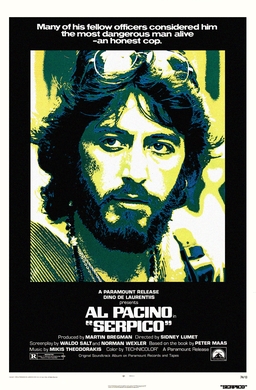
1973’s “Serpico” was almost a much different movie. By that I don’t mean a different spin or a different genre. I mean there were some dramatically different creatives first attached to the gritty biographical crime drama. Sam Peckinpah was once in line to direct but eventually backed out. But the kicker was Robert Redford and Paul Newman, both relatively fresh off working together in “Butch Cassidy and the Sundance Kid” and “The Sting”, were set to star with Redford playing the titular character Frank Serpico. They too left the project.
It was a bumpy road, but soon Sidney Lumet was brought in to direct. Even more notable, Al Pacino was given the lead role. Written by Waldo Salt and Norman Wexler, “Serpico” was an adaptation of a 1973 book by author Peter Maas. It told the true story of New York City police officer Frank Serpico who came face to face with rampant police corruption. It was a gutsy film for its time and it received criticism from some within the NYPD and other groups who claimed the feature overlooked key parts and underrepresented key people from the true account.
Early on we see Frank Serpico as a young ambitious Italian who graduated from the New York Police Academy and was eventually stationed at a hopping downtown precinct. He starts as a patrolman but his feel for the street gets him promoted to a plainclothes officer. But he quickly begins seeing the underside of the department. And when he refuses to take a $300 payoff, Frank breaks an unwritten rule within the fraternity that puts him at odds with many of his fellow cops.
Pressure mounts for Frank to fall in line but he continues to resist, going as far as to become the eyes and ears of the commissioner. With a target on his back from both within and outside the department, Frank finds himself buckling under the pressure. Pacino’s performance organically evolves throughout the movie, turning his character from a well-intended but naive idealist to a hardened and stressed-out cynic. Pacino’s appearance mirrors the change, going from clean and buttoned-up to blousy shirts, bucket hats, and sandals.
Pacino would go on to win a Golden Globe and be nominated for an Academy Award for his performance. While the script doesn’t always do his character favors, Pacino is able to keep both his character and the story itself centered. He’s helped by a solid supporting cast featuring John Randolph, Jack Kehoe, Barbara Eda-Young, Tony Roberts, and Biff McGuire. Look close and you’ll also catch a couple of fun uncredited appearances by Judd Hirsch and F. Murray Abraham.
“Serpico” certainly had its detractors mainly among those who felt it veered too far away from the true account and was a little too selective in how it chose to focus its story. But as entertainment goes it works well as a big city crime drama with a sprinkle of neo-noir flavoring. And in the end the strengths of Lumet’s direction, Pacino’s performance, and Arthur J. Ornitz’s gritty cinematography are more than enough to get past the film’s handful of stumbles.
Watch Serpico on Fawesome.tv here: https://fawesome.tv/movies/10693246/serpico?utm_source=Reelgood&utm_medium=RG

Discovering human nature
By Roger Ebert
Source: RogerEbert.com
Dark City” by Alex Proyas resembles its great silent predecessor “Metropolis” in asking what it is that makes us human, and why it cannot be changed by decree. Both films are about false worlds created to fabricate ideal societies, and in both the machinery of the rulers is destroyed by the hearts of the ruled. Both are parables in which a dangerous weapon attacks the order of things: a free human who can see what really is, and question it. “Dark City” contains a threat more terrible than any of the horrors in “Metropolis,” because the rulers of the city can control the memories of its citizens; if we are the sum of all that has happened to us, then what are we when nothing has happened to us?
In “Dark City” (1998), all of the human memories are newly fabricated when the hands of the clock reach 12. This is defined as “midnight,” but the term is deceptive, because there is no noon. “First came darkness, then came the Strangers,” we are told in the opening narration. In the beginning, there was no light. John Murdoch, the hero, asks Bumstead, the police detective: “When was the last time you remember doing something during the day?” Bumstead is surprised by the question. “You know something?” Murdoch asks him. “I don’t think the sun even exists in this place. I’ve been up for hours and hours, and the night never ends here.”
The narration explains that the Strangers came from another galaxy and collected a group of humans to study them. Their civilization is dying. They seek to find the secret of the human heart, or soul, or whatever it is that falls outside their compass. They create a vast artificial city, which can be fabricated, or “tuned,” whenever they want to run another experiment.
We see the tuning taking place. All humans lose consciousness. All machinery stops. Changes are made in the city. Skyscrapers are extruded from the primordial materials of the underworld, architecture is devised, rooms are prepared for their inhabitants, props are set in place. Aided by a human scientist, the Strangers inject memories into the foreheads of their test subjects. When humans awaken, they have no memory of the day before; everything they remember has been injected from a communal memory bank. If a man commits murder one day and then is given a new identity, is he still capable of committing murder? Are men inherently good or evil, or is it a matter of how they think of themselves? The Strangers need to know.
Murdoch (Rufus Sewell) has developed an immunity to the devices of the Strangers. His latest memory injection was incomplete. It was administered by Dr. Schreber (Kiefer Sutherland), a scientist who works for the Strangers but has no love for them. Murdoch wakes in a hotel room with the corpse of a dead woman; the script for the day has made him a serial killer of prostitutes. Schreber warns him he is the subject of an experiment but has proven resistant to it. The Strangers are coming for him, and he must flee.
That sets the story into motion: Murdoch wanders through the city, trying to discover its underlying nature; Detective Bumstead (William Hurt) tries to capture him, but will gradually be won over by Murdoch’s questions (he is programmed as a cop, but not a very good one; he keeps complaining, “no one ever listens to me”). Then there is the torch singer, Emma (Jennifer Connelly), who remembers that she is John’s wife and loves him, and that they met at Shell Beach. Everyone says they know how to go to Shell Beach. But no one seems able to say exactly where it is.
The Strangers occupy the bodies of human cadavers. Most of them are tall; one is in a child’s body but is no child. The alien beings themselves, living inside the corpses, look like spiders made of frightened noodles. They can levitate, they can change the matter of the city at will, they have a hive insect organization, they gather in a subterranean cavern to collectively retune the city. This cavern has visuals reminding us of two Fritz Lang films: the underworld mechanisms in “Metropolis” (1927) and his “M” (1931), with the pale faces of criminals rising row above row into the gloom.
In October, I went through “Dark City” a shot at a time for four days at the Hawaii Film festival, with moviegoers who were as curious as I was. We froze frames, we dissected special effects, we debated the meaning of the film, and our numbers even included a psychiatrist who told us of the original Daniel Schreber, a schizophrenic whose book on his condition influenced Freud and Jung.
Sometimes during the shot-by-shot analysis, we simply froze a frame and regarded it. Some of the street scenes echo paintings by Edward Hopper or Jack Vettriano. This is not only a beautiful film but a generous one, which supplies rich depth and imagination and many more details than are really necessary to tell the story. Small wonder that the name Bumstead appears, perhaps in honor of Henry Bumstead, one of the greatest Hollywood art directors. The world created by the Strangers seems borrowed from 1940s film noir; we see fedoras, cigarettes, neon signs, automats, older cars (and some newer ones — the world is not consistent). Proyas wrote the screenplay with David S. Goyer and Lem Dobbs; the screenplays Dobbs wrote for “Kafka” and Goyer wrote for “Batman Begins” contain some of the same notes sounded here.
Proyas likes deep-focus compositions. Many interior spaces are long and narrow. Exteriors look down one street to the vanishing point, and then the camera pans to look down another street, equally long. The lighting is low-key and moody. The color scheme depends on blacks, browns, shadows and the pallor of the Strangers; warmer colors exist in human faces, in neon signs and on the billboard for Shell Beach. “I am simply grateful for this shot,” I said in Hawaii more than once. “It is as well-done as it can possibly be.” Many other great films give you the same feeling — that their makers were carried far beyond the actual requirements of their work into the passion of creating something wonderful.
I believe more than ever that “Dark City” is one of the great modern films. It preceded “The Matrix” by a year (both films used a few of the same sets in Australia), and on a smaller budget, with special effects that owe as much to imagination as to technology, did what “The Matrix” wanted to do, earlier and with more feeling.
The poignancy of “Dark City” emerges in its love stories. At a crucial point, John Murdoch tells Emma, “Everything you remember, and everything I’m supposed to remember, never really happened.” Emma doesn’t think that can be true. “I so vividly remember meeting you,” she says. “I remember falling in love with you.” Yes, she remembers. But this is the first time they have met. “I love you, John,” she says. “You can’t fake something like that.” And Murdoch says, “No, you can’t.” You can inform someone who they love, and that is what the Strangers have done with their memory injection. But what she feels cannot be injected. That is the part the strangers do not understand. Emma has a small role but it is at the heart of the movie, because she truly knows love; John has still to discover it — to learn about it from her.
The Strangers are not evil. They simply proceed from alien assumptions. They are not even omnipotent, which is why Murdoch, Bumstead and Schreber have relative freedom to move about the city. At the end, we feel a little sorry for them. They will die surrounded by happy beings whose secrets they could not discover.
Notice an opening shot that approaches the hotel window behind which we meet Murdoch. The window is a circular dome in a rectangular frame. As clearly as possible, it looks like the “face” of Hal 9000 in “2001.” Hal was a computer that understood everything, except what it was to be human and have emotions. “Dark City” considers the same theme in a film that creates a completely artificial world in which humans teach themselves to be themselves.
Watch Dark City on tubi here: https://tubitv.com/movies/100017001/dark-city
By Mr. Arkadin
Source: The Silver Screen Oasis
“You are not a child anymore. You soon will be a goddamn man. Start learning what life is about now son.”
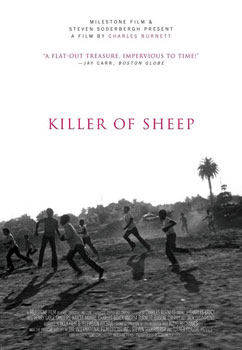
Killer of Sheep is that rare film that eschews plot and story lines for human experience. The movie opens in the past with a reprimand to young Stan, and to us as well. We join Stan in the present, his wife and children in the seedy Watts section of Los Angeles. We will live with them for only eighty-three minutes, but in this short time, director Charles Burnett will present us with life in all its flawed beauty. What we learn is up to us.
The origins of KOS are well known. While studying at UCLA, Burnett began making ample use of the universities film lab and equipment. Dismayed by Blaxploitation film, which dealt with stereotypes (most of them criminal), Burnett drew inspiration from Neorealism and the work of Vittorio De Sica whose work explored the lives and emotions of the everyday man. Non-actors fill most of these roles in true De Sica fashion. Burnett had originally envisioned a three film series about Stan and his wife, but limited funds and equipment use (UCLA wanted their lab back) has only left us with a small portion of Burnett’s epic.
Raising a family in deteriorating Watts, Sam is a man of much mileage who has long since run down. Despairing of personal hopes and dreams, he works at a nearby slaughterhouse where cool detachment has become his way of life. For Stan to admit his total desperation would be suicide. Instead, he is a sleepwalker doing the things he must to survive. Insulated and isolated, Stan is almost unreachable by those who love him.
Burnett got his start in photography and much of KOS is just that—pictures and music. We are observers of a certain kind of life here and perhaps the most touching thing about this film, is the fact that Burnett trusts us with his vision. We walk around his neighborhood taking in the sights, making up our own minds about what we see. Many of these wordless scenes can be viewed as small vignettes or parables that attempt to explain black life as a whole: A child laying under a train while another playfully steals his shoes, Kids jumping across rooftops heedless of danger, or Stan’s lonely dance with his wife as they are unable to connect physically or emotionally.
If pictures tell stories, Burnett’s choice of music provides context and commentary on his social backdrop. Sheep hanging in the slaughterhouse suggest it is “A Mean old World” (Little Walter) indeed. Paul Robeson’s “That’s America To Me” underscores the harsh reality that the American Dream is only a fantasy for the impoverished. Earth Wind and Fire’s “Reasons” is a record played by Stan’s child who sings along while Stan’s wife puts on makeup, arranges her hair and dress for her man who has long since lost interest. Burnett shows his genius here by cutting between the two rooms, showing us daughter and mother listening to the same song, which has a different meaning for each of them. When Stan’s wife looks in on their child it’s a bittersweet moment. Here is a little girl singing along to an adult-themed song about love. When Stan’s wife appears in the frame we wonder if she is the embodiment of what this child will become. Will her fate be the same as her mother?
Although the movie has its share of bleak moments, if Stan were merely a miserable man, this wouldn’t be much of a film. His refusal to admit his situation (“We ain’t poor! I give stuff to the Salvation Army!”) belies his inability to climb out of it. A man can live without many things, but honor is not one of them. There’s also humor in Stan’s son, who is always in trouble (he likes a little bit of cereal with his sugar and milk), Stan’s adventure buying the used motor, or the gang drinking in the windowless car. There is a tenderness as well. Stan loves his daughter. She is the only thing that can still touch his heart. When he plays with her, you know that beauty and love still exist for him—even in the darkest places of his soul.
Although Killer of Sheep owes much to De Sica and the Neorealist movement, it is fundamentally different in the fact that there is no crisis that changes Stan’s outlook. In Bicycle Thieves (1948) or Umberto D. (1953), crisis creates change. KOS provides no such easy outlets and we are left pondering hard questions with no easy answers. At the end of the film Stan’s circumstances haven’t changed, but he has. His view is not one of acceptance or understanding, but determination.
As Stan drives the sheep to the killing floor, we realize there is no hope for his situation. It’s for his children that he does these things now, in hopes they will leap across the void that separates these separate American existences. Is he a defeated man? Perhaps. That’s a question Burnett wisely leaves in our hands, rather than moralizing. Stan might not have the stars to play with nor the moon to run away with, but he has some things money cannot achieve—namely his community and the love of his family.
When new life comes to the neighborhood, it grows at the personal cost and sacrifice of others to sustain and nurture it. We see this in the death of the sheep and perhaps the death of Stan’s hopes and aspirations, which are unfulfilled. Stan does have hope for his children, and this hope has returned him to the human race and drives him on. These things, like the sugar that sweetens his son’s cereal, temper his life and help him to see that perhaps his journey on this earth is not so bitter after all.
Watch Killer of Sheep on Hoopla here: https://www.hoopladigital.com/movie/killer-of-sheep-henry-gayle-sanders/18383114

By Vern
Source: Vern’s Reviews
After I watched DR. WAI IN “THE SCRIPTURE WITH NO WORDS” for the specific reason that it was a Jet Li movie directed by Ching Siu-Tung, I realized I should watch the more recent movie that fits the same description. THE SORCERER AND THE WHITE SNAKE (2011) is another fantasy martial arts romance, outlandish in a different way than the other one because it’s based on a Chinese legend about animal demons.
Li plays the titular sorcerer, a truck trying to carry explosives across a shaky rope bridge, and of course Whitesnake play themselves, performing many of their hits as well as debuting songs from that year’s album Forevermore. At least I assume that was what Ching intended, but he caved to the bean-counters, so instead Li plays a skilled Buddhist demon hunter called Abbott Fahai, and early in the movie we are abruptly confronted with the sight of two beautiful human lady torsos with scale-covered breasts and giant snake body lower halves, rolling around sexily on top of each other. It’s one of those things where I’m kind of icked out by it but also very happy for whatever number of people there are out there who are into snake ladies and are sorely underserved by mainstream cinema. Merry Christmas, you pervs.
Anyway, they seem to be going at it, but I guess they’re supposed to be sisters frolicking. The green snake is Quingqing (Charlene Choi, THE TWINS EFFECT, TWINS MISSION) and the white snake is Susu (Eva Huang, KUNG FU HUSTLE, DRAGON SQUAD). They’re spying on some humans climbing a mountain to find herbs, and Quingqing decides to go play a prank on them – appearing in giant snake form to hiss at young herbalist Xu Xian (Raymond Lam, SAVING GENERAL YANG), scaring him so bad he falls off the mountain into the water.
Susu has a conscience and/or thinks Xu Xian is a cutey, so she switches to human form and resuscitates him in the form of a romantic underwater kiss. And then it becomes a thing where she comes into civilization in human form and courts him, but he rejects her at first, thinking he’s in love with this person he doesn’t quite remember who saved his life. (Rather than tell him “That’s me, stupid” she knocks him into the water and does it again.) Tagging along, Quingqing befriends Abbott Fahai’s assistant Neng Ren (Wen Zhang, THE GUILLOTINES, THE MERMAID), who luckily is bad at using his little dial that detects demons.
Well, maybe not lucky, because he doesn’t notice the ENTIRE BOAT FULL OF LADY BAT DEMONS that Quingqing casually points out to him. This leads to one of the better action sequences, when the Abbott flies in and leapfrogs across a succession of boats, including several canoes that are mid-air after being launched by a big wave. He and Neng Ren battle a swarm of humans with with bat wings as well as a more monstrous digital character. That part seems kinda like a Hong Kong take on VAN HELSING.
Xu Xian and Susu end up getting married, but he doesn’t know she’s a snake demon, and those type of secrets are not good for marriages. So the scene where Fahai attacks her and she turns into a snake and he sees it is kind of like somebody walking in on their wife straddling some dude. Luckily he forgives her, but only after accidentally stabbing her with a magic dagger (you know how it is) so it becomes a quest to get a rare magic root that will heal her.
The style of the movie is a little schizophrenic. Much of it has a very clean digital look that seems chintzy compared to Hollywood movies. For example, in the opening scene Abbott Fahai and Neng Ren step out into a blizzard and battle an ice harpy (Vivian Hsu, THE ACCIDENTAL SPY) and it’s all extremely green-screeny, with an FX-based battle where Li and his doubles are spinning a staff around and doing moves, but the frame drops, flying and ice beam FX make it seem like it’s pretty much an animated movie. (It’s also one of those movies that is very clearly designed to take advantage of 3D.) But then it cuts to some beautiful actual locations, and the lantern festival sequence looks like a huge set on a soundstage – it kind of feels like a Disneyland ride, which is a compliment.
I love the unashamed way movies like this present their mythological reality – it’s so different from the west, where artists fear straying from realism and the literal. Ching, of course, has no such hangups. Not long after he’s given us “Yes, they are sexy half lady/half snakes who can turn into a snake or a lady, fuckin deal with it, buddy,” he also has a computer animated turtle, rabbit and mouse just walk in (upright, but they’re regular animal sizes and not humanoid at all) and start talking, like it’s normal. I wasn’t sure if they were also demons and could turn into people, but they never did, so I decided they were just animals. The mouse continues to be a major character throughout the movie, treated as a peer with the demons and humans. (He should get a spin-off buddy movie with the puppet rat mutant from DR. WAI.)
Apparently there’s some part I didn’t pick up on with a “Chicken Devil” played by the great Lam Suet. I don’t know if this means I wasn’t paying enough attention or if it’s one of those Easter eggs. They don’t have Easter in Buddhism, though.
The story spends more time on the melodrama of the young lovers than on the Abbott, but Li’s performance is good and it’s a pretty interesting character. Rather than killing demons he catches them in little pots like he’s an ancient Ghostbuster, and he keeps them imprisoned in his pagoda, with the promise that if they meditate and improve themselves they can be freed. This seems pretty enlightened at first, but when we meet the snakes we realize that it’s still unfair to assume that every demon is evil and deserving of this kind of punishment. They’re just creatures trying to live their lives, and they should be able to slither around doing what they want, they shouldn’t have to hide out at Midian or something to be safe from guys like him. So, while being well-intentioned, he sort of becomes the antagonist.
And SPOILER due to these events he does learn that his attitude toward demons has been too rigid. I like that it ends on a sweet little character moment – Fahai throwing Neng Ren an apple and talking to him as a friend even though he’s been turned into a bat-demon.
Much of this movie looks beautiful, and some of the stuff that looks cheesier is bizarre enough to still be appealing. But there are definitely points where the digital look is off-putting to me. I can imagine myself being much more drawn into its operatic emotions if it was one of those soft-focus ‘90s Hong Kong fantasies like THE BRIDE WITH THE WHITE HAIR. (I guess I’ll have to check out Tsui Hark’s GREEN SNAKE, a 1993 variation on the same legend.) Still, I gotta respect a movie with the line, “Before I met you I meditated for a thousand years, but those thousand years were worth less than a moment with you.” That’s some passionate love shit only a snake demon could say. I bet you don’t get that in, like, a Nicholas Sparks movie. (I don’t think I’ve seen any, though, so correct me if I’m wrong.)
Watch The Sorcerer and the White Snake on Kanopy here: https://www.kanopy.com/en/kcls/video/15557900
INDIAN COUNTRY NEWS
"It is the duty of every man, as far as his ability extends, to detect and expose delusion and error"..Thomas Paine
Human in Algorithms
From the Roof Top
I See This
blog of the post capitalist transition.. Read or download the novel here + latest relevant posts
अध्ययन-अनुसन्धानको सार
 After the Crash