
By Keith Carlington
Source: Keith and the Movies
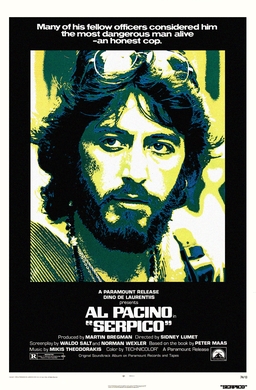
1973’s “Serpico” was almost a much different movie. By that I don’t mean a different spin or a different genre. I mean there were some dramatically different creatives first attached to the gritty biographical crime drama. Sam Peckinpah was once in line to direct but eventually backed out. But the kicker was Robert Redford and Paul Newman, both relatively fresh off working together in “Butch Cassidy and the Sundance Kid” and “The Sting”, were set to star with Redford playing the titular character Frank Serpico. They too left the project.
It was a bumpy road, but soon Sidney Lumet was brought in to direct. Even more notable, Al Pacino was given the lead role. Written by Waldo Salt and Norman Wexler, “Serpico” was an adaptation of a 1973 book by author Peter Maas. It told the true story of New York City police officer Frank Serpico who came face to face with rampant police corruption. It was a gutsy film for its time and it received criticism from some within the NYPD and other groups who claimed the feature overlooked key parts and underrepresented key people from the true account.
Early on we see Frank Serpico as a young ambitious Italian who graduated from the New York Police Academy and was eventually stationed at a hopping downtown precinct. He starts as a patrolman but his feel for the street gets him promoted to a plainclothes officer. But he quickly begins seeing the underside of the department. And when he refuses to take a $300 payoff, Frank breaks an unwritten rule within the fraternity that puts him at odds with many of his fellow cops.
Pressure mounts for Frank to fall in line but he continues to resist, going as far as to become the eyes and ears of the commissioner. With a target on his back from both within and outside the department, Frank finds himself buckling under the pressure. Pacino’s performance organically evolves throughout the movie, turning his character from a well-intended but naive idealist to a hardened and stressed-out cynic. Pacino’s appearance mirrors the change, going from clean and buttoned-up to blousy shirts, bucket hats, and sandals.
Pacino would go on to win a Golden Globe and be nominated for an Academy Award for his performance. While the script doesn’t always do his character favors, Pacino is able to keep both his character and the story itself centered. He’s helped by a solid supporting cast featuring John Randolph, Jack Kehoe, Barbara Eda-Young, Tony Roberts, and Biff McGuire. Look close and you’ll also catch a couple of fun uncredited appearances by Judd Hirsch and F. Murray Abraham.
“Serpico” certainly had its detractors mainly among those who felt it veered too far away from the true account and was a little too selective in how it chose to focus its story. But as entertainment goes it works well as a big city crime drama with a sprinkle of neo-noir flavoring. And in the end the strengths of Lumet’s direction, Pacino’s performance, and Arthur J. Ornitz’s gritty cinematography are more than enough to get past the film’s handful of stumbles.
Watch Serpico on Fawesome.tv here: https://fawesome.tv/movies/10693246/serpico?utm_source=Reelgood&utm_medium=RG
 After the Crash