
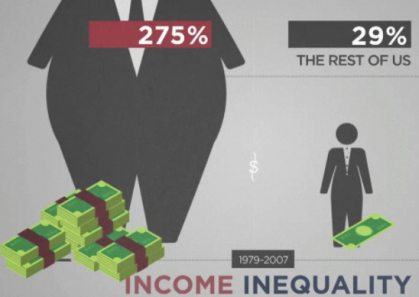
Source: Washington’s Blog
Inequality Also Dampens Social Mobility, Increases Political Pressure and Produces a Less Competitive Workforce
Standard & Poor’s released a report on inequality today, concluding:
Higher levels of income inequality increase political pressures, discouraging trade, investment, and hiring. Keynes first showed that income inequality can lead affluent households (Americans included) to increase savings and decrease consumption (1), while those with less means increase consumer borrowing to sustain consumption…until those options run out. When these imbalances can no longer be sustained, we see a boom/bust cycle such as the one that culminated in the Great Recession (2).
Aside from the extreme economic swings, such income imbalances tend to dampen social mobility and produce a less-educated workforce that can’t compete in a changing global economy. This diminishes future income prospects and potential long-term growth, becoming entrenched as political repercussions extend the problems.
Our review of the data, as well as a wealth of research on this matter, leads us to conclude that the current level of income inequality in the U.S. is dampening GDP growth, at a time when the world’s biggest economy is struggling to recover from the Great Recession and the government is in need of funds to support an aging population.
S&P joins many others in concluding that runaway inequality hurts the economy, including:
- Current Fed chair Janet Yellen
- Former Fed chairman Ben Bernanke (video continues here)
- Federal Reserve Governor Sarah Bloom Raskin (more)
- Former FDIC Chair Sheila Bair
- Nobel prize winning economist Joseph Stiglitz
- Nobel prize winning economist Paul Krugman
- One of America’s leading economists, Robert Shiller
- Former chief IMF economist Raghuram Rajan
- Former U.S. Secretary of Labor and UC Berkeley professor Robert Reich
- Stanford University professor John Taylor
- Northeastern University professor Robert Gordon (more)
- University of Oregon professor Mark Thoma
- University of California professor Emmanuel Saez
- Paris School of Economics professor Thomas Piketty
- Famed economist John Kenneth Galbraith
- Harvard Business School professor David Moss
- Paris School of Economics professor Romain Rancière
- London School of Economics professor Robert Wade
- University of Notre Dame professor David Ruccio
- Harvard professor Lawrence Katz
- Arkansas State University professor Christopher Brown
- Global economy and development division director at Brookings and former economy minister for Turkey, Kemal Dervi
- Societe Generale investment strategist and former economist for the Bank of England, Albert Edwards
- Michael Niemira, chief economist at the International Council of Shopping Centers
- Scott Brown, chief economist at Raymond James
- Former executive director of the Joint Economic Committee of Congress, senior policy analyst in the White House Office of Policy Development, and deputy assistant secretary for economic policy at the Treasury Department, Bruce Bartlett
- World Bank economist Branko Milanovic
- Deputy Division Chief of the Modeling Unit in the Research Department of the IMF, Michael Kumhof
- IMF economist Andrew Berg (and see this)
- IMF economist Jonathan Ostry (and see this)
- IMF economist Charalambos Tsangarides
- Federal Reserve chairman from 1934 to 1948, Marriner S. Eccles
- And many others
Even the father of free market economics – Adam Smith – didn’t believe that inequality should be a taboo subject.
Numerous investors and entrepreneurs agree that runaway inequality hurts the economy, including:
- More than half of all international investors polled by Bloomberg
- Billionaire and legendary investment adviser Jeremy Grantham
- Billionaire and hedge fund manager Stanley Druckenmiller
- Billionaire Bill Gates
- Billionaire Warren Buffet
- Billionaire Nick Hanauer
Indeed, extreme inequality helped cause the Great Depression, the current financial crisis … and the fall of the Roman Empire . And inequality in America today is twice as bad as in ancient Rome, worse than it was in Tsarist Russia, Gilded Age America, modern Egypt, Tunisia or Yemen, many banana republics in Latin America, and worse than experienced by slaves in 1774 colonial America. (More stunning facts.)
Bad government policy – which favors the fatcats at the expense of the average American – is largely responsible for our runaway inequality.
And yet the powers-that-be in Washington and Wall Street are accelerating the redistribution of wealth from the lower, middle and more modest members of the upper classes to the super-elite.
 After the Crash
Pingback: Standard & Poor’s: Runaway Inequality Dampens GDP Growth, Leads to Boom/Bust Cycles and Discourages Trade, Investment and Hiring | MemePosts
Runaway inequality is not the cause of booms/bust cycles. Runaway inequality and boom/bust cycles are both results of easy money(low interest rates) by the Fed. The author has it wrong, it is too much borrowing and consuming by the masses(due to low interest rates) that leads to runaway inequality. It’s amazing that even economists think that increased debt by the masses will “sustain” the economy, avoid recession and therefore be good for the masses. You know what would help the masses, and reduce runaway inequality? Saving, the exact opposite of borrowing. If people spend all their money then go into debt, that increases inequality, duh. This should be kinda obvious, don’t you think? And to get people to save, interest rates must rise(by free market forces, not mandated rates by the Fed/government). The only economists I see have this common sense are the Austrian School economists, Please look into the Austrian School and specifically “Austrian business cycle” for what really causes boom/bust cycles.
Btw, the author also cites Keynes. It is Keynes theories advocating money printing and artificial interest rates that has help make the rich even richer. Why do you think mainstream media like S&P like to cite him, and always try to bash the Austrians like Ron Paul and Peter Schiff.