
By Christian Parenti
Source: The Grayzone
The lockdowns and the stimulus required to keep the economy alive helped drive inflation. Then the Fed jacked up interest rates. And all hell broke loose.
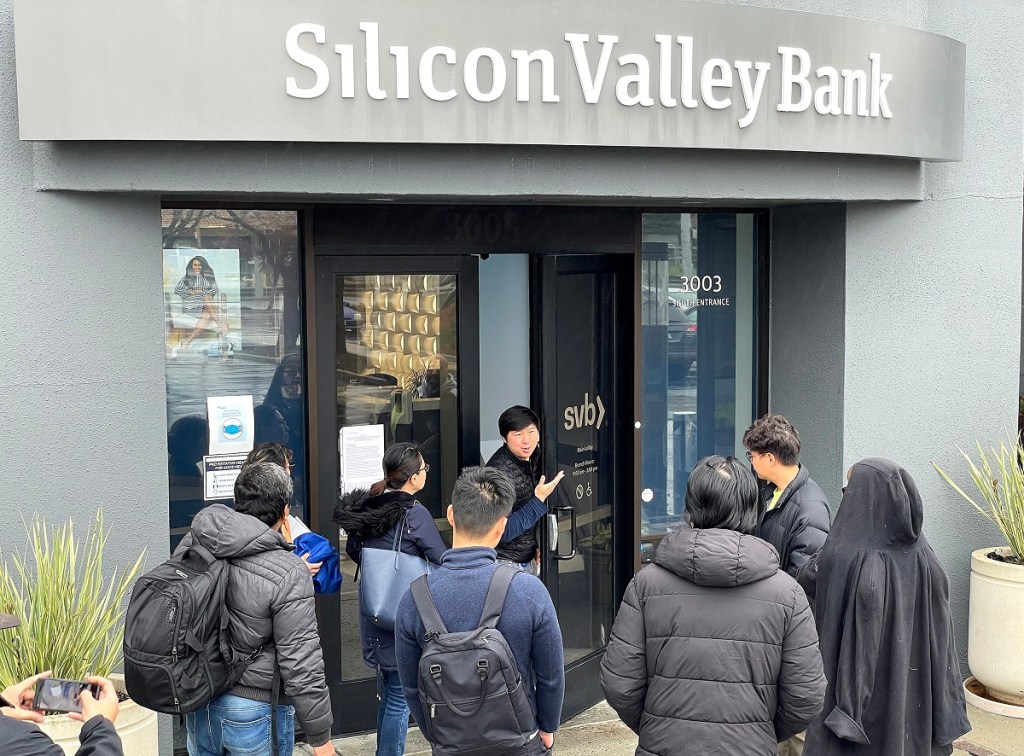
On Friday March 10th, 2023, Silicon Valley Bank (SVB) died of Covid. Alright, it’s a little more complicated than that, but Covid lockdowns followed by massive government stimulus were a critical – and massively under-acknowledged – factor in propelling the bank’s demise.
At the heart of the crisis is the gigantic pile of low-interest debt that was issued during the height of the pandemic. While private-sector pandemic-era debt like corporate bonds also soared, US government debt like Treasury bonds piled up.
In a nutshell, during the pandemic the government issued enormous amounts of extremely low interest government debt — about $4.2 trillion of it. But now interest rates, including on government debt, are higher than they have been in 15 years and investors are dumping their old low-interest debt. As they dump, the resale price of the old debt goes down. The more it declines, the more investors want to dump. And thus, a panic is born.
To understand the problem fully, the question of US government debt has to be put into its larger context, which is: the pandemic response as a whole.
When news of the Covid virus first broke in December 2019, the 2 Year Treasury bond was being offered at 1.64% interest; the 10 year was at about 1.80%, and the resale value of such bonds on secondary markets was strong. Then, in March 2020, as Covid cases and deaths spiked, the US began to shutter its economy with panicked lockdowns that were supposed to “flatten the curve” or slow the spread of the virus and thus protect the hospitals. But Covid was politicized and the lockdowns were extended.
As the lockdowns dragged on, the US economy began to collapse, shrinking at a record-shattering annualized rate of 31.4% during the second quarter of fiscal year 2020.
To avoid total economic devastation, the federal government began massive debt-financed spending. In March 2020, Trump signed into law the $2.2 trillion economic stimulus bill the CARES Act, or Coronavirus Aid, Relief, and Economic Security. Then, in March 2021, Biden signed the American Rescue Plan Act which contained $1.9 trillion more in Covid relief. Finally, in April 2021, another trillion or so of Covid relief arrived in the Consolidated Appropriations Act.
Thanks to these laws, every industry and most people received public money. There was increased and extended unemployment payments, as well as the so-called “stimmy checks” or stimulus payments to everyone earning under $75,000 a year (about half the population). The Paycheck Protection Program spent almost a trillion dollars. The Provider Relief Fund doled out $178 billion to the healthcare system.
All this debt spending kept millions of people in their homes, and helped feed, employ, and care for millions more. The measures allowed hundreds of thousands of businesses to stay afloat even as many thousands of others went under. The impact of the spending on Americans’ well-being was generally positive. For a moment, the US child poverty rate was cut in half, falling to 5.2%.
But the economically destructive lockdowns were not necessary and did not work. Covid fanatics maintain that the lockdowns were unavoidable because the virus is so deadly. That, however, is uninformed. Last year I explained in detail how the Lockdown Left got the Covid crisis wrong. Not a single critic has challenged any of the facts I presented so there is little point in rehashing them all here.
Those who advocated an alternative to ham-fisted lockdowns, like the authors of the Great Barrington Declaration, which called for “focused protection” of vulnerable groups like the elderly, were viciously targeted in a reputation destruction campaign covertly orchestrated by former NIH director Francis Collins and de facto Covid czar Anthony Fauci. Never mind that the document’s authors were three eminently qualified scientists: Sunetra Gupta, professor of Theoretical Epidemiology at Oxford University; Jay Bhattacharya, professor of medicine at Stanford; and Martin Kulldorff, formerly a professor of medicine and biostatistics at Harvard. They were portrayed as far-right cranks who were almost eager to see millions die. But now, they have been vindicated.
Ultimately, the federal government spent $4.2 trillion propping up the economy that it was simultaneously choking to death with lockdowns. These two contradictory pressures laid the groundwork for the recent bank failures. Government mandated lockdowns hit the economy like a body blow. Factories closed, small businesses went under, ports and logistic hubs reduced operations, and about 2 million mostly older workers simply resigned. But at the same time, the federal government injected vast amounts of purchasing power into the economy, thus boosting consumption.
These two, contradictory government moves imposed almost unbearable pressure on supply chains. As shortages mounted, prices began to surge. Put simply: lockdowns plus stimulus equaled inflation.
Consider just one of the most important bottlenecks in the whole economy. During lockdown, many commercial driving license schools were closed. This helped create a shortage of about 80,000 truckers. If trucks do not roll supplies run low and prices go up.
At first, the official line on inflation – parroted by the Lockdown Left – maintained that inflation was “transitory.” But it was not. Inflation peaked at 9.1% in June 2022 while wage growth lagged at about 5%. In April 2020 during the worst of the lockdown, the Federal Reserve’s Federal Funds Rate sank to 0.5%. By February 2022, it had only risen to 0.8%.
Meanwhile, inflation was surging. By February 2022, inflation had reached 7.9%. Only then did the Fed, in an effort to tamp down prices, begin raising interest rates at the fastest pace rate in its history. The federal Funds rate was around 4.57% when SVB went under. Perhaps a massive wave of taxation could have soaked up enough liquidity to have helped cool prices, but that was a political impossibility. The more politically palatable response in Washington was for the Federal Reserve to raise interest rates.
Herein lies the problem. During the height of the lockdowns, banks bought up enormous amounts of government debt. As the Wall Street Journal put it: “U.S. banks are suffering the aftereffects of a Covid-era deposit boom that left them awash in cash that they needed to put to work. Domestic deposits at federally insured banks rose 38% from the end of 2019 to the end of 2021, FDIC data show. Over the same period, total loans rose 7%, leaving many institutions with large amounts of cash to deploy in securities as interest rates were near record lows.” Awash in deposits with not enough demand for loans, the banks bought US government securities. Their purchases surged 53% between 2019 and the end of 2021, to a total of $4.58 trillion, according to Fed data reported by the Wall Street Journal.
Because so much debt was being issued, it carried super-low interest rates. For example, on July 27, 2020, the 10 Year Treasury was offered at an annual interest rate of only 0.55%. This is fine if you are the borrower of money, but if you are the lender (that is to say, a bank giving the federal government money in exchange for a Treasury bond), it means your income stream will be reduced to a mere trickle. If inflation rises, it essentially disappears.
As the yield on new government debt reached toward 5% and inflation hung stubbornly at around 6.4%, all of that old, low-interest, pandemic-era debt started to look like garbage and banks began unloading it. The more that banks dumped old debt, the less value that debt had on resale markets. The lower its resale value, the more the banks wanted to dump it. SVB lost almost $2 billion selling off Government securities. And when they announced the loss, their stock price plunged by 60%.
At the same time, many of SVB’s clients were withdrawing money. This was in part because rising interest rates made borrowing new money more expensive and thus incentivized the use of savings in day-to-day business operations. Also, higher inflation and higher interest rates made low-earning bank deposits less attractive and compelled depositors to redeploy their surplus capital towards higher-earning investments. So, just as SVB needed cash, deposits were evaporating.
By the end of the week of March 10, the four biggest banks in the United States had lost $51 billion because of their panicked dumping of pandemic-era debt. Right after SVB was taken under government control, state regulators closed the New York-based Signature Bank. Before the weekend was over the Federal Reserve announced the creation of a new lending facility that would ensure that “banks have the ability to meet the needs of all their depositors.” Furthermore, the Fed said it was “prepared to address any liquidity pressures that may arise.”
It would seem that the federal government is ready to execute another de facto partial nationalization of US banking, just as they did in 2008 via emergency “cash injections” and then the Troubled Assets Relief Program (TARP). In this current crisis, banks can avoid losses on their low-interest debt if they do not sell it before its maturity. For that to happen, the banks need money. The Fed has said it will pour enormous amounts of money into the banks while all of the relevant officials have proclaimed that the banking system will somehow pay for this. All of this will almost certainly mean even more government debt will be issued.
Already, interest payments on the federal debt are one of the largest single items in the US budget – set to reach $400 billion this year. That is almost half as much as the grotesquely overdeveloped military budget. By comparison, federal spending on housing is only $78 billion.
Shoring up the banking system is necessary because if it collapses, the whole economy goes with it. At least in the short term, Americans are hostages of the US financial system. But government intervention without any new regulations and taxes upon the financial sector will likely mean more inflation and a bigger financial bubble. By refusing to properly tax the top 1%, the federal government also commits itself to more austerity for the many and more welfare for the rich, because rising government debt means a rising portion of our taxes must go toward interest payments.
This system of crisis-prone, hyper-financialized capitalism seems ever more like a junkie. If it doesn’t get its regular fix of public sector help, it will simply collapse and die.
Even if the federal government can stanch the current crisis, the pandemic debt story is global and very likely to cause trouble for some time to come. As a 2021 report by the World Bank put it: “The debt buildup during the pandemic-induced global recession of 2020 was the largest in several decades. This was true for all types of debt—total, government, and private debt; and advanced-economy and EMDE [emerging market and developing economy] debt; external and domestic debt. In 2020, total global debt reached 263 percent of GDP and global government debt 99 percent of GDP, their highest levels in half a century.”
The US intelligentsia and its media elites are finally beginning to reckon with the impact of misguided and authoritarian lockdowns on student learning and the psychological and physical health of millions. But in all the discussion of the current bank runs, the pivotal role of lockdowns in priming the crisis remains overlooked.
 After the Crash