
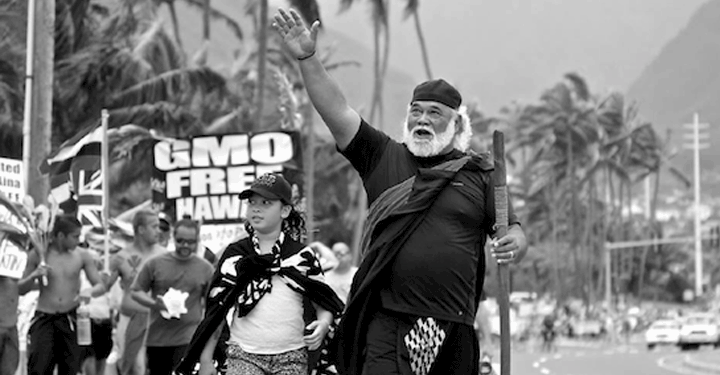
Maui is winning the war against Monsanto

hawaiians_against_gmo_720_375

By Michelle Kennedy Hogan

Source: Inhabitat

Maui is winning the war against Monsanto, according to an attorney for the Sustainable Hawaiian Agriculture for the Keiki and the Aina (SHAKA) Movement. On November 4, Maui voters approved a measure that would ban GMOs in Maui County. But earlier this year, Hawaii Judge Barry Kurren ruled that only states, not counties, can ban GMOs, saying that county laws are pre-empted by state law so they are “invalid.” Monsanto, Dow and others sued to stop the legislation, hoping that Kurren would rule the same after the Maui initiative passed, but Kurren decided to pass the case onto Chief Judge Susan Oki Mollway after public pressure mounted against him. Now the Maui ban on GMOs can move forward, marking a definitive win for the people of Maui.

According to the Natural Society, “until at least the fall of 2011, Judge Kurren’s wife, Faye, was a trustee of The Nature Conservancy (TNC), a 6-billion-dollar environmental group.” TNC specializes in working with mega-corporations, who donate major money, in return for receiving TNC’s “good housekeeping seal of approval” as friends of the environment. “In 2011, TNC leveraged a blockbuster deal with Dow Chemical. Dow pledged a $10 million donation. In exchange, Dow could forthwith use the TNC logo on its site and all its products. Among TNC’s council are businesspersons from Monsanto, Coca Cola, and of course, Dow. Among TNC’s corporate funders are again – Dow, Coke, DuPont, and Pepsi,” according to Natural Society.

In addition to striking down GMO bans, Kurren also recently struck down Ordinance 960 – a pesticide and GMO regulatory bill – in Kauai. Kurren was to be the presiding judge in the Maui County case, but knowing that Kurren has multiple ties to Big Agriculture, the people of Maui County pushed back. Many thought that the case could not be won, given Kurren’s past rulings and Big-Ag ties, and that Maui county would not be able to uphold the ban on GMOs on their island.

RELATED: How Monsanto is turning an island paradise into a GMO wasteland

Originally, the SHAKA Movement agreed to allow a magistrate judge to preside over the case – in this case, it was Kurren. Once the SHAKA Movement found out Kurren would be in charge of their case, they withdrew their approval. Kurren then relinquished the position to Chief Judge Susan Oki Mollway.

Having a different judge – a judge without known ties to the financial dealings of Monsanto and Dow Chemical – could have huge implications for the GMO ban and lead Maui to a win over Monsanto. The ruling further allows Maui County to file their own motions and respond to motions filed by the plaintiffs, according to SHAKA attorney Michael Carroll. If the law stands as voted, only the Maui County Council will be able to lift the ban on GMOs in their county.

Monsanto Sues Maui for Direct Democracy, Launches New PR Campaign

maui monsanto protest

By Rebekah Wilce

Source: PR Watch

Residents of Maui County, Hawai’i voted on November 4 to ban the growing of genetically modified (GMO) crops on the islands of Maui, Lanai, and Molokai until scientific studies are conducted on their safety and benefits. Monsanto and Dow Chemical’s unit Mycogen Seeds have sued the county in federal court to stop the law passed by the people.

In Vermont, the Grocery Manufacturers Association (GMA, of which Monsanto and Dow were recently listed as members) has sued the state over its law requiring GMO labels. And Monsanto has a history of suing to prevent consumer labeling regarding its products. The company sued a number of dairies in the 1990s and 2000s for labeling milk free from recombinant bovine growth hormone (rBGH), which Monsanto developed and marketed as Posilac® (sold to Eli Lilly in 2008), the only commercially approved form. Vermont itself is no stranger to such suits. The International Dairy Foods Association sued Vermont for passing a law requiring labeling of milk containing rBGH (Monsanto wrote an amicus brief in support of the plaintiff, and GMA was a plaintiff-appellant) — and it won in federal court.

On the same day that Monsanto said it would challenge the decision of Maui’s citizens to regulate their own land and environment in court, the company also launched a new national advertising campaign as part of an effort to improve the image of the widely reviled company.

The glossy ads portray families of many cultures sitting down to eat gorgeous foods, invoking images more often seen in the pages of Saveur than in the hallways of one of the world’s largest chemical companies.

In addition to print ads in several national magazines and TV ads airing on national cable networks and several local stations in coastal cities, the campaign includes a slick new website launched in September, Discover.Monsanto.com.

The website invites questions from the public. The vast majority are skeptical, if not hostile. Others sound like they were written by Monsanto staff. Predictably, some of the hardest questions, like the one posed by Tim H., “In 2013, how much money has Monsanto spent on lobbyists in DC? What laws were these lobbyists attempting to create/amend and why?” are given short shrift.

Monsanto’s pretty TV ads target moms and millenials, according to the company’s corporate brand lead, Jessica Simmons. Monsanto has even hired a new “director of millenial engagement,” Vance Crowe, 32. He represented the company at a recent South by Southwest Eco conference in Austin, where revelations that Monsanto had paid for a panel of farmers to attend and present generated some excitement, as Tom Philpott reports in Mother Jones.

Crowe told NPR‘s “The Salt” blog, “[T]he challenge with something like SXSW Eco is that it doesn’t do anybody any good if people are so passionate that they’re yelling. The challenge is how can we enter the conversation so that people don’t feel like they have to yell to be heard?” Apparently, Crowe hopes to “enter the conversation” one party at a time. He enthusiastically describes how he and a gay colleague attended sessions on “sustainable fashion” and got invited to parties where they won fans and accolades.

Coincidentally, the front page of Discover.Monsanto.com contains, under “Here’s where we work,” a picture of corn crops being tended in Maui, with the text, “Hawaii’s unique climate allows for three to four growing seasons a year, reducing the time it takes us to develop new products. Our island roots go back more than 45 years.”

The marketing text may indicate the issue at the heart of Monsanto’s lawsuit against Maui. Those multiple growing seasons mean that “about 90 percent of all corn grown in the U.S. is genetically engineered and has been developed partially at Hawaii farms,” according to the Associated Press. Monsanto and the rest of the seed crop industry reap $146.3 million a year in sales from their activities in the state, according to a 2009 USDA report. Now Monsanto would have to substantially downsize its activity in Maui County in order to follow the new law, according to its lawsuit.

Monsanto’s new PR campaign seeks to make its brand approachable to the American consumer. Yet, with 92 percent of Americans demanding that GMO foods be labelled, according to a new Consumer Reports poll, Monsanto and its new millenial hires have their work cut out for them.

Consumer Reports recently put out a study on where GMOs are hiding in your food, including in packages labeled “natural.” You can access the report here.

Rebekah Wilce is a reporter and researcher who directs CMD’s Food Rights Network project.