Corporatism Stifles Innovation

Corporatism-630-360

By James Hall

Source: BATR.org

For an economy to grow and create actual wealth, innovation is a bedrock component in the development of enhanced prosperity. Prosperity is an intriguing concept. Simply making and accumulating money falls short of establishing a successful economic model. This recent report illustrates a prime example. Facebook stock soars, as company briefly passes IBM in market value. “By most measures, Facebook is dwarfed by IBM: With about 7,000 employees, ten-year-old Facebook is on track to garner $12 billion in sales this year. The 103-year-old IBM has more than 400,000 workers and sold almost $100 billion of computer hardware and software in 2013.”

Is Facebook a shining star of innovation? Or is it the product of a society, which has given up on working towards a successful economy, whereby a prosperous middle class partakes in the engine of continued and shared affluence? Conversely, is IBM an innovated inventor, or is it a dinosaur of a previous era?

However, you answer such questions, Edmund Phelps in an opinion article, Corporatism not capitalism is to blame for inequality argues that tangible innovation is in decline.

“Innovation tailed off between 1940 and about 1970, while the top decile’s share of wealth and income began rising in the 1970s.

The causation runs the other way: losses of dynamism have tended to sharpen wealth inequality because it hits workers of modest means more than it hurts the wealthy. Developing new products is labour-intensive. So is producing the capital goods needed to make them. These jobs disappear when innovation stalls.”

An explanation of The Rise and Fall of Western Innovation, addresses the plight of economic reality. “It is undeniable that the U.S. economy is not delivering the steadily improving wages and living standards the nation’s residents expect.”

Mass Flourishing is meant to be Edmund Phelps’s chef d’oeuvre, the capstone to a half century of research into the sources of national wealth.

A decline in the pace of innovation threatens prosperity, in the U.S. and everywhere else.

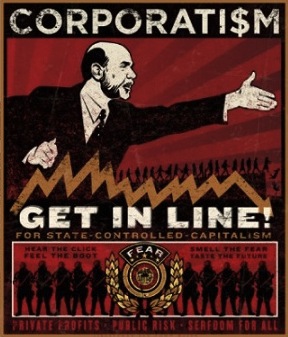
The main cause of this decline, according to Phelps, is corporatism—the inevitable tendency of businesses, workers, and other interests to band together to protect what they have. In modern economies, he says, corporations, unions, and other interests turn government into an agency for forestalling change and preserving the status quo.”

The noted economic expert and academic Robert J. Shiller, in his article, Why Innovation Is Still Capitalism’s Star, provides a critique of “Mass Flourishing: How Grassroots Innovation Created Jobs, Challenge and Change”.

“Professor Phelps discerns a troubling trend in many countries, however, even the United States. He is worried about corporatism, a political philosophy in which economic activity is controlled by large interest groups or the government. Once corporatism takes hold in a society, he says, people don’t adequately appreciate the contributions and the travails of individuals who create and innovate. An economy with a corporatist culture can copy and even outgrow others for a while, he says, but, in the end, it will always be left behind. Only an entrepreneurial culture can lead.”

Jared Bernstein does not agree as stated in a response to Professor Shiller in ‘Does the Government Stifle Innovation? I Don’t See It (To the Contrary…)’. “My points are that a) many important innovations have involved government support somewhere along the way, and b) while one could and should worry about waste in this area, I’ve not seen evidence, nor does Shiller provide any, of stifling. …”.

Well, that viewpoint sure sound like Obama’s infamous endorsement of a government corporatism model, “If you’ve got a business — you didn’t build that. Somebody else made that happen.”

When examining the way corporate transnational businesses operate in the real world, their lack of internal in-house innovation is notorious. These gigantic corporatist carnivores excel at mergers and accusations in the quest of monopolization of markets. In these endeavors, their best friend is government cronyism and favoritism.

The essay, Blaming Capitalism for Corporatism, makes an important point.

“In various ways, corporatism chokes off the dynamism that makes for engaging work, faster economic growth, and greater opportunity and inclusiveness. It maintains lethargic, wasteful, unproductive, and well-connected firms at the expense of dynamic newcomers and outsiders, and favors declared goals such as industrialization, economic development, and national greatness over individuals’ economic freedom and responsibility. Today, airlines, auto manufacturers, agricultural companies, media, investment banks, hedge funds, and much more has at some point been deemed too important to weather the free market on its own, receiving a helping hand from government in the name of the “public good.”

Here within dwells the essential dilemma, defining the genuine “Public Good“. Government often acts according to Mr. Bernstein’s idea of progress, especially in technological terms. Focus on the notion – “economically important” – and the language filter that translates into a benefit for the Corporatocracy matrix.

“While “entrepreneurial culture” will always be essential, many innovations that turned out to be economically important in the US have government fingerprints all over them. From machine tools, to railroads, transistors, radar, lasers, computing, the internet, GPS, fracking, biotech, nanotech—from the days of the Revolutionary War to today—the federal government has supported innovation often well before private capital would risk the investment.”

Corporatism invents methods of greater control and market dominance for select elitist beneficiaries. When government provides seed money to fund research projects, pure science is seldom the objective. As examined in the essay, How Government Did (and Didn’t) Invent the Internet, Harry McCracken writes: (I’m even prepared to believe that if the Internet hadn’t been invented at DARPA, the private sector would have stepped in and done the job. But we’ll never know for sure, since it was invented at DARPA.)

Thus, the paradox most people are unable to see beyond the guise of “so called” progress. Is government involvement or outright development of transhumanist futuristic technology a valid form of innovation or is it the terminal scourge of central planning and a controlled economy? Surely, under such a system, the “Mass Flourishing” of sharing the wealth, will no longer be an issue among the “useless eaters”, designated for extinction.

– See more at: http://www.batr.org/corporatocracy/073014.html#sthash.RFUeioGh.dpuf
Individual Wealth in Perspective

billionairehousing

By James Hall

Source: Negotium

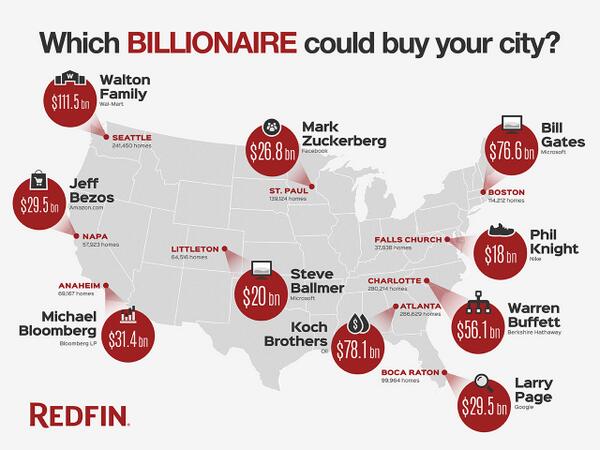
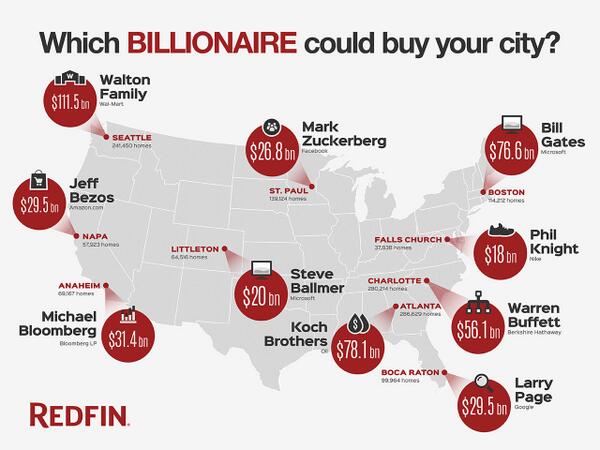
A quaint comparison of what money can buy in today’s market has Bill Gates being able to afford every home in Boston. His $76.6 billion reported by the Washington Post or the $78.4 billion by Forbes seems a pittance when put up against John D. Rockefeller’s peak wealth of $318.3 billion (based on 2007 US dollar). According to your resident commissars over at MSNBC, “The median net worth of American households hasn’t changed much over the past decades, it’s about $20,000.” So if Gates decided to purchase all the Beantown houses, whom would he pay for the bricks and mortar? Certainly, most Americans may think of “their home is their castle”, but few actually own a debt free deed to their grand estate. No wonder the banks and financial institutions, are so fond of placing liens on real property.

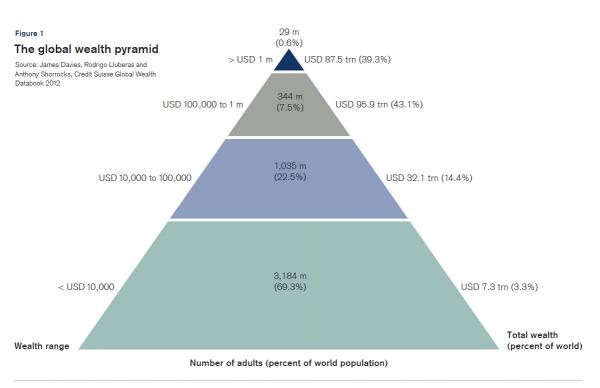
The proportional context of looking at individual wealth within the relative value of global wealth is examined in the essay; It’s A “0.6%” World: Who Owns What Of The $223 Trillion In Global Wealth, seems trite. Zerohedge concludes, “The bottom line: 29 million, or 0.6% of those with any actual assets under their name, own $87.4 trillion, or 39.3% of all global assets.”

CSwealth

Here are the stunning facts:

“In 2012, 3.2 billion individuals – more than two-thirds of the global adult population – have wealth below USD 10,000, and a further one billion (23% of the adult population) are placed in the USD 10,000–100,000 range.

The average wealth holding is modest in the base and middle segments of the pyramid, total wealth amounts to USD 39 trillion, underlining the potential for new consumer trends products and for the development of financial services targeted at this often neglected segment.

The remaining 373 million adults (8% of the world) have assets exceeding USD 100,000.

And then the top of the pyramid: 29 million US dollar millionaires, a group which contains less than 1% of the world’s adult population, collectively owns nearly 40% of global household wealth.

Some 84,500 individuals are worth more than USD 50 million, and 29,000 are worth over USD 100 million.”

After absorbing this macro economic analysis, it should ease the pain that the stewardship of world wealth is in such trustworthy hands. No need to burden the masses with the weight of building wealth, when that formula for getting to the top of the financial pyramid, has room for only the few. The expert obelisk creators never meant for wealth sharing and the tools to construct one’s own prosperity are not included in your capital accumulation education. The liability of mortgage and property tax obligations to retain your edifice requires regular payments to maintain the privilege of possession. Ownership is only a conditional wealth asset.

Investopedia says 3 Simple Steps To Building Wealth are:

“You need to make it. This means that before you can begin to save or invest, you need to have a long-term source of income that’s sufficient enough to have some left over after you’ve covered your necessities.

You need to save it. Once you have an income that’s enough to cover your basics, you need to develop a proactive savings plan.

You need to invest it. Once you’ve set aside a monthly savings goal, you need to invest it prudently.”

Ordinary consumers do not build great fortunes. The elementary prescription for “getting ahead” is severely limited in thinking for a world that frequently conducts business as a blood sport. However, many of the enterprises that carve out a market for their products or services have a distinct edge over the unconnected entrepreneur. Namely, government directed and controlled startups or collaborated ventures frequently become the commercial giants of the economy. Here lays the confusion when defining wealth as an accounting device of personal ownership of assets.

In addition, governments are often in the privatization and sale of state assets. The Economists reports that the “IMF estimate that non-financial government assets average 75% of GDP in advanced economies. In most countries, these are worth more than financial assets (stakes in listed firms, sovereign-wealth and securities holdings and the like).”

Liquid cash flow and high worth individuals, especially with inside track contacts, are able to cherry pick sweet heart deals. Such opportunities, usually transfers treasure, but infrequently are engines of new wealth creation. The only guarantee is that money, made or lost depending upon the accounting needs of the vulture predator, is never an option for the normal hard working taxpayer.

Unless people accept the reality that creating and growing wealth is a noble objective that involves the widespread commerce participation of a merchant class, the outrageous disparity of the top down wealth stream will widen even more, as the top tier inclusion narrows to fewer mega-billionaires.

Global business encourages transnational conglomerates with commercially identifiable names and logos. When entire economies prevail under a business plan that eliminates any rival competition, and achieves sole market dominance, the prospects to advance the individual wealth ledger of the average person diminishes.

An opportunistic society can only exist when independent business flourishes. Government bureaucrats and corporate technocrats oppose an unambiguous free market economy. As the map of the über-billionaires illustrates, their checkbook could swallow up entire cities. However, digesting, let alone growing communities into quality environments for future generations, takes an active involvement in the wealth building process that rewards contributing players.

Without a widespread populace practicing mutually beneficial business transactions, the capacity to achieve the skills necessary to compete successfully, will never develop. Instead of making money, saving money and investing money, learn the aptitude of business as a lifelong endeavor.

The poor will always be scraping the bottom, until they learn how to advance their abilities for the betterment of their own families. The alternative to greater concentration of wealth is to initiate a viable substitute to the financial stranglehold that furthers the appetites of egomaniacs like the character, Bretton James in the movie Money Never Sleeps. In the end, the true individual wealth that anyone can attain is the sincerity and moral substance of his or her own character. Money may not snooze from making more cash, but is only a means to elevate living a life worth lived.

In such a quest, the super rich may have a net worth equivalent to one’s property, but they can never afford the essence of your family or measure of your community.