
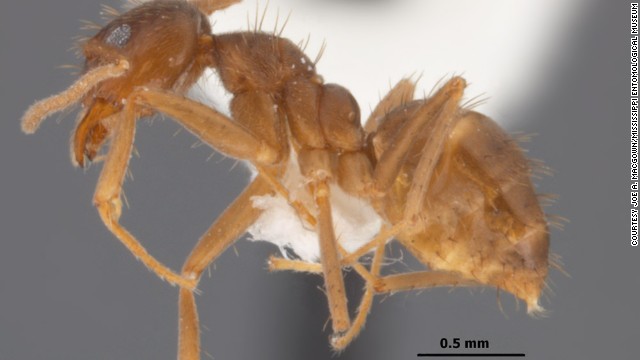
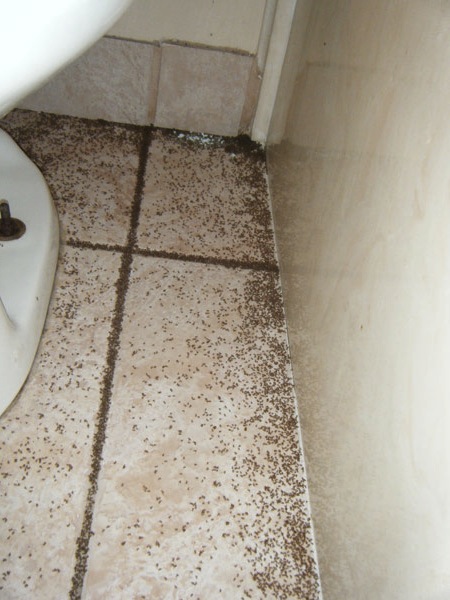

The New York Times Magazine recently featured a story by Jon Mooallem on a new invasive ant species that seems straight out of a nightmare or horror film. From the article:
Entomologists report that the crazy ants, like other ants, seem drawn to electronic devices — car stereos, circuit boxes, machinery. But with crazy ants, so many will stream inside a device that they form a single, squirming mass that completes a circuit and shorts it. Crazy ants have ruined laptops this way and, according to one exterminator, have also temporarily shut down chemical plants. They are most likely climbing into these cavities to investigate possible nesting sites. But as David Oi, a research entomologist at the Department of Agriculture, told me, the science-fiction-ish theory that the bugs are actually attracted to the electricity itself can’t be ruled out.
Rasberry crazy ants do not have a painful bite, but they effectively terrorize people by racing up their feet and around their bodies, coursing everywhere in their impossibly disordered orbits. (They’re called crazy ants because their behavior seems psychotic.) Some people in Texas have become so frustrated with crazy ants that they have considered selling their houses or been driven to the verge of divorce. “Usually, the husband doesn’t think it’s such a big deal, and the wife is going batty,” one exterminator explained. An attorney living on an infested farm south of Houston told me: “It reminds me of the scenes in Africa, where you see flies crawling all over people. Occasionally they’ll knock one off, but for the most part they’re so accustomed to it that they finally give up.”
Crazy ants decimate native insects. They overtake beehives and destroy the colonies. They may smother bird chicks struggling to hatch. In South America, where scientists now believe the ants originated, they have been known to obstruct the nasal cavities of chickens and asphyxiate the birds. They swarm into cows’ eyes.
So far, there is no way to contain them. In the fall, when the temperature drops, the worker ants are subject to magnificent die-offs, but the queens survive, and a new, often larger crop of crazy ants pours back in the following spring. Rasberry crazy ants were first discovered in Texas by an exterminator in 2002. Within five years, they appeared to be spreading through the state much faster than even the red imported fire ant has. The fire ant is generally considered one of the worst invasive species in the world. The cost of fire ants to Texas has been estimated at more than $1 billion a year.
Rasberry crazy ants are now in 27 different counties in Texas and have also been spotted in Louisiana, Mississippi, Florida and Georgia…
…Edward LeBrun, an ecologist at the University of Texas at Austin who has been studying the area, believes a single “supercolony” of crazy ants occupies as many as 4,200 acres in Iowa Colony and is spreading 200 meters a year in all directions.
The reporter gave the following horror-inducing account of his first encounter with the ants in Iowa Colony, a rural area south of Houston:
“See! See! See!” the Dukes kept telling me. Wherever they pointed, there were ants: under the door of a microwave oven, crawling out of the electrical outlets, heaped in the flower beds where I mistook them for fresh topsoil. It was shocking, and the Dukes seemed vindicated by my shock. “You don’t feel them crawling up your clothes?” Melvin’s wife, Sharlene, asked me at one point. She was walking around barefoot and in shorts, and I could see ants trickling across her feet and ankles and legs — spelunking between her toes. She clutched a can of a pesticide called Enforcer Instant Knockdown to her chest, more as a security blanket than as a weapon, and constantly swept her hands over her calves.
Soon ants were spiraling up the tongues of my sneakers, onto my sock. I tried to shake them off, but nothing I did disturbed them. Before long, I was sweeping them off my own calves. I kept instinctively taking a step back from some distressing concentration of ants, only to remember that I was standing in the center of an exponentially larger concentration of ants. There was nowhere to go. The ants were horrifying — as in, they inspired horror. Eventually, I scribbled in my notebook: “Holy [expletive] I can’t concentrate on what anyone’s saying. Ants all over me. Phantom itches. Scratching hands, ankles, now my left eye.” Then I got in my car and left.
Of course worse things happen to people, but there’s something uniquely unsettling about the feeling of being overtaken by insects. This type of fear is explored in the following passage from the article:
The Hungarian-born philosopher Aurel Kolnai gave the horrifying qualities of bugs some serious thought. Kolnai ultimately decided that what upsets us is “their pullulating squirming, their cohesion into a homogeneous teeming mass” and their “interminable, directionless sprouting and breeding.” That is, it’s the quantity of crazy ants that’s so destabilizing. As the American psychologist James Hillman argued, an endless swarm of bugs flattens your perception of yourself as precious and meaningful. It instantly reduces your individual consciousness to a “merely numerical or statistical level.”
While there’s definitely some truth to this, I think there’s a little more to it. Though we may instinctively avoid things which could possibly sting or bite, because bugs are also associated with the natural process of decomposition, a reflexive revulsion towards contact with insects (for most people) may also be an expression of the fear of death. Insects might also tap into a xenophobia towards creatures that are most unlike ourselves physically and behaviorally, though we might not be as different from insects like ants as we’d like to believe. Just like humans, the crazy ants can dominate an environment to such an extent that it becomes inhospitable to most other insects and animals. And while we all have the potential ability to think independently, there’s also the potential to adopt a “hive mind” or herd mentality. Perhaps it’s the subconscious awareness of such negative aspects we share with insects that horrify us as much as the differences.
 After the Crash