Prepare to Be Bled Dry by a Decade of Stagflation

By Charles Hugh Smith

Source: Of Two Minds

The Great Moderation of low inflation and soaring assets has ended. Welcome to the death by a thousand cuts of stagflation. It was all so easy in the good old days of the past 25 years: just keep pushing interest rates lower to reduce the cost of borrowing and juice credit expansion ((financialization) and offshore industrial production to low-cost nations with few environmental standards and beggar-thy-neighbor currency policies (globalization).

Both financialization and globalization are deflationary forces, as they reduce costs. They are also deflationary to the wages of bottom 90%, as wages are pushed down by cheap global labor and stripmined by financialization, which channels the vast majority of the economy’s gains into the top tier of the workforce and those who own the assets bubbling up in financialization’s inevitable offspring, credit-asset bubbles.

To keep the party going, central banks and governments pushed both forces into global dominance: hyper-financialization and hyper-globalization. Policy extremes were pushed to new extremes: “temporary” zero-rate interest policy (ZIRP) stretched on for 6 years as every effort was made to lower the cost of credit to bring demand forward and inflate yet another credit-asset bubble, as the “wealth effect” of the top 5% gaining trillions of dollars in unearned wealth as asset bubbles inflated pushed consumption higher.

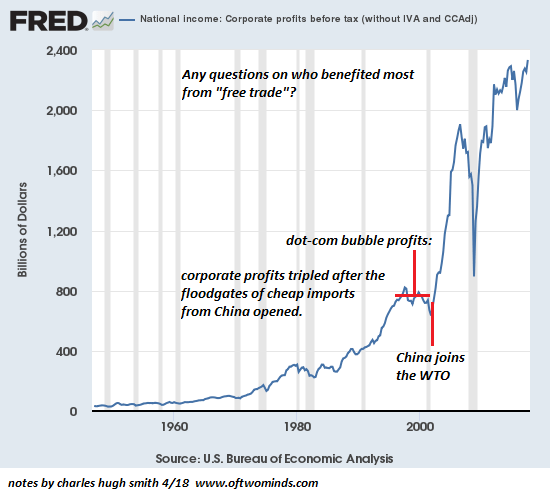
Corporate profits soared as credit became essentially free and super-abundant and globalization lowered costs and institutionalized planned obsolescence, the engineered replacement of goods and software that forces consumers to replace their broken / outdated products every few years.

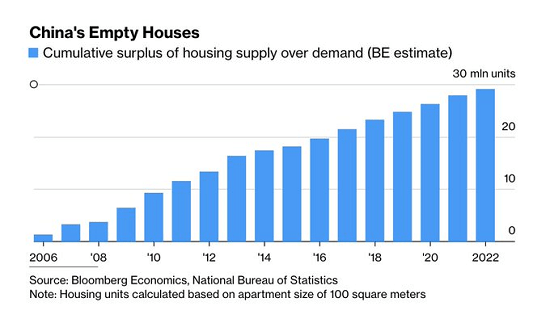
Every economic lever was pulled to extend the vast profits generated by hyper-financialization and hyper-globalization. Currencies were manipulated lower to boost exports, cheap credit kept zombie companies alive, bridges to nowhere and millions of empty flats were built to boost jobs and profits, and so on.

At long last, all these gimmicks have reversed or reached marginal returns: they no longer keep inflation suppressed, asset bubbles inflating and profits expanding. The malinvestment of global capital will be revealed and the costs of the policy gimmickry will be paid by years of stagflation: high inflation, low or negative growth and endless debt crises as the reliance on cheap credit to boost profits comes home to roost.

It turns out that the inevitable offspring of hyper-financialization and hyper-globalization are inflation, credit crises and the undermining of national security as the self-serving goal of pushing corporate profits higher via globalization led to fatal dependencies on competing powers for the essentials of modern life.

Correcting these decades-long extremes will take at least a decade as long-suppressed inflation becomes endemic, supply-chain disruptions become the norm and capital has to be invested in long-term national projects such as reshoring and the engineering of a new more efficient energy mix–projects that will only be expenses for many years.

This demand for structural investments with no immediate profit payoff is what drove the stagflation of the 1970s, a factor I explain in The Forgotten History of the 1970s and The 1970s: From Rotting Carcasses Floating in the River to Kayak Races.

The gains will not even be measured by our current outdated economic metrics of GDP and profits. The gains will be in the national security of essential supply chains and production and in the relocalizing of jobs and capital, not corporate profits.

Our reliance on the endless expansion of credit, leverage and credit-asset bubbles will have its own high cost: the collapse not just of the current Everything Bubble but of the engines that inflated one bubble after another.

Central bank and state authorities are thrashing about cluelessly, as all their gimmicks are now problems rather than solutions. The current policy gimmicks laid the foundations for a decade or more of high inflation, low growth and credit crises as the phantom “wealth” of credit-asset bubbles evaporates.

This will drive a reverse Wealth Effect as the top spenders are crushed by the collapse of asset bubbles. Long-term trends in demographics (shrinking workforces and the skyrocketing population of elderly) and depletion of resources will add fuel to the inflationary / low growth / credit crises bonfires.

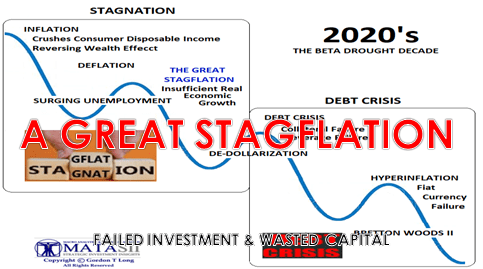
Gordon Long and I discuss all these mutually reinforcing trends in A Great Stagflation (36 min). This is the culmination of our decade of programs about all the policy gimmicks that were pushed to extremes to maintain the illusion of stability and growth–an illusion that’s evaporating as it makes contact with stagflationary realities.
How Breakdown Cascades Into Collapse

By Charles Hugh Smith

Source: Of Two Minds

Maintaining the illusion of confidence, permanence and stability serves the interests of those benefiting from the bubbles and those who prefer the safety of the herd, even as the herd thunders toward the precipice.

The misconception that collapse is an all or nothing phenomenon is common: Either the system rights itself with a bit of money-printing and rah-rah or it collapses into post-industrial ruin and gangs are battling over the last stash of canned beans.

Neither scenario considers the fragility and resilience of the socio-economic system as a whole. It is both far more fragile than the believers in the permanence of the waste is growth model grasp and more resilient than the complete collapse prognosticators grasp.

The recent relatively mild logjams in global supply chains of essentials are mere glimpses of precariously fragile delivery-supply systems. These can be understood as bottlenecks that only insiders see, or as unstable nodes through which all the economy’s connections run. Put another way, the economy’s as a network appears decentralized and robust, but this illusion vanishes when we consider how the entire economy rests on a few unstable nodes.

One such node is the delivery of gasoline and fuels. It’s such an efficient and reliable system that 99.9% of us take it for granted: there will always be plenty of gasoline at every station, the tanks of jet fuel will always be topped off, and so on.

The 0.1% know that this system, once disrupted, would knock over dominoes all through the economy.

Hyper-efficiency and hyper-globalization has reduced the number of producers of essentials to the point that disruptions cannot be overcome with redundant sources. We see this everywhere in the global economy: a handful of plants and companies (sometimes a single source of essential components) process or manufacture essential components in much larger systems.

This is how you end up with thousands of newly manufactured vehicles parked in lots awaiting one critical part that is in short supply.

Another key weakness is the entire system’s reliance on debt, leverage and speculation. Few seem to understand that physical production and delivery systems can grind to a halt for financial reasons–for example, lines of credit being pulled, a counterparty to some arcane commodity swap goes under, taking the presumably solvent corporation down with it, and so on.

The more debt that’s been piled up, the greater the instability of the entire system. Risk always appears low until the system destabilizes, and then all the hedges fail and risk breaks out, flooding through the entire financial system.

Leverage is great fun on the way up, as it magnifies gains. Since the Federal Reserve implicitly guarantees that “buy the dip” will generate massive gains, why not ramp up leverage ten-fold to maximize those Fed-guaranteed gains?

Leverage is less fun on the way down. When the underlying collateral has shrunk to 20% of the leveraged bets being made, a 21% decline in the asset wipes out all the collateral holding up the palace of leveraged debt.

The Fed can print money but it can’t create collateral, nor can it make insolvent entities solvent. All the Fed can do is increase the debt and leverage, which is not the solution, it’s the problem.

Speculation is also inherently unstable, as the euphoric herd, once startled, turns in panic and stampeded in fear. Markets which appeared liquid–i.e., sellers could count on someone buying as many millions of shares as they desired to sell–become illiquid, as buyers vanish like mist in Death Valley. With buyers gone, prices plummet to levels the herd reckoned “impossible” just days before.

The Fed’s entire strategy in the 21st century has been to inflate asset bubbles that generate the illusion of wealth–the so-called wealth effect which is presumed to inspire voracious borrowing and spending.

Unfortunately for the Fed, most of the gains flowed to the top 0.1%, and an economy based on a handful of billionaires buying super-yachts and spaceships is a line of dominoes awaiting the inevitable “accident.” So there are two systemic problems with relying on asset bubbles to generate “wealth”: 1) since 90% of the assets are owned by a thin slice of the populace, bubbles increase destabilizing inequality, and 2) bubbles are intrinsically unstable. So the U.S. economy, dependent on the Fed for the “juice” of monetary stimulus, is now dependent on incredibly unstable bubbles in assets, debt and leverage, bubbles which have generated extremes of wealth/income inequality that are destabilizing the social and political orders.

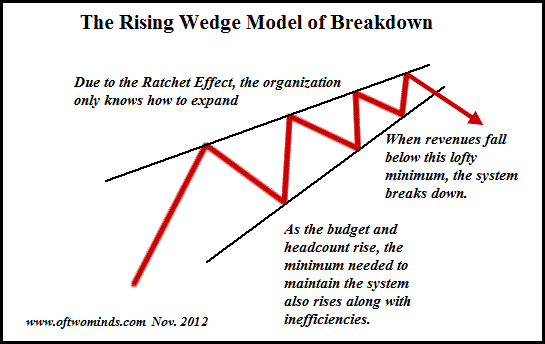
As the three charts below illustrate, the fragility and instability are well hidden until it’s too late: bubbles, debt, leverage, budgets and revenues can only click higher because the system breaks down if there is any sustained decline (the rising wedge model of breakdown). Once the subsystems fail, there’s no putting the eggshell back together.

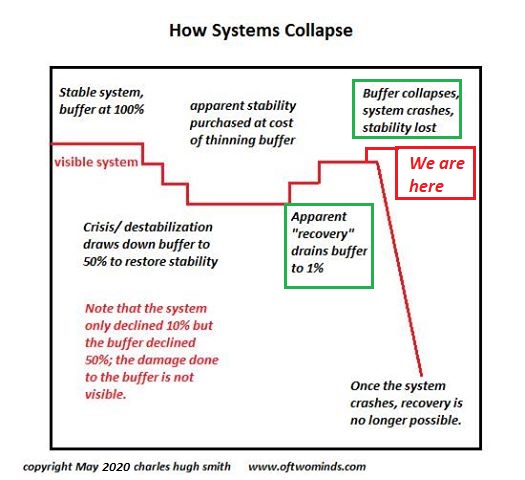
The second chart depicts how buffers thin beneath the surface, masking the systemic fragility. The loss of redundancy, the decay of maintenance, the loss of experienced workers–all of these are hidden from public view until the system breaks down.

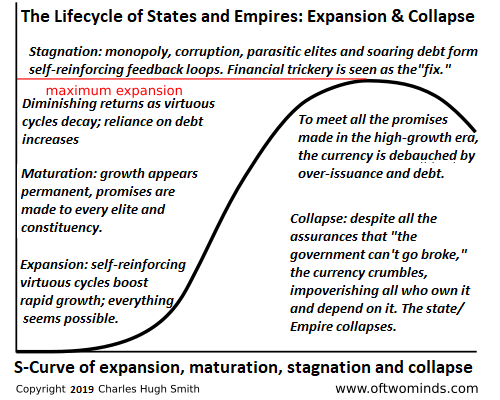
The third chart tracks the S-curve of expansion, confidence, complacency, delusion and collapse followed by human systems, from nations to empires to corporations: as the buffers thin and the rising wedge reaches an apex of vulnerability, the leadership evinces a delusional confidence in the permanence and stability of increasingly fragile, unstable systems.

Maintaining the illusion of confidence, permanence and stability serves the interests of those benefiting from the bubbles and those who prefer the safety of the herd, even as the herd thunders toward the precipice.

This is how breakdowns in apparently stable subsystems triggers the fall of dominoes throughout the larger system, leading to a collapse that was widely viewed as “impossible.” Such is the power of complacency and delusion.