
U.S. Takes Down Israeli Spy Software Company

Source: Moon of Alabama

A number of international papers report today on the Israeli hacking company NSO which sells snooping software to various regimes. The software is then used to hijack the phones of regime enemies, political competition or obnoxious journalists. All of that was already well known but the story has new legs as several hundreds of people who were spied on can now be named.

How that came to pass is of interest:

The phones appeared on a list of more than 50,000 numbers that are concentrated in countries known to engage in surveillance of their citizens and also known to have been clients of the Israeli firm, NSO Group, a worldwide leader in the growing and largely unregulated private spyware industry, the investigation found.

The list does not identify who put the numbers on it, or why, and it is unknown how many of the phones were targeted or surveilled. But forensic analysis of the 37 smartphones shows that many display a tight correlation between time stamps associated with a number on the list and the initiation of surveillance, in some cases as brief as a few seconds.

Forbidden Stories, a Paris-based journalism nonprofit, and Amnesty International, a human rights group, had access to the list and shared it with the news organizations, which did further research and analysis. Amnesty’s Security Lab did the forensic analyses on the smartphones.

The numbers on the list are unattributed, but reporters were able to identify more than 1,000 people spanning more than 50 countries through research and interviews on four continents.

Who might have made such a list and who would give it to Amnesty and Forbidden Stories?

NSO is one of the Israeli companies that is used to monetize the work of the Israel’s military intelligence unit 8200. ‘Former’ members of 8200 move to NSO to produce spy tools which are then sold to foreign governments. The license price is $7 to 8 million per 50 phones to be snooped at. It is a shady but lucrative business for the company and for the state of Israel.

NSO denies the allegations that its software is used for harmful proposes with a lot of bullshittery:

The report by Forbidden Stories is full of wrong assumptions and uncorroborated theories that raise serious doubts about the reliability and interests of the sources. It seems like the “unidentified sources” have supplied information that has no factual basis and are far from reality.

After checking their claims, we firmly deny the false allegations made in their report. Their sources have supplied them with information which has no factual basis, as evident by the lack of supporting documentation for many of their claims. In fact, these allegations are so outrageous and far from reality, that NSO is considering a defamation lawsuit.

The reports make, for example, the claim that the Indian government under Prime Minister Narendra Modi has used the NSO software to spy on the leader of the opposition party Rahul Gandhi.

How could NSO deny that allegation? It can’t.

Further down in the NSO’s statement the company contradicts itself on the issues:

As NSO has previously stated, our technology was not associated in any way with the heinous murder of Jamal Khashoggi. We can confirm that our technology was not used to listen, monitor, track, or collect information regarding him or his family members mentioned in the inquiry. We previously investigated this claim, which again, is being made without validation.

We would like to emphasize that NSO sells it technologies solely to law enforcement and intelligence agencies of vetted governments for the sole purpose of saving lives through preventing crime and terror acts. NSO does not operate the system and has no visibility to the data.

How can NSO deny that the Saudi government, one its known customers, used its software for spying on the then murdered Jamal Khashoggi when it ‘does not operate the system’ and ‘has no visibility to the data’?

You can’t claim both a. assure knowledge and b. to have no way to have gained it.

But back to the real issue:

  • Who has the capacity to make a list of 50,000 phone numbers that include at least 1,000 who were spied on with NSO’s software?
  • Who can ‘leak’ such a list to some NGO and make sure that lots of ‘western’ media jump onto it?
  • Who has an interest in shutting NSO down or to at least make its business more difficult?

The competition I’d say. And the only real one in that field is the National Security Agency of the United States.

The U.S. often uses ‘intelligence’ as a kind of diplomatic currency that keeps other countries dependent on it. If the Saudis have to ask the U.S. for snooping on someone it is much easier to have influence over them. NSO is disturbing that business. There is also the problem that the first class spying software NSO is selling to somewhat shady customers might well fall into the hands of some big U.S. adversary.

The ‘leak’ to Amnesty and Forbidden Stories is thus an instrument to keep some monopolistic control over client regimes and over spying technology. (The Panama Papers were a similar kind of U.S. sponsored ‘leak’, only in the financial field.)

Edward Snowden, who once was committed NSA supporter but leaked NSA documents because he wanted it to stick to the law, is supporting this campaign:

Edward Snowden @Snowden – 16:28 UTC · Jul 18, 2021
Stop what you’re doing and read this. This leak is going to be the story of the year: https://theguardian.com/world/2021/…

Edward Snowden @Snowden – 15:23 UTC · Jul 19, 2021
There are certain industries, certain sectors, from which there is no protection. We don’t allow a commercial market in nuclear weapons. If you want to protect yourself you have to change the game, and the way we do that is by ending this trade.
Guardian: Edward Snowden calls for spyware trade ban amid Pegasus revelations

Snowden seems to say that NSO, which sells it software only to governments, should stop doing so but that the NSA should continue the use of such spying instrument:

Speaking in an interview with the Guardian, Snowden said the consortium’s findings illustrated how commercial malware had made it possible for repressive regimes to place vastly more people under the most invasive types of surveillance.

Snowden’s opinion on this is kind of strange:

chinahand @chinahand – 17:28 UTC · Jul 19, 2021
fascinating how Mr “US state surveillance is the greatest threat to humanity” gets worked up about the fact that a bit of state surveillance is apparently outsourced to a private contractor by mid and low tier state actors.

Edward Snowden @Snowden – 17:06 UTC · Jul 19, 2021
Read about the Biden, Trump, and Obama officials who accepted blood money from the NSO group to bury any efforts at accountability — even *after* their involvement in the death and detention of journalists and rights defenders around the world!
WaPo: How Washington power brokers gained from NSO’s spyware ambitions

The uproar in the the media created by the NSO revelation is already having the desired effect:

Amazon Web Services (AWS) has shut down infrastructure and accounts linked to Israeli surveillance vendor NSO Group, Amazon said in a statement.

The move comes as a group of media outlets and activist organizations published new research into NSO’s malware and phone numbers potentially selected for targeting by NSO’s government clients.

“When we learned of this activity, we acted quickly to shut down the relevant infrastructure and accounts,” an AWS spokesperson told Motherboard in an email.

AWs has for years known about NSO’s activities. NSO has been using CloudFront, a content delivering network owned by Amazon:

CloudFront infrastructure was used in deployments of NSO’s malware against targets, including on the phone of a French human rights lawyer, according to Amnesty’s report. The move to CloudFront also protects NSO somewhat from researchers or other third parties trying to unearth the company’s infrastructure.

“The use of cloud services protects NSO Group from some Internet scanning techniques,” Amnesty’s report added.

That protection is no longer valid. NSO will have quite some problems to replace such a convenient service.

Israel will whine about it but it seems to me that the U.S. has decided to shut NSO down.

For you and me that will only marginally lower the risk of being spied on.
The Real Reason Why Blackstone Is Courting The Pentagon

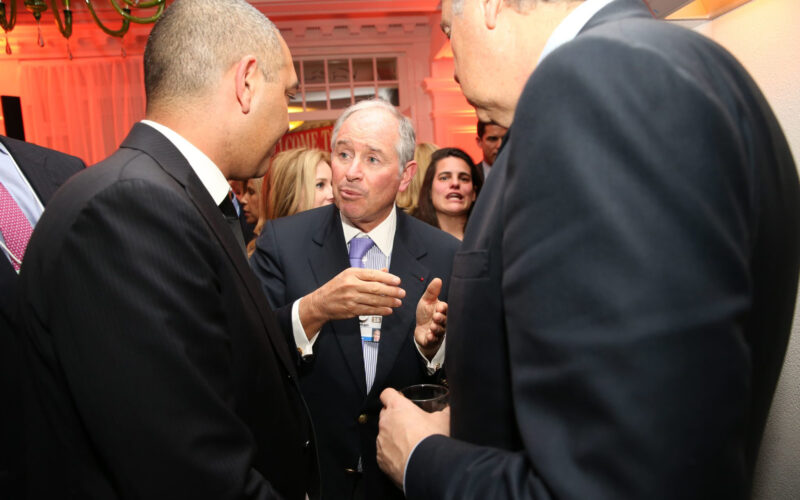
Photo credit: Financial Times / Flickr (CC BY 2.0) .

The sudden push by Wall Street’s largest private equity firm to heavily lobby the Pentagon and State Department for largely unspecified reasons is part of an increasingly visible conflict within the U.S. establishment regarding how to handle the Artificial Intelligence “arms race.”

By Whitney Webb

Source: Unlimited Hangout

One of Wall Street’s largest private equity firms, the Blackstone Group, has been making a series of moves that have left mainstream analysts puzzled, with the most recent being Blackstone’s hire of David Urban, a Washington lobbyist with close ties to the Trump administration.

Blackstone’s courting of a Trump ally was not surprising given that the firm’s CEO, Steven Schwarzman, recently donated $3 million to Trump’s re-election efforts and had previously chaired the President’s now-defunct Strategic and Policy Forum of “business leaders” and advisors. The close ties that have developed between Schwarzman and Trump following the latter’s election in late 2016 have led mainstream media to describe Schwarzman as a confidant of the President.

However, what was odd about Blackstone’s hiring of David Urban was its murky reason for doing so, as the firm plans to task Urban with lobbying the Pentagon and State Department on “issues related to military preparedness and training.” This is odd, as CNBC noted, because Blackstone “doesn’t have any publicly listed government contracts, and its known investments don’t appear to have direct links to the defense industry.” However, Urban has extensive experience in dealing with both Departments in addition to his close ties to the current administration and the fundraising apparatus of the Republican Party.

While media reports on Blackstone’s recent hire of Urban were unable to elucidate the motive behind Blackstone’s sudden desire to court the Pentagon and State Department, they did note that Blackstone’s previous hire of a Trump-connected fundraiser lobbyist, Jeff Miller, had been remarkably successful earlier this year, with Miller lobbying Congress specifically on coronavirus relief legislation like the CARES Act. The CARES Act ultimately allowed private equity giants like Blackstone to access funds designated for coronavirus relief, likely thanks to the efforts of Miller and other lobbyists hired by Blackstone as well as other private equity giants like the Carlyle Group.

Though CNBC was left looking for answers as to Blackstone’s sudden interest in aiding the Pentagon with “military preparedness” and wooing the State Department, the likely motive may be related to other recent moves made by the company, such as the hire of former Amazon and Microsoft executive Christine Feng. Feng, who was hired by Blackstone on August 3, previously led data and analytics mergers and acquisitions at Amazon Web Services (AWS), which is a contractor to the U.S. intelligence community and other U.S. federal agencies. Previously, Feng was a senior member of Microsoft’s Corporate Development team. Microsoft recently won lucrative contracts for information technology (IT) services and cloud computing for the State Department and Pentagon, respectively.

According to Blackstone executives, the decision to hire Feng was made due to her “deep relationships in Silicon Valley” and “her experience working at Amazon and Microsoft.” They also added that her hire was motivated by Blackstone’s push to “identify new opportunities to invest and partner with innovative companies reshaping the world” and Blackstone’s recent effort to “double down” on tech sector investments. Notably, Feng’s hire came just a few months after Blackstone had hired Vincent Letteri, another tech-focused investor experienced with growth-stage tech companies, and amid a series of recent investments by Blackstone in tech firms, including HealthEdge software and Chinese data center provider 21Vianet, among others.

Schwarzman’s Push for “Common Governance”

It strongly appears that Blackstone’s recent moves, including Urban’s hire, are part of the firm’s bid to become one of the top “innovative companies reshaping the world” as the Artificial Intelligence (AI) arms race becomes a key driver in the “reshaping” of the global economy. Blackstone’s Steven Schwarzman is a key part of the relatively tight-knit group of billionaires and influential political figures, like Henry Kissinger and Eric Schmidt, that are working to create a “global compact on the research, introduction, and deployment of AI,” and Schwarzman has heralded the coming age of AI as representing a “fourth revolution” for humanity.

Schwarzman argued for greater global collaboration on AI-driven technologies, particularly between the U.S. and China, in a July 2020 Op-Ed for Yahoo! Finance where he wrote that the establishment of “common governance structures” for the research, introduction and deployment of AI is necessary if “we are to avoid the negative consequences of AI,” ultimately comparing the current pace of development of AI to that of past arms races, such as those involving nuclear and biological weapons. Per Schwarzman, these “common governance structures” would produce “explicit global commitments, agreements, and eventually international laws with consequences for violation” that relate directly to AI and its use.

Blackstone’s head is convinced that these “common governance structures” should be built between the U.S. and China, hence his heavy investment in universities and artificial intelligence education in both countries. For instance, Schwarzman created the Schwarzman Scholars program in 2016 where around 100-200 students from around the world pursue a Master’s Degree in Global Affairs at Tsinghua University in Beijing annually. The official goal of the program, which was modeled after the Rhodes Scholars program, is to “create a growing network of global leaders that will build strong ties between China and the rest of the world.” The program’s advisors include former Secretary of States Henry Kissinger, Condoleezza Rice and Colin Powell and former UK Prime Minister Tony Blair as well as former World Bank President James Wolfensohn and former U.S. Secretary of the Treasury and Goldman Sachs executive Henry Paulson. Schwarzman has also donated hundreds of millions of dollars to create an AI-focused institute at Oxford University.

Then, in the U.S., Schwarzman gave $350 million to MIT, prompting the school to create the Schwarzman College of Computing, which aims to specifically “address the global opportunities and challenges presented by the ubiquity of computing — across industries and academic disciplines — and by the rise of artificial intelligence.” MIT News later noted that “the impulse behind the founding of the college came from trips he [Schwarzman] had taken to China, where he observed intensified Chinese investment in artificial intelligence, and wanted to make sure the U.S. was also on the leading edge of A.I.” The college’s inauguration also featured Henry Kissinger as a speaker, where Kissinger mulled the potential impacts of AI and stated that “AI makes it technically possible, easier, to control your population.”

Eric Schmidt, the former CEO of Google, credits Schwarzman’s lead to invest in AI education in the U.S. and abroad as determining “the future of American philanthropy.” “Steve’s donation triggered an arms race among all the universities to match him. This is the next trend in philanthropy, in my view,” Schmidt told Axios regarding Schwarzman’s MIT donation last May. Schmidt also stated that his own investment in Princeton University’s Computer Science department had been prompted by Schwarzman’s previous acts of “AI philanthropy.”

Last May, a federal commission that Schmidt chairs, called the National Security Commission on AI (NSCAI), produced a document that was obtained by a FOIA request earlier this year. One particularly important page made a point that was essentially repeated in Schwarzman’s July Op-Ed regarding a “global AI compact.” Titled “The Importance of a US/China AI Cooperation,” it begins with a quote from Kissinger, a key advisor to and “great friend” of Schmidt, about the need for “arms control negotiation” for AI and then states that “the future of [AI] will be decided at the intersection of private enterprise and policy leaders between China and the US.” In other words, the Schmidt-chaired NSCAI argues that the future of AI will be determined by the political leaders and business leaders of China and the U.S. The page also adds that “we [The United States] risk being left out of the discussions where norms around AI are set for the rest of our lifetimes. Apple, Amazon, Alibaba, and Microsoft will not be.”

This is particularly significant given the NSCAI is tasked with making recommendations to the federal government regarding how to move forward with AI regulations within the context of “national security” and its members include key members of the Pentagon, U.S. intelligence community and Silicon Valley behemoths that double as contractors to the U.S. military, U.S. intelligence or both. One of the NSCAI’s interests, per the FOIA-obtained document, is the use of “AI in diplomacy,” suggesting that it also seeks to explore potential State Department uses for AI. Notably, earlier this year, and a year after the aforementioned NSCAI document was written, the State Department saw key aspects of its IT infrastructure privatized and given over to NSCAI-linked companies like Microsoft.

The Establishment Divide over AI

Given Schwarzman’s views on AI, his AI-focused “philanthropy,” and Blackstone’s recent pivot towards technology, it becomes easier to understand why Blackstone has recently hired David Urban to lobby the Department of Defense and the State Department. Over the last few years, Schwarzman ally Eric Schmidt has “reinvented himself as the prime liaison between Silicon Valley and the national security community” through his chairing of the NSCAI and other positions and has been lobbying “to revamp America’s defense forces with more engineers, more software and more A.I.” Blackstone’s plans to use David Urban to woo the Pentagon are likely directly related to these efforts to speed up and determine not just when but how the U.S. military adopts A.I-driven technologies, particularly regarding the degree of collaboration with China.

Schwarzman, Schmidt, Kissinger and their allies, as pointed out above, appear to favor direct collaboration with China regarding A.I., seeing it as better for business and the best way to avert “catastrophe.” This is particularly true for Schwarzman who has close business ties to China and has been described as “Trump’s China whisperer” by mainstream media. Indeed, Schwarzman and Blackstone have completed numerous, multi-billion dollar deals in China, with a Hong Kong-based publication even claiming that “Schwarzman has become the go-to man for Chinese buyers.” In addition, Schwarzman has a strong personal relationship with Chinese leader Xi Jinping and is credited with softening Trump’s rhetoric and stance on certain issues related to China since 2017. Part of the reason for this, per Henry Kissinger, owes to Schwarzman’s “unique standing” in China where Schwarzman has “done so many useful things.”

Despite his close ties to Schwarzman, Trump has sent mixed signals regarding how much of Schwarzman’s advice regarding China he will take. Trump’s tendency, in public anyway, has been to bolster the nationalist rhetoric of the cadre of neoconservatives and other figures who compose the Committee on the Present Danger, China (CPDC), chief among them former Trump strategist Steve Bannon.

Bannon and other CPDC figures have described Schwarzman as a “rival,” with Bannon specifically singling Schwarzman out, asserting that the Blackstone founder threatened to “undo his efforts” at guiding the President towards more nationalist policies popular with his base, such as fighting an “economic war” with China. Bannon’s concerns are also echoed by some hardliners in the Trump administration and the Pentagon who, like Bannon, view China as an existential threat to U.S. hegemony and, therefore, “national security.”

Ultimately, with David Urban’s hire, Schwarzman and Blackstone appear to be taking their efforts to shape AI’s future by lobbying the Pentagon and State Department directly in the event that Trump’s nationalistic tendencies threaten their vision of U.S.-China collaboration in AI in the post-Coronavirus world.