Aortic Stenosis: The latest heart attack scapegoat

The media’s found yet another reason you might have a heart attack

By Kit Knightly

Source: Off-Guardian

In only our second article of this new year, This Year in the New Normal, OffG predicted that a major news story of 2022 would involve predicting and explaining heart problems that hadn’t actually happened yet.

Not even a month later, we’ve already been proven right.

Urgent warning as 300,000 Brits living with stealth disease that could kill within 5 years

That’s a Sun headline from three days ago.

The article is about a recent study, which apparently found that aortic valve stenosis is likely far more prevalent in the community than previously thought.

Aortic Stenosis (AS) is a disease affecting the valve of the heart which connects to the aorta, causing it to never open fully and making it more difficult for blood to flow.

Those with AS can suffer fatigue, chest pains, dizzy spells and even sudden death. Known complications include blood clots, which can lead to strokes or heart attacks.

According to the article…

the overall prevalence of severe aortic stenosis among the over 55s in the UK in 2019 could be almost 1.5 per cent – equal to around 300,000 at any one time.

Just under 200,000 (68 per cent) were symptomatic – meaning they had severe disease that would be eligible for surgery.

The remaining 90,000 (32 per cent) had a “silent” case of the condition and will probably not be diagnosed unless they are being screened for another problem.

Without timely treatment, up to 172,859 (59 per cent of the overall total) will die over the next five years to 2024, it’s estimated.

Are you following?

Let me sum it up for you in neat bullet points:

  • Aortic Stenosis is a potentially deadly disease affecting the heart.
  • A review has found that it is “under diagnosed”.
  • Around 100,000 people in the UK could have the disease and not even know it.
  • Many of them will likely die in the next five years.

Thus, any rise in heart attacks or other cardiac diseases is fully explained.

Any heart problems that do occur are totally unrelated to the experimental “vaccines” which are known to cause heart problems and blood clots, they want to be very clear on that.

Now, you could argue this is just a coincidence, a routinely hysterical public health scare story that just happened to land in the middle of the pandemic.

Obviously, we can’t prove that’s not the case, but there is plenty of evidence arguing against it.

For one thing, it is not as if aortic stenosis is a regularly recurring public health talking point, like breast cancer or diabetes. A brief google news search shows that, prior to Covid times, there was scant mention of the condition in the media for the past ten years. Only a handful of articles about celebrities having the condition or academic papers about new treatments.

It’s not a disease that has ever, as far as we can see, been thrust to the forefront of the public consciousness…until now.

It should also not be forgotten that this is not the first time an explanation for future heart attacks has been proferred. We have been hip-deep in pre-emptive explanations of cardiac arrest for weeks.

Remember “post pandemic stress disorder”? It’s a (completely made-up) nervous condition that some doctors predicted would increase the number of heart problems in the UK by 300,000 this year.

Interestingly, that’s 300,000 again. Both scares predicting the same exact number of cases is a funny little coincidence.

There are further examples, earlier this week it was reported that people who have had Covid are more likely to suffer heart attacks and strokes.

Research papers claim “long covid” can lead to blood clots, heart inflammation and strokes (all acknowledge side effects of the “vaccines”).

It’s not just predictive anymore either, Scotland is in a rush to explain its sharp rise in heart attacks and strokes.

One such story might be a coincidence…but four or five?

The media just keeps coming up with more and more reasons we may see a lot of heart attacks in the near future.

Interesting that.

THE POWER OF MAGIC ELIXIR

By Gary Z McGee

Source: Waking Times

“Solitude is fine, but you need someone to tell that solitude is fine.” ~Honoré de Balzac

Solitude and meditation are a combination of the most powerful tools known to mankind, provided one can eventually swap them out for the equally powerful tool of magic elixir.

But let’s not get ahead of ourselves. Let’s not make the mistake of putting the cart in front of the horse. In order to discover magic elixir, one must first dare solitude and meditation. This requires a Hero’s Journey of sorts: a separation phase, an initiation phase, and a return phase. Let’s break it down.

Into the Wild (Separation Phase):

“It is what one takes into solitude that grows there, the beast within included.” ~Nietzsche

Sometimes the only way to realize that life is beautiful is to look at it in a beautiful way.

This is not a plea for donning rose-colored glasses. Not at all. It is an appeal to leave the all-too-familiar rust, dust, dullness, naivete, softness, and fragility of the comfort zone. It’s a call to beauty, the beauty of adventure. The beauty of living between worlds and gaining the wherewithal to migrate back and forth.

Solitude is powerful because it separates us from the rat race and reveals interconnected beauty. We go from being a rat in a cage to a creature enthralled by its connection with Nature as a whole. We go from being a millstone in a daily grind to being a whetstone that we can sharpen ourselves against. We go from being a cog in the clockwork to an alarm clock that awakens us to higher awareness. In solitude, we can no longer pretend that we are asleep.

Most members of the herd never taste solitude. They get caught up in the rat race, trapped in their cultural conditioning, stuck in religious indoctrination, or imprisoned in political brainwashing. They lose sight of the underlying essence. They sacrifice their wildness for mildness. And when it comes that their life requires a little bite, they discover that they have no teeth.

Solitude rewilds the domesticated animal and teaches it how to regrow its teeth. In conservation biology the term “rewilding” is the rehabilitation process of captive animals. In the case of rewilding the world, or The Great Rewilding, the captive animal just happens to be human.

Understand: rewilding does not mean regressing. It’s not a call back into the cave. Not at all. It’s exactly the opposite. It’s the call of the wild which helps us realize that civilization has become the modern-day Plato’s Cave. The call of the wild is the heart’s longing for itself to become open-hearted once again. Rewilding is simply a healthy means toward achieving that end.

Rewilding begins within. If you rewild yourself again and again, you might earn the right to rewild the world.

Learn to be nourished by solitude rather than defeated by it. Solitude will break you. That’s fine. Let it. You have to feel your brokenness. You have to fall in love with it. Otherwise, you will only ever be a fool of your hope and never authentically hopeful.

The Hope-fool, Hopeless, Hopeful Dynamic (Initiation Phase):

“Life has no meaning. Each of us has meaning and we bring it to life. It is a waste to be asking the question when you are the answer.” ~Joseph Campbell

Confucius described the “fasting of the heart” as a form of meditation which leads to letting our preconceptions go and making room to receive.

The Hope-fool enters their solitude filled with preconceptions and expectations. Their cup is overflowing with delusions of grandeur and pigeonholed meaning. They have yet to bring their own meaning to life because they are drowning in the delusion that existence is meaningful.

In order to bring one’s own meaning to life, the individual must die to their preconceived notion that life is meaningful. That is to say, the individual must become hopeless.

Losing all hope is the beginning of meaningful hope. It’s the crossing of the first threshold. It’s surrendering to the fall into the rabbit hole. It’s taking the red pill after forsaking the blue. It’s embracing the Desert of the Real upon exiting Plato’s Cave. It’s “making room to receive.” What does one receive? Truth. Hard truth. The harsh truth that reality is fundamentally meaningless.

This harsh truth is a dark gift. It’s the psychological death of the old self and the birth of a new more capable self. It’s a painful rebirth. It’s tempest-testing, honor-honing, humor-sharpening. The reward is deep insight.

This deep insight forms a mirror inside us which reflects the world as it is rather than how we were conditioned, indoctrinated, or brainwashed into seeing it. From this deep reflection we become a drop on Indra’s Web, reflecting the whole. We fractal out. We fractal in. We interconnect. The hope-fool collapses into hopelessness only to be resurrected into Hope, into providence. The uninitiated (Hope-fool) becomes the initiated (hopeless) becomes individuated (Hopeful).

Hopelessness is the crucible in which the elixir is cooked. Hope is the integration, containment, and encapsulation of the elixir that makes it magical.

Provident Reciprocity (The Return Phase):

“Everything that is formulated becomes more tolerable.” ~Emil Cioran

Having gleaned otherworldly secrets (deep wisdom, hopeless love, the experience of survival), it’s now time to transform it all into art.

Pain is the magic ingredient within art that makes it meaningful, valuable, and worthwhile. Art without pain is mere makeup. Art infused with pain is transcendent, otherworldly, transformative and transportive. The pain strikes at the heart of the human condition and drags us into heightened levels of experience.

This reveals a profound revelation: the heart of hope is hopelessness. It’s yin-yang perfect. It’s existentially masochistic. These are the profound ingredients of the storytelling medicine of magic elixir.

It’s painful to put yourself out there. It’s painful to be vulnerable, but those people who do that are the dreamers, the innovators, and the creators of magic elixir. They bring hard-earned secrets back to the tribe as a gift of tough love. They choose to become medicine, which could only be discovered while in the deep throes of allowing the journey to be the thing (hopelessness). Then they bring that powerful medicine back to the tribe in the form of hope.

Magic elixir is a squaring of the circle. It’s a hacking of the mind of God. Where the circle is the infinite interconnectedness between all things (God) and the square is the magic elixir (the meaning which contains it) that we bring back to the world.

Those carrying magic elixir have access to the crossroads between Nature and the human soul. They can bridge the gap between the sacred and the banal. It’s on the bridge back to the tribe where they repackage and recode their wisdom. They take what they learned in the wild and develop new forms of courage and endurance which they inject into their elixir.

They have learned how to compress Infinity into bounded form. They fit it into a frame, a book, a painting, a potion, or even a red pill. They bring it back to the tribe, or they leave it on the trail for others to discover. It becomes legendary, mythological, something that ordinary people can get drunk on and gain access to extraordinary experience.

Cultural transformation is the raison d’être of magic elixir. It keeps culture progressively evolving in a healthy way so that it doesn’t become stagnant, congealed, or stuck in dead patterns.

This provident reciprocity does not end. No. Process over outcome. Journey over destination. Those who once dared solitude must dare again. They are too busy connecting the finite with the infinite, dancing between worlds, and bridging gaps with mystic recalibrations and relearned myth to be overwhelmed by the tribe. They must flip scripts. They must turn tables. They must keep rediscovering solitude and returning with updated magic elixir that will continue to overwhelm the tribe.

Saturday Matinee: Voyage of the Rock Aliens

By Chris Scullion

Source: That Was a Bit Mental

Director: James Fargo

Starring: Pia Zadora, Tom Nolan, Craig Sheffer, Michael Berryman, Ruth Gordon, Alison La Placa

“I still can’t believe you’re an alien. What a novelty act!” (Dee Dee, Voyage Of The Rock Aliens)

One day in the future, when I have children, there will come a day when I’m asked “dad, what were the ’80s like?”

I already know how I’ll respond. Without saying a single word I’ll gesture to the couch, insist they sit down, turn the telly on and make them watch Voyage Of The Rock Aliens. Just to fuck with them.

After all, as a massive fan of anything ’80s I reckon I’ve seen enough movies and TV shows to determine what best sums up the decade. And this, quite frankly, is the most ’80s thing I’ve ever seen by a long way.

And I’ve seen this photo:

You see, what we have here, friends, is a sci-fi musical comedy in which all the songs are the catchiest, cheesiest ’80s pop you can imagine. And it’s brilliant.

It tells the story of a bunch of aliens, led by the super-serious ABCD (pronounced ‘Absid’, naturally), who fly around space in a ship shaped like a massive Flying V guitar.

These aliens are tasked with exploring the galaxy and studying anything they find in order to try to locate the source of Rock & Roll. Guess where they end up? That’s right, Venus Earth.

Here’s one of them, STUVWXYZ. About as inconspicuous as a toe up the arse

More specifically, they land in the town of Speelburgh (ahem), where local prettyboy Frankie rules his fellow teenagers with an iron fist.

As the lead singer of his band The Pack, he’s somehow managed to impose some sort of musical dictatorship banning anyone else in the town from playing instruments or singing.

This includes his girlfriend Dee Dee (singer Pia Zadora), who fancies herself as the next big musical sensation but is being held back by Frankie’s harsh singbargo.

Enter the Rock Aliens, who you’d better believe are going to ruddy well sing and dance all they want because it’s all they know. And once they do, the rest of the Speelburgh teens – Dee Dee included – are blown away by their new musical style (which is basically Devo).

Mind you, Dee Dee’s got some singing skills too. Pia Zadora’s pretty good in this, actually

ABCD quickly takes a shine to Dee Dee, by which I mean his head literally explodes and his limbs fall off the first time he sees her. That’s not a figure of speech, that actually happens.

For some reason this doesn’t put Dee Dee off and the two fall for each other, with ABCD asking Dee Dee to join his band.

Dee Dee is thrilled, but how will she react when she discovers that ABCD and his bandmates are aliens? And is Frankie really going to let this weird prick win his girlfriend over? Dramaaaaaa.

I genuinely uttered the phrase “what the fuck is this all about” five or six times throughout the course of Voyage Of The Rock Aliens. And that’s no bad thing.

For example, you’ve got the opening sequence, set on another planet, in which Pia Zadora (playing someone else) and Jermaine Jackson sing their new single for no reason at all: after which Jackson fucks off and is never seen again.

“Let’s get out of here, Michael.” “I’m not Michael.” “You’re not?” “No, I’m Pia Zadora.” HAHAHA, YOU THOUGHT I MEANT JERMAINE JACKSON, OH CHRIST WHAT A TWIST

Then there’s the bizarre subplot involving two escaped mental patients, one of whom (The Hills Have Eyes‘ Michael Berryman) falls in love and sees the error of his ways.

These are but a few moments of madness: others include a robot helper (voiced by Peter ‘Optimus Prime’ McCulloch) disguising itself as a fire hydrant, an odd dance number set in a ladies’ toilet, and a giant mutant octopus thing which is sitting in the nearby lake waiting to take over the town.

Then there’s Ruth Gordon playing a bizarre sheriff who has a surprising lack of tact when phoning the families of accident victims:

“Am I speaking to the widow of John S. Lamont?”

“You must be mistaken, I’m not a widow.”

“The hell you’re not!”

This being a musical, the songs are naturally of great importance, and anyone into cheesy ’80s pop will be in heaven.

Each track is delightfully catchy and yet charmingly shit, with nonsensical lyrics all over the shop (“It’s the nature of the beast / I’m keeping up my status quota”) that often don’t have anything to do with the story. Which is sort of the point of songs in a musical, but fuck it, I’m giving it a pass.

The best of the bunch is definitely the opening track though (the one with Jermaine Jackson in it). Curious? Enjoy:

Of all the ’80s sci-fi musical comedies I’ve seen over the years, Voyage of The Rock Aliens is undoubtedly the best. It’s also undoubtedly the only, but let’s not try to ruin the mood.

Get some similarly ’80s-minded friends around, shit fancy dress optional, turn the volume as loud as it can go without the neighbours coming round to cave your face in, and enjoy a helping of delicious ’80s cheese so plentiful that you’ll having dreams about hairspray, synthesisers and robot fire hydrants for weeks to come.

New Meta-Analysis Concludes Lockdowns “Have Had Little To No Effect On COVID Mortality”

By Arjun Walia

Source: The Pulse

A new meta-analysis regarding the effectiveness of lockdowns examined evidence to determine if there is actually any empirical evidence to support the belief that lockdowns reduce COVID-19 mortality.

It was published by Jonas Herby, a special advisor at the Center for Political Studies in Copenhagen, Denmark. Lars Jonung, a professor emeritus in economics at Lund University in Sweden, and Steve H. Hanke, a professor of Applied Economics and Founder & Co-Director of The Johns Hopkins Institute for Applied Economics, Global Health, and the Study of Business Enterprise.

The meta-analysis looked at 18,590 studies that address the belief that lockdowns were effective. The authors explain,

“After three levels of screening, 34 studies ultimately qualified. Of those 34 eligible studies, 24 qualified for inclusion in the meta-analysis. They were separated into three groups; lockdown stringency index studies, shelter-in-place order (SIPO) studies, and specific NPI studies. An analysis of each of these three groups support the conclusion that lockdowns have had little to no effect on COVID-19 mortality.

More specifically, stringency index studies find that lockdowns in Europe and the United States only reduced COVID-19 mortality by 0.2% on average. SIPOs were also ineffective, only reducing COVID-19 mortality by 2.9% on average. Specific NPI studies also find no broad-based evidence of noticeable effects on COVID-19 mortality.”

The paper goes into detail about the screening methods applied. 1,048 studies remained after a title-based screening. After this 931 were excluded because they did not measure the effect of lockdowns on mortality or did not use an empirical approach. 117 were left, read and inspected for a more thorough assessment by the authors, which left only 34 studies that were eligible for this meta-analysis.

The paper points out that researchers at the Imperial College London early on in the pandemic (Ferguson et al. (2020)) predicted that lockdown strategies would reduce COVID-19 mortality by up to 98%. This is what motivated the researchers to look into this deeper. Another big motivation was the fact that “there was no clear negative correlation between the degree of lockdown and fatalities in the spring of 2020.”

“Given the large effects predicted by simulation studies such as Ferguson et al. (2020), we would have expected to at least observe a simple negative correlation between COVID-19 mortality and the degree to which lockdowns were imposed.”

Overall, despite that the topic still seems to remain an open debate with no clear answers, this meta analysis found that lockdowns, school closures, border closures, and limiting gatherings have had and no effect on COVID-19 mortality. They did however find that business closures may have reduced COVID-19 mortality, “but the variation in estimates is large and the effect seems related to closing bars.”

All kinds of studies were used, ones with controls and ones without, peer reviewed literature, working papers, long term data, short term data etc.

The report dives deep into the data, methods and limitations. All studies can be criticized, so it’s important to go through the report for yourself and take away whatever conclusions you may.

Keep in mind that currently, there are more than 400 studies on the failure of compulsory COVID interventions.

One thing that is certain across the board, however, regardless if one thinks lockdowns did or did not have any effect on COVID-19 mortality, they did indeed have catastrophic consequences. This has been evident throughout the pandemic.

For example, renowned Swedish Clinical professor in infectious disease and professor of epidemiology from the Karolinska Institute, Anna-Mia Elkström, along with professor Stefan Swartling Peterson, a Public Health Physician and Professor of Global Health also from the Karolinska Institute, found that nearly one year into the pandemic, lockdowns may have killed more people than COVID. They did so by going through data collected by UNICEF and UNAIDS. They were interviewed about these findings multiple times in Sweden.

Just seven months into the pandemic, Germany’s Minister of Economic Cooperation and Development, Gerd Muller, cautioned that global lockdown measures will result in the killing of more people than COVID itself.

Just five months into the pandemic a Lancet study reported that government strategies to deal with COVID such as lockdowns, physical distancing, and school closures are worsening child malnutrition globally, whereby “strained health systems and interruptions in humanitarian response are eroding access to essential and often life-saving nutrition services.”

Just nine months into the pandemic, on an international scale the lockdowns placed 130 million people on the brink of starvation. Even The World Economic Forum estimated  that the lockdowns will cause an additional 150 million people to fall into extreme poverty, 125 times as many people as have died from COVID.

In November 2020, Professor David Paton, Professor of Economics at the University of Nottingham and Professor Ellen Townsend, a Professor of Psychology at the University of Nottingham School of Medicine wrote the following,

Taken together, the data are clear both that national lockdowns are not a necessary condition for Covid-19 infections to decrease and that the Prime Minister was incorrect to suggest to MPs that infections were increasing rapidly in England prior to lockdown and that without national measures, the NHS would be overwhelmed…Lockdowns have never previously been used in response to a pandemic. They have significant and serious consequences for health (including mental health), livelihoods and the economy. Around 21,000 excess deaths during the first UK lockdown were not Covid-19 deaths. These are people who would have lived had there not been a lockdown.

A paper published by the National Bureau of Economic Research in June 2021 found that excess deaths increased shortly after the implementation of these measures.

A paper published by SSRN, a well known global E-Library that provides 1,063,815 research papers from 693,848 researchers in more than 65 disciplines explains,

The extent of human life loss due to lockdowns themselves has never been taken into consideration in the decision-making process…The forecasts which were chosen for political decision making systematically overestimated the threat, supporting excessive measures. The pro-lockdown evidence is shockingly thin, and based largely on comparing real-world outcomes against dire computer-generated forecasts derived from empirically untested models.

I digress, I think you get the point.

All if this is mixed in with the fact that for most healthy people, COVID has a high survival rate, and ones chances of ending up in the hospital are quite slim. This is even more pronounced for children. Most people who suffer from COVID are already quite ill. In the United States for example, 95 percent of people who died with COVID also had an average of four other causes listed on their death certificate. In the UK, there have only been 6,183 deaths caused solely by COVID in England and Wales between Feb 2020 and Dec 2021.

It seems like a more focused protection approach like The Great Barrington Declaration advocated for would have been a more adequate approach. This brings me to my next point, mass censorship.

Whether or not lockdowns were effective at reducing COVID-19 mortality is besides the point. Why was there such an active campaign to censor and ridicule scientists and experts who opposed these measures? A proper discussion and debate was not had within the mainstream, instead the masses were led to believe that these sentiments were coming from “conspiracy theorists” and not actual data. This censorship in itself is suspicious, the truth does not take much to defend itself, so if lockdowns were so effective why put such a large effort into censoring opinion and evidence stating otherwise?

This new meta-analysis will be added to the long list of data sets that have gone completely ignored by government health agencies, who have a long history of not being able to admit when they’ve been wrong while completely ignoring information that opposes what they deem to be fact, when in fact, it could be fiction.

DHS Suggests Those Who Spread ‘Misleading Narratives’ That ‘Undermine Trust in US Gov’t’ are Terrorists

By Matt Agorist

Source: The Free Thought Project

The Department of Homeland Security (DHS) on Monday issued a bulletin warning of a heightened terrorism alert in the United States. One of the “key factors” for the heightened threat, which the DHS considers terrorism, is “the proliferation of false or misleading narratives, which sow discord or undermine public trust in U.S. government institutions.”

Naturally, this has many folks concerned, especially considering the examples cited in the bulletin which include “false or misleading narratives” about “unsubstantiated widespread election fraud and COVID-19.

While parts of the memo cite calls for violence and attacks by foreign terrorist organizations — which are actual terror threats — as cause for concern, the idea that the government’s definition of misinformation could potentially earn you the label of “terrorist,” is shocking.

The bulletin is titled, “Summary of Terrorism Threat to the U.S. Homeland” and reads as follows (emphasis added):

The United States remains in a heightened threat environment fueled by several factors, including an online environment filled with false or misleading narratives and conspiracy theories, and other forms of mis- dis- and mal-information (MDM) introduced and/or amplified by foreign and domestic threat actors. These threat actors seek to exacerbate societal friction to sow discord and undermine public trust in government institutions to encourage unrest, which could potentially inspire acts of violence. Mass casualty attacks and other acts of targeted violence conducted by lone offenders and small groups acting in furtherance of ideological beliefs and/or personal grievances pose an ongoing threat to the nation. While the conditions underlying the heightened threat landscape have not significantly changed over the last year, the convergence of the following factors has increased the volatility, unpredictability, and complexity of the threat environment: (1) the proliferation of false or misleading narratives, which sow discord or undermine public trust in U.S. government institutions; (2) continued calls for violence directed at U.S. critical infrastructure; soft targets and mass gatherings; faith-based institutions, such as churches, synagogues, and mosques; institutions of higher education; racial and religious minorities; government facilities and personnel, including law enforcement and the military; the media; and perceived ideological opponents; and (3) calls by foreign terrorist organizations for attacks on the United States based on recent events.

As stated above, reasons 2 and 3 are obvious threats of terror and make sense. However, given the government’s tendency to paint with a broad brush, undermining public trust could make millions of people terrorists, including the Free Thought Project.

It is the job of a true journalist to undermine trust in the government and given the shifting goal posts on what is defined as “misinformation” over just the last two years, literally anyone could find themselves subject to this definition. To hammer their point home, DHS specifically calls out misinformation on COVID-19.

Key factors contributing to the current heightened threat environment include:

  1. The proliferation of false or misleading narratives, which sow discord or undermine public trust in U.S. government institutions:
    • For example, there is widespread online proliferation of false or misleading narratives regarding unsubstantiated widespread election fraud and COVID-19.

Remember in 2020, when any talk of a potential lab leak theory was considered “misinformation”? By this definition, everyone who talked about the lab leak theory was a potential terrorist.

Doctors like Robert Malone and Peter McCullough, who challenge the vaccination mandate, are now, according to this bulletin, terrorists. Given the fact that the government is urging Spotify to censor Joe Rogan for “misinformation,” according to this bulletin, Rogan is also a terrorist. Their information and discussions on Covid-19 have certainly sown discord and undermined public trust — and rightfully so — but does this make them a terror threat?

Obviously, it does not. The only people who would be threatened by healthy, science-based skepticism as espoused by doctors like these two, are tyrants who wish to control the narrative.

Given the extremely broad definition of what the government considers “misinformation,” this bulletin is one of the most worrisome documents to come from the feds in recent history. What’s more, the mere act of releasing such a document, actually “undermines public trust in U.S. government institutions” by threatening those who would dare question the status quo.

Make no mistake, this is a move to criminalize free speech by allowing the executive to declare anyone who disagrees with their dictates, a terrorist. With declarations like this, the government doesn’t need terrorist organizations to “sow discord” — they are doing it themselves.

Joe Rogan shows us the real purpose of cancel culture

By Kit Knightly

Source: Off-Guardian

Joe Rogan has just been cancelled. Again. It’s not about covid “misinformation” this time.

No, now he’s a racist.

Some enterprising young mind combed through 13 years and hundreds of episodes of The Joe Rogan Experience, and cut together around twenty instances of Rogan using “the n-word”.

This video was shared by award-winning musician India Arie, and used to explain her pulling her music from Spotify’s platform in protest of Rogan’s continued presence there.

Rogan claims that these clips are all taken out of context in his recent apology video, and none were ever intended to be racist. This may well be true…we can’t check for ourselves, because Spotify removed all the episodes.

These important bits of context were, naturally, removed from the viral video. Besides, it has since been said that context doesn’t even matter.

And you know what, they’re right. The context doesn’t matter, perhaps the intention doesn’t even matter, what matters is “Why now?”

Some of these clips are over twelve years old, and yet there have never been any calls to boycott Spotify or cancel his show until just the last couple of days.

Were they not racist before? Or was everyone just OK with the racism? Could there be something else behind this?

…but why bother pausing the hate-fest to ask questions, right?

The only message that matters is – Joe Rogan is a racist now, and streaming giant Spotify have pulled over seventy episodes of his show from their platform as a result.

Of course the cyber-torches and internet-pitchforks coming for Joe Rogan is nothing new. Having preached the tenets of a healthy lifestyle, promoted alternate Covid treatments, and invited dissenting experts onto his show, Rogan has obviously been on the establishment’s hit list for a while.

This reached a peak in January when ageing rock royalty Neil Young gave Spotify an ultimatum: Remove Joe Rogan’s “misinformation”, or take my music down.

Despite adding a weasely disclaimer to the beginning of the podcast’s episodes, Spotify essentially sided with Rogan, probably because they couldn’t be seen to bow to that kind of pressure, and because they figured most people had forgotten Neil Young was still alive.

In short, and despite other musicians like Joni Mitchell adding their voices to Young’s, the gambit failed and Rogan remained on the air.

Then, just last week, White House Press Secretary Jen Psaki added fuel to the fire by announcing the President would like to see “more done” by tech companies to “limit the amount of misinformation” on their platforms.

Within days of that press conference, the viral video compilation of racial slurs had appeared, and Rogan is now a racist as well as an “anti-vax covidiot” or whatever they are calling us these days.

He’s also an object lesson in the entire purpose of cancel culture, and extreme identity politics in general.

I don’t know how many of our readers are gamers, or remember Half Life 2, but go with me here…

Around two-thirds of the way through the game you encounter giant insect-like aliens called Ant Lions, and soon afterwards get a special attack: The ability to “paint” enemies with pheromones which cause an unending swarm of Ant Lions to attack them.

Of course, the giant insects don’t know WHY they are attacking your enemies, they don’t sympathise with your aims and are not capable of understanding your plans, all they know is the chemical signals driving them to fits of rage.

You probably don’t need me to explain the metaphor.

This is the purpose of rampant, hysterical identity politics. You can paint your enemies as a target and watch the mindless swarm do its work.

As much as “cancel culture” is portrayed as a totally organic process, without any top-down control, this is simply not the case.

It is almost NEVER organic, and seemingly ALWAYS contrived.

If you need to be persuaded of that, simply look at who is immune to it.

Both Joe Biden and Justin Trudeau have got enough racist (or at least racist-seeming) scandals to get them cancelled if the process really was anything but a covert tool of maintaining the status quo. And yet still they stand.

To show how selective it is, we have examples of the same exact behaviour eliciting complete opposite responses depending on the person involved.

When Gina Carano compared the hatred of the unmasked and unvaccinated to the way Jews were treated in Nazi Germany, she lost her job and her agent.

When Margaret Hodge made similar comments about Corbyn’s Labour party, there was no rebuke at all.

It seems only people outside the establishment, or promoting the ‘wrong’ opinions, are ever in real danger of falling victim to ‘organic’ cancellation.

Indeed, one can be a totally white-bread member of the entertainment industry for years and be safe in the knowledge your racism/homophobia/misogyny etc will never really come to light, but step out of line on the wrong subject at the wrong time, and you will suddenly find yourself facing a tidal wave of past “sins” about to wash over you.

Look at Donald Trump, an insider to the bone when he was just a billionaire reality TV host, but then he ran against Hillary and became “literally Hitler” overnight.

Rogan is a perfect examplar of this phenomenon. Spend ten years going on about legalising weed, taking DMT and talking about martial arts and you can say “the n-word” as much as you want and nobody notices or cares. But the minute you even mildly interrogate an important media narrative, then the mob ‘organically’ remembers you were a racist the whole time.

The evidence of contrivance is obvious. Simply ask yourself: where did this video compilation of racial slurs actually come from? Who made it?

Rogan’s uses of “the n-word” are not new. They are all several years old and from 23 separate episodes, all multiple hours long. And there are almost 1800 episodes of the show to plough through if you decide to go searching. So making this video is at least two days’ work of simply watching the episodes – and that’s assuming you know where to start looking.

And that’s before editing or trying to make it “go viral”.

Was all this done on a whim by some bored pro-vaxxer?

Does that sound likely?

Far more likely is that it was created and deployed to discredit Rogan’s COVID-questioning without having to engage with the Covid sceptic evidence or arguments.

It’s even possible the video may even have already existed before the current controversy. After all, why create this climate of stifling sensitivity if you don’t have the tools to use it?

Perhaps most authors, actors, comedians etc. have a “tape” in the vault somewhere. A database of racism, homophobia or transphobia just waiting to be released when needed. A collection of neo-kompromat that works best as a deterrent, but is always ready to be loosed if needed.

Those people who do step too far out of their box are taken down, and act as an example to others. Ensuring everyone on the public stage is singing from the same hymn sheet.

Because that, it seems, is what cancel culture is for.

Can a Nation Prosper as its Institutions Fail?

By Charles Hugh Smith

Source: Of Two Minds

Economists focus on what can be easily measured: sales, profits, prices, tax revenues, etc. Since the decay and failure of institutions isn’t easily quantified, this decay doesn’t register in the realm of economics. Since it isn’t measured, it doesn’t exist.

But institutional decay and failure is all too real, and it begs the question: how can a society and economy thrive if its core institutions fail? The short answer is they cannot thrive, as institutions are the foundations of the social and economic orders.

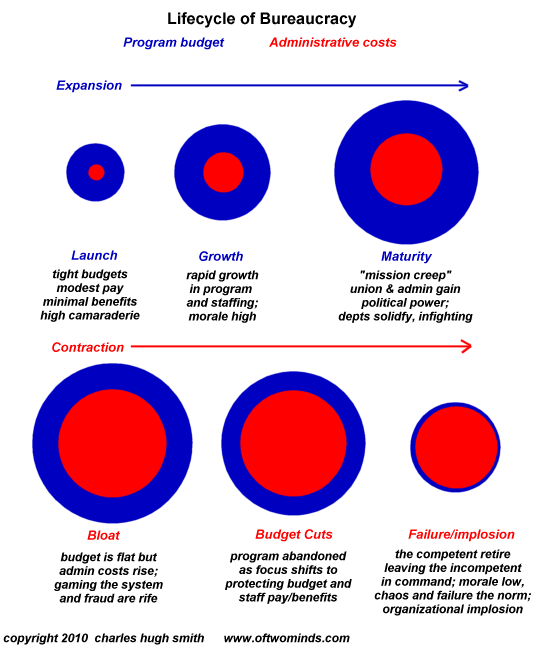
As I explain in my new book, Global Crisis, National Renewal, the conventional view has a naive faith that “great leaders” can reverse institutional rot. This faith overlooks the systemic sources of institutional decay and failure which are outlined in the graphic below, The Lifecycle of Bureaucracy, a.k.a. institutions.

Leaders are constrained by the nature of centralized organizations and the incentive structure that slowly shifts from rewarding efforts to further the institution’s core mission to self-service and protecting an ossified, failing institution from outside scrutiny and reform.

As Samo Burja explains in his insightful essay, Why Civilizations Collapse, those inside institutions are by design so compartmentalized that few (if any) even recognize the institution is failing. As long as everything is glued together in each little compartment, no one grasps the entire institution has lost its way. And since no one recognizes it, no one attempts to save it.

Institutions end up advancing caretaker managers who excel at the political game of rising to the top of a sprawling institution. When the decay (or budget cuts) finally trigger a crisis, the institution has been stripped of visionaries with a bold grasp of what’s needed to restore the focus on the core mission and institute new incentives. The bold leaders quit in disgust or were sent to bureaucratic Siberia as potential threats to the status quo.

The problem is institutions fail by the very nature of their centralized design. The organization is centralized so directives flow down the chain of command, and every branch is compartmentalized to limit the power of each department and employee to disrupt the orderly flow of top-down directives.

Within this compartmentalized, top-down structure, the incentives are to follow procedures rather than get results. The rewards go to those who dutifully follow procedures rather than to those who raise the alarm about the loss of transparency, effectiveness and focus on fulfilling the mission.

The path of least resistance is to protect the existing structure and add more compartments, i.e. “mission creep.” Rather than focus on the dissipation of resources and the decline of the core mission, leaders add “feel good” missions and PR promotions of phony reforms and initiatives that bleed more resources from the core mission.

Consider the institution of democracy, which has been corrupted into an invitation-only auction of state favors and rentier skims. Democracies have another fatal flaw: politicians win re-election by promising virtually everyone something for nothing: more benefits and entitlements and lower taxes. The gap between higher costs and declining revenues will be filled by government borrowing.

All this additional borrowing will supposedly be paid by the magic of “growth”, which will expand tax revenues at a rate that exceeds the cost of borrowing.

But demographics, resource depletion and the diminishing returns of a consumer economy fueled by rapidly expanding public and private debt have sapped “growth” in fundamental ways. Ironically, borrowing and spending more to spur “growth” only hastens the diminishing returns of increasing debt to fund consumption today.

Democracies are thus optimized for rapid “growth” and are ill-suited to transition to DeGrowth, i.e. less of everything for the vast majority of the citizenry as resources become scarce and debt eats the economy alive. (DeGrowth could work to everyone’s benefit, which is the point of Global Crisis, National Renewal.)

Central banking is another failing institution. When faced with fiscal crises, central states/banks inevitably succumb to the temptation to print/borrow currency in whatever sums are needed to fill the shortfall of the moment, i.e. political expediency. This profligate creation of currency seems to be magic at first; everyone accepts the “new money” at the current value. But eventually gravity takes hold and the currency’s purchasing power declines, as the real economy (the production of goods and services) grows at rates far below the expansion of credit and currency.

Even the greatest empires in human history have been unable to resist the “easy” solution of devaluing currency as the means of fulfilling all the promises that were made in more prosperous times.

The progression of centralized power slowly but surely replaces the self-organizing, resilient, decentralized structures of civil society with tightly bound hierarchical centralized structures that are increasingly ineffective, increasingly costly and increasingly fragile, i.e. increasingly prone to failure or collapse.

The irony of institutional decay and failure is everyone inside is so busy following procedures that nobody notices the decay until the whole worm-eaten structure collapses. Look no farther than financialized asset bubbles, healthcare and education for examples of institutions in run-to-failure decline.

We are in effect so busy arranging the beach umbrellas per our instructions that we don’t notice the approaching tsunami. Can a nation prosper as its institutions decay and collapse? Only in the fantasies and magical thinking of the delusional.